


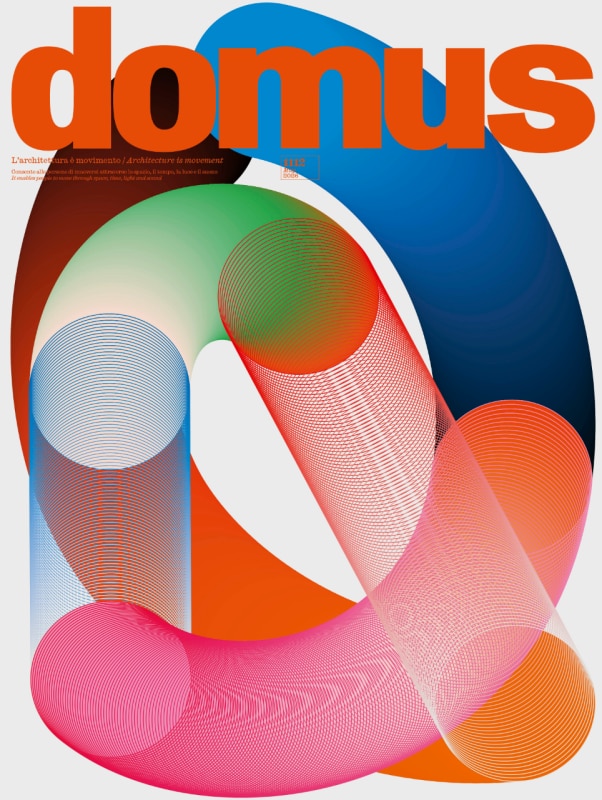
What must a building be, in the world we inhabit? Not a form. Not a function. Not an icon. Domus 1112 arrives on newsstands with Ma Yansong as guest editor and with this question as its compass — a question that admits no simple answers, and that the issue confronts with the radicalism and grace that belong to its finest moments.
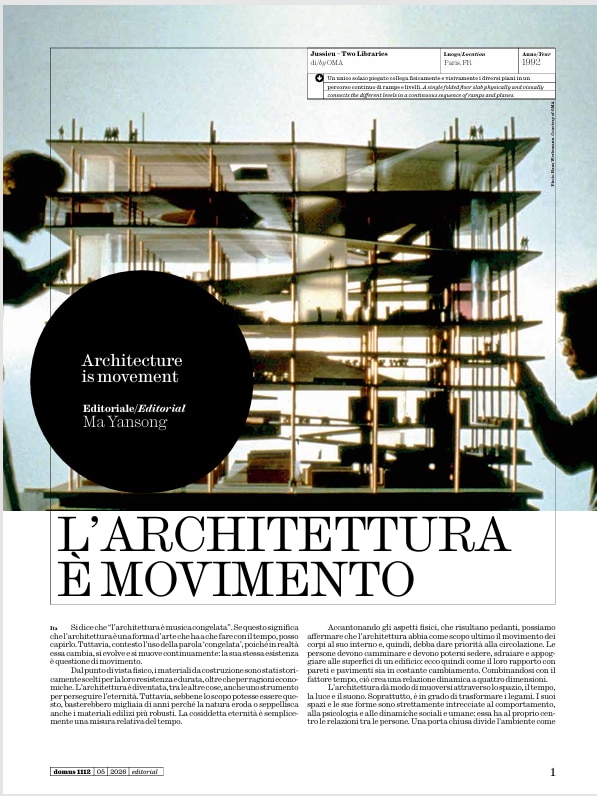
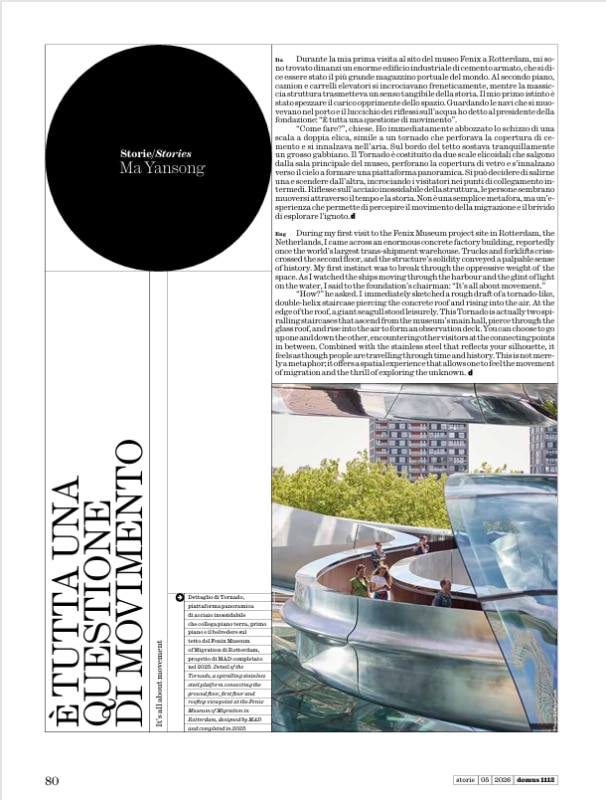
Architecture, says Yansong, is movement. It is the way bodies move through space, through time, through light and sound. It is said to be frozen music, but the word “frozen” is wrong. A closed door divides space like a wall; a ramp traverses it like a walk through nature. Architecture must not only satisfy human needs: it must inspire. It must interact. It encourages spatial transitions, dissolves boundaries, multiplies the possible forms of being human.
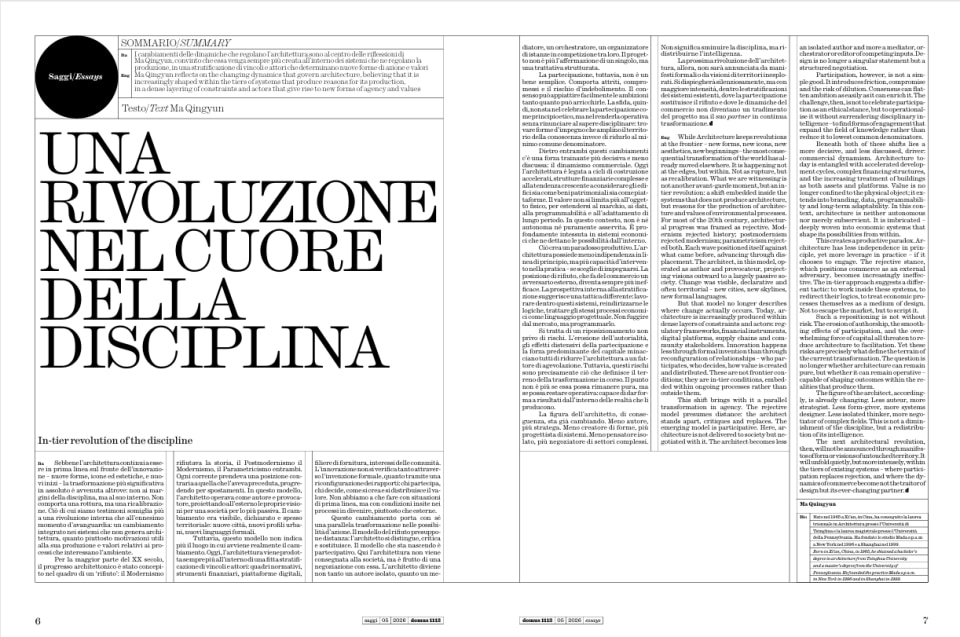
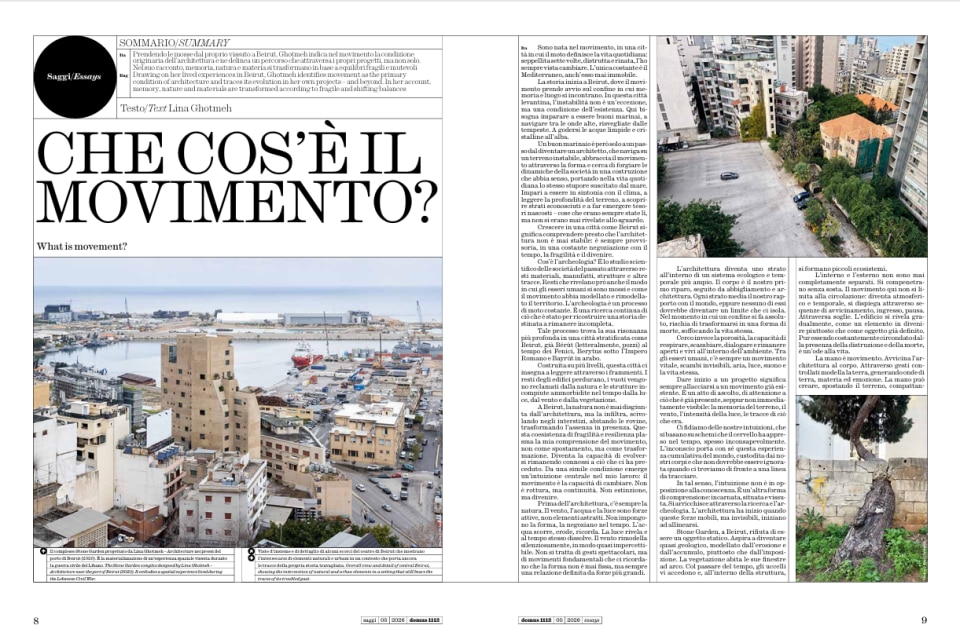
Two essays respond to this opening. Ma Qingyun rereads the present state of the discipline as an internal, silent revolution unfolding within normative, financial and digital systems. Architecture is no longer delivered to society — it is negotiated with it. This is not a diminishment of the discipline; it is a redistribution of its intelligence. Lina Ghotmeh, meanwhile, draws on her own experience of growing up in Beirut, a city buried seven times and reborn: for her, movement is not displacement but transformation — the capacity to evolve while remaining connected to what came before. Architecture is always a form of listening before it is a form of building.
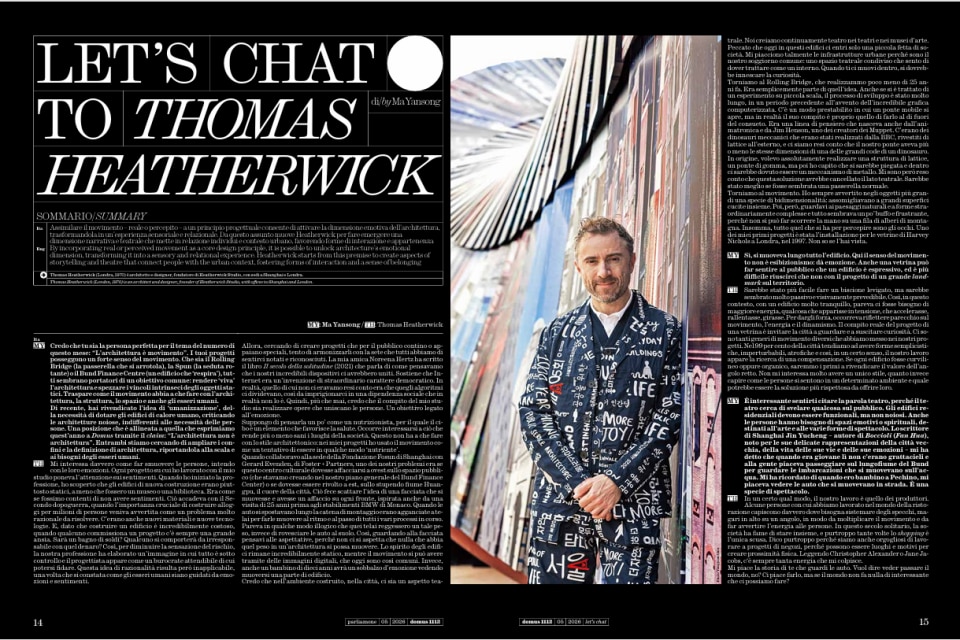
The conversation between Ma Yansong and Thomas Heatherwick is among the most intense of the editorial season. Heatherwick articulates a conviction that runs through the entire issue: the profession has developed an image in which everything is under control, in which the designer appears as a reliable bureaucrat. Yet this idea of rationality proves inapplicable once one recognises that human beings are guided by emotion and feeling. The sense of movement is not exhibitionism: it produces emotion. And emotion is architecture’s most urgent task in the century of solitude.
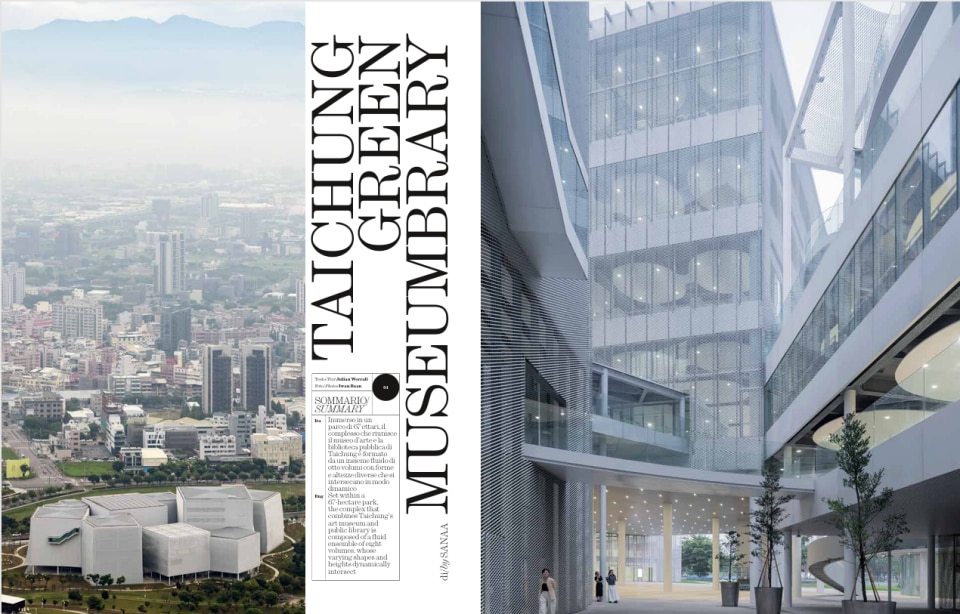
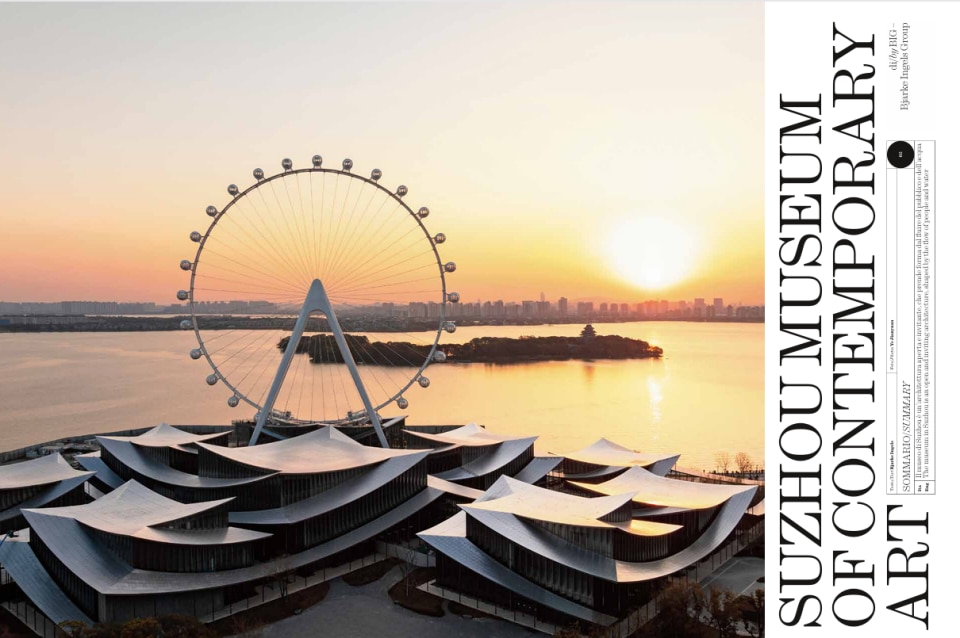
From here, the issue opens into a geographical and poetic atlas of movement in contemporary practice. SANAA’s Taichung Green Museumbrary, inaugurated in December 2025 in Taiwan, unites an art museum and public library within a system of eight interconnected volumes, spiral ramps and spaces of fusion: it works with the Neutral, in the sense Barthes intended, indeterminate spaces open to the contingent. BIG’s Suzhou Museum of Contemporary Art is twelve pavilions dissolving into the landscape of Jinji Lake, their brushed-steel roofs draped like catenaries.
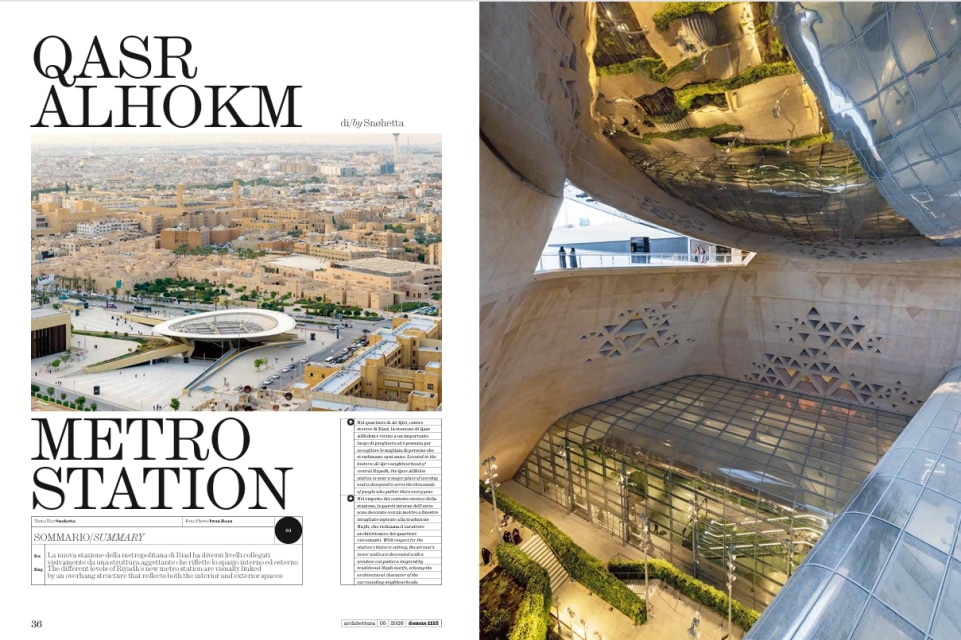
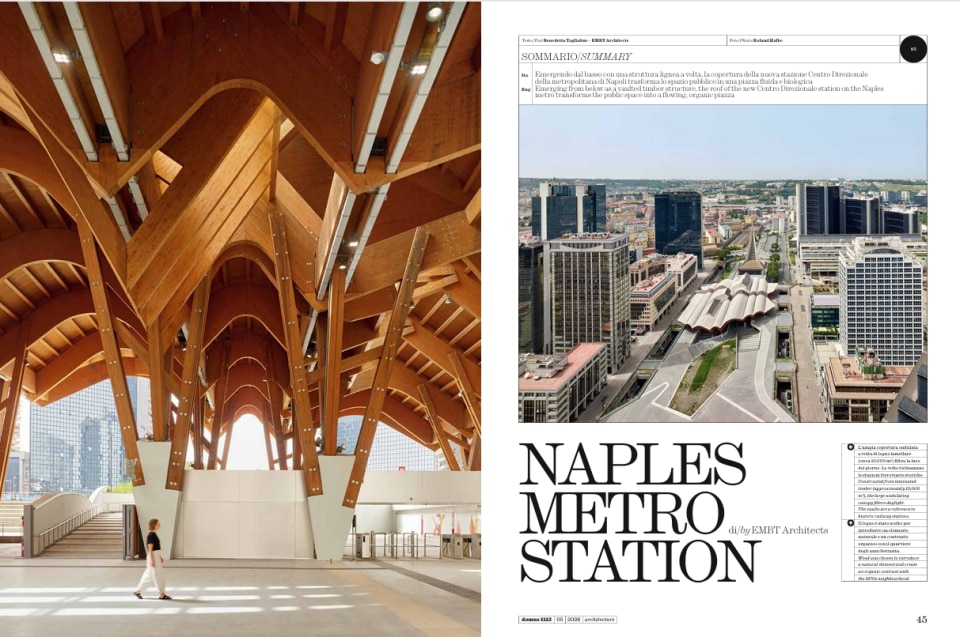
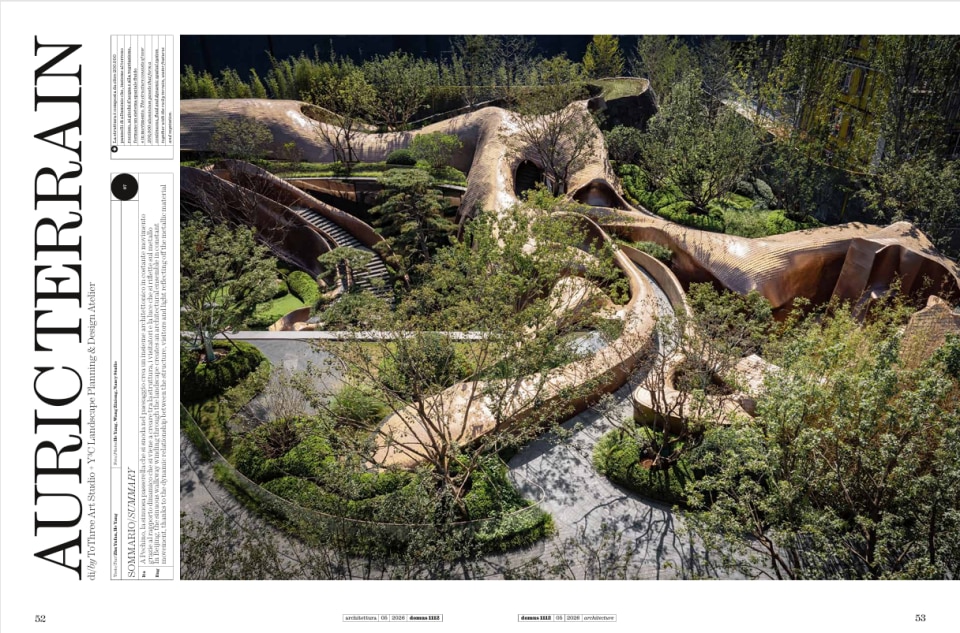
Snøhetta’s Qasr AlHokm station in Riyadh acts as an urban periscope: the roof reflects the city downward and the underground upward, while a temperate garden thirty-five metres below street level introduces an impossible nature into the city’s belly. Benedetta Tagliabue’s Centro Direzionale station in Naples brings a forest of glulam timber into the city, connecting Kenzo Tange’s isolated, artificial district — a product of the 1970s, to the historical and volcanic depths of Naples. Auric Terrain in Beijing is a sinuous walkway of over 200,000 aluminium panels that unfurls like a dragon’s vein through the landscape, where movement becomes a dynamic relationship between body, light and matter.
Architecture is no longer handed over to society, it is negotiated with it: it is not a diminution of discipline, it is a redistribution of its intelligence.
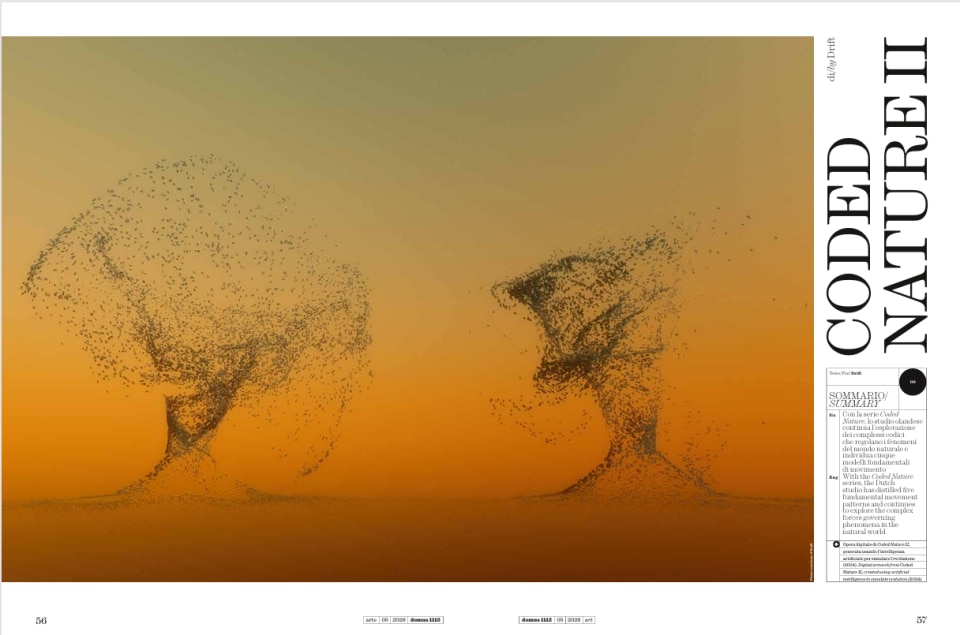
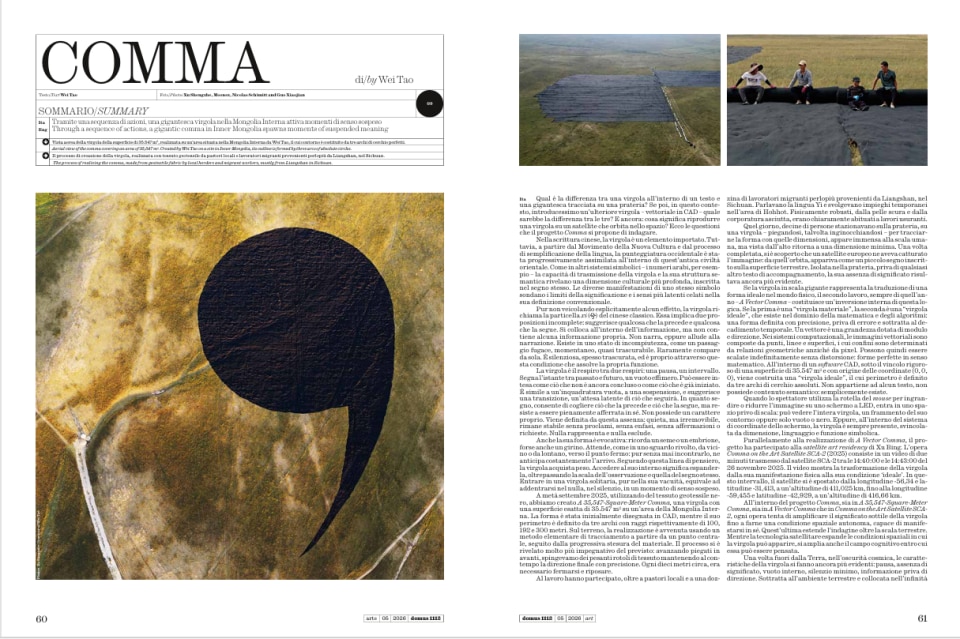
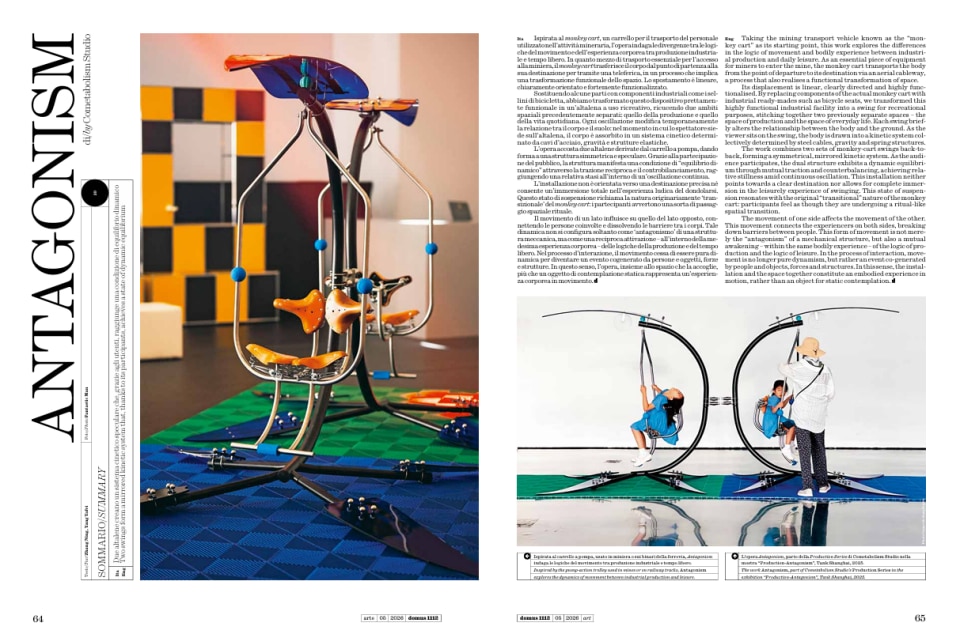
Three voices shape the artistic journey. Drift presents “Coded Nature II: Vortex”, in which the public assumes the role of the wind and activates the system. Wei Tao recounts the Comma Project: a gigantic comma of 35,547 square metres traced across the Inner Mongolian steppe in geotextile fabric, then existing as a mathematical vector in CAD, then transmitted by a satellite in orbit, three states of the same punctuation mark, three ways of inhabiting the absence of meaning. Cometabolism Studio presents “Antagonism”: two swings fashioned from a mining monkey cart that create, through the public, a dynamic equilibrium between traction and counterbalance, production and leisure reconciled in a single gesture.
Curated by Matt Shaw, the Tempi nuovi section presents two studios that embody contemporary forms of movement. Xing Design works with emerging technologies: from the Yuyuan station in Shanghai, with its programmable LED ceiling that changes the artificial sky according to the seasons, to the Cloud Engine in Jingdezhen, an underground energy hub that returns a park to the city. Andblack Design Studio operates at the point of tension between Western parametricism and local Indian craft: the sculpture Vayu, composed of 4,000 unique wooden pieces mimicking the wind; the Louvered House, with adjustable slats for natural ventilation and flexible use.
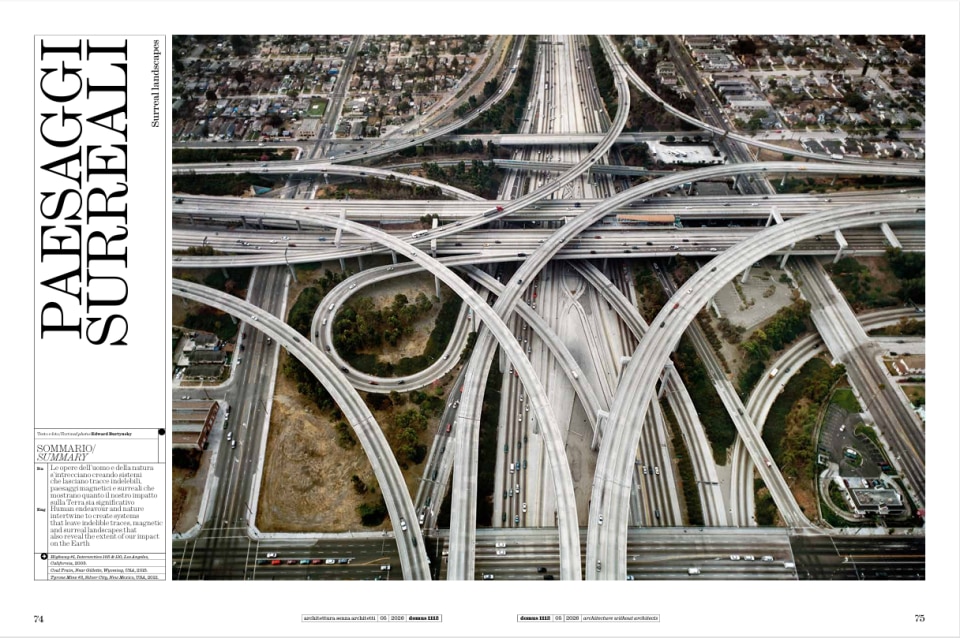
The Architecture without Architects section is entrusted to Edward Burtynsky. Three images, Highway #1 in Los Angeles, Coal Train in Wyoming, Tyrone Mine in New Mexico, tell of the entanglement between human works and natural forces, producing landscapes that are both magnetic and surreal. The text is a meditation on scale: had we lived up to our ingenuity while keeping our population at sustainable levels, we might have had everything. It did not happen. The Tyrone copper mine, its waste materials taking on psychedelic colours the moment they meet the air, is one of the most unsettling landscapes Domus has ever published.
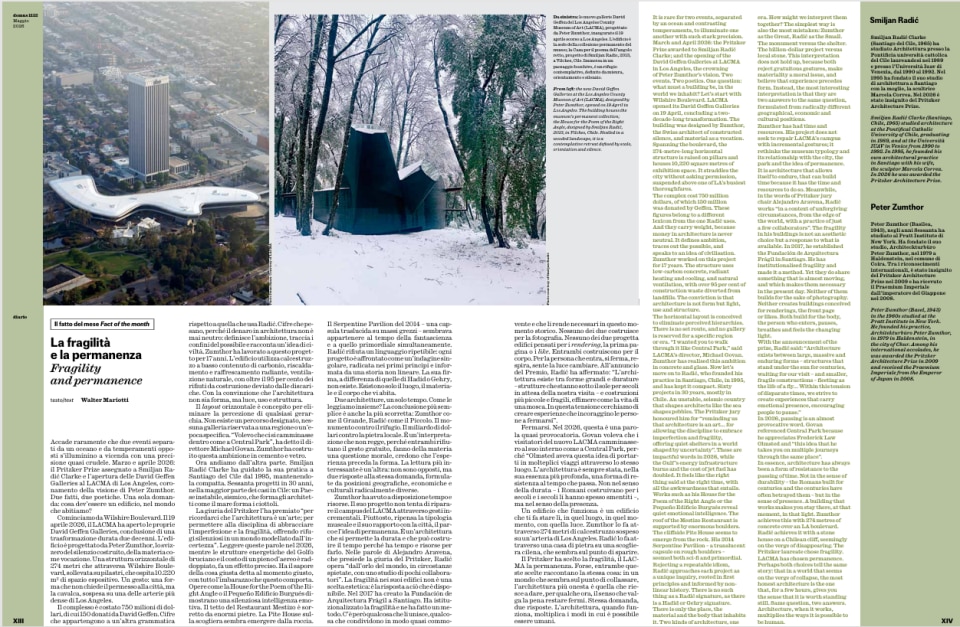
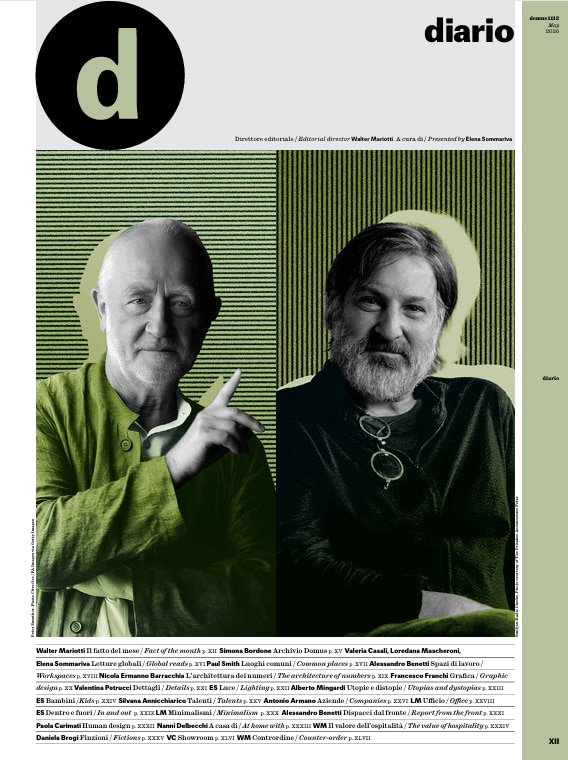
The Diary opens with the event of the month: two occurrences separated by an ocean and by opposite temperaments, yet illuminating one another with an almost cruel precision. The 2026 Pritzker Prize awarded to Smiljan Radić Clarke, sixty projects over thirty years, a compact studio, no concessions to the scale of the gesture, and the opening of the David Geffen Galleries at LACMA, the crowning achievement of Peter Zumthor’s seventeen years of work. Mariotti reads them together: not as opposites, but as two answers to the same question, formulated from radically different positions. Neither builds for the photograph. Both build for the body.
Architecture must not only satisfy human needs: it must inspire. It must interact. It encourages spatial transitions, dissolves boundaries, multiplies the possible forms of being human.
Then come the Global Readings: “We the Bacteria” by Beatriz Colomina and Mark Wigley, which overturns the modern paradigm by opening architecture to cohabitation with microbes; “Cucire universi” by Domitilla Dardi, tracing the links between crochet patterns and the structures of Pier Luigi Nervi; “Architecture Against Architecture” by Reinier de Graaf, a manifesto in fourteen points on the necessity of rethinking how and why we build today; and “Roma vietata”, a photographic essay on Rome’s piazzas occupied by cars, before the battles to protect historic city centres.
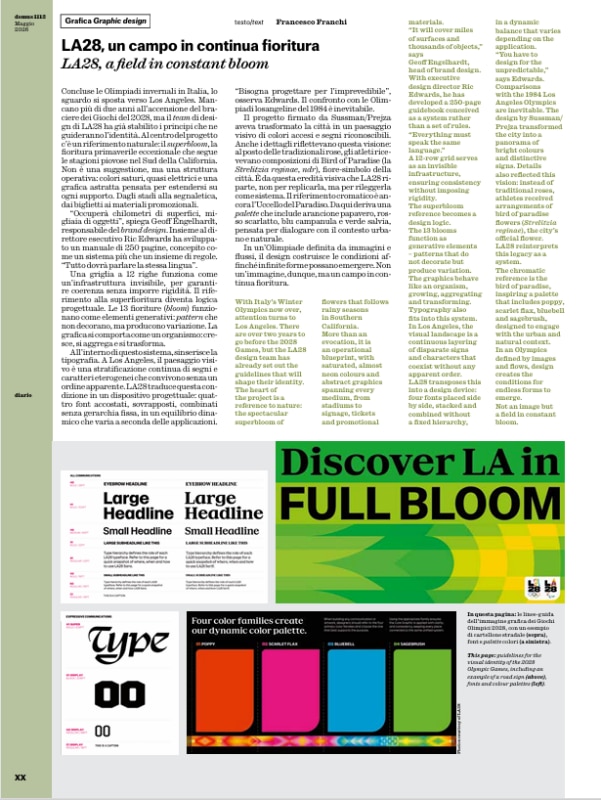
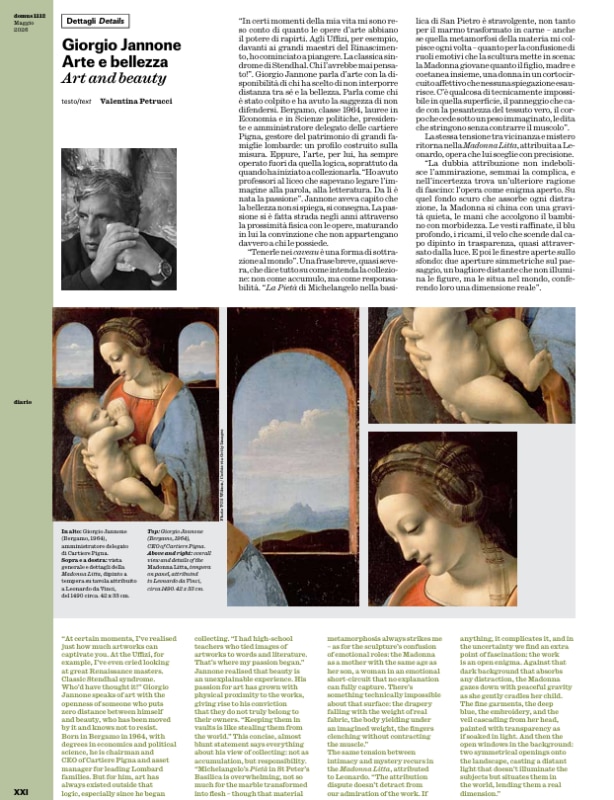
Within the body of the Diary: Paul Smith reflects on handrails, from the Biblioteca Laurenziana to Barragán’s house in Mexico City. Valentina Petrucci signs the portrait of Giorgio Jannone, president of Cartiere Pigna, who speaks of his relationship with art — from Stendhal syndrome at the Uffizi to the Madonna Litta. Francesco Franchi analyses the visual identity of the 2028 Los Angeles Olympics: thirteen generative blooms, a palette inspired by the Bird of Paradise, four fonts set side by side without fixed hierarchy.
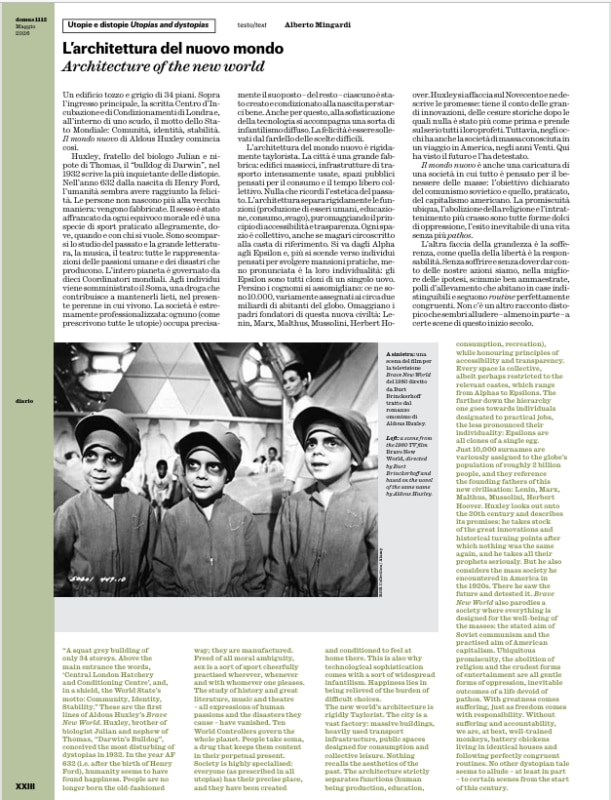
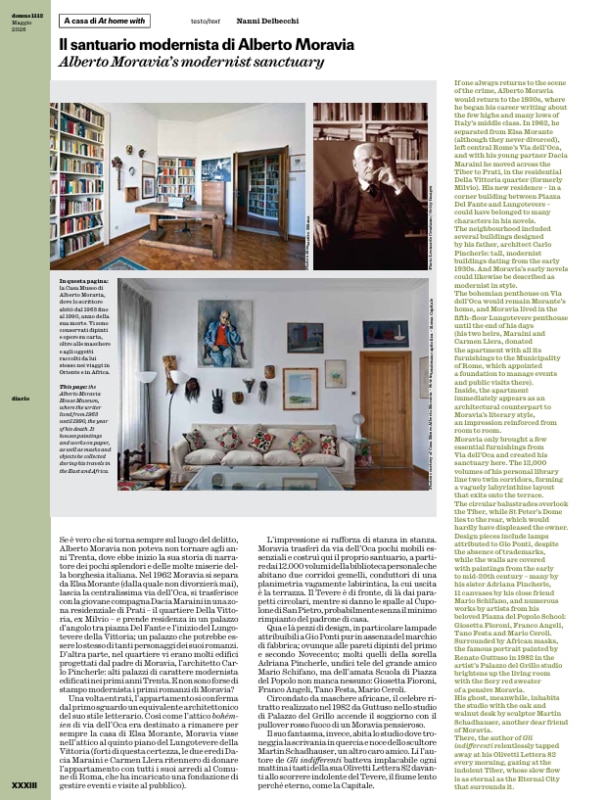
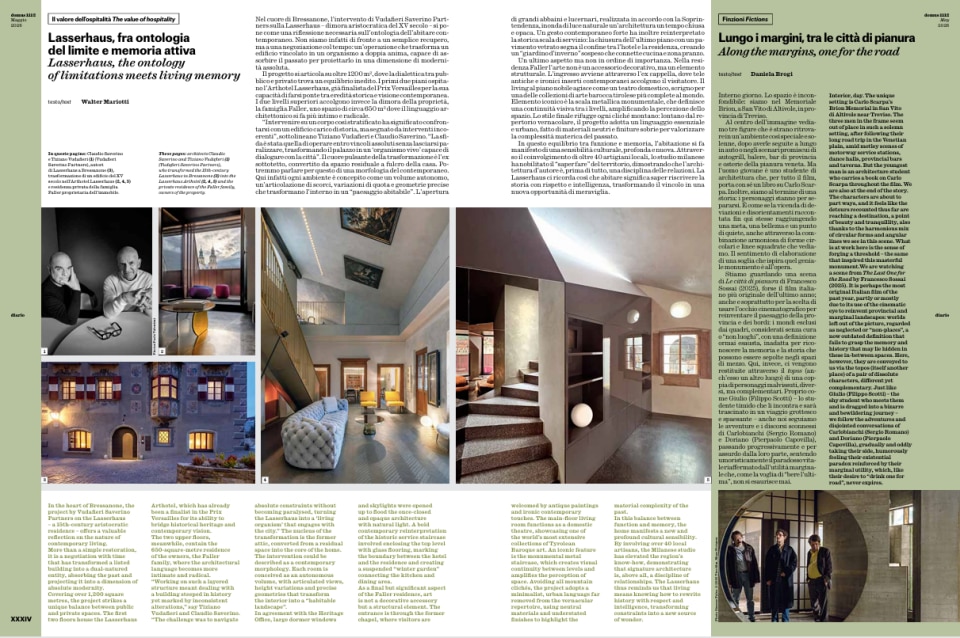
Alberto Mingardi rereads Huxley’s Brave New World and wonders whether the dystopian novel of 1932 might not be gesturing toward certain scenes of this early century. Nanni Delbecchi portrays Alberto Moravia’s apartment on Lungotevere della Vittoria, 12,000 volumes, African masks, eleven canvases by Schifano, Guttuso’s portrait with the fire-red pullover, the modernist sanctuary of a novelist who always returned to the scene of the crime: the 1930s of the Italian bourgeoisie. Loredana Mascheroni covers the Made to Measure collection by Herzog & de Meuron for UniFor, presented at the 2026 Salone del Mobile, where cork becomes the absolute protagonist. Walter Mariotti signs “Il valore dell’ospitalità” with the Lasserhaus in Bressanone, an intervention on a fifteenth-century aristocratic residence, and a reflection on the ontology of contemporary dwelling.
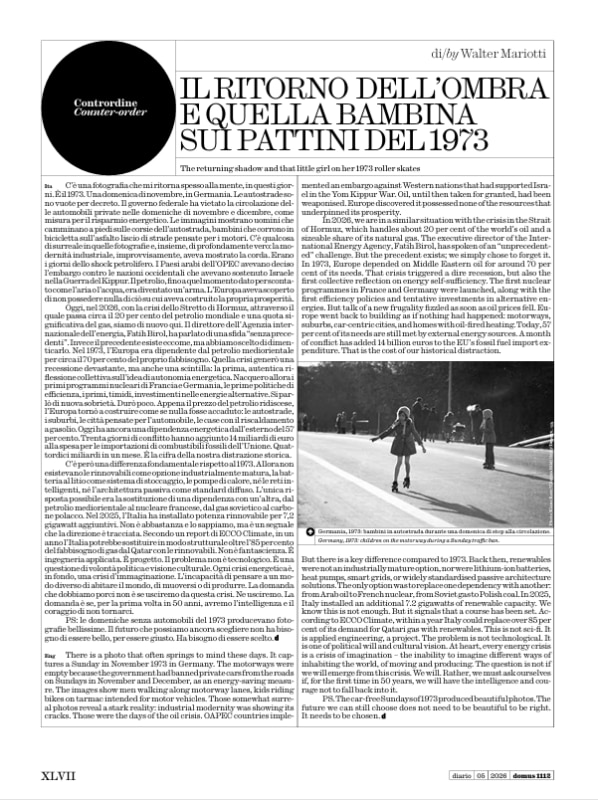
Mariotti’s Contrordine begins with a photograph: November 1973, Germany, motorways emptied by decree, children riding bicycles on asphalt built for engines. Those were the days of the oil shock. Today, with the crisis in the Strait of Hormuz, through which roughly twenty percent of the world’s oil passes, we find ourselves there again. The precedent exists: in 1973, Europe depended on Middle Eastern oil for approximately seventy percent of its energy needs. The difference, this time, is that alternatives exist. In 2025 Italy installed an additional 7.2 gigawatts of renewable capacity; according to ECCO Climate, within a year the country could replace more than eighty-five percent of its gas imports from Qatar. The problem is not technological. It is a question of political will and cultural vision. Every energy crisis is, at its core, a crisis of imagination.
The question is not whether we will emerge from this one — we will. The question is whether, for the first time in fifty years, we will have the intelligence and the courage not to return.