

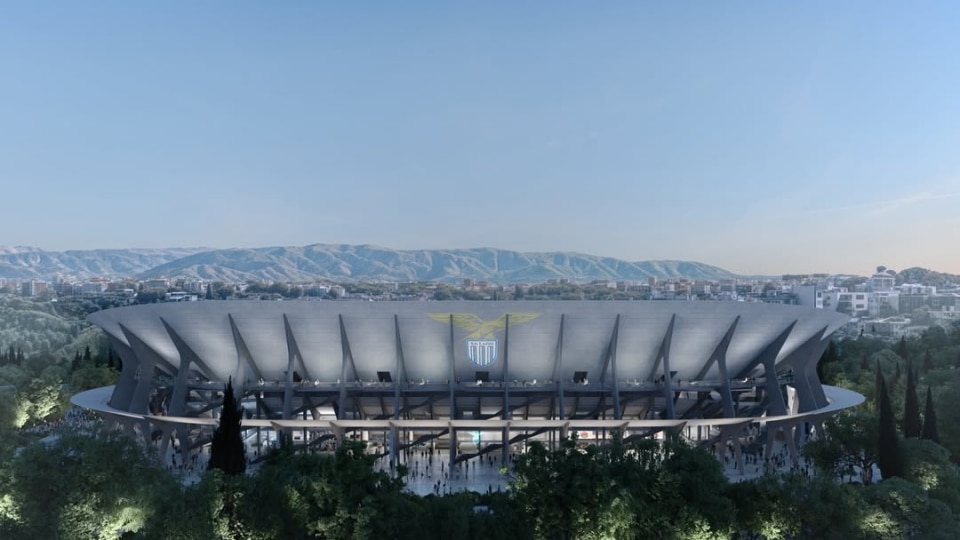
The project that will transform the iconic Stadio Flaminio in Rome — designed in 1959 by Pier Luigi Nervi and a manifesto of Brutalism as well as of the engineer’s structural virtuosity — has just been presented.
The scheme is developed by a group that includes architect Pier Luigi Nervi, the original designer’s grandson and namesake; Professor Domenico D’Olimpio of Sapienza University for scientific coordination; and Professor Roberto De Lieto Vollaro of Roma Tre University, under the overall design direction of Archea Associati. As suggested by the first renderings, the concept is to superimpose a new volume — topped by a lightweight roof — onto the existing reinforced-concrete structure, which will be carefully restored. The new addition will be supported by an exoskeleton that aligns both structurally and visually with the concrete pillars below.
The vertical extension will increase capacity from 20,000 to 50,000 seats, while improving comfort, acoustics, sightlines and weather protection for both the iconic — and currently deteriorated — building and its spectators.
The project also takes a forward-looking view of the surrounding district, home not only to the Flaminio but also to other contemporary architectural “gems”, including Renzo Piano’s Auditorium Parco della Musica and the MAXXI by Zaha Hadid Architects. The renewed stadium is envisioned as an urban attraction well beyond the ninety minutes of a match, thanks to new services, retail and event spaces, improved accessibility solutions and stronger connections to soft mobility networks.
The work is expected to be completed in time for the 2032 European Championship, for which an expression of interest has already been submitted. The ball now passes to the offices of Rome for the official approval.
Opening image: Render courtesy Archea