


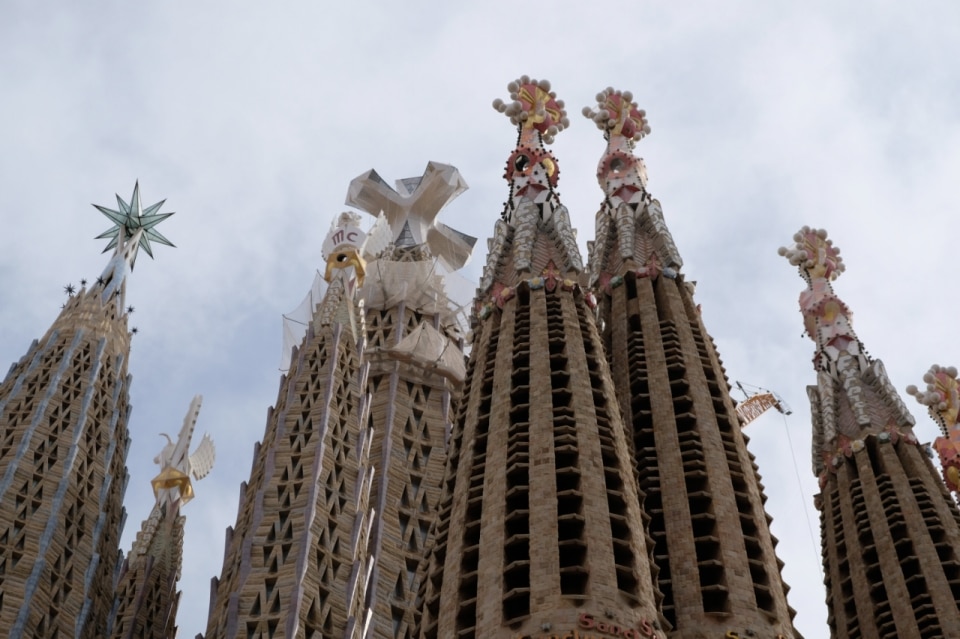
“Inside the Tower of Jesus Christ we find a hyperboloid, which posed a real challenge for the construction of the internal staircase. It took months and months of work with a geometry professor to develop the formula that would allow each step to adapt to such a complex form while maintaining the same width”. In an ordinary architectural context, referring to an elementary auxiliary device like a staircase — let alone its morphology — would hardly raise any interest; it would not require a multidisciplinary team, nor become the subject of extended debate or analysis, as it would remain tied to its original function: an accessory element external to the work.
However, in the long evolutionary process of the Sagrada Família, every decision is embedded in a delicate system, where even a seemingly obvious and basic element, such as a spiral staircase, can branch out into interconnected problems and intractable knots, with tangible consequences on the overall balance.
For many years, the most persistent image of the Temple has been that of an unfinished architecture, immobilised and framed by a perpetual construction site. Although this prospect is now increasingly remote, the Sagrada still seems haunted by it, like a second shadow. The tangible risk is to confine it within an idealised dimension of the unfinished, considering its abstract and symbolic complexity independently from its material components. And yet, if every great endeavour is made up of hundreds of small parts, the Sagrada Família is composed of just as many minute and invisible elements, capable of conveying the scale of its ambition as much as its physical magnitude.
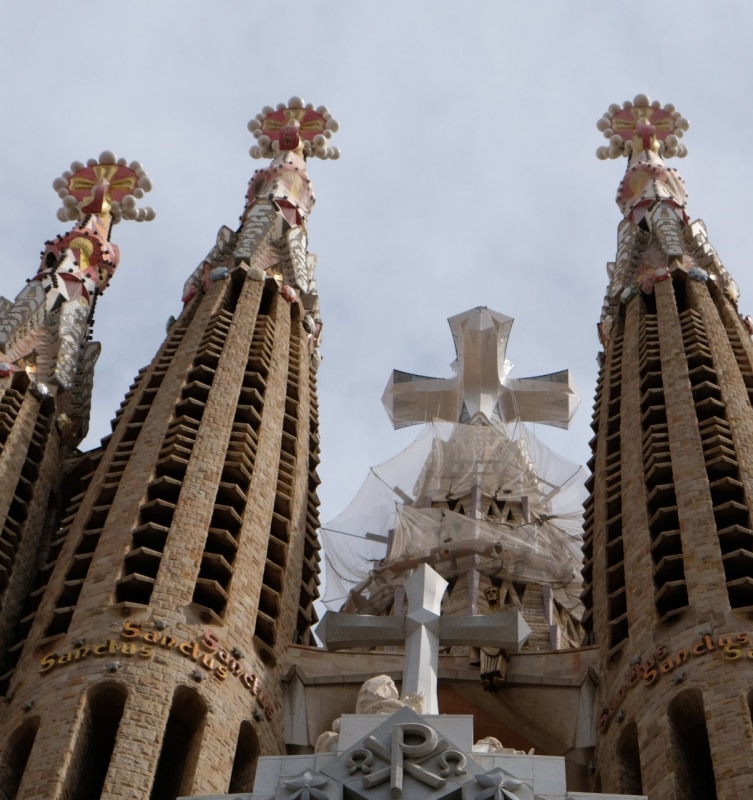
When we met architect Mauricio Cortés, who oversaw the construction of the Tower of Jesus Christ — set to be inaugurated on June 10, 2026 — the impression was one of stepping outside the suspended realm of myth and returning to a discussion grounded in design continuity, in paths and instructions to be interpreted, as a distant perspective does not make expectations any less real.
“Technology has advanced to a point where it allows us, as counterintuitive as it may seem, to be more faithful to Gaudí’s original idea”, the architect tells Domus, suggesting that contemporary construction techniques, rather than creating distance, offer a valuable opportunity to move closer to the original project — not altering its language, but refining its execution.
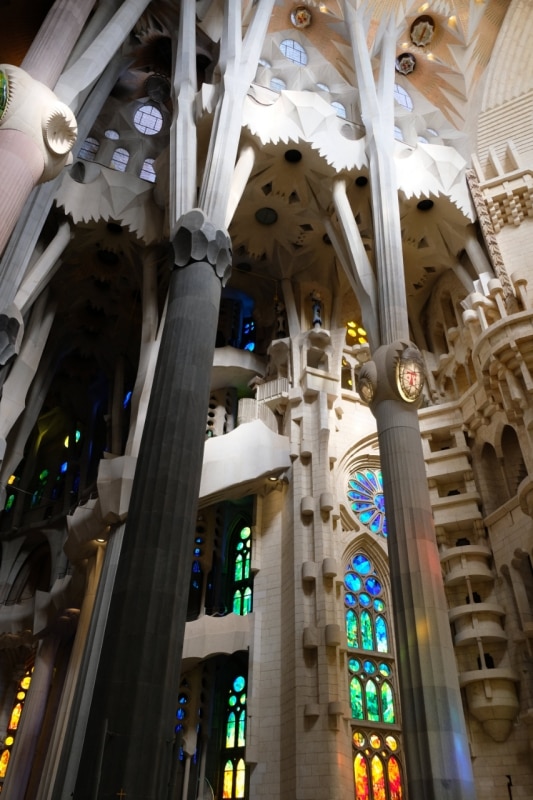
A telling example is provided by the pre-compressed stone panels of the central tower which, reinforced with internal tension rods, made it possible to reduce wall thickness to around 45 cm, ensuring both stability and lightness without resorting to reinforced concrete or external buttresses. The four-armed three-dimensional cross in glass and glazed ceramics, completed on February 20, 2026, also benefited from recent hybrid innovations, with metallic ribs and infill in ultra-high-performance concrete developed specifically for this project. The entire system is calibrated so that, from the external ceramic layer to the internal translucent stone, the total thickness is just 20 cm, preserving a sense of openness despite the reduced dimensions.
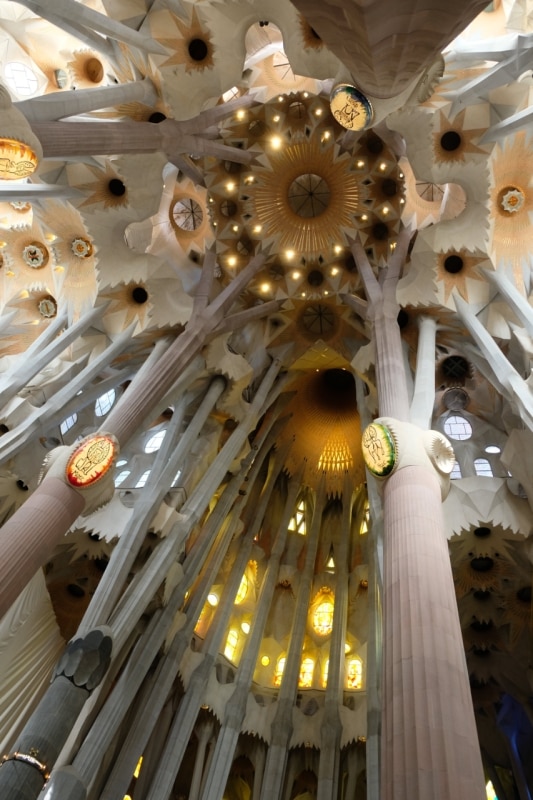
These are pioneering solutions with a significant impact on the overall result. Preliminary studies of the foundations, dating back to the original 1882 design by Francisco de Paula del Villar, had revealed their inadequacy to support the weight of the six tallest towers, Cortés explains. Strengthening the base therefore required, at the same time, a reduction in the weight of the building’s vertical elements, in order to decrease loads without compromising structural integrity.
The issue, therefore, has never been solely about completion, but about the continuous transmission of layered knowledge, to be persistently adapted to the present context. Behind each of these technical solutions lies an effort to balance contemporary regulations with the project outlined by Gaudí, itself reconstructed from a heterogeneous set of documentary sources and fragments of models, sketches, and publications that survived the destruction of his workshop during the Spanish Civil War.
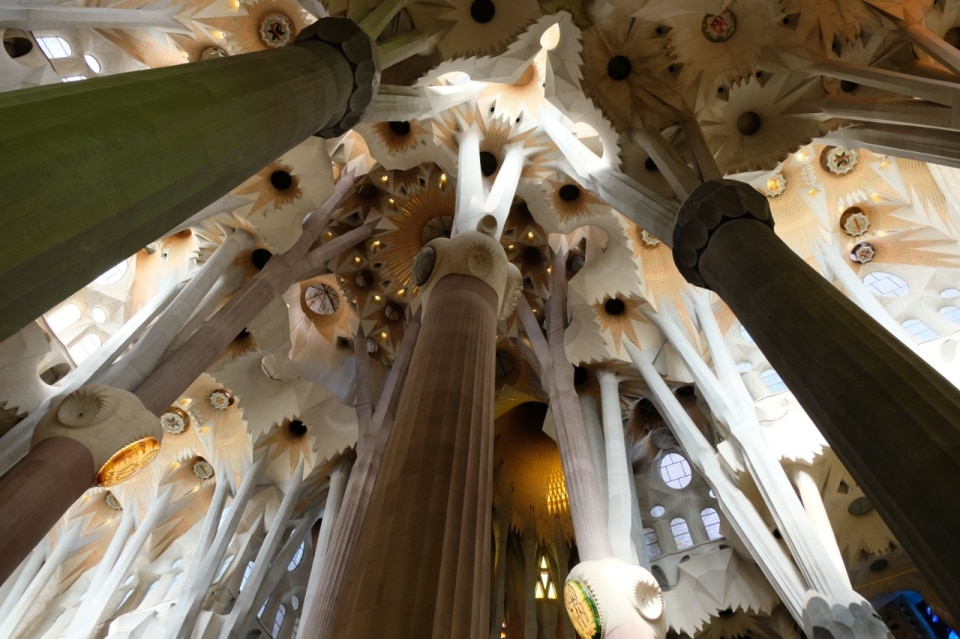
For the cross, for instance, the indications were surprisingly precise. “We relied on small models made by Gaudí and detailed descriptions published during his lifetime. They describe a form that should function like a ‘resplendent’ and ‘radiant’ crystal, capable of refracting light during the day and projecting it above the city at night like a system of light beams”.
If physical models convey the form and geometry of the Sagrada Família, the written descriptions and letters addressed to his collaborators speak instead of materiality, symbolism, and expressive intent. In other words, it is within these traces that the ideal meets the material, in a process of research and methodological inquiry that has guided the collective work of architects and interdisciplinary teams for five generations.
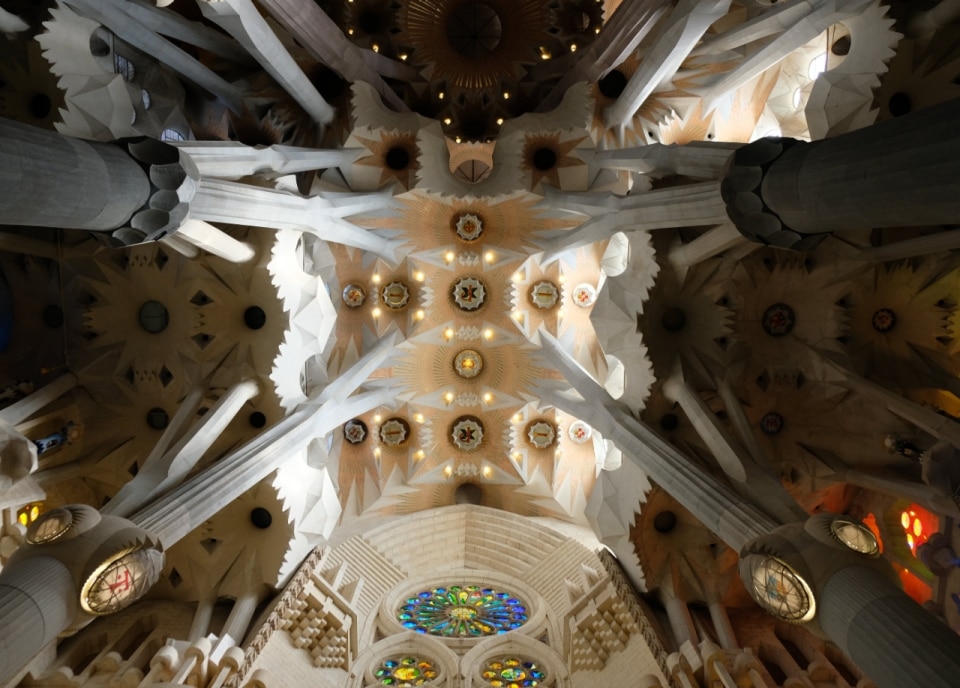
The reconstruction of Gaudí’s intent follows a critical, cross-reading of sources that never resolves into a fixed form, and this inclination toward transformation is reflected in the overall development of the Temple, up to the three-dimensional cross. “You start with a square that rotates in opposite directions toward the centre, and through these rotations you arrive at an octagonal base. It’s the same principle as the columns: halfway up their height they have eight sides, then sixteen, thirty-two, sixty-four, until they become circular”.
“Gaudí geometrised everything”, the architect reminds us, immediately highlighting the collective and evolving nature of the Sagrada Família. “It was a way of building, but also of communicating how the project should be carried forward”. In a context often marked by limited financial resources, this clarity allowed the project to be transmitted over time, making it understandable even to those who would continue it after his death.
The political and communicative strategy that Gaudí put in place to secure a future for the Sagrada Família after his death — with meticulousness, rigour, and a touch of shrewdness — remains one of its most revealing and, at the same time, least understood aspects today, especially considering how readily contemporary visitors attribute to it an unquestioned architectural value.
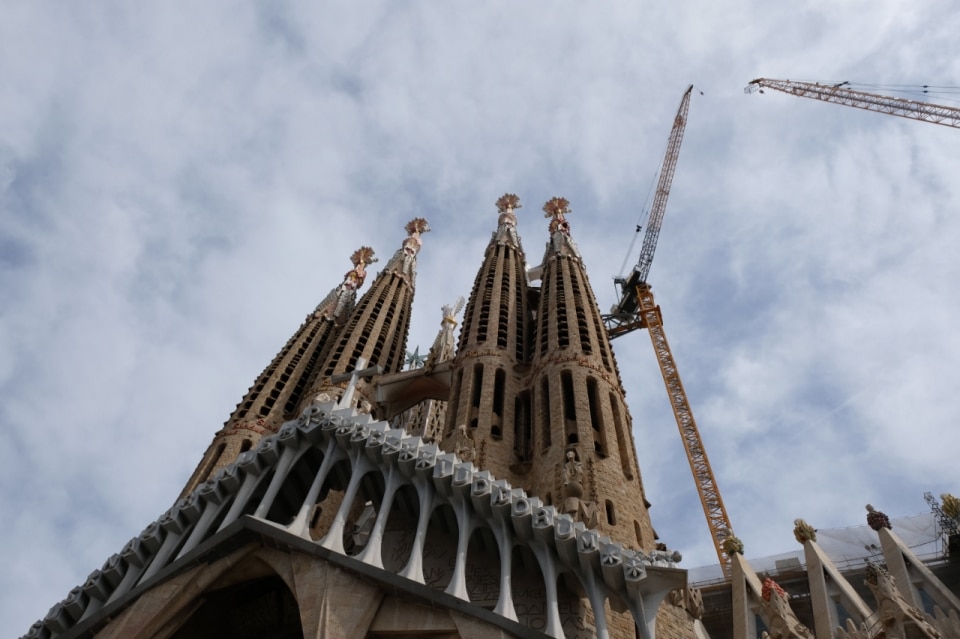
It is no coincidence that, after the apse, he chose to proceed with the Nativity façade: its naturalistic and celebratory character was intended to engage and motivate future generations, as well as to attract the support of donors. Its figurative richness was meant to win over the public, the same public that had mocked some of his civil buildings and would likely have been repelled by a harsher and more austere entrance such as that of the Passion.
Today, the Sagrada Família has challenged the unquestioned assumptions of the architectural canon, redefining religious architecture in ways that have had lasting effects on its perception. It demonstrates how a project can move across different eras without becoming nostalgic or imitative, maintaining a pragmatic coherence that is built progressively rather than preserved.
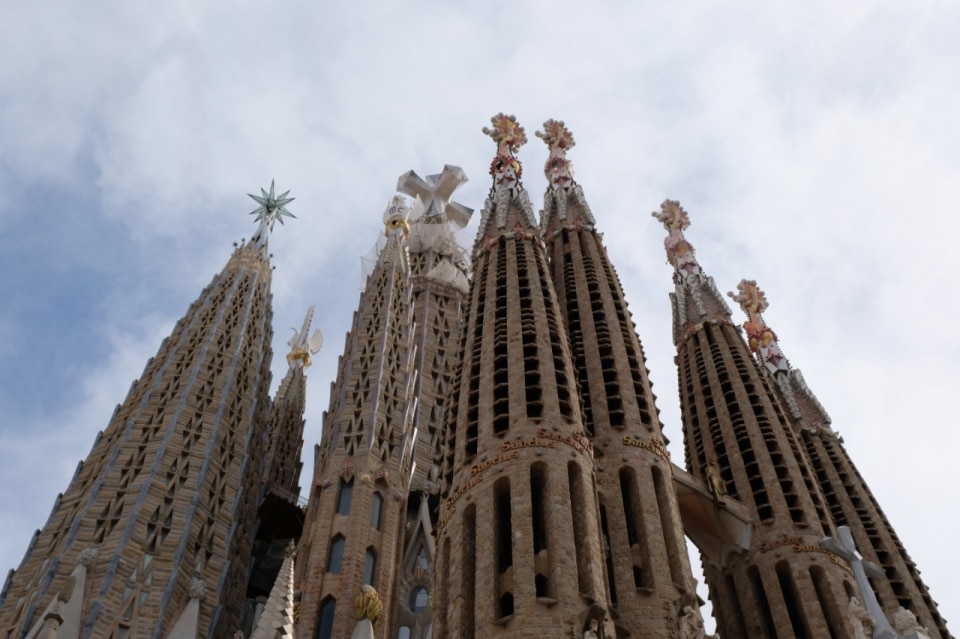
The completion of the Tower of Jesus Christ marks a crucial phase in the history of the construction site: for the first time, a generation of architects is bringing to completion the symbolic and structural core of Gaudí’s work after “more than ten years of work across multiple fronts,” as Cortés notes. And yet, as we take our leave, cranes continue to move behind him. Every step has been adjusted, every formula refined, every problem resolved. But each deadline marks a handover, and every solution becomes the starting point for the next question.
Opening image: Sagrada Família, 2026. Photo Ilaria Bonvicini