

We are all content creators. The internet has transformed us, in just a handful of years, from consumers into producers. We were creating before, of course: we wrote, drew, took photos, performed. But never before has so much “content” been generated and, above all, put into circulation, shared at this scale.
You could argue that younger generations share less than those before them, that you’ve read in the New York Times that we are moving back toward a model where a few creators are followed by many viewers. Still, we take photos and videos and post them with a level of dedication that has no precedent. Just look at what happens during major events. Just look at Design Week.
Some people are better than others. More productive or more reserved. There are geniuses, professionals, amateurs, and plenty of people who are just bad at it, like in any field. The perfect weapon of this new cascade of content is, of course, the smartphone: you use it to create, you use it to watch. But alongside the smartphone, a range of dedicated tools has emerged—what we might call a new kind of videography. New starting from the format itself, which privileges verticality in 9:16—the format of Instagram Stories and TikTok videos.
If we had to define the Osmo Pocket briefly, it is a drone that doesn’t fly.
Drones are among the protagonists of this shift. And when you talk about drones, you are probably talking about DJI, the Chinese company that is the undisputed leader of the sector (and also responsible for one of the most striking headquarters in the world, designed by Norman Foster). For a few years now, however, the Shenzhen-based brand has been developing a device that is, in some ways, derived from drones, but is in fact a proper video camera. Designed for the social media era, the Osmo Pocket is arguably the camera of our time. DJI has recently updated it with a new version, and we tested it—during Design Week.
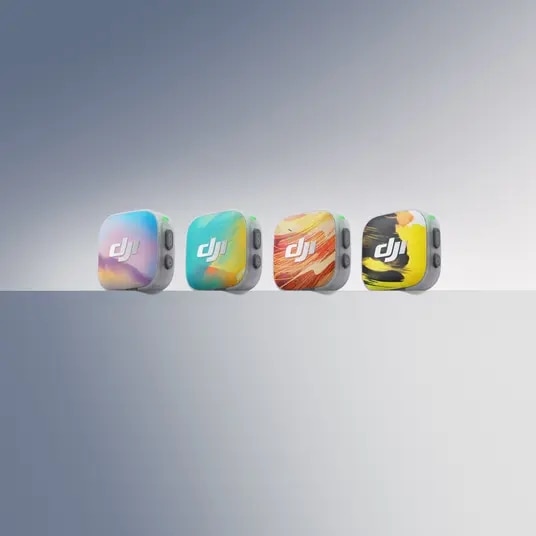
Alongside the Osmo Pocket 4, DJI has also recently introduced the Mic Mini 2 microphones, accompanied by a series of colorful covers, including editions developed in collaboration with artist Victor Ngai.
If we had to define the Osmo Pocket in brief, it is a drone that doesn’t fly. It borrows the core technologies DJI developed for its flying devices: first and foremost the miniaturized stabilized gimbal—the small rotating head that houses lens and sensor—and all the tracking and face recognition systems. Just as drones can follow and film us, the Osmo Pocket does the same.
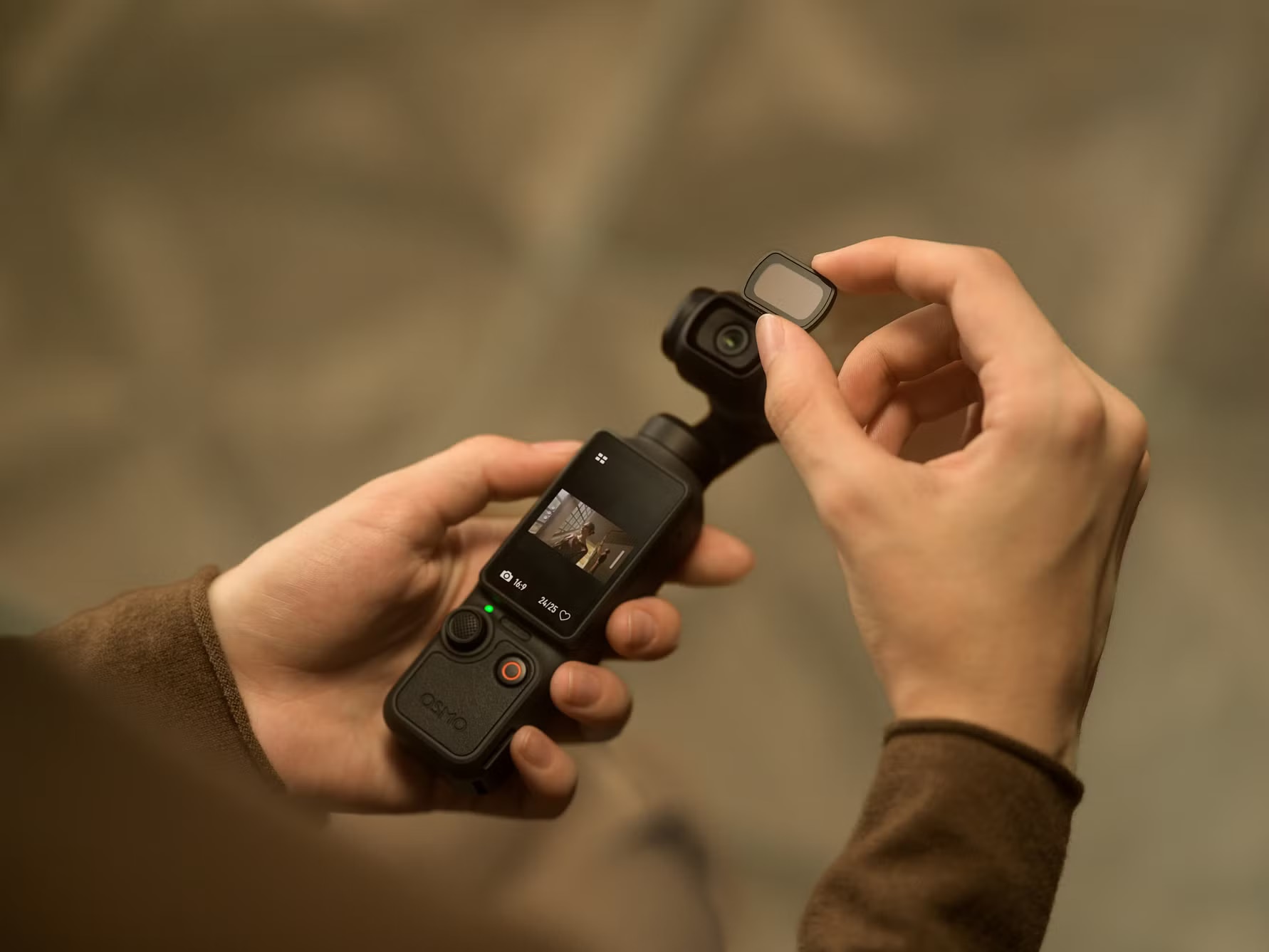
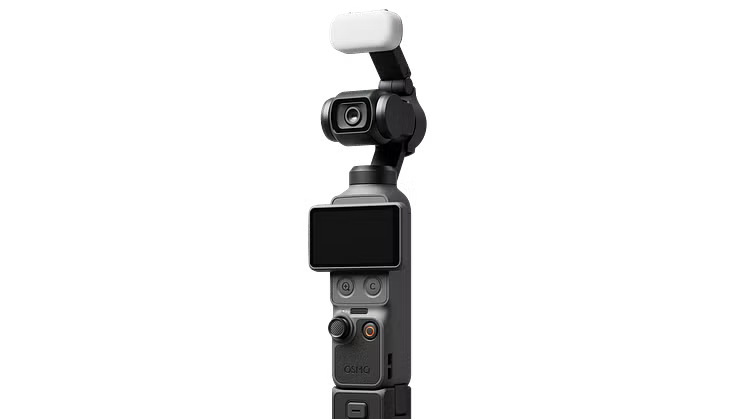
Osmo Pocket 4, whose key features you can find here, retains the form factor that made the device recognizable. It is essentially a grip with a rotating head on top. The screen can be flipped, allowing both horizontal and vertical shooting. There is a power button and a joystick primarily used to control the camera’s movement. Rotating the screen horizontally reveals an additional pair of physical buttons for 2x zoom and a customizable control. The reconfiguration of controls is one of the key turning points of this new model compared to previous versions. That doesn’t mean it will make your life easier. Quite the opposite.
You can also take photos with the Osmo Pocket, but it is clear that this is not where it performs best. It is a device designed first and foremost for video: for movement, for continuity, for the construction of a sequence rather than a single shot. Using it as a still camera is possible, but it feels like a secondary use.
Using the Osmo Pocket 4 felt a bit like holding a drone, and the learning curve turned out to be quite steep.
used the Osmo Pocket 4 throughout Design Week, with the goal of recording video with a level of stabilization and an aesthetic different from that of a smartphone. Content meant primarily for social media, especially Instagram Stories, therefore in vertical 9:16 format.
The images—some examples of which are shown in this article—tend to place objects at the center rather than people. Probably not what the Osmo Pocket was originally designed for. The times I used it for interviews, or to follow Tom Dixon through the narrow corridors of the hotel he created specifically for Design Week, it proved to be an extremely useful tool. I don’t shoot selfie videos, but I can imagine I would have appreciated it in that context as well. When it came to documenting installations, objects, and more or less unseen locations, however, things were much less immediate. Then again, that kind of visual work—capturing environments and design—is inherently more complex, colder, and, in a way, less engaging. It’s not just the Osmo Pocket.
Learning how to use it
The first crucial setting turned out to be the gimbal mode, something I realized almost immediately. The default mode is Follow, which tracks the user’s movements; Tilt Locked keeps the horizon stable; and FPV allows the camera to fully follow the operator’s motion. Choosing between these modes significantly changes the outcome, and understanding how each behaves takes time. I found myself switching between them depending on the situation, navigating touch controls, swipes, and scrolling menus. Not exactly straightforward.
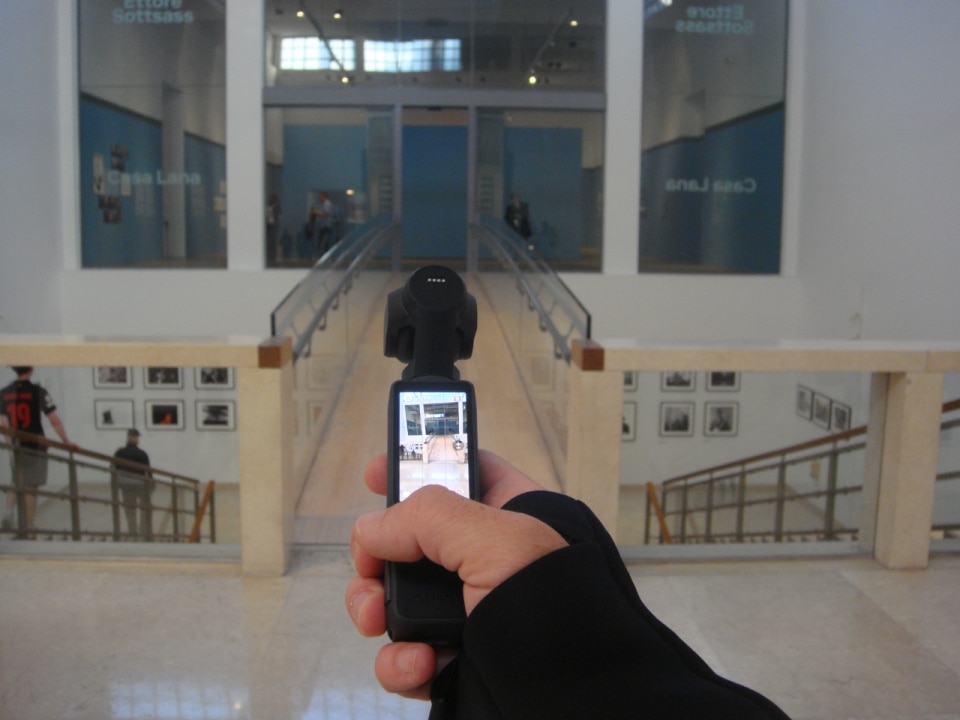
Controls are a delicate matter on the Pocket 4. Some aspects are genuinely cumbersome, partly due to the small touchscreen. In vertical shooting, in particular, the device can feel slightly unforgiving. For instance, the joystick can be used both to control zoom and to move the gimbal head. I often needed both. But switching quickly between these functions wasn’t always easy: there is a small touch control that manages the transition. Sometimes it works, sometimes it doesn’t. What does it depend on? It can be quite frustrating.
Who it’s for and what it leaves behind
If you’re not experienced, the Osmo Pocket can feel unpredictable. Not in the sense of early-2000s compact CCD cameras, which had a distinct character, but in the way it records: between gimbal behavior, tracking, and camera movement, it doesn’t always deliver what you expect. In my case, it was also my first real experience with this type of device.
Using the Osmo Pocket 4 felt a bit like holding a drone—but one that doesn’t fly, that doesn’t automatically produce spectacular aerial images, making up for the complexity of certain shooting maneuvers. On top of that, the learning curve proved demanding. Often the opposite of what I expected would happen: while shooting, I felt I was getting good results, but reviewing the footage later revealed stutters, imperfect movements, and small errors that were hard to control. It’s a tool that requires practice, and at first it can betray expectations.
At the same time, the DJI Osmo Pocket works well for vlogs or short-form content, but it may fall short if you expect professional standards. That became clear in conversations with videomaker Luca Ronzoni, with whom I often shot side by side during Design Week—him with a high-end digital camera, me with the Osmo. But with its 1-inch sensor and remarkable portability, it’s clear the Osmo Pocket is aimed at a different audience. A casual audience. An audience that perhaps doesn’t know it yet and would have a lot of fun with it.
It’s not a problem-solving camera, nor a device designed to simplify things. It’s something you buy if you are interested in producing different images, with a specific, almost “drone-like” aesthetic that you cannot achieve with either a smartphone or a traditional camera. It is a tool for those who want to add a new visual language to the way they tell stories—and are willing to learn how to use it.
It's something you buy if you're interested in producing different images with a specific aesthetic
The images it produces are not necessarily better than those of a smartphone, but they are different. And perhaps that is the point: what does quality even mean today? During Design Week, I used it as a constantly updated visual diary, posting short video clips directly, accompanied by brief overlaid text. Rather than chasing technical perfection, I was interested in building a coherent, recognizable aesthetic. Was I the only one who noticed?
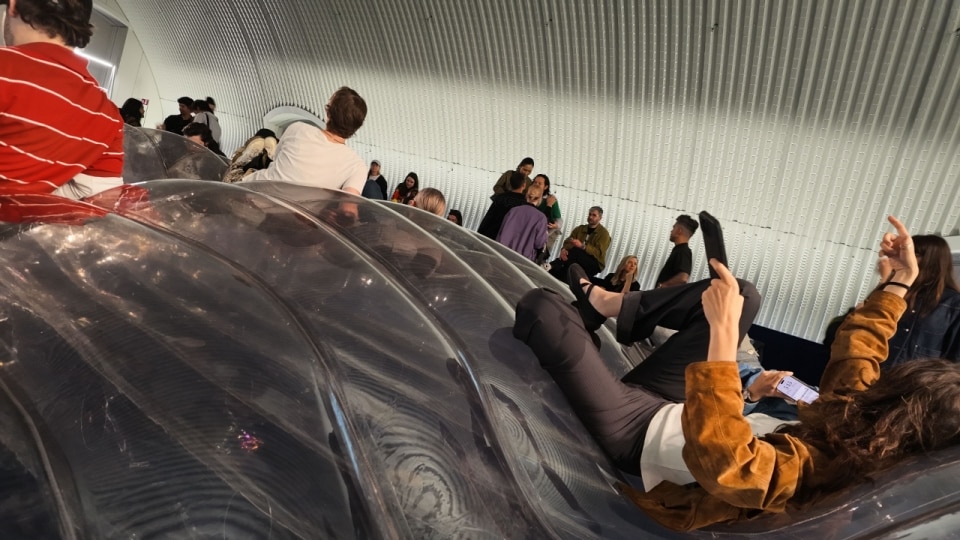
It is curious that a device like this is not more widespread. Perhaps because DJI is still perceived more as a technical brand than a cultural one. And yet the Osmo Pocket is not just a tool: it is a device that produces images with its own grammar. Perhaps it could be communicated differently.
It is tempting to think that, in twenty years, this kind of imagery might have its own comeback moment, much like early-2000s digital compacts do today. A recognizable aesthetic tied to a specific device—something that now feels purely technical, but is already a language.
So is it worth it? Definitely yes, for those who have a strong affinity with video (certainly stronger than mine) and want to build more complex narratives (I keep thinking of the small masterpieces by Henry Craver). Used the way I used it—as a simple, unedited Design Week diary—it works, but remains a fairly basic use of what it can actually do.
More than a better camera, the Osmo Pocket 4 is a different kind of camera.
Relatively affordable, lightweight, capable of producing images that are, in their own way, unique, it is an essential tool for an era in which we are no longer accompanied by printed photos, nor even by images viewed on a laptop screen, but where the primary experience happens on the small screen of a smartphone. From there, we take off toward infinite parallel worlds—the ones the Osmo Pocket is capable of capturing in a truly distinctive way.