

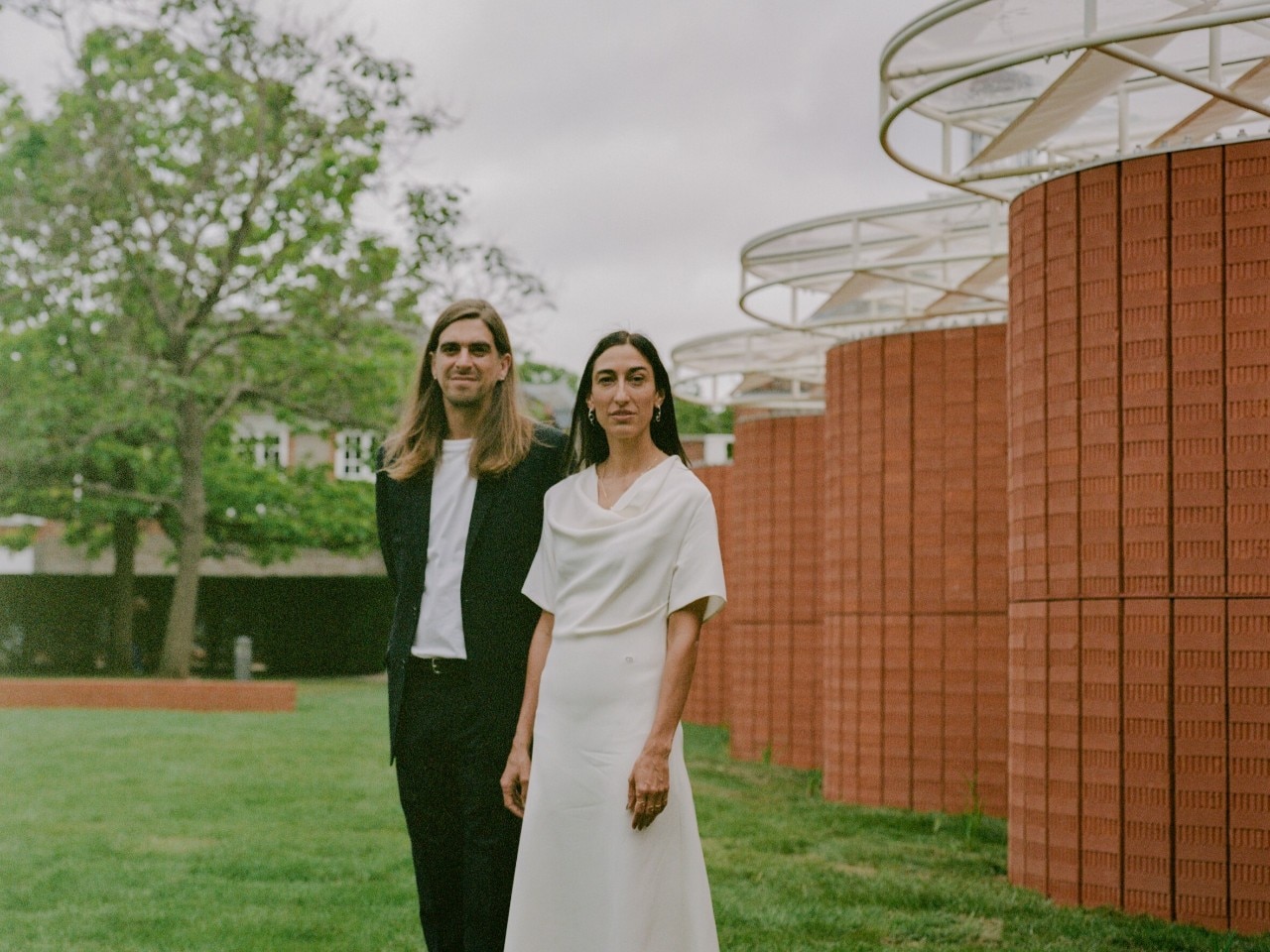

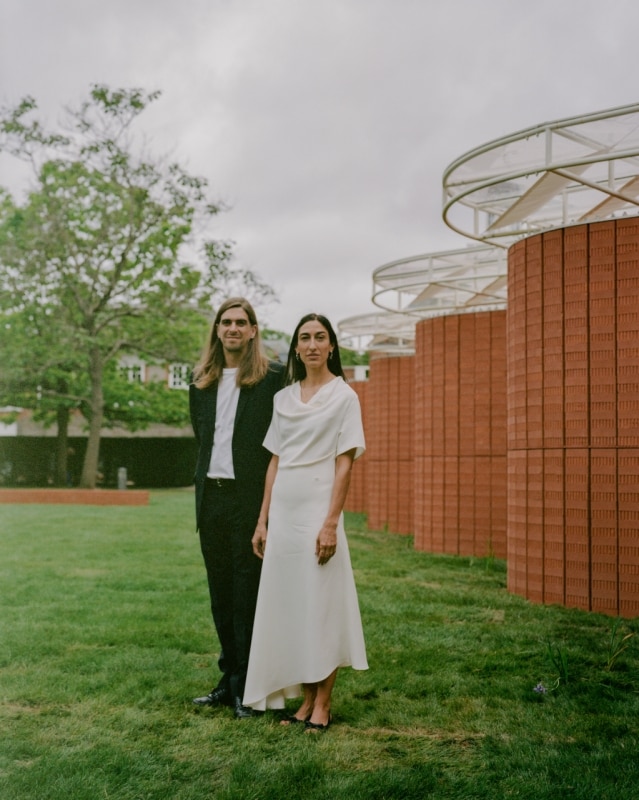
Twenty-five years after its launch, the Serpentine Pavilion has become a landmark moment in the design world, spotlighting the architectural preoccupations of the day through one arresting structure. LANZA Atelier’s edition pulls focus back to the fundamentals of architecture, and to what they can reveal about the world around us.
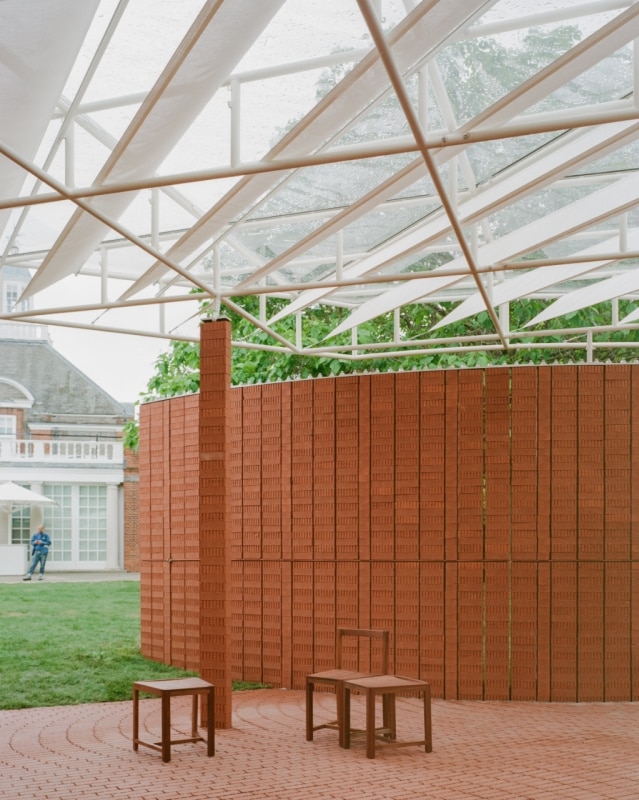
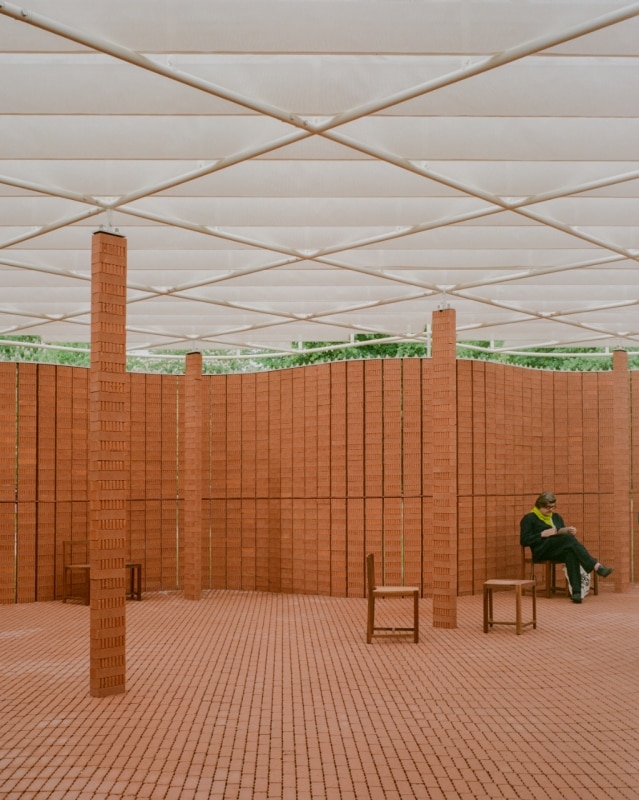
This year’s Serpentine Pavilion is conceptually minimalist. It begins with trees: the pavilion’s boundary is shaped by the canopy of the dense foliage that stands on the north side of the Serpentine Gallery. It continues with a vernacular device known as the “crinkle-crankle” wall, a curvilinear garden wall developed as a structurally thrifty alternative to its straight counterpart. It ends with bricks, which, aside from the lightweight roof on the north side, become the pavilion’s almost exclusive material, foregrounding the common Sienna brick and its recognisable orange hue.
A wall drawn from the site
These three drivers – site, vernacular and material – shape the Serpentine Pavilion’s 25th edition. Designed by Mexican studio LANZA Atelier, the pavilion is simply titled a serpentine, drawing attention to the long, undulating wall that traverses the now famous lawn of the Serpentine Gallery.
If the pavilion turned over, everything would fall down in pieces.
Lanza Atelier
The site, which over many years has offered a blank canvas to architects who had never built in the UK before, is now resolutely divided in two. The experiences from its north and south sides become self-contained and distinctly different, similar to the sensation of turning a corner on a London street and finding a new urban reality existing from one metre to the next.
This is what LANZA Atelier’s pavilion is about: observation. “The process always starts with drawing the site – drafting the real site we have for a project,” Alessandro Arienzo explains in conversation with Domus. In this case, the duo had to work with several restrictions, a Grade I listed heritage setting being the most dominant. “The most beautiful – because I think restrictions are beautiful – and helpful, was the offset of the trees, the canopy. From that I think we knew more what we didn’t want to do than what we wanted to.”
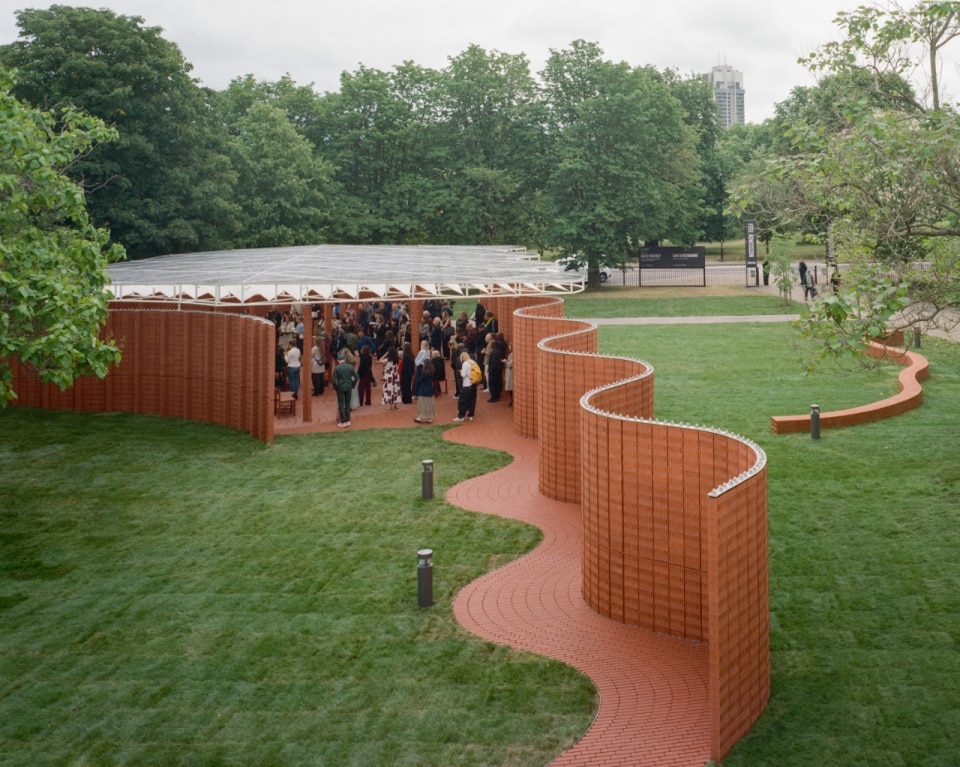
What they didn’t want was to create a pavilion unrelated to its context. “We didn’t want to insert a ‘piece’ in the garden,” Arienzo says. “We wanted to have a space for the garden, to have an open pavilion. So the space has two sides: one with a cover, and the other which is part of the garden.”
Learning by observing
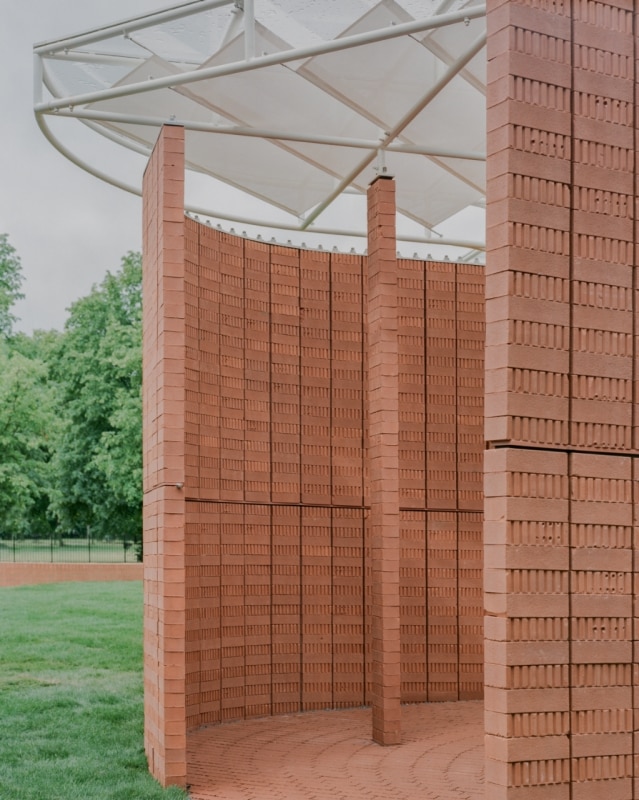
The broader consideration of the British garden becomes a focal point within the pavilion, most distinctively through its signature feature: a contemporary rendition of the crinkle-crankle wall. Built in brick, these historic walls were conceived as rhythmic, alternating curves, with origins in the engineering knowledge of ancient Egypt. They reached Britain via the Dutch, and still stand intact, with their enhanced curvilinear stability, mainly in Suffolk. They were used for practical reasons: crinkle-crankle walls required fewer bricks than straight walls because the curves provided lateral support, making them cheaper to build when materials became expensive. Within LANZA Atelier’s pavilion, the curves take on an added phenomenological function, one that Isabel Abascal identifies as “joy”.
I think we knew more what we didn't want to do than what we wanted to do.
Lanza Atelier
“You learn to write by reading, or to paint by painting; but with architecture, you learn by observing,” Abascal says, elaborating on the pavilion’s function as an incubator for looking. “It’s because you realise how things are built – you look at things and try to understand how they are put together. And that leads to a place being didactic, and to people being able to relate and learn about architecture. I think all throughout our work you can tell how things are put together. And that connects to joy, because – of course – learning is joyful.”
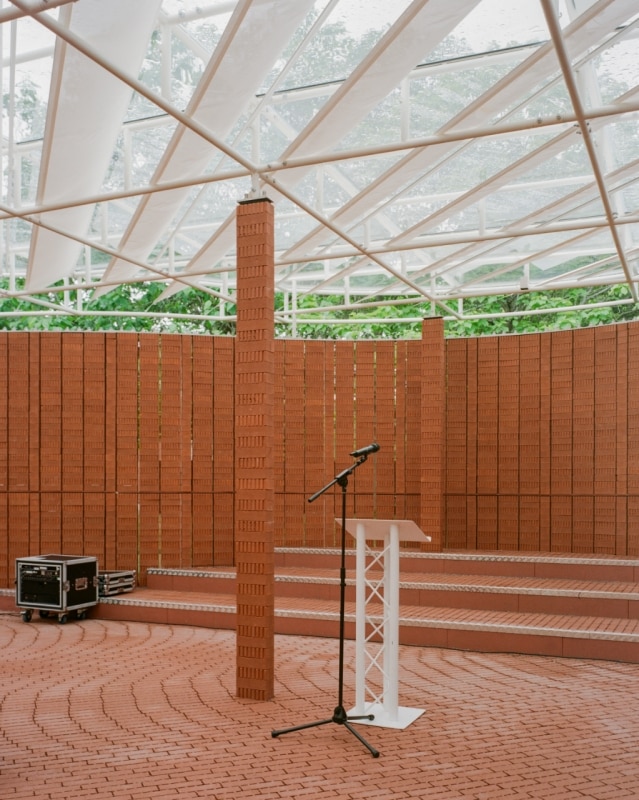
The way things are “put together” in the pavilion extends from a wider spirit of frugality. The Sienna bricks are held together by what the duo calls “gravity”: there is no cement, and the structure is assembled through an abacus-like system in which the masonry is inserted into a series of poles. So much so that, “if you flip the pavilion upside down,” Arienzo remarks, “everything would come down in pieces.”
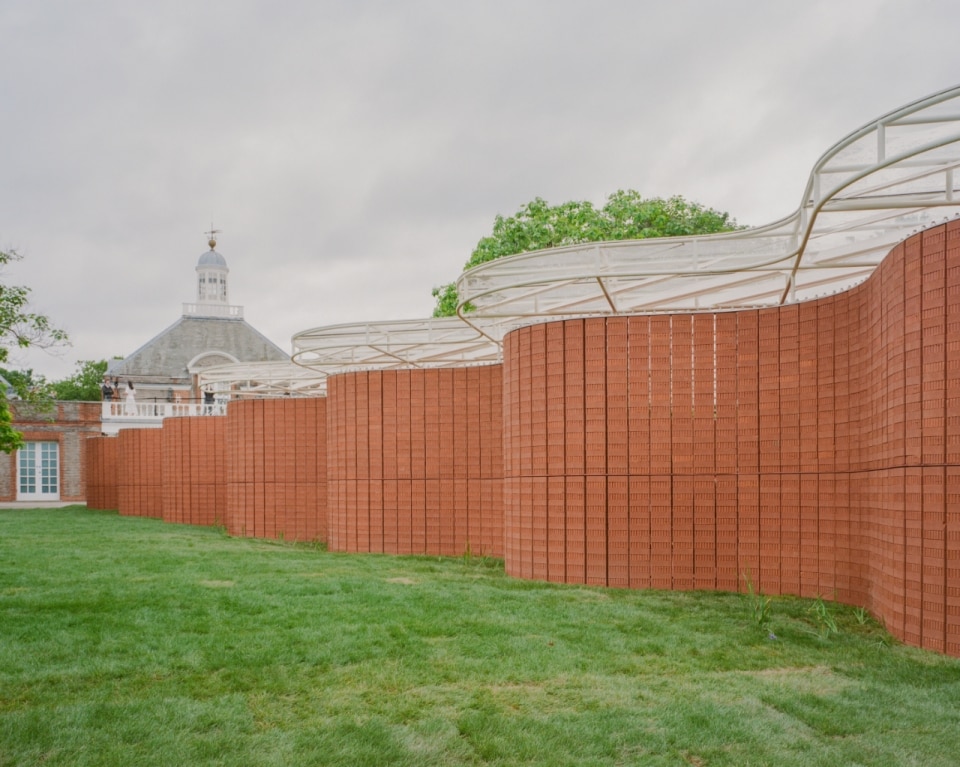
This economy of systems works in a similar way to the vernacular components the pavilion celebrates. Within the pavilion – remarkably the first Serpentine Pavilion ever to be constructed in the UK’s ubiquitous material of brick – a close look at each element slowly exposes the layers of its utility and rationale. LANZA Atelier’s elimination of mortar is not simply a construction choice, but a sensory one. The gaps exposed within each vertical rung of bricks, where mortar would otherwise have held them tightly together, make the entire masonry structure permeable: the curves of the new serpentine wall breathe.
There is a diffusive element within all of LANZA Atelier’s work, which is often public-facing and consistently invites a close reading of its materials and construction. As Abascal describes, it is also about the first-person learning that this approach makes possible. “You learn intellectually about how things are put together,” she says, “but at the same time, you learn unconsciously by how your body relates to a place – by how your body moves in a place. You learn about yourself, about the world, about relationships.”
Broadly speaking, in its 25-year history, the Serpentine Pavilions can be divided into two groups: those that are self-considering or extrospective, and those that are more internal, prompting meditation on something that exists intrinsically within their context. Peter Zumthor and Piet Oudolf’s 2011 pavilion, made only of black-stained timber, shrubs and flowers, brought people inwards to contemplate the freedom of nature. A year later, Herzog & de Meuron and Ai Weiwei’s circular, sunken edition focused on the sky, the earth and the layers of history in between. In 2022, Theaster Gates punched a hole in an otherwise darkened cylinder to consolidate views towards the ever-changing moods of the London sky.
LANZA Atelier’s contribution comfortably joins these ranks, becoming one of the pavilions that evocatively does more with less. In their case, they have built a place that urges people to simply look at where they are. And perhaps that is all it needs to do.