


The capital of the United Arab Emirates is increasingly gaining a prominent role in the international spotlight, as demonstrated by its rapid transformation into a geopolitical and cultural stage of global significance over just a few decades: this identity is distinct from its neighbouring sisters, the bustling Dubai and the more conservative Sharjah, making Abu Dhabi a mix of innovation and tradition, showing in the metropolitan landscape lapped by the desert and mangrove forests, nestled between islands and reaching towards the sky with its soaring towers.
In particular, in recent years, impressive government investments have been pointing the radar on the artificial island of Al Saadiyat, where international star-architects have been called upon to leave their mark in the mosaic of one of the most ambitious cultural districts worldwide: a chase for primacy in search of a balance between territorial marketing and architectural thinking.
In addition to Jean Nouvel's Louvre Abu Dhabi, which opened in 2017, other highly anticipated projects are still under construction on the island, such as Norman Foster's Zayed National Museum and Mecanoo's Natural History Museum, both expected to be completed in 2025. And, last but not least, Frank O. Gehry’s Guggenheim.
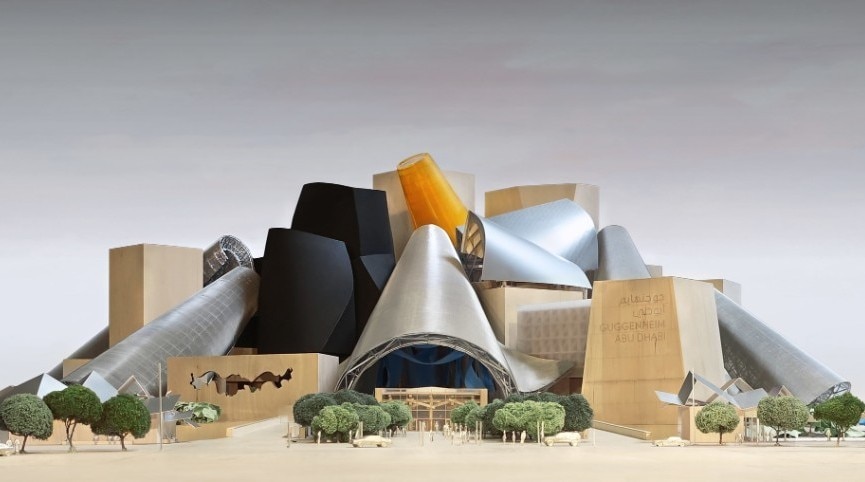
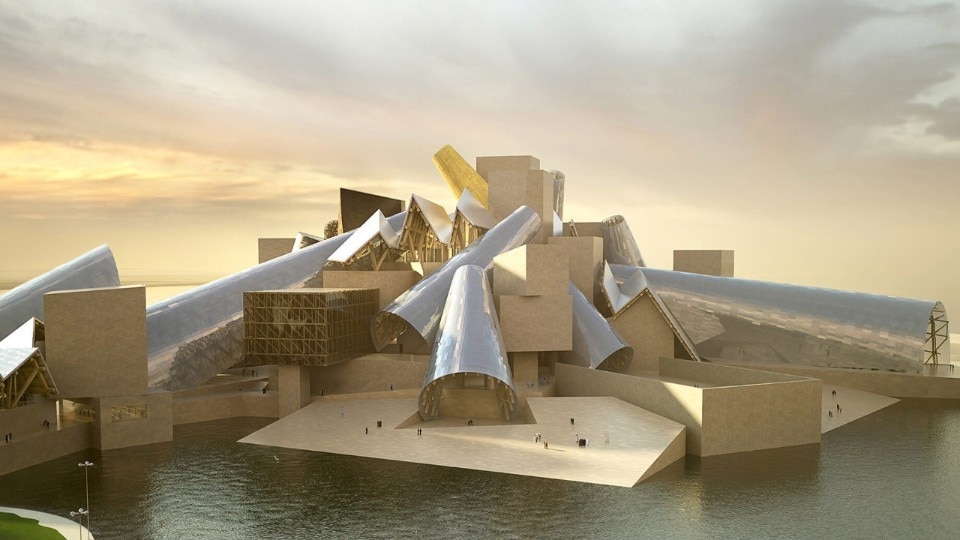
Announced in 2006, the museum is expected to be completed in 2026, after a series of delays, suspensions and sporadic resumptions of work. With a surface area of approximately 30,000 square metres, the building will be the largest Guggenheim in the world, housing an art and technology centre, galleries for special exhibitions, permanent collections, an education centre, archives, a library, a research centre and a restoration laboratory.
The work will not lack the nonchalantly unsettling flair that characterizes Gehry's work: eleven conical structures contrasted with monolithic volumes create a complex and vaguely disorienting composition that nevertheless, as Gehry states, through “intentional disorder”, “achieves clarity”. An oxymoron in full "Gehry style", the trait that Domus has documented, discussed and portrayed since its origins, deeply rooted in 1970s US critical debate.
We'll just have to see it in person to evaluate.
Opening image: Courtesy Gehry Partners, LLP