

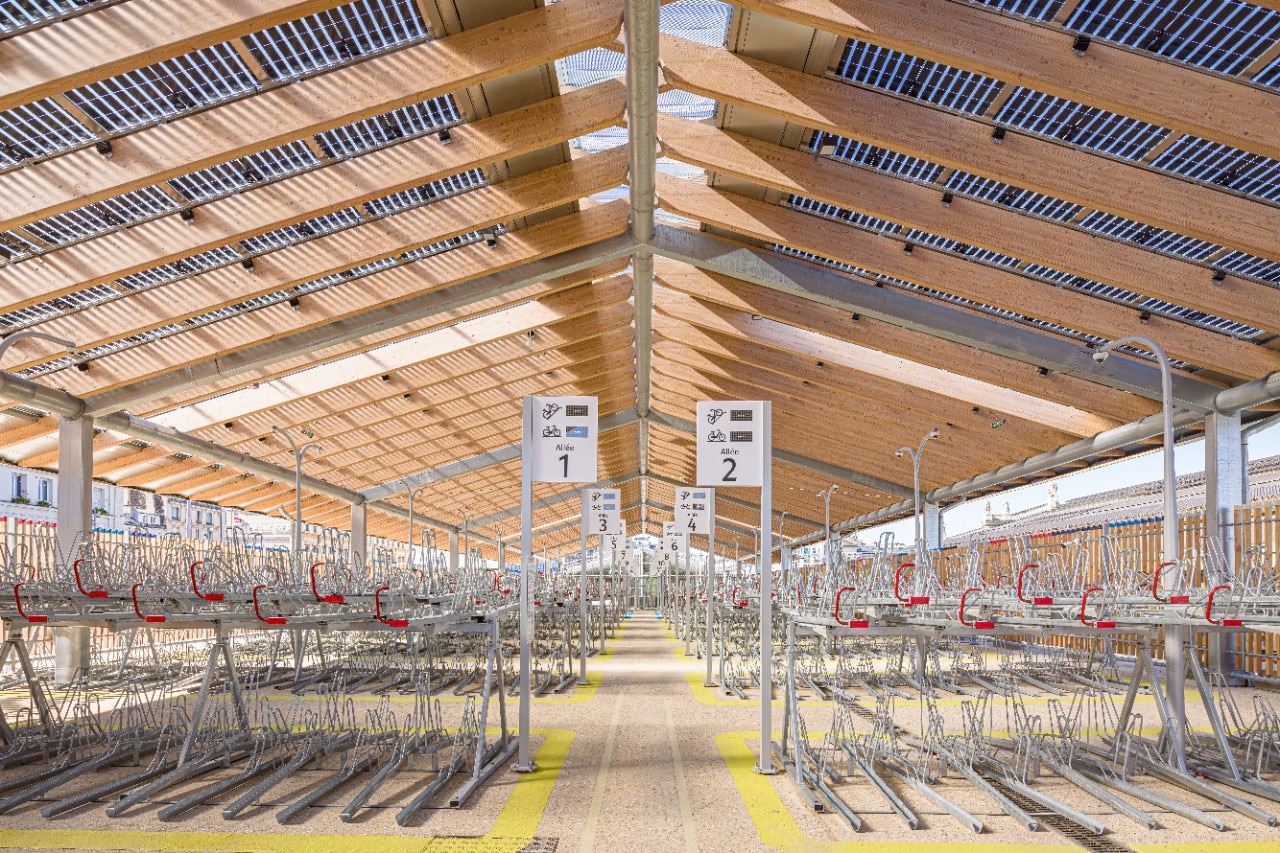


There are 700 thousand people passing through Gare du Nord every day: what was a symbol of Haussmann's Paris in the second half of the 19th century is now Europe's largest train station by passenger traffic, and in the not-too-distant future it may yet represent a new chapter in the city's history. In fact, by 2030, thanks to the expansion of the metro rail infrastructure and the comeback of long-distance trains, it is estimated that 900 thousand passengers will pass through, and this figure urgently calls for an upgrade of facilities and services to ensure integrated and sustainable mobility.
And at Gare du Nord, in fact, Arep, the SNCF group's subsidiary dedicated to rail infrastructure, has conceived a light architecture that looks at enhancing intermodal exchanges: a bicycle parking lot with more than 1,200 spaces whose design is meant to integrate with the nearby station building, the imposing building and Parisian landmark designed by Jacques-Ignace Hittorff between 1860 and 1865, which he considered his masterpiece. Accessible from the station's eastern entrance, the 70-meter-long by 24-meter-wide open pavilion is protected by a two-pitch solar canopy as well as a perforated wooden windbreak facade.
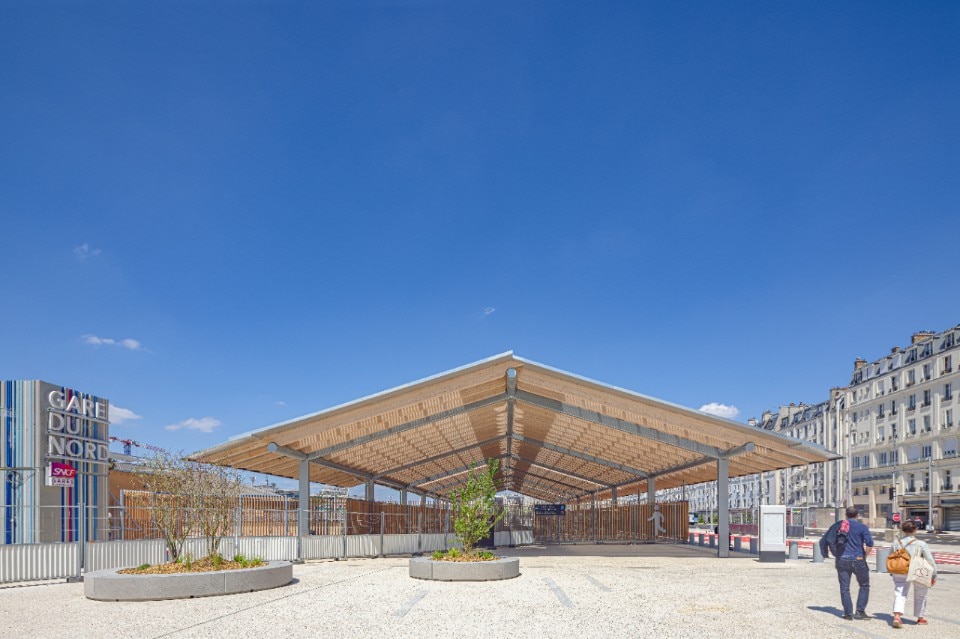
"We chose lightness to build this large photovoltaic carport, which invites experimentation with the mixed uses of shared roofs. Its conception, as well as its function, invites the adoption of sober lifestyles in terms of energy and materials," Raphaël Ménard, chairman of Arep's management board and professor of Post-Carbon Architecture at the Paris Est Faculty of Architecture, tells Domus. Indeed, the project is among the cross-disciplinary efforts that Arep is multiplying in France and abroad-many in China related to the significant extension of the rail network-precisely to rethink mobility and urban spaces from a post-carbon perspective.
While the profile of the pitches echoes the design of the nineteenth-century station roof, thus promoting harmonization with the context, the use of materials looks without preclusion at contemporary needs and opportunities. The structure, made of wood and galvanized steel - a choice due to the low thickness of the slab, only 30 cm, which imposes strict load constraints - and especially the photovoltaic panel roofing goes beyond the language of a strict respect for heritage (del patrimoine) to integrate technological systems responsive to current challenges. Even 'circular architecture plays a role in this project: the skylights we see between the two pitches are in fact made from some 40 pieces of salvaged glass from the Centre Pompidou walkway.
Described by Arep as a "metropolitan sombrero," the pavilion is designed to adapt to a +4°C climate scenario and a city that in 2050 could reach 50°C during peak heat. Accessible from 5 a.m. until 1 a.m., the pavilion is equipped with two inflator stations, repair stations, and electric bike charging stations.
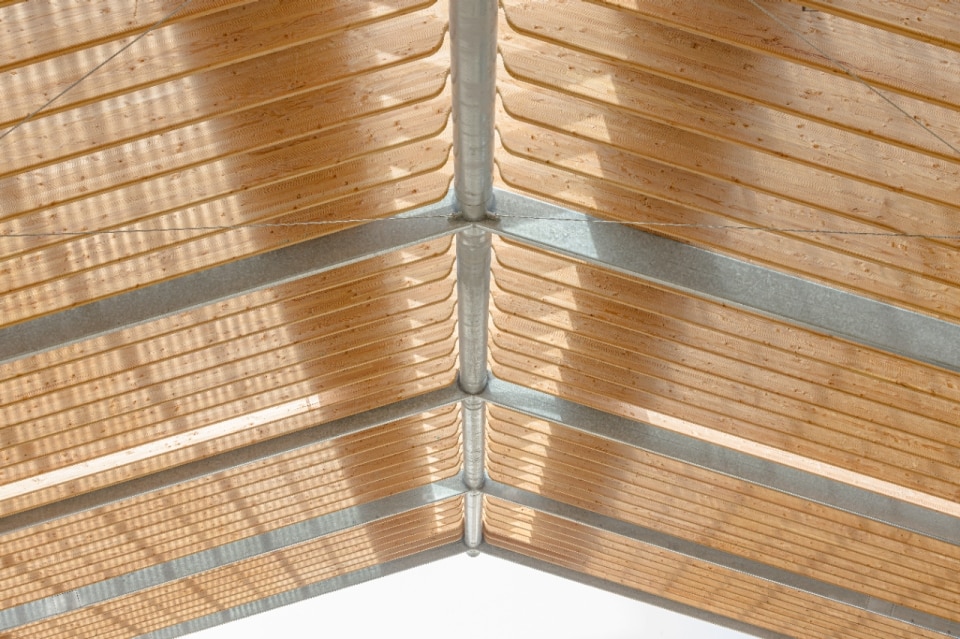
The project, completed in 2024, is accompanied by a fine volume by Arep Éditions titled "Halles, soleil, climat, cohue" (translatable as "Pavilions, sun, climate, crowd") that looks beyond the specific case of the photovoltaic pavilion and its value as a case study, a case that remains extremely significant: what if one day not only the 1,700 square meters of its roof were to be covered with panels, but the entire roof of the Gare du Nord? In addition to taking a step forward, the volume takes a step back, tracing the building types that distinguish what in France falls under the name of "halles," architectures for railway pavilions, markets, or trade fairs. Described as "a temple" by Charles Baudelaire, halles testify to architecture's ability to respond to only seemingly ordinary needs with an extraordinary variety of material and technical solutions, sublimating its identity under the banner of an aptitude for adaptation toward new functions and challenges of all times.