


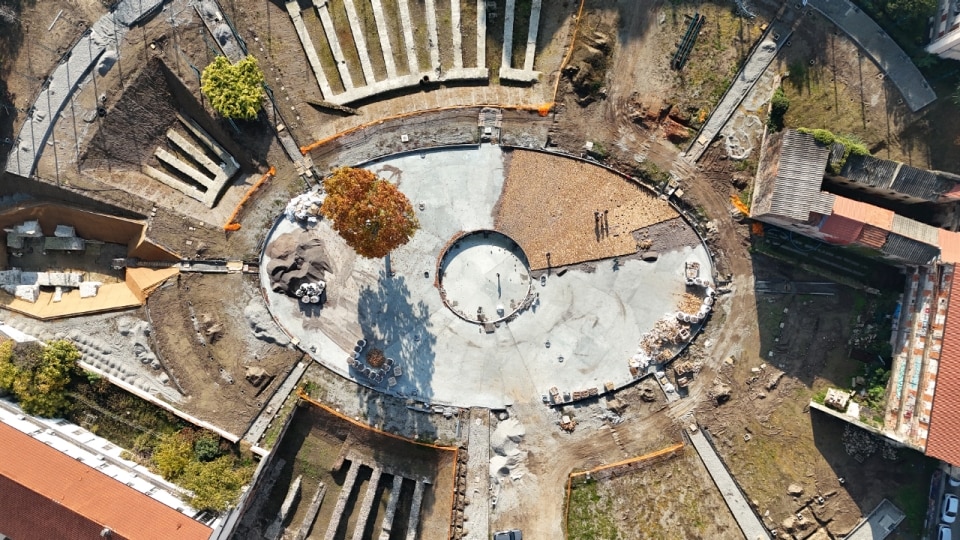
One of the most significant urban projects of recent years is taking shape in Milan. It is the Parco Amphitheatrum Naturae, a new archaeological park that will rise in the De Amicis area, a hinge zone between the Columns of San Lorenzo and the Darsena, right next to the route of the new M4 metro line. Here, just outside the city walls of ancient Mediolanum, stood a Roman amphitheater dating back to the first century AD (therefore roughly contemporary with the Colosseum in Rome, built in AD 80), which will soon be brought back to light.
For the city of Milan, 2025 has been a year of major transformations, from the architecture built for the Milan–Cortina 2026 Winter Olympics, to the official farewell to the San Siro stadium, a new skyscraper—this time “lying down”— at CityLife, and numerous bridges aimed at improving traffic flow.
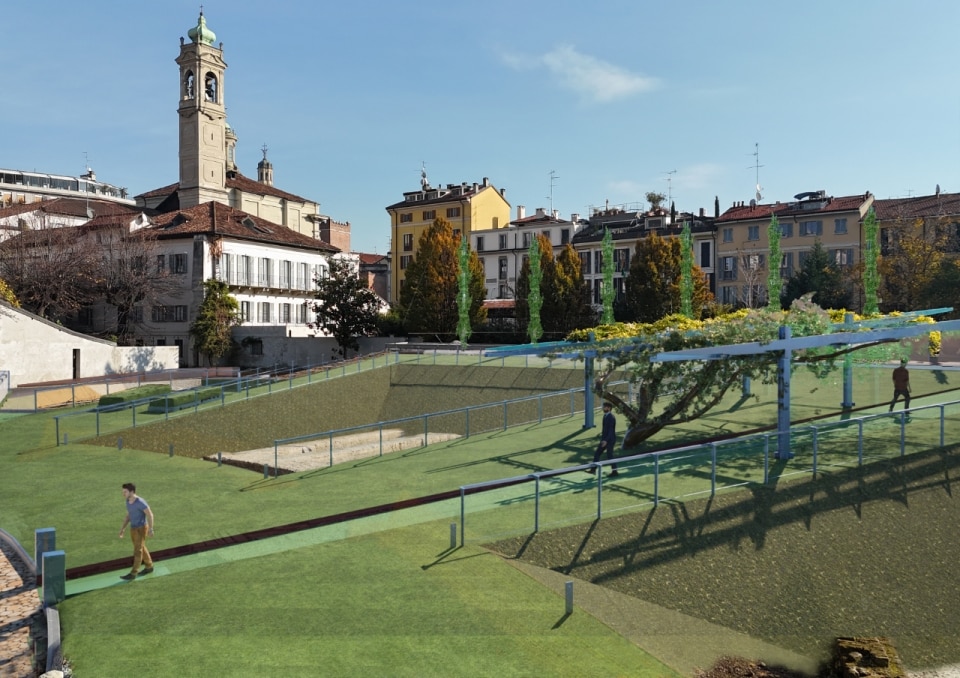
This time, however, it is not a true (re)construction project, but rather a landscape intervention that makes a disappeared monumental architecture legible, focusing more on the creation of a shared urban experience. We discussed this with Attilio Stocchi, who designed the project under the supervision of the Superintendency of Archaeology, Fine Arts and Landscape for the metropolitan city of Milan.
The invisible amphitheater and the choice not to reconstruct
According to Eugène Viollet-le-Duc, one of the most important theorists in the history of architecture, restoring a building does not mean returning it exactly to its origins, but rather “reinstating it in a complete state that may never have existed at any given moment.” Far from the temptation of replication, the Parco Amphitheatrum Naturae project proposes a discreet approach, aimed at offering only a perception of the imposing structure built in the first century AD.
The large elliptical building, over 150 meters along its major axis, was progressively dismantled starting in the fourth century, and its stones—made of ceppo d’Adda—were later reused to build the nearby Basilica of San Lorenzo, in a process of transformation that literally incorporated the ancient structure into the medieval fabric of the city. Today, all that remains of the amphitheater are underground traces and fragments of its foundations.
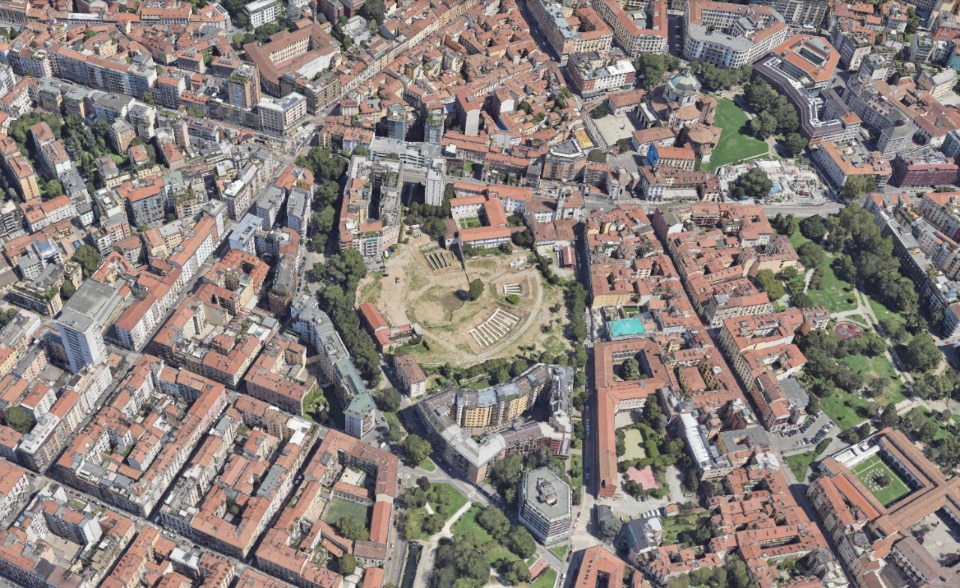
“Recreating the architecture of the ancient amphitheater in its original grandeur would be unthinkable today,” architect Attilio Stocchi explained to Domus. “An attempt at reconstruction, even at a reduced scale, would be invasive, anachronistic and, above all, senseless.” Hence the decision to work not on the architectural object itself, but on its imprint—on the geometry it left in the ground and in the city’s collective memory.
Green as a tool for reconstruction
The concept of Pan—its name an explicit reference to the god of nature and vitality—was born from the idea that nature itself could “celebrate a lost relic of the ancient world.” The project designs a large landscape bas-relief, with gentle height differences—no more than three meters—to evoke the void of the ancient arena. Stocchi defines it as a “landscape-imprint,” a space marked more by the memory of geometries than by the introduction of new functions.
The elliptical footprint of the amphitheater is thus reconstructed through greenery. Of the eighty-four foundation walls that once supported the seating tiers, most—those no longer existing—are “interpreted” by hedges that trace the structural rhythm of the vanished building. Similarly, the pillars of the first order of the amphitheater’s façade are reimagined as pergolas: light elements that mark the perimeter without enclosing it, restoring a sense of monumental scale through a precise rhythm.
The structures uncovered during excavation campaigns, including the remains of the Porta Triumphalis, will therefore not be museumized in the traditional sense, but integrated into a park meant to be experienced daily, offering a “new vision of history and past life.”
The second phase: the Zodiac project
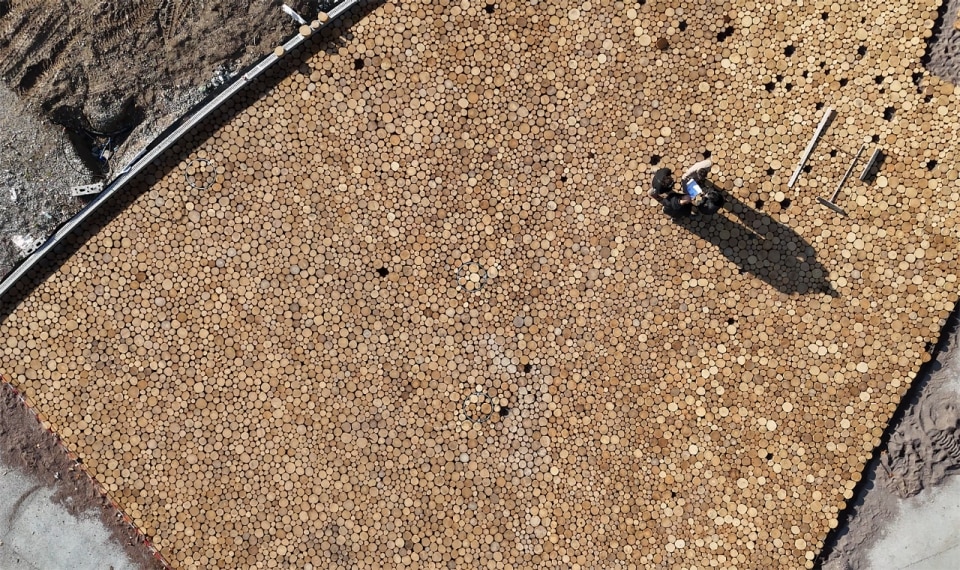
The project includes an elevated walkway that guides visitors along the perimeter of the ellipse, offering views over the archaeological areas left exposed. At the center, in the space of the ancient arena, a circular orchestral pit is planned for events and performances, while the natural wooden flooring helps reinforce the “anti-monumental” character of the intervention. The amphitheater—historically associated with the spectacle of death—is thus symbolically overturned into a space dedicated to life, culture, and social interaction, scheduled to be inaugurated in May 2026.
Work will continue throughout the summer, with the completion of equipped green areas and a series of services connected to the amphitheater, covering a total surface of about 7,500 square meters. This phase is known as the “Zodiac” project, which expands the amphitheater’s radius with a green area divided into twelve sectors and extends capillarily into the urban context, connecting with surrounding buildings and streets. The result will be a continuous green route linking the amphitheater to the Columns and the Basilica of San Lorenzo, crossing the Parco delle Basiliche and reaching as far as Sant’Eustorgio.
In this sense, the Parco Amphitheatrum Naturae presents itself as an ambitious experiment: not an archaeological theme park nor a reconstructed monument, but a landscape infrastructure that entrusts greenery and pathways with the task of making a past history legible. It remains to be seen whether, once completed, the project will truly succeed in fulfilling the promise of a shared public space—but the wait is almost over.
Opening image: Parco Amphiteatrum Naturae, site photo. Courtesy Attilio Stocchi