


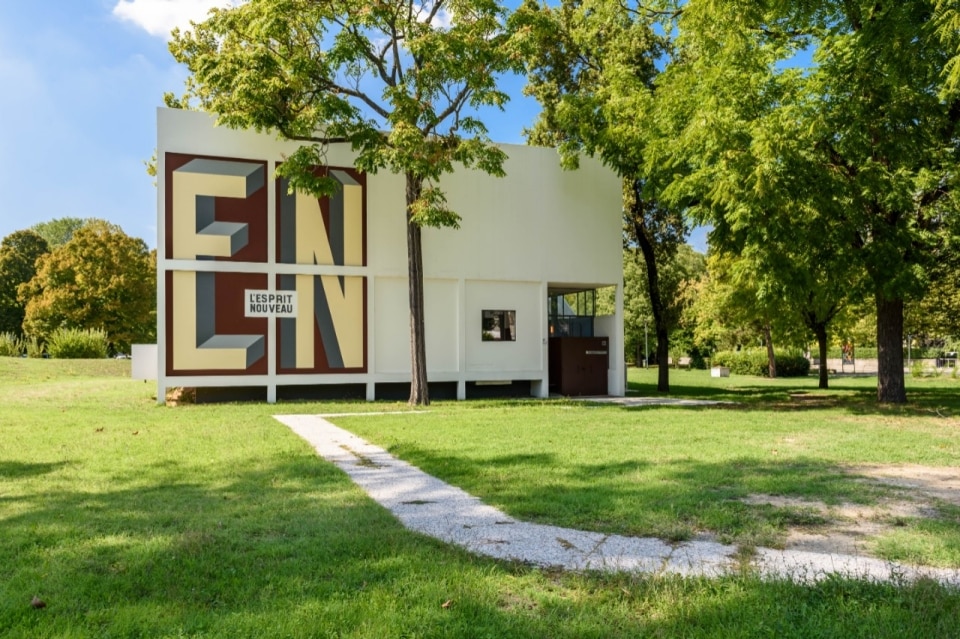
Let’s start with the obvious: Le Corbusier was the architect of the great rational utopias of the twentieth century. From the Unité d’Habitation in Marseille to the Plan Voisin — which envisioned demolishing part of historic central Paris and replacing it with a grid of towers set among green spaces — his work consistently sought to impose order, geometry, and function onto the complexity of urban life.
The Pavillon de l’Esprit Nouveau, designed with Pierre Jeanneret for the 1925 Exposition Internationale des Arts Décoratifs et Industriels Modernes, emerged directly from this vision: not simply as a temporary structure, but as a habitable manifesto for the modern city. Today, Bologna is home to the world’s only existing replica of the pavilion.
Dixit, by contrast, is almost its complete opposite. Created in 2008 by French neuropsychiatrist Jean-Louis Roubira, the card game became one of the most popular phenomena in contemporary tabletop gaming precisely because it rejects logic, precision, and singular interpretations. Its dreamlike imagery operates through mental associations, intuition, and ambiguity.

Now, Le Corbusier and Dixit meet. It happens just inside Bologna's Esprit Nouveau Pavilion, where artist and graphic designer Daniele Catalli has transformed the urban utopias of the Modern Movement into a collective device of imagination, dreaming and interpretation.
Telling cities through dreams
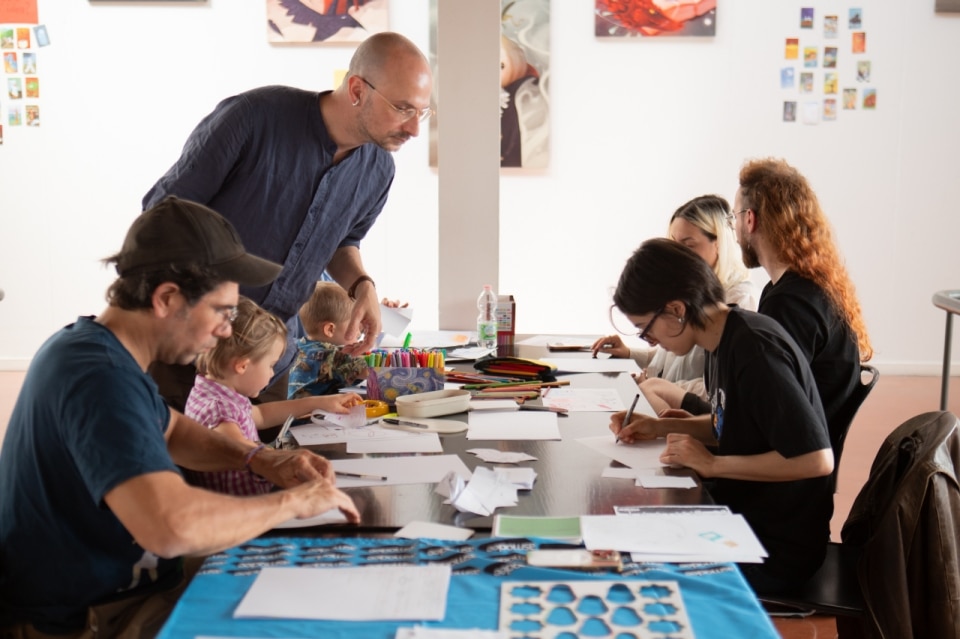
Surrounded by large-scale reproductions of Le Corbusier’s ideal cities — from the Plan Voisin to the “City for Three Million Inhabitants” — Catalli led a workshop interpreting people’s thoughts about a city that does not yet exist, and perhaps never will. “What interests me is the present, and drawing above all as a means of understanding it,” he tells Domus. “And then, why not, of imagining utopias.”
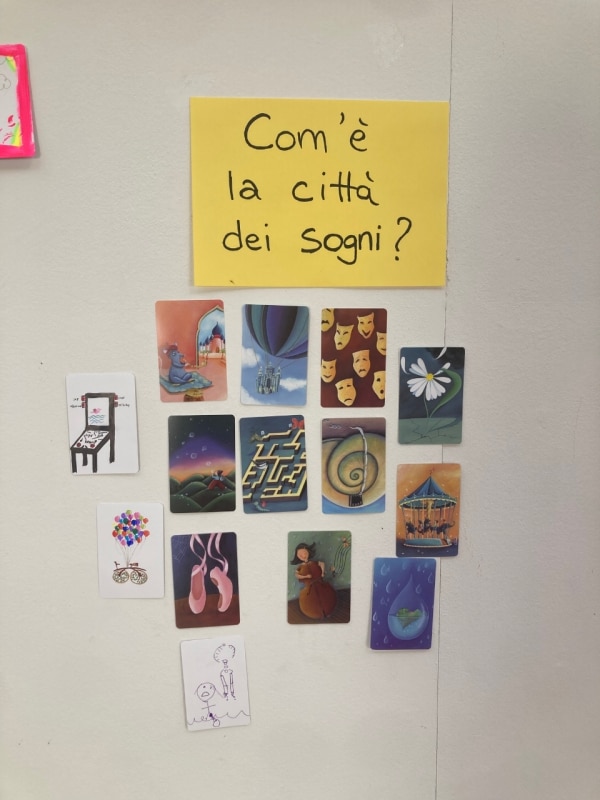
Hanging on the walls of the pavilion’s vast double-height hall are enlarged reproductions of Dixit cards alongside three questions: What does the city of dreams look like? Where is home? What is an idea?
The project stems from a collaboration between Asmodee Italia, publisher and distributor of board games, and Adiacenze, the contemporary art association co-directed by Amerigo Mariotti and Giorgia Tronconi, which for the past three years has been developing Closer – Becoming the City, a program dedicated to the city and its relationships through the language of art. For the summer season, Adiacenze opened the Pavillon de l’Esprit Nouveau to the public.
Within this context comes Catalli’s performance, in which participants were asked to describe their dreams and he, acting almost as a translator, transformed those nocturnal visions into images through the medium of drawing.
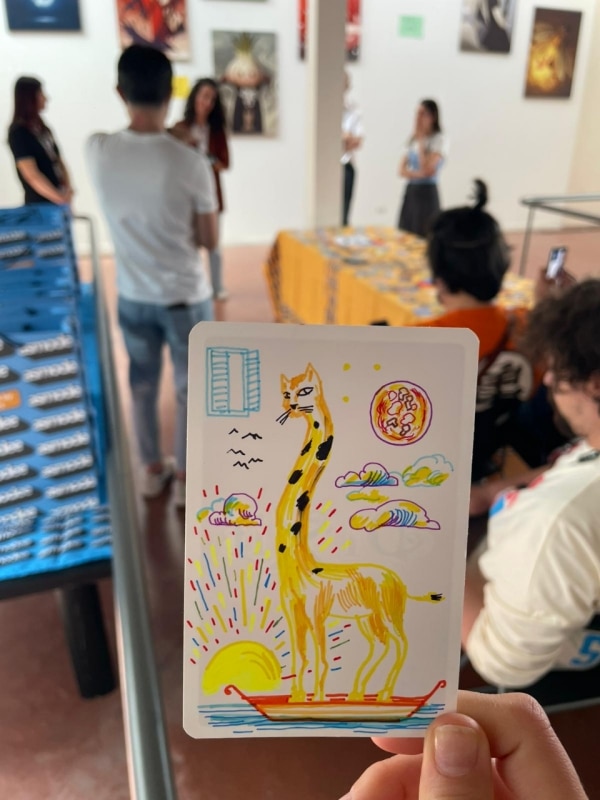
The idea is to formulate urban visions starting precisely from what is unreal yet remains deeply rooted within people. Dixit’s illustrations possess a dreamlike, visionary aesthetic: they never depict realistic scenarios, but rather images that feel plausible within the imagination, capable of stimulating “our ability to bring out something that would otherwise remain buried, much like the Rorschach test,” explains the neuropsychiatrist involved by Asmodee Italia. It is no coincidence that Dixit itself was created by a neuropsychiatrist
What does Dixit have to do with Le Corbusier?
Le Corbusier imagined perfect cities, crossed by vast traffic arteries and dominated by towers immersed in greenery. With the 1925 Plan Voisin — presented inside the Pavillon de l’Esprit Nouveau itself — he even proposed demolishing part of central Paris in order to replace it with a grid of cruciform skyscrapers designed for a modern, efficient, and rational society.
Today, these urban utopias conceived by Le Corbusier, and more broadly by the Modern Movement — one need only think of Frank Lloyd Wright’s Broadacre City — survive primarily as theoretical manifestos, capable of clearly expressing the ideologies of the designers who imagined them.
Catalli works precisely within this tension between utopia and imagination. “Using drawing as a translation of dreams puts me in the position of ‘losing’ something but also ‘gaining’ something else,” he explains. “It’s like a game of telephone.”

Dixit cards do not explain urban space; they evoke it. The cities drawn by Catalli are never truly designed in the conventional sense, but instead appear as visual fragments, symbols, and mental stage sets that resemble memories or visions more than urban plans.
“For me, cities are layers,” the artist explains. “They are not buildings or monuments.” Rather, they are something to move through and interpret. “Each layer can be read differently depending on who is looking at it.”
It is the same logic guiding the workshop hosted inside the pavilion: beginning with people’s dreams in order to construct images that do not simply illustrate a city, but the way a city is experienced, imagined, and reshaped by memory.
Opening image: Le Corbusier and Pierre Jeanneret, Pavilion de L'Espirit Nouveau, 1925. © Municipality of Bologna. Photo Giorgio Bianchi