


.jpg.foto.rmedium.jpg "Illustrazione Musealis - Federico Babina")
.jpg.foto.rmedium.jpg "Illustrazione Musealis - Federico Babina")
One of the major fundamental issues of contemporary museography, loaded with consequences yet still unresolved, is the long-standing debate over the semantic relationship between container and content: that is, the inevitable negotiation between the demands of heritage and those of architecture, around which the development of contemporary museum institutions has revolved for decades.
Since the early twentieth century, the museum—especially the contemporary art museum—has progressively established itself as an autonomous and critical subject, and thus as an object of study and comparison for anyone wishing to expand its functions by questioning its presumed typological neutrality as a container. From the inauguration of the Centre Pompidou in 1977 to the imminent opening of the Lucas Museum of Narrative Art in Los Angeles by Guest Editor 2026 of Domus Ma Yansong, there are countless internationally renowned architects who, over the years, have helped guide the transformations of this institution, very often suspended between instances of renewal and legitimacy. We have collected the 50 museums that deserve a visit for their architectural design.
If at first the growing weight of architectural gesture on the symbolic and cultural role of the museum was viewed with suspicion — sometimes prompting truly apocalyptic and uncompromising condemnations —today it is more crucial than ever to continue questioning this interconnection between history, matter, and form, conceiving the museum as a networked system devoted to a strategic, bidirectional amplification of container and content.
Of this art-architecture node, we spoke with illustrator and architect Federico Babina who, in addition to having created the cover of the December 1107 issue of Domus, told us about his new project Musealis.
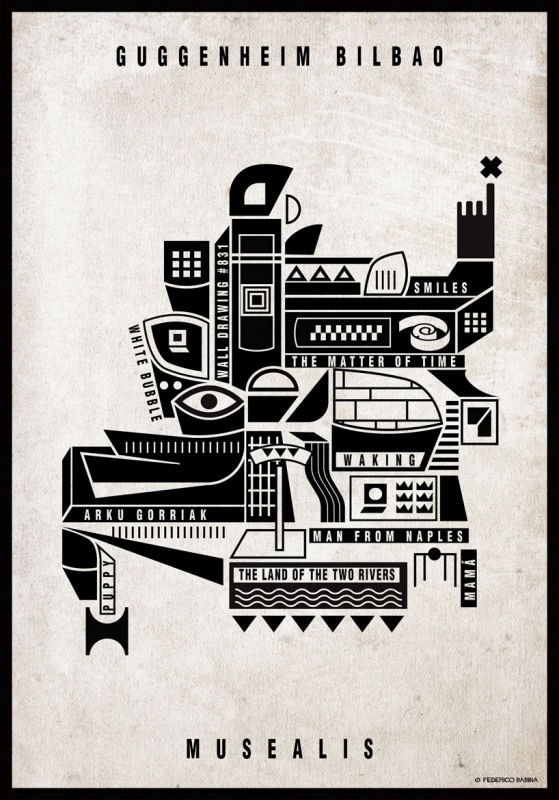
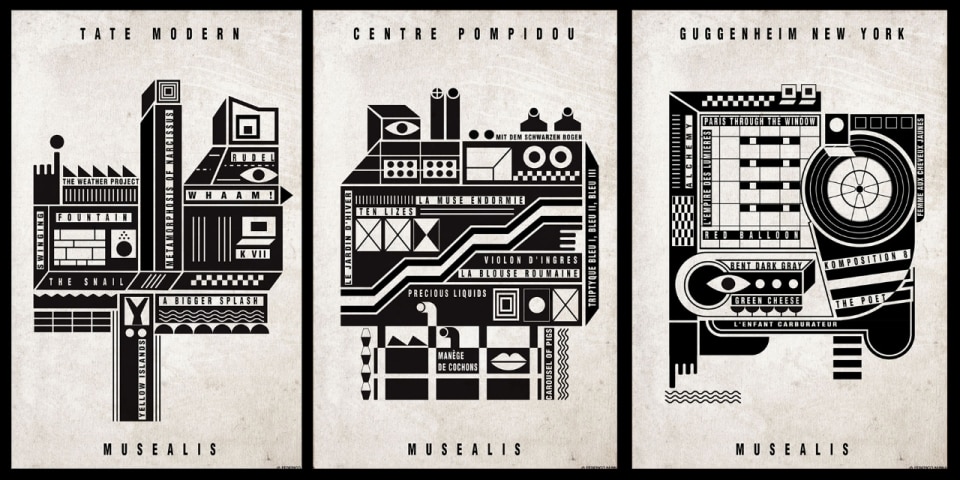
Musealis is a visual journey in seventeen stages, an imaginary black-and-white atlas where some of the world's most iconic museums become essential, almost archetypal forms. The representations are not simply reproductions of the museums: they are a mixture of isometric axonometries, elevations, and floor plans, a kind of hybrid of architectural drawing and evocative illustrated vision, so that the building is a narrative pattern to be deciphered.
Federico Babina
Graphic lines aimed at essence, at a reconciliation between disciplines: “architecture as form and structure, and illustration as narration and concept”. Babina’s practice has always developed along this boundary, investigating how architecture can be transformed, through the illustrated mark, into an emotional diagram. The project pushes to the extreme his interest in a space—the museum—as a place of “passage” and experience before knowledge: “For me, the museum has never been just a building or a container of works, but a place one enters with one step and leaves with another, even if physically one remains the same”.
It is no coincidence that he speaks of them as spaces akin to sacred ones, finding in the rituals of these secular cathedrals both a solid point of reference and that need for attention and openness that makes museums “living organisms, made not only of walls and rooms, but of words, memories, and invisible relationships”.
The experiential dimension of these places is thus condensed into images that function as maps of collective memory. Each illustration is a deformed yet conscious reconstruction of the cultural substratum that supports the museum and “the works that inhabit it”, in a synthesis that does not see the artwork and the architectural object overpowering one another, but rather integrating in favour of a coherent and multifaceted translation.
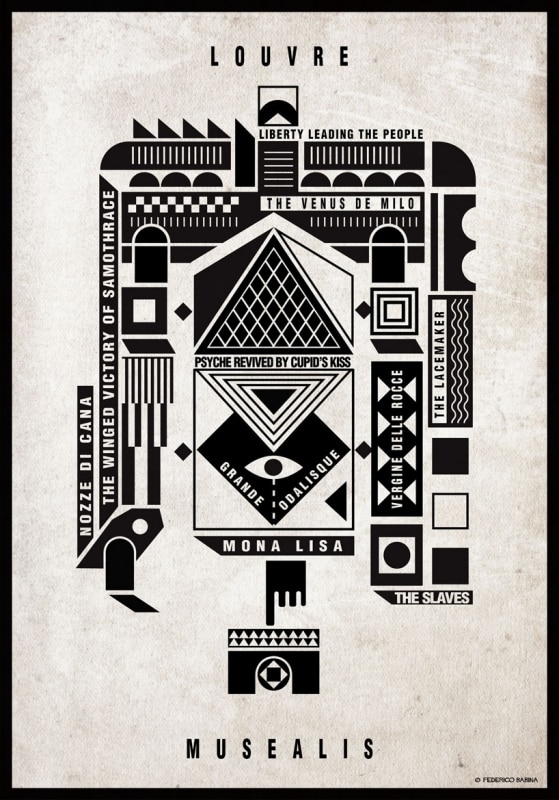
“Architecture”, he explains, “with its geometries, welcomes and allows itself to be traversed by words, by the titles of the most emblematic works it houses. No longer captions, but bricks: artworks are transformed into lines, squares, curves, solids, and voids that constitute the very image of the museum”.
Unlike the animated series Arch Snapshots created for Domus in 2019—in which he illustrated some of the main architecture and design movements from Bauhaus to Parametricism, in Musealis Babina worked by subtraction, including chromatically. While maintaining a lively drawing style, he used black and white to develop a timeless visual language, so that each mark would function as a “mental engraving” or a “text to be read” through geometries and words, with a slow rhythm and an intimacy that only monochrome can convey.
Starting from museums endowed with a strong and immediately recognizable architectural identity—buildings that have each, in their own way, helped redefine the never-resolved relationship between container, content, and use—Babina adopts a consciously organicist approach. “I don’t like seeing art and architecture separately”, he explains. “The true meaning of a museum, or any cultural space, is born precisely from the encounter between the two”. The architectural project and the character of the exhibited objects, in his view, form narrative fabrics that together generate a story that is both physical and conceptual, which he translates into a visually accessible system that preserves its layered complexity intact.
In the context of a debate that has further expanded with the introduction of new technologies into museum spaces—once again shifting the focus toward a more digital and dematerialized narration of heritage—Musealis reminds us of the value of museums as spaces permeable to the real transformations of contemporaneity, and thus as “living places, capable of telling stories not only through what they show, but through what they are”: an active element of the cultural landscape, where art and architecture can only be “two voices of the same discourse”.