


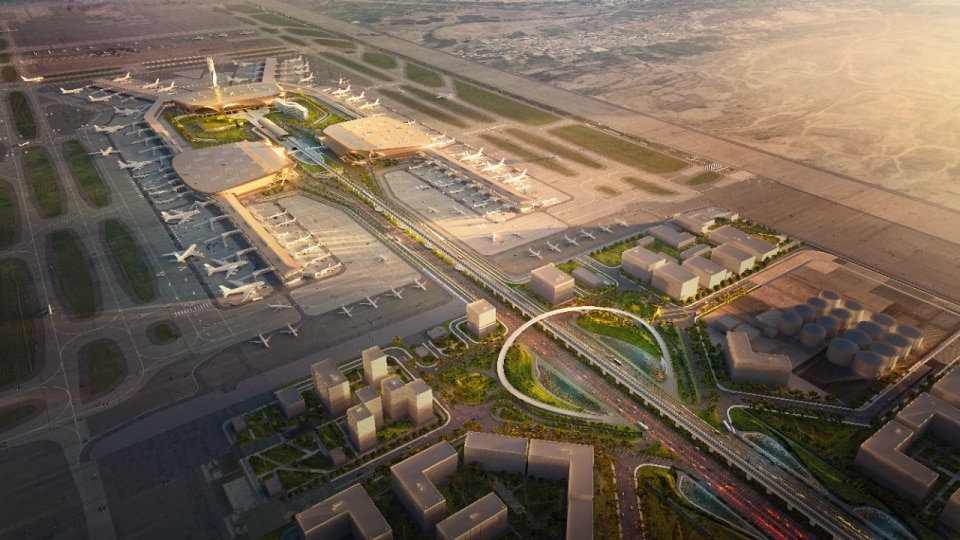
In the 18th century it was seaports that dictated the geography of metropolises. In the 19th, railroads drew new urban maps. The 20th century belonged to highways. Now, according to an increasingly popular view among urban planners and infrastructure designers, the 21st century could be dominated by airports. It is not about building bigger or more efficient airports. The revolution under way concerns the very way the relationship between airport and city is conceived: from the necessary but cumbersome peripheral infrastructure relegated to the margins of the urban fabric, the airport is bidding to become the generating nucleus of new metropolitan forms. This is the model of the "aerotropolis," city-airport in which the airport is no longer a transit terminal but the economic, social and cultural engine of an entire urban ecosystem. It is estimated that by 2040 some 19 billion passengers will transit the world's airports annually, with an average growth rate of 5 percent.
Parallel to that, the global commercial air fleet will expand by one-third by 2030. These are numbers that force reflection: how can cities metabolize this exponential growth in air mobility? The answer proposed by aerotropolis theorists is radical: instead of marginally adapting existing infrastructure, the entire urban structure must be rethought by placing the airport at the center. The model theorized by urban planner John Kasarda envisions airports transformed into destinations in their own right, no longer simply places of transit but attractive hubs capable of aggregating commercial, office, exhibition, hospitality and even residential activities. The idea is to create economic clusters gravitating around the airport: from hotel chains to convention centers, from multinational companies' offices to logistics districts. Concrete examples are already taking shape. Dubai's Al Maktoum Airport, with a projected capacity of 260 million passengers, is configured not as a terminal but as an entire futuristic city with commercial spaces, hotels, green oases and integrated digital services.
Berlin has transformed the former Tegel airport into Europe's largest urban redevelopment project, converting it into a technological and residential complex. Italian airports such as Rome Fiumicino are evolving toward the smart hub model, equipping themselves with vertiports for urban air mobility and integrating advanced technologies for air traffic control. This vision, however, is not without profound contradictions. Sociologist Richard Sennett has spoken of the "stunted city" referring to aerotropolis: places where there is nothing you can learn by walking down the street, homogenized spaces that reproduce the same stores, the same functional architecture, without any expression related to the history of the area. The risk is to create global non-places that erase local specificities. The critical issues are also social and environmental. The case of the Florence airport is emblematic: the occupation of the central area of the Plain with the airport and its appurtenances risks saturating the last green lung of the city, altering already fragile urban balances and transforming neighboring municipalities into degraded suburbs subordinated to the monocultural logic of the airport.
It is the model of the "aerotropolis," city-airport in which the airport is no longer a transit terminal but the economic, social and cultural engine of an entire urban ecosystem.
In addition, the aerotropolis model assumes a level of accessibility and connectivity that many cities, especially smaller ones, struggle to provide. Without coordinated investment in sustainable mobility, the airport risks becoming a generator of congestion rather than a catalyst for development. The real crux concerns the ability to govern this transformation without sacrificing the quality of urban life. The airport can be an engine of economic development, but it cannot replace the historic center as the community's place of identity. It can generate employment and attract investment, but it must not become a speculative machine that erodes the social and environmental fabric of cities. The challenge is to find a balance between infrastructural efficiency and livability, between global connectivity and local rootedness. Only then can they truly become the beating heart of 21st century metropolises, without turning them into uniform expanses of asphalt and concrete where the only possible landscape is duty-free.
Opening image: Mumbai Airport