



In The Waves of Light, Rabindranath Tagore, one of India's most celebrated poets, evokes a vision of the country of harmony, fluidity, color and light. We were inspired by this same vision of India: learning from its past, understanding its present and dreaming of its future. This was the philosophy that guided the creation of Navi Mumbai International Airport (NMIA).
Zaha Hadid Architects' project will become the second hub in the state of Maharashtra, offering an efficient alternative as a gateway to the city, substantially increasing the region's transportation capacity in response to growing demand from one of India's most dynamic economies. The project was developed and implemented through a public-private partnership (PPP) between the Government of Maharashtra and Adani Airports, which replaced GVK as the private partner during the development phases. Terminal 1 was inaugurated in October 2025 by the Prime Minister of India, Sri Narendra Modi.
Mumbai and aviation
Since the 1930s, with the RAF Santacruz base and then the opening of Santacruz Airport in 1946, air transportation in Mumbai has experienced steady and vibrant growth. This is largely due to the strategic location of the city, situated midway between northern and southern India and between Europe and the Far East.
The country's rapid economic rise and growing demand for air traffic have necessitated the creation of a new infrastructure that can support future growth and solidify Mumbai's role as Asia's aviation hub. The ambition and scale of the project aim to strengthen the global projection of India's economy, culture, and presence, and to consolidate Mumbai's role as a major aviation hub between the Americas, Europe, Asia, and Australasia-a true global hub.

Bombai experience
The Bombay experience can be described as a state of mind: a lifestyle shaped by a rich history, multiple religions, a diverse population, and a frenetic and joyful pace of life. All of this creates a unique cultural diversity and an almost dreamlike atmosphere, the same one that visitors encounter in Bollywood films.
For this, NMIA should not reflect a single destination, but offer a level of excitement, richness, and vitality equal to what the traveler will experience upon entering the city of Mumbai. At the same time, as a 21st century global gateway, the airport must ensure passenger service standards equal to or better than those of the world's most modern terminals. The design must be representative, a sublimation of the experiences, sounds, colors, and cultural variety of Mumbai and Maharashtra.

Architectural concept
The NMIA airport project involves the construction of a complex with two runways and three terminals, divided into three distinct phases--each dedicated to the construction of a different terminal. The fluid forms of the lotus flower, one of India's national symbols, inspire the design: the petals gradually reveal themselves as visitors pass through the area.
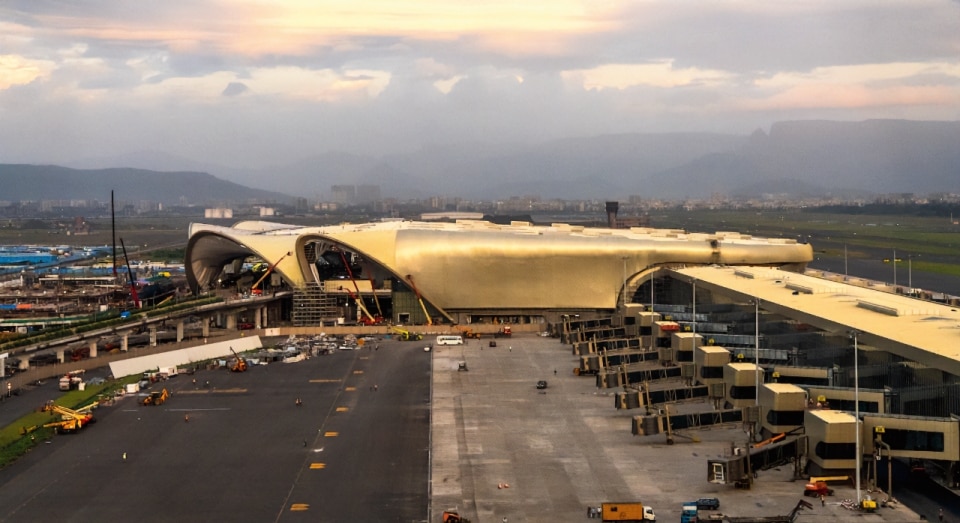
The volumes of Terminal 1 and the future Terminal 3 are oriented toward the main access axis, welcoming passengers into the complex central structure. This creates a sequence of spaces on the ground side, where the morphology of the airport is gradually revealed. The asymmetrical geometry of the area in front of Terminal 1 conveys a dynamic sense of discovery during the approach to the building. The structure seems to emerge from the ground, in harmony with the surrounding landscape, in a delicate balance between solidity and lightness.
Like a lotus opening to the light, Navi Mumbai's new airport welcomes passengers in fluid architecture, with terminals that unfold like petals and guide the journey through a harmonious path.

The continuous, undulating silhouette, recognizable at first glance, defines the facade and gives the building a language of elegant simplicity. As you ascend the ramps, the building opens to welcome visitors and offer them shelter. The forecourt serves as the main meeting point for both passengers and non-ticketed companions, who are not allowed inside the terminal.
The forecourt serves as the main meeting point for both passengers and non-ticketed companions, who are not allowed inside the terminal.
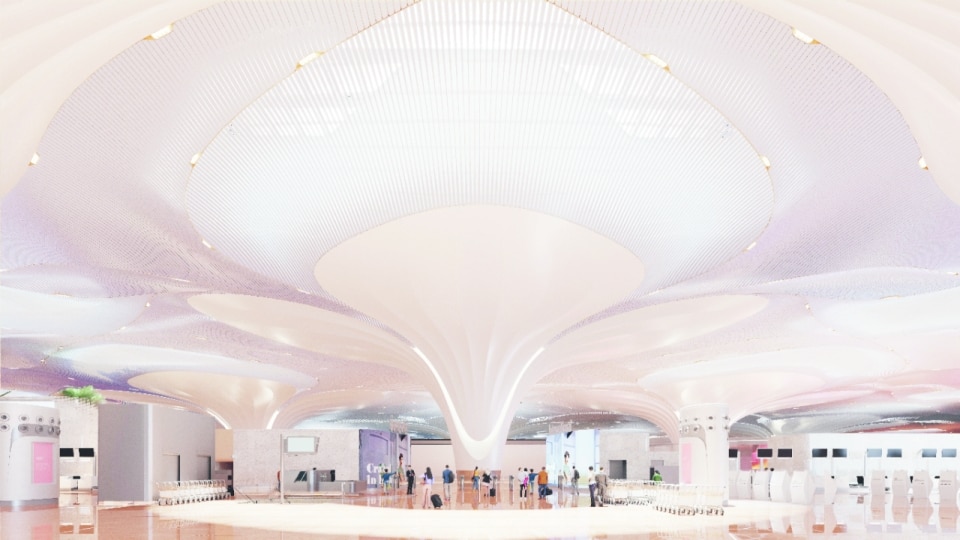
In the interior, sculptural columns reinterpret the overlapping petals of a flower in an architectural key. These structural elements are integrated with a system of skylights that rhythmically mark the path through the terminal, intuitively guiding passengers from the landside to the boarding areas.
Geometry, light and structure
Terminal 1 was designed with simplicity in mind. The building consists of only two contiguous main floors - departures and arrivals - with a minimum number of level changes. This ensures a compact and extremely efficient layout, minimizing travel distances.
.This linear configuration offers additional benefits: a simple and functional baggage system, and the ability to create an immersive experience for passengers. The design incorporates structural flexibility that makes it resilient. The focus is on the central body (Head House), visible from afar as a jewel set in the "crown" of the terminal.
The piers, in contrast, follow a simple modular design that enhances the central role of the Head House, which seems to float above them while maintaining a harmonious visual integration. The roof is supported by 12 columns inspired by the overlapping of lotus petals. The openings in these columns allow natural light to filter into the spaces below, accompanying the passengers' path and providing a sense of directionality and orientation.
The Bombay experience can be described as a state of mind: a way of life shaped by a rich history, multiple religions, a diverse population, and a frenetic and joyful pace of life.

Linear skylights along the ceiling diffuse light throughout the building.
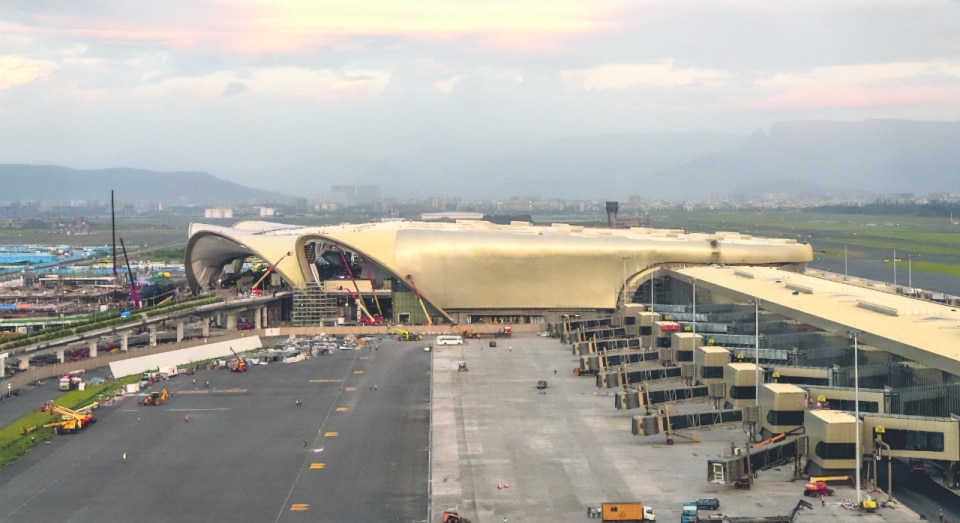
Like lotus petals, the breeze through the columns helps modulate natural light. Landside side, the building's roof ripples and bends to bring natural light into the terminal's access areas, while airside side a simple but recognizable silhouette welcomes arriving passengers.The glazed facade floods the departures lounge with natural light, offering expansive views of the flight area. The NMIA achieves its full physical expression through a careful choice of materials, textures and colors. The materials used for the roof cladding meet not only aesthetic requirements but also the climatic challenges of Mumbai, where eight months of dry, dusty weather alternate with four months of intense monsoon rains.
A sustainable airport
NMIA aims to be a model of low-carbon principles, going beyond international best practices. Energy efficiency and sustainability are at the heart of the project, which integrates concepts such as passive breathable roofs, active energy management systems, optimal use of space, careful selection of materials, and adaptation to local and seasonal climatic conditions. The goal is to make NMIA the leading Green Hub in India.
The success of the new Terminal 1 also depends on its ability to attract investment and foster the development of local businesses. The new central complex will offer a unique combination of ample available space, a world-class intermodal hub with sustainable connections to a vast domestic and international catchment area, and state-of-the-art aviation infrastructure that meets the highest environmental standards.
Cristiano Ceccato is a director at Zaha Hadid Architects, trained in architecture and computer science, specializing in parametric and computational design. He leads the studio’s aviation projects team.