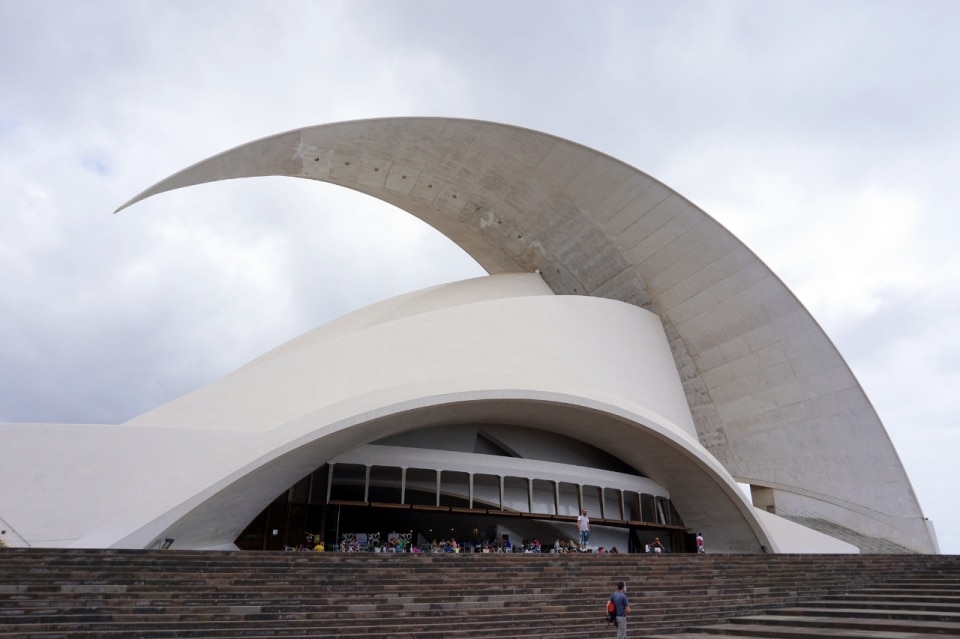

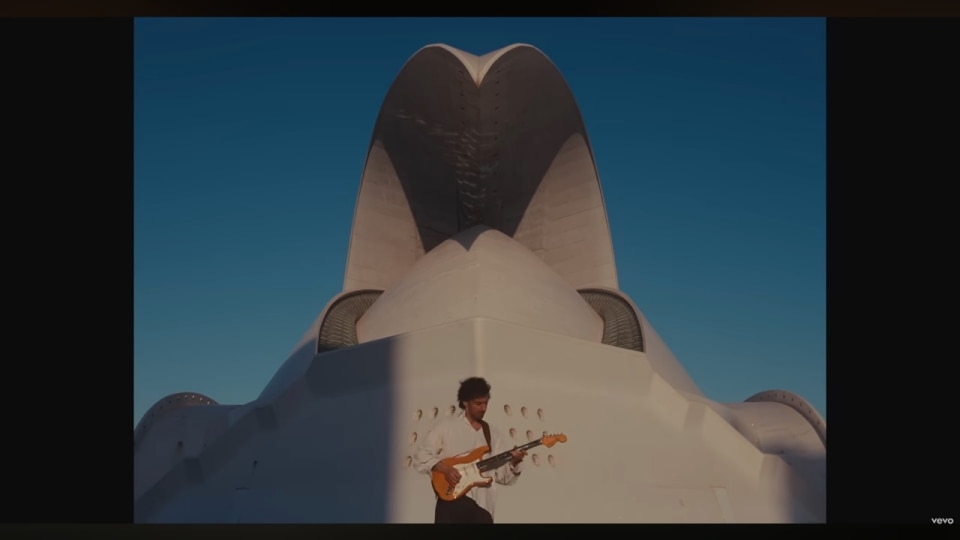
Six years on from The New Abnormal, The Strokes are back with the video for Going Shopping, a single from their upcoming album Reality Awaits, due for release on 24 July. Directed by Johann Rashid and featuring actor Walton Goggins, the video playfully reimagines the visual style of Paul Simon’s ‘You Can Call Me Al’. However, rather than the role-swapping and choreography, the real star of the show is the Adán Martín Auditorium in Tenerife, which was designed by Santiago Calatrava and opened in 2003.
Located in Santa Cruz de Tenerife, the building is one of Calatrava’s most recognisable projects and arguably the one that best condenses many of the recurring themes of his work: the use of white concrete as a plastic material, the centrality of structure, and a formal tension that transforms engineering complexity into an expressive and monumental language.
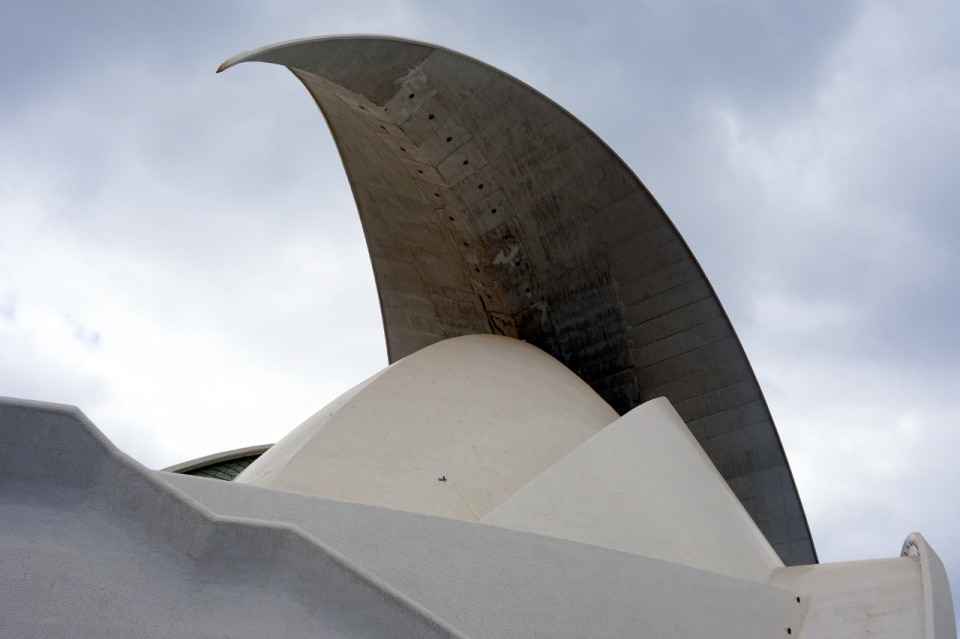
In the Strokes’ video, the auditorium is mainly captured through its exterior surfaces, where it is possible to identify the three architectural elements that define the entire structure: the Wing, the Shell, and the Sail. The Wing — the large cantilevered roof — is an aerial, curved blade-like structure inserted into the main volume, rising like a wave up to a height of 58 metres before tapering towards the entrance.
The body of the Symphony Hall emerges as a compact, curved volume, flanked by a series of secondary spaces — rehearsal rooms, exhibition areas, and a chamber music hall — arranged within a continuous basalt-clad base that covers the entire site. This plinth forms a public plaza that absorbs the level differences of the surrounding streets and functions as an open-air foyer. Inside, the concert hall, with approximately 1,600 seats, is defined by a vaulted geometry, with crystalline wooden paneling that contributes both to the acoustics and to the spatial experience.
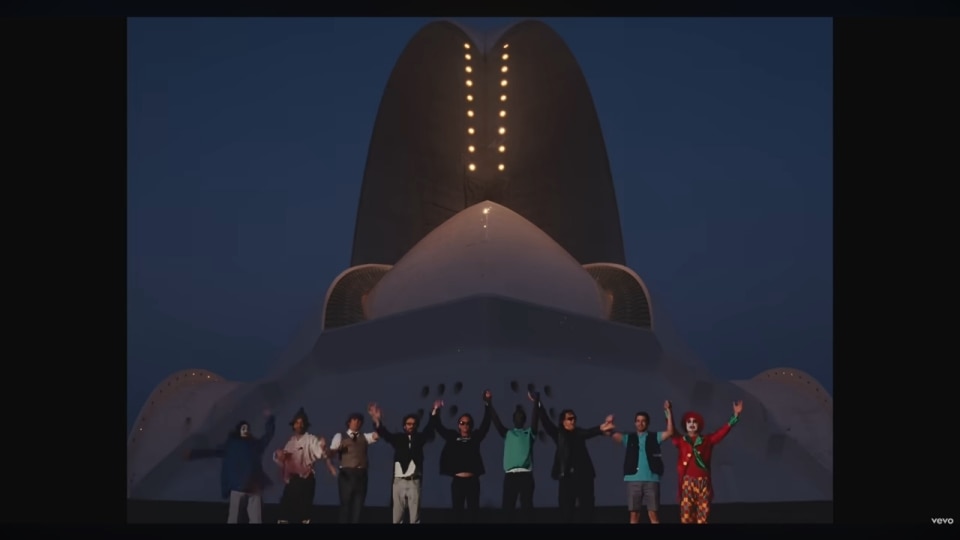
The entire complex is built in concrete, with a structural system combining a frame and prefabricated ribbed surfaces for the roof. Externally, the white cladding enhances the continuity of the curved surfaces and reflects the Atlantic light, reinforcing the sculptural character of the whole. The main entrances are designed as large curved glass-and-wood walls that can be opened fully, directly connecting foyer and public space while taking advantage of the island’s mild climate.
The choice of Tenerife and of the auditorium appears to be linked to a production contingency — Goggins was on the island for filming his next movie — but this pragmatic decision has resulted in a setting where the iconic architectural profile of the building defines the visual coordinates of a video that is both ironic and rigorous, balancing carefully crafted construction with, at least on the surface, a healthy dose of improvisation