

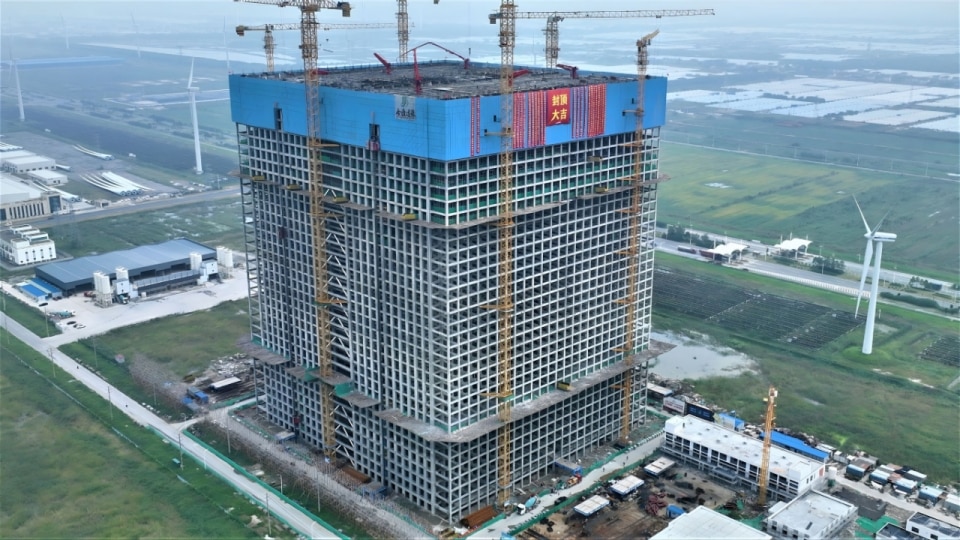
On the eastern coast of the Yellow Sea, in the city of Rudong north of Shanghai, the world’s first fully operational commercial gravitational energy storage system is about to come online. At first glance it resembles a brutalist residential tower: a dense concrete structure rising almost forty stories. In reality, it functions as a giant mechanical battery, designed to store electricity generated by renewable sources and release it back into the grid when demand rises.
Although similar projects are being explored in several countries, none has yet reached commercial operation. The technology provider Energy Vault, together with project partners Atlas Renewable Energy and China Tianying Inc., is now close to activating the plant. The system has already passed technical testing, has been connected to China’s electrical grid, and is awaiting the final regulatory approvals before entering service.
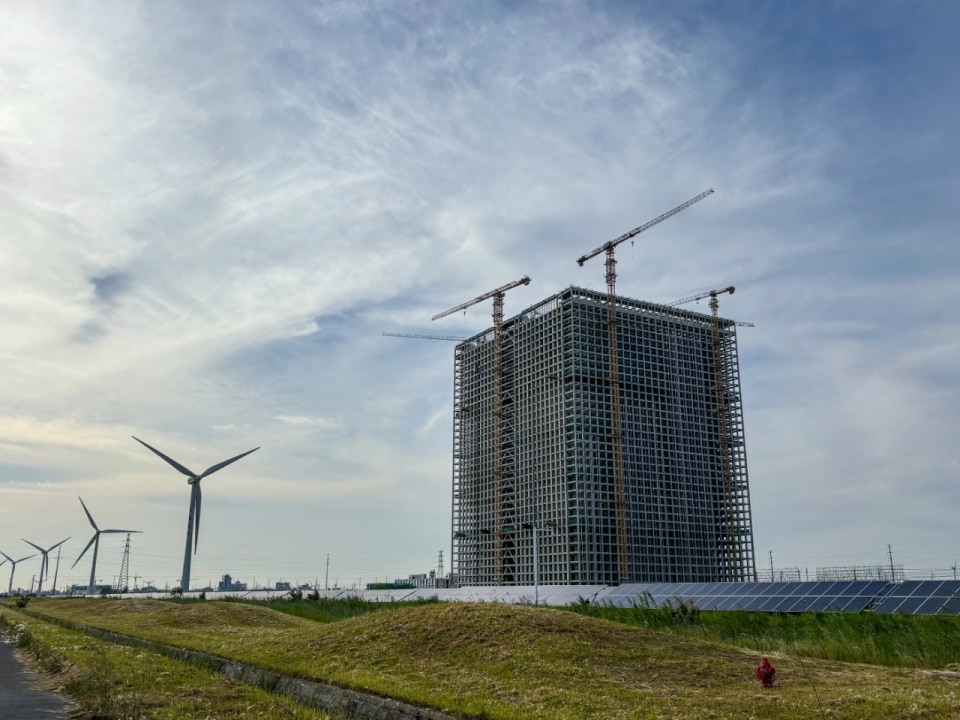
The technology behind the tower is called GESS (Gravitational Energy Storage System). Its principle is surprisingly simple: store electrical energy by converting it into gravitational potential energy — the energy contained in a mass positioned at a certain height. When renewable sources such as wind or solar produce more electricity than the grid requires, that surplus energy powers motors that lift heavy blocks upward. When demand increases, the weights are lowered in a controlled way. As they descend, generators convert the motion back into electricity that can be fed into the grid.
In Rudong, the structure stands 148 meters tall and occupies a footprint of roughly 120 by 110 meters. The system has a storage capacity of 100 MWh and can deliver up to 25 MW of power, providing about four hours of electricity at full output.
The EVx gravity storage technology
Energy Vault was among the first companies to invest in large-scale gravitational energy storage. Founded in 2017 by a group of Swiss researchers, the startup focuses on developing storage systems that can serve as alternatives to conventional electrochemical batteries. The technology deployed in Rudong is called EVx. At its core is a tower equipped with mechanical arms and cables that move composite blocks weighing about 35 tons along both vertical and horizontal paths inside the structure. The blocks are made from recycled materials — including waste concrete and industrial aggregates — and are stacked in an organized way inside the tower to maximize storage capacity while minimizing land use.
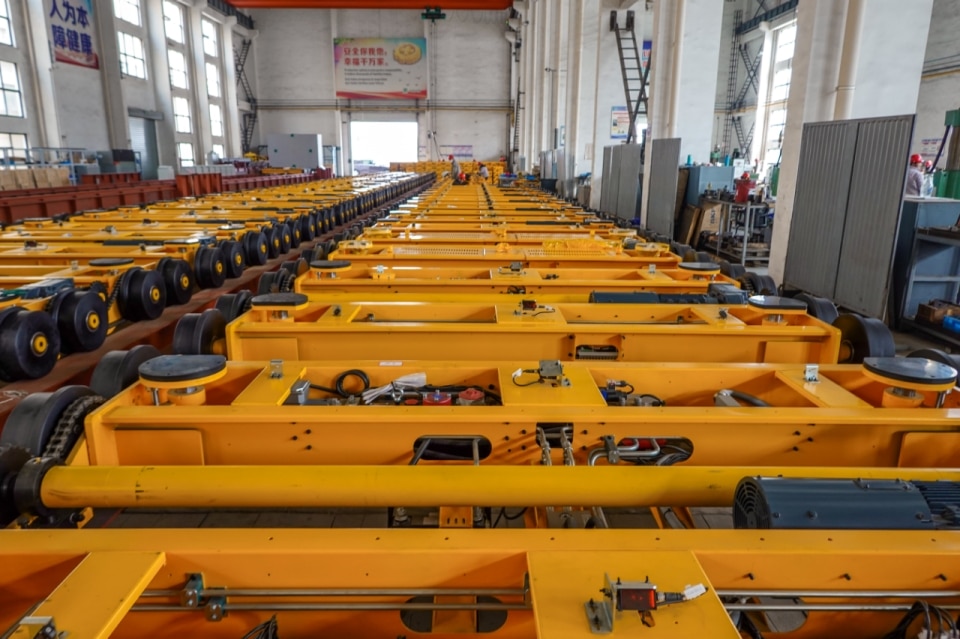
When the nearby wind farm generates excess electricity, that energy powers motors that lift the blocks toward the top of the structure. In doing so, the energy is stored as gravitational potential energy — effectively charging the battery by raising heavy masses. When the grid needs power, the blocks descend along rails inside the tower. The same motors then operate in reverse as generators, converting the motion back into electricity that can be supplied to the grid. The system reaches an efficiency of more than 80 percent and has an estimated lifespan of over 35 years, with relatively low maintenance costs and without relying on liquids or critical chemical materials.
Beyond the Chinese project, Energy Vault is developing similar facilities in the United States, including a plant in Snyder. The company has also expressed interest in a potential installation at the former coal mine of Nuraxi Figus Mine in Sardinia. If systems like these become widespread, the batteries of the future may look less like containers filled with lithium and more like architectural structures designed to store energy — infrastructures where engineering, landscape, and architecture converge into a new kind of energy landscape.
Opening image: Rudong, China Gravity Energy Storage System. Courtesy Energy Vault