


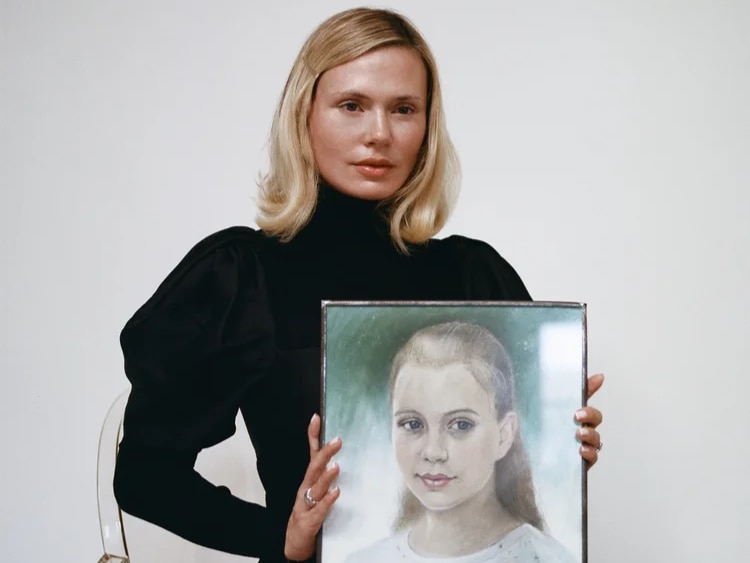
The collective shock of the art world has not yet fully subsided following the sudden news of the death of Hilde Lynn Helphenstein, who was found lifeless on May 31 in a hotel room in São Paulo. The circumstances of her passing are still under investigation, and Brazilian authorities have registered the case as a suspicious death. According to press reports, medications, an empty bottle of vodka, and broken glasses were found in the room.
With her Instagram profile boasting 145,000 followers, @JerryGogosian – a clearly ironic fusion of two of the most prominent and influential names in the contemporary art industry, critic Jerry Saltz and powerful gallerist Larry Gagosian – Helphenstein created a tool for social and cultural criticism. This instrument worked better than many other attempts at counter-narrative, which often remained trapped in niche projects and were difficult for a wider audience to access.
The social media project launched in 2018 quickly became a living observatory on the inner workings of a sector characterized by deep eliteness and a reiterated language locked within formulas that are no longer credible.

Through memes, satirical videos, and sharp jokes, Helphenstein made herself the spokesperson for a pop and horizontal language with which to desecrate and deconstruct the static nature and hypocrisy of an industry she knew very well. Two years working as a gallerist in Los Angeles allowed her to breathe the un-clear air of certain highly inaccessible environments, understanding the internal contradictions of a fragile system built on exclusivity and class differences. After two years, Helphenstein evidently already had a lot to say, and she opened the account while keeping her face and identity hidden.
The turning point came in 2020: from her profile, she published a story encouraging female employees at Gagosian in New York to report any sexual harassment experienced by Sam Orlofsky, then director and part of the gallery’s staff since 2001. The numerous responses led to the immediate firing of Orlofsky by Larry Gagosian, turning the case into a massive scandal. In the same year, Helphenstein’s face and identity were revealed, her audience grew, and new collaborations emerged – first and foremost with Sotheby’s, alongside the launch of the podcast “Art Smack” and, later, the newsletter “The Jerry Report”.
In the future art world, you will own nothing and be happy.
Hilde Lynn Helphenstein
In a very short time, Helphenstein became a reference point for those who often could not find the words, means, or resources to counter the insidious and sometimes manipulative logic of an often coercive system – ranging from unpaid internships to payments “in exposure” and other forms of exploitation.
However, @JerryGogosian was certainly not the first attempt to shed light on the rotten parts of the system. What worked better in her case? And above all, for whom? A young and diverse audience, made up of enthusiasts and students but especially sector professionals – artists, gallerists, curators, and collectors – found a strong, independent, and relevant voice in the boldness of Helphenstein’s digital language. It was a voice neither controlled nor influenced, free to bring controversies to light and point fingers at the “big shots” holding power in the field.
Her friendly approach toward the audience – “your BFF in the art world,” as she defined herself in her Instagram bio – was not a hollow, winking strategy, but rested on an authentic knowledge of the shared discomfort felt by an entire generation of cultural workers and a real interest in sabotaging it, at least on a media level.
We are constantly surrounded by news of market speculation, insurmountable class barriers, toxic work dynamics, and under-the-table deals among the usual chosen few. Seeing the art world reiterate mechanisms of privilege similar to those that already pollute the global socio-economic scene is deeply depressing, and it is precisely here that Helphenstein directed her energies.
She reminded us that art is politics and that the internet can be a powerful tool for aggregation, capable not just of describing the status quo but also, at times, of changing it. Her passing therefore goes far beyond the news columns and leaves a true void, depriving us of an irreplaceable voice, even if flanked by other valid projects. One thinks of @culturequota, which significantly defines itself as “Jerry Gogosian’s Little Sister,” or the contemporary @freeze_magazine dedicated to “homemade art memes for pretentious VIPs” which ironizes the name of the historic magazine Frieze.
Today we can state that the cynical, amused, light, and irreverent language characterizing social media “meme-criticism” projects has officially broken into our feed. It confirms that digital satire stopped being mere entertainment a long time ago and has become a political tool for counter-information in its own right.
Helphenstein exploited it to the fullest, and her parabola leaves us a disillusioned awareness of contemporary drifts, masterfully summarized in one of her most striking posts dated August 11, 2025: “In the future ART WORLD, you will own nothing and be happy.”
Featured image: Portrait of Hilde Lynn Helphenstein. Courtesy of Jerry Gogosian's official website