

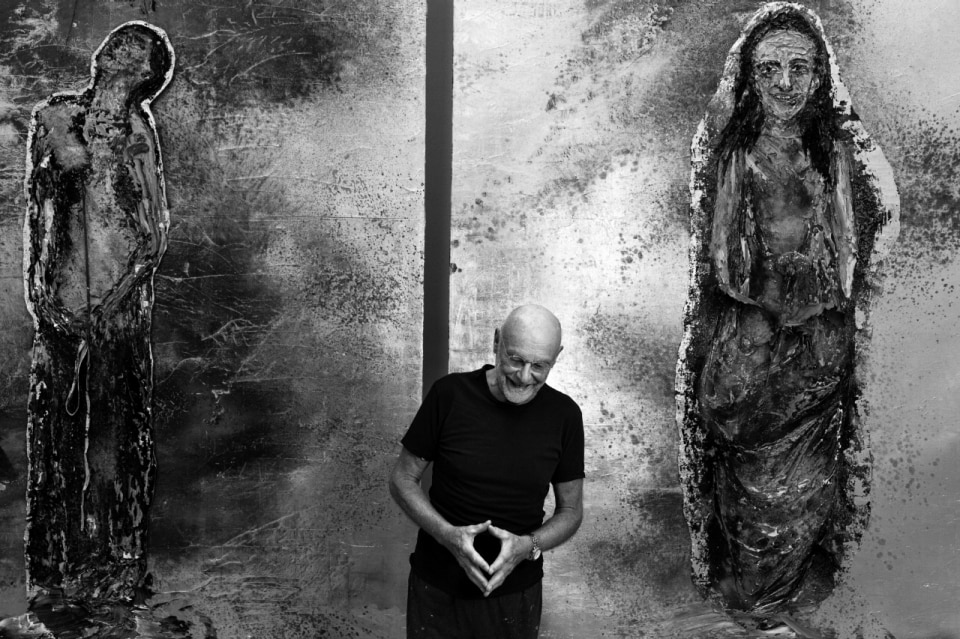
In the early 1970s, Joseph Beuys was a professor at the Kunstakademie Düsseldorf. Among his students was a young artist destined to become one of the most important figures of our time: Anselm Kiefer. Over the course of his long career — marked by a body of work spanning multiple languages, techniques, and themes — Kiefer has traversed the history of humanity, mining the past for tools to interpret the present and to connect individual stories with major collective events.
Today, this research reaches a new synthesis in the exhibition “Le Alchimiste”, installed in the Sala delle Cariatidi at Palazzo Reale in Milan: a space scarred by the bombings of the Second World War and never fully restored — the same hall where Pablo Picasso exhibited Guernica in 1953.
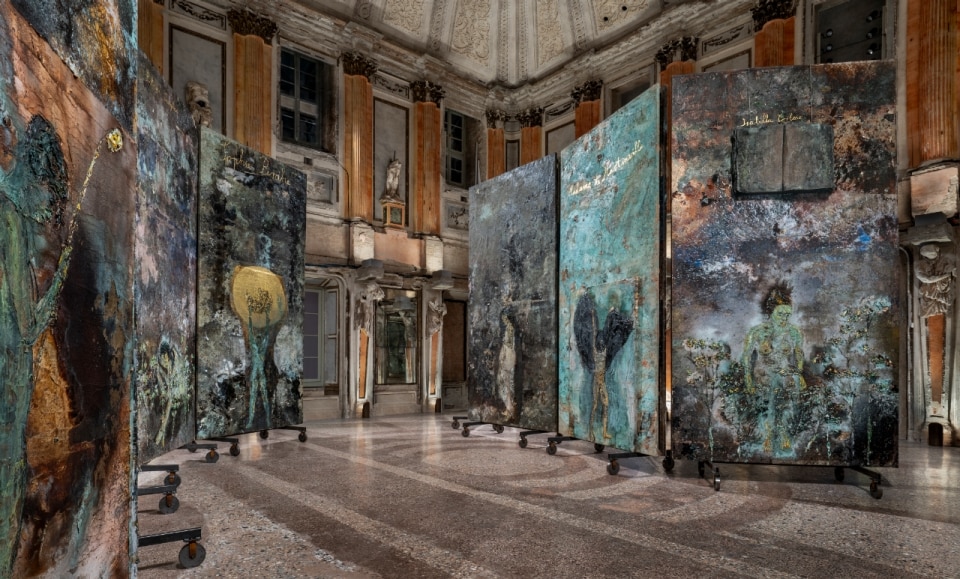
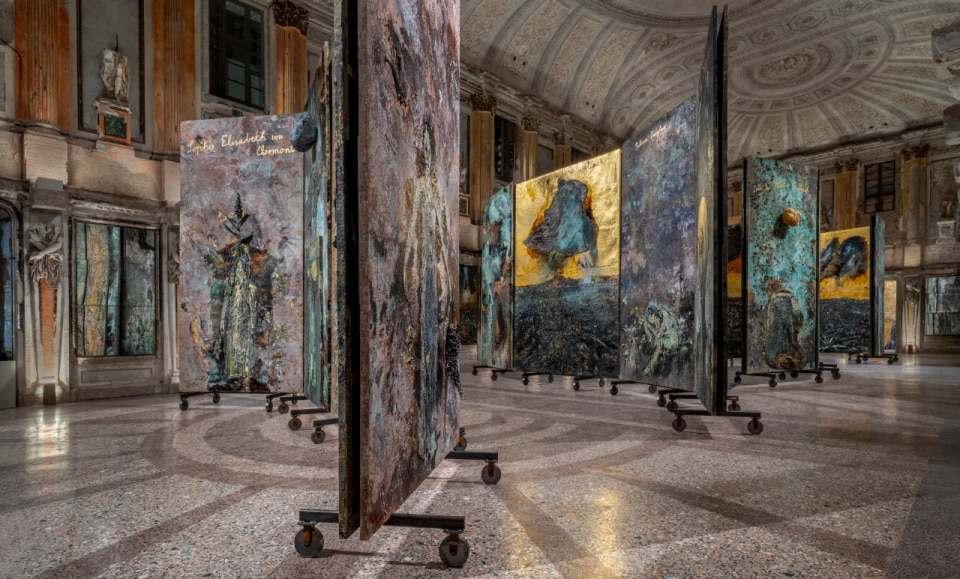
With Kiefer, the room is populated by twenty-four monumental canvases depicting women alchemists, scientists, and Renaissance thinkers. The figures emerge from dark, gilded surfaces made of organic materials, burnings, and oxidations, entering into dialogue with the bomb-damaged caryatids that brace the hall. The exhibition restores visibility to bodies of knowledge erased from the official narrative: Kiefer transforms ruin into a site of knowledge and resistance.
It marks the second time the great German painter has created a major installation in Milan — and an opportunity to retrace, from the beginning, the human and artistic journey of an author whose vision has redefined our relationship with spirituality and with reality.
From post-World War II Germany to the 1980 Venice Art Biennale
Anselm Kiefer was born on March 8, 1945, in Donaueschingen, a small German town in the southwestern part of the state of Baden-Württemberg, a few months before the end of World War II. The aftermath of the conflict and the scene of destruction in Germany, devastated by bombing and Nazism, had a profound impact on the artist's childhood.
In 1963, he had the opportunity to go to France on a scholarship, where he became interested in the works and history of Vincent van Gogh. Upon returning to Germany, he enrolled in the law faculty at the University of Freiburg, but soon decided to devote himself entirely to his artistic vocation. He began attending courses at the Academy of Fine Arts in Freiburg, where he was a student of Peter Dreher, who introduced him to a vision of art as a place of layered research that intersects different disciplines. His encounter with Joseph Beuys a few years later also helped to strengthen the individuality and emotionality of his work, especially in the recognition of the salvific value of artistic action.
As impossible as it is to define art, as much as it continually eludes our understanding, one thing is certain: the man I am is incapable of living without art. This is easy to say and yet it is an absolute dependence.
Anselm Kiefer
At the end of the 1960s, between 1968 and 1969, he began a series of actions he called Occupations (Besetzungen), in which he had himself photographed posing with his right arm raised, as if to imitate – albeit imperfectly – the Nazi salute, in front of a series of monuments and historical sites, not only in Germany but in various European countries.
The artist's body became a “lightning rod”, lifting the veil of silence and shame that had stifled discussion in Germany about the drama of its recent national history: parody, visual quotation, and the dismantling of National Socialist architecture and Germanic myths are cathartic tools through which Kiefer immerses himself in the identity and culture of his own nation, and by extension of humanity as a whole, to liberate it through consciousness. This impulse guides his work in the 1970s, which branches out into different techniques including painting, sculpture, photography, and the creation of various books, so much so that his first exhibition at the Galerie am Kaiserplatz in Karlsruhe is entitled Anselm Kiefer. Paintings and Books (Anselm Kiefer. Bilder un Bücher).
In 1976, he studied at the German Academy Villa Massimo in Rome and, in the same year, participated in documenta 6 in Kassel and also in the Paris Biennale. But it was in 1980 that Kiefer had the opportunity to engage with an international context when he was invited, together with Georg Baselitz, to represent the Federal Republic of Germany at the 39th Venice Biennale. The neo-expressionist painting of the two German artists, and Kiefer in particular, made a memorable and powerful impact. That occasion certainly contributed to the consolidation of his name, and in 1981 he exhibited overseas for the first time at the Marian Goodman Gallery in New York.
For Kiefer, the second to last decade of the 20th century was a time when his focus broadened from the subject to the material depth and visual construction of surfaces. He enriched his aesthetic language with various new materials, such as wood, straw, sand, and above all lead, which the artist recognized as a “material for ideas” and with which he also began to create books that were transformed into sculptures.
In 1984, he visited Jerusalem, and this trip provided him with an opportunity to explore Jewish culture and religion, with a particular interest in Kabbalah, in which he found a symbolic and mystical imagery that would unfold in the years to come.
In 1989 he participated in the landmark exhibition Magiciens de la Terre at the Centre Pompidou, curated by Jean-Hubert Martin, and at the end of the 1980s, Kiefer decided to leave Germany and move to France, beginning a new period in his life and artistic production.
The 1990s in France and the transition to the new millennium with the Seven Heavenly Palaces
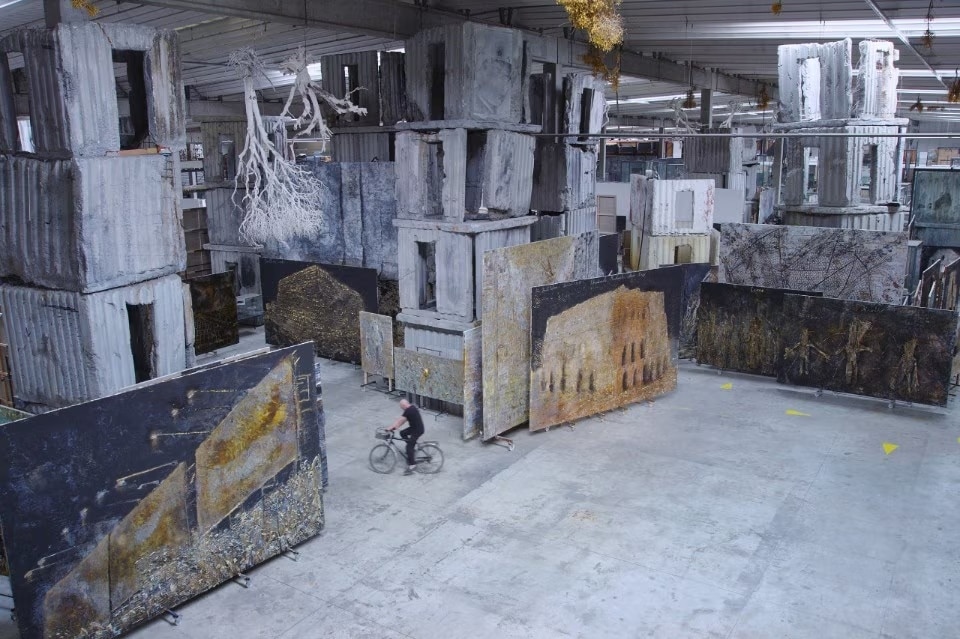
In 1992, Kiefer began rebuilding the La Ribaute site, a complex originally dedicated to silk production, located in Barjac, in the south of France, which the artist transformed into the creative epicenter of his activity until 2007, when he moved again, this time near Paris, to Croissy. This was another enormous space, where he built a new village in progress, offering him continuous new possibilities for expansion, so much so that in 2020, in a letter to the former guest editor of Domus, David Chipperfield, he wrote that he had thought of transporting the house where he had lived as a child with his parents, in a small village near the Rhine River, to that location.
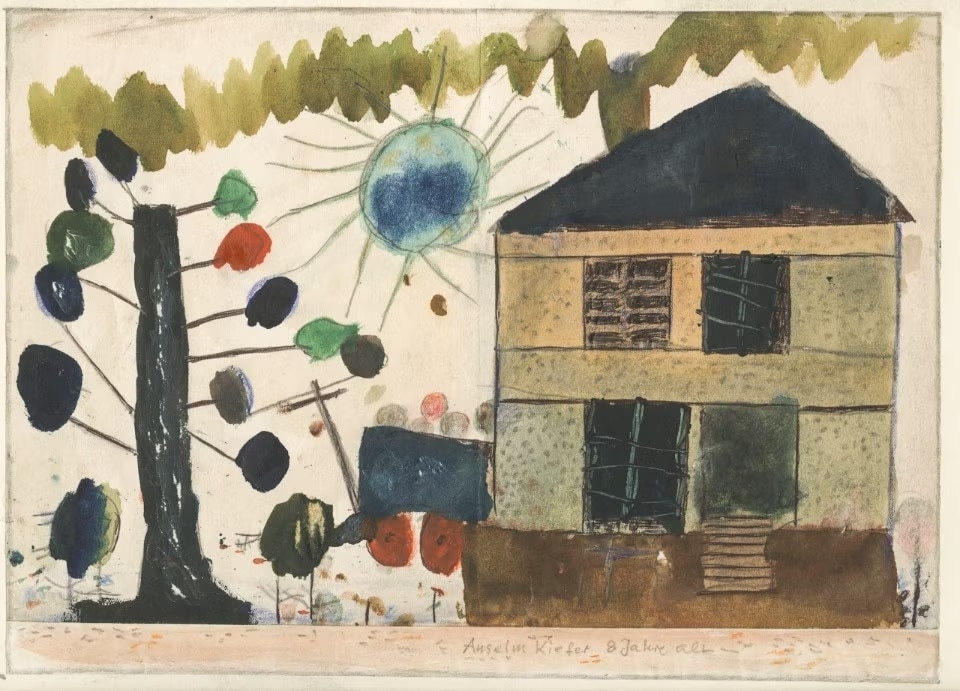
With the end of his long period in Germany, he devoted himself to the study of distant cultures and made a series of trips to the Far East, including India, Japan, China, and Thailand.
From the moment he moved to Barjac, new elements became part of his imagination: ancient architecture, such as pyramids and ziggurats, boundless desert landscapes, but also the link with cosmology, with romantic starry skies and the numbering of the cosmos. Some of his works from this period feature dedications and quotations from poets such as Paul Celan, but also, for example, the Renaissance philosopher Robert Fludd, whose all-encompassing vision of the universe combined scientific knowledge, Christian tradition, and Kabbalah, which resonate in Kiefer's thinking during that time.
The palette represents the image of the artist connecting heaven and earth. He works here, but he looks up there. He is always moving between the two realms. Artists are like shamans, who while meditating sit in a tree, remaining suspended between heaven and earth.
Anselm Kiefer
In 1997, he returned to the Venice Biennale, and with the start of the new millennium, Jewish mysticism became increasingly central to his work, focusing on texts of the Hekalot genre, which means “palaces,” which Kabbalah experts read as representing an ascetic and ascendant journey of the soul consisting of seven stages.
Between 2003 and 2004, in Barjac, he created his first monumental structures in reinforced concrete, consisting of modules assembled to form constructions soaring towards the sky with a precarious and claudicating appearance, which can also be recognized in a set designed in 2003 for the Teatro San Carlo in Naples, for the staging of Richard Strauss's Elektra.
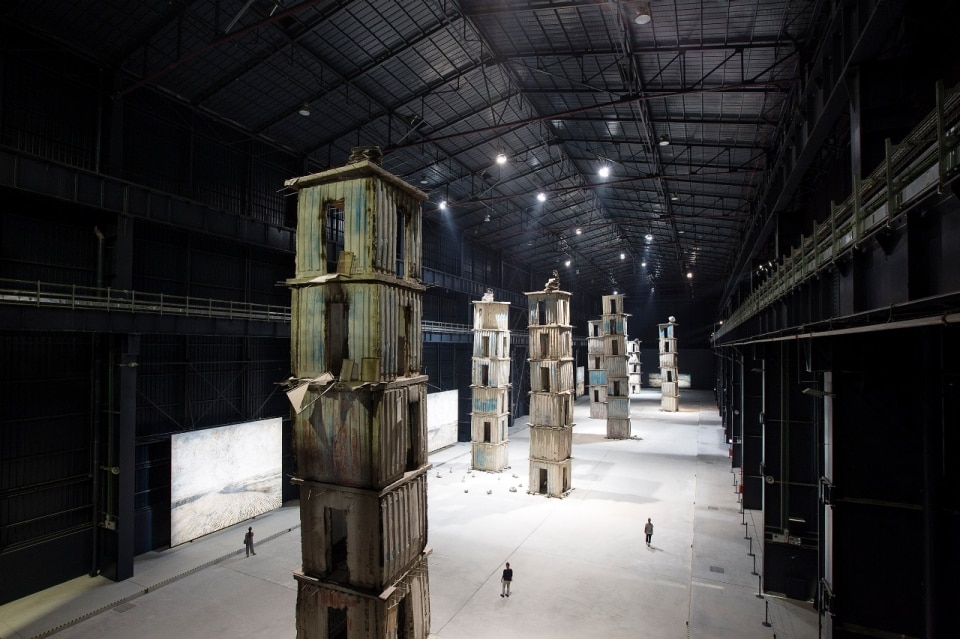
In 2004, one of the German artist's best-known permanent installations was created in a private institution: The Seven Heavenly Palaces is built with the collaboration of gallery owner Lia Rumma in the main aisle of the Pirelli HangarBicocca complex in Milan. Seven towers filled with references to historical, literary and philosophical iconographic elements that are also scattered throughout Anselm Kiefer's work.
In 2007, a series of prestigious exhibitions celebrating the German master took place: from the exhibition at the Grand Palais in Paris to the towers in the garden of the Royal Academy of Arts in London, to the permanent installation created for the Musée du Louvre. Having moved to the Paris area in 2008, Kiefer was the first artist to be appointed to the Chair of Artistic Creation at the Collège de France in 2010.
Wim Wenders' auteur portrait and projects in Italy in recent years, up to Le Alchimiste
Viewing Anselm Kiefer's works in person is a deeply moving experience for the viewer, and it is even more extraordinary to be able to observe the master's creative process. Anselm Kiefer's universe is recounted in a poetic and attentive manner in one of Wim Wenders' latest works, Anselm, presented during the 76th edition of the Cannes Film Festival. From Barjac to Paris to the house in Rastatt where he grew up in the Odenwald, to the exhibition in Venice in 2022. Wim Wenders shows a previously unseen portrait of Kiefer, retracing some moments of his life and, above all, allowing fans to get closer to his artistic process and the moment of creation, highlighting Kiefer's language, deeply immersed in matter and meaning.
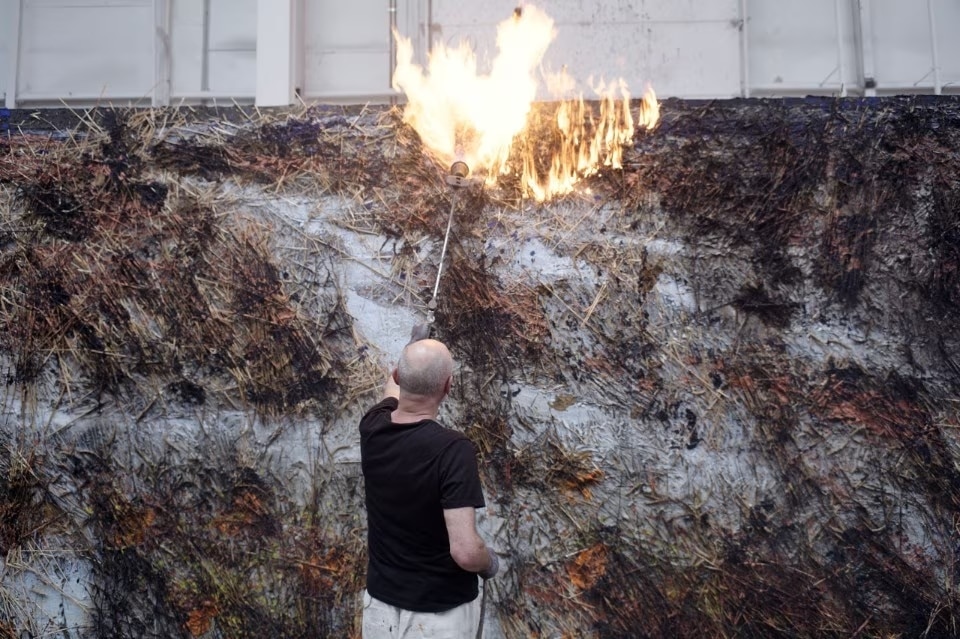
At the same time, over the last ten years, Anselm Kiefer has been involved in several major projects around the world, such as the exhibition at the Musée Rodin in Paris dedicated to the relationship between the two artists. But it is above all in Italy that the German artist has found fertile ground for some major projects: from the 2022 exhibition at the Doge's Palace in Venice, with works inspired by the philosopher and man of letters Andrea Emo, to the exhibition inaugurated in the spring of 2024 at Palazzo Strozzi in Florence, to the major exhibition at Palazzo Reale, inaugurated to coincide with the opening of the Milan-Cortina 2026 Winter Olympic Games.
Here, forty-two monumental, free-standing canvases, conceived as a single environmental work, pay tribute to the alchemists, women who made a decisive contribution to the birth of modern science. Among them is Caterina Sforza, a central figure also for her connection with Milan, a protagonist of concrete and experimental scientific practice, documented by a rare manuscript containing recipes for medicines and alchemical procedures.
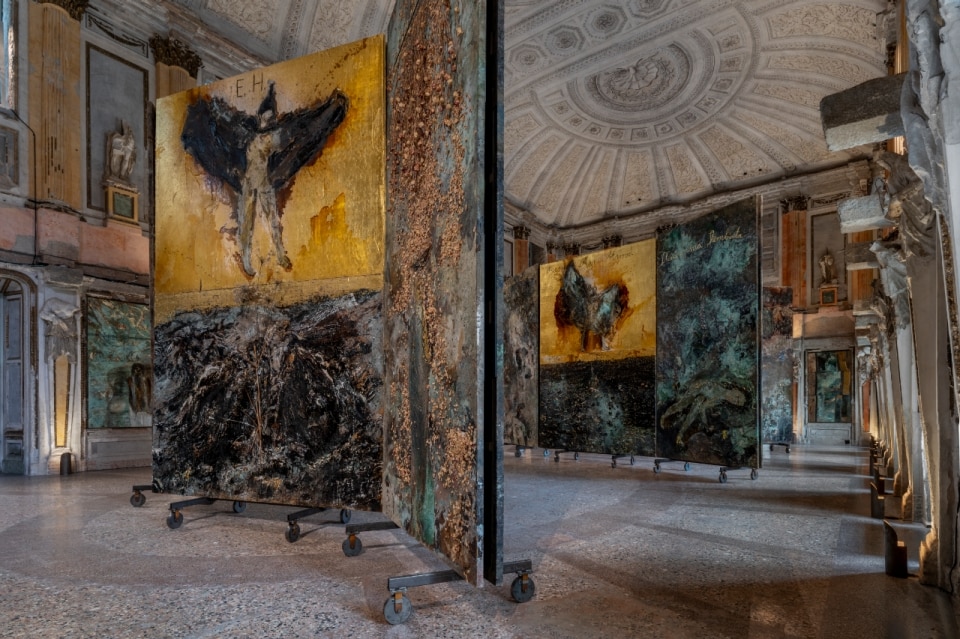
In this cycle, conceived as a single, deeply symbolic work, Kiefer summarizes the core themes of his research – myth, history, collective memory, healing, destruction, and rebirth – reaffirming painting as a process of transformation capable of bringing attention back to what has long been removed.
Opening image: Portrait of Anselm Kiefer, Paolo Pellegrin, 2025
- Exhibition:
- Le Alchimiste
- Curated by:
- Gabriella Belli
- Where:
- Sala delle Cariatidi, Palazzo Reale, Milan
- Dates:
- February 7 – September 27, 2026