

He would become one of the most influential artists of the second half of the twentieth century, but Gerhard Richter did not yet know it when an issue of an Italian magazine founded in 1928 by Gio Ponti passed through his hands.
Born in Dresden in 1932 and trained between East and West Germany, Richter experimented with informal painting during his years at the Düsseldorf Academy, working within a gestural and abstract language that did not yet offer a clear direction. The turning point came in an unexpected, everyday way: a photograph of a table on a page of Domus.
The photograph of Tisch comes from, I believe, an Italian design magazine called Domus. I began to paint it, but I was not satisfied with the result, so I erased it with newsprint.
Comments on Some Works, 1991, in Gerhard Richter: Text. Writings, Interviews and Letters 1961-2007, Thames & Hudson, London, 2009, p. 259
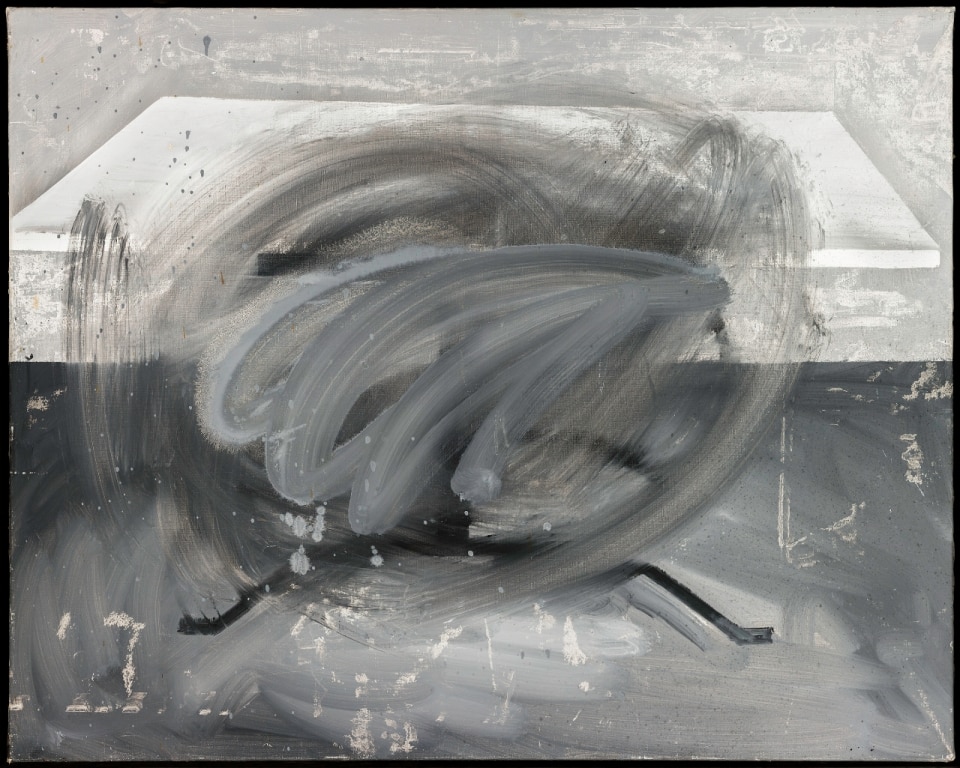
The painting, titled Tisch (Table, 1962), is horizontal in format and depicts a design table with a white top and dark legs. The background is divided into two chromatic fields: a light gray in the upper section and a darker gray below.
At the center of the canvas, however, the image of the table begins to lose sharpness. The surface is marked by circular movements made with paint thinner, interrupting the legibility of the object.
In Tisch, several constants of Richter’s practice already emerge. The image remains recognizable, yet it is subjected to a process of erasure carried out by the artist himself, compromising its clarity. Figuration persists, but in a destabilized form, beginning to lose definition. This unstable balance anticipates both Richter’s later photo-paintings and his gradual move toward abstraction.
You can still see traces of the newspaper where it adhered to the canvas while the paint was still wet. But I liked the painting even less and decided to cover it with paint.
Comments on some works, 1991, in Gerhard Richter: Text. Writings, Interviews and Letters 1961-2007, Thames & Hudson, London, 2009, p. 259
“The photograph of Tisch (Table, 1962) comes from, I think, an Italian design magazine called Domus. I began to paint it, but I was not satisfied and erased it with newsprint. Traces of the newspaper are still visible where it adhered to the canvas while the paint was still wet. I liked the painting even less and decided to cover it with paint. Suddenly it took on a new appearance that I liked, and I felt that I should not touch it again, although I am not entirely sure why,” Richter would later explain.
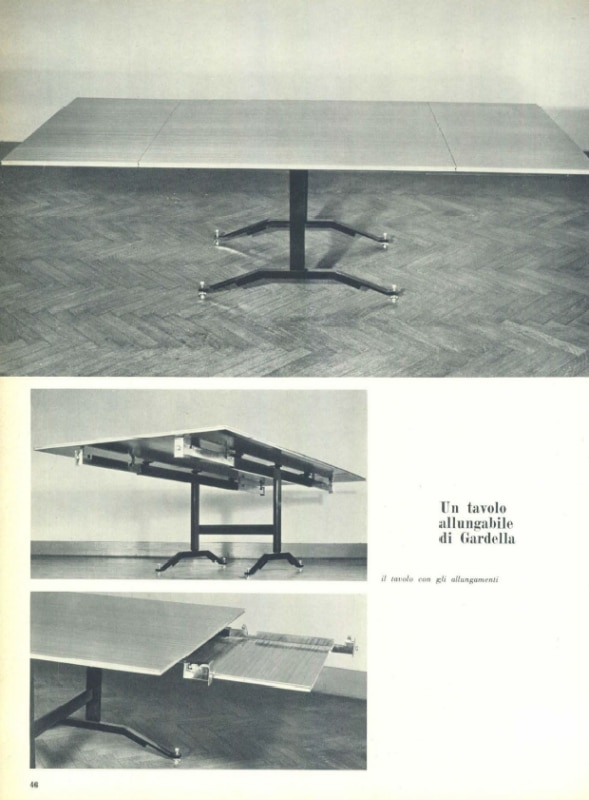
As the dedicated entry on the artist’s website archive notes, the work can be juxtaposed with Folding Clothesline (1962), made in the same year. The two works share the choice of an everyday object elevated to the status of subject, as well as the photographic origin of their compositions. In both cases, Richter works with found images—sourced from advertising or other materials he began to encounter after his arrival in West Germany—in stark contrast to the visual culture of East Germany that he had recently left behind. While the clothesline refers to an accessible, ordinary object, the table in Tisch is a piece of Italian design, designed by Ignazio Gardella and published in Domus in three different views.
Of these three images, Richter chose the one that shows only the tabletop, disregarding the more elaborate design of the base.
Suddenly it took on a new appearance that I liked, and I felt that I should not touch it again, although I am not entirely sure why.
Comments on some works, 1991, in Gerhard Richter: Text. Writings, Interviews and Letters 1961-2007, Thames & Hudson, London, 2009, p. 259
Although it was not the first work he made in 1962, Tisch would be chosen by Richter as the official starting point of his painting. “I wanted to start afresh after my time in East Germany and after the many paintings I had already made in the West,” he would explain.
A choice later confirmed when the work was placed at the opening of the catalogue raisonné: “Inaugurating the catalogue with Tisch meant drawing a line under my previous production.”
Today, the work is also the starting point of the big retrospective icurrently being held at the Fondation Louis Vuitton in Paris (October 17, 2025 - March 2, 2026), where it is presented as the first conscious gesture of a painting that, for decades, has questioned the relationship between image and reality, bequeathing to subsequent generations of artists some of the key questions of representation, which remain open to this day.
Opening image: Gerhard Richter, Tisch [Table], 1962 (CR 1) Oil on canvas, 90 × 113 cm Private collection © Gerhard Richter 2025 (18102025) Photo © Jennifer Bornstein