

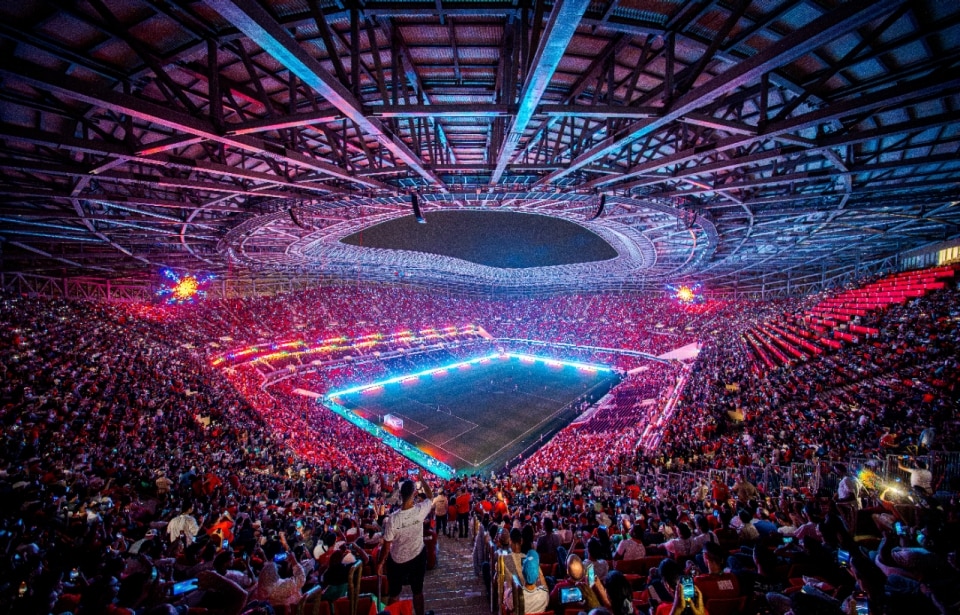
Inaugurated just months before the 2026 Africa Cup of Nations final between hosts Morocco and the formidable Senegal, the new Prince Moulay Abdellah Stadium in Rabat is perhaps one of the most visible components of the urban and infrastructural transformation that Morocco has been undergoing — or striving for — in recent years. The project is by Populous, the international studio specializing in sports and entertainment architecture whose portfolio includes some of the most important stadiums in the UK and worldwide, from Wembley to Arsenal’s Emirates Stadium to Sydney’s Olympic Stadium.
Domus spoke with François Clément, Senior Principal at Populous EMEA, about the new Rabat venue, its parametric façade, and its references to Moroccan tradition.
Sports infrastructure and national ambitions
Morocco’s decision to entrust Populous with the design of its new international stadium comes during a phase of significant public investment, further accelerated by the prospect of hosting the 2030 World Cup.
Rabat, specifically, is experiencing a wave of major developments and heritage upgrades, from its “museum district” — home to five institutions including the renowned Villa des Arts — to the Bouregreg Valley expansion plan, which spans a 6,000-hectare area and includes the construction of a bridge over the river that separates Rabat to the north from the adjacent city of Salé.
In this context, a stadium capable of attracting visitors, filling its seats, and generating value takes on a crucial role “in reflecting and demonstrating national momentum,” Clément explains. This is why the new Prince Moulay Abdellah aims to avoid becoming yet another “cathedral in the desert”: it is conceived as an infrastructure serving both daily life and international events. Its location within the city lies in an area dedicated to sports facilities, south of Rabat, adjacent to a largely residential district. Thanks in part to the monumental presence that an international firm like Populous brings, the project seems intended — at least in spirit — to “activate” a part of the city detached from its center.
The stadium: acoustics, fans, and an “African Kop”
The venue has a capacity of 68,700 seats — not among the world’s largest, considering Wembley’s 90,000 or Johannesburg’s more than 94,000, yet still competitive at the international level, and a significant number for Africa.
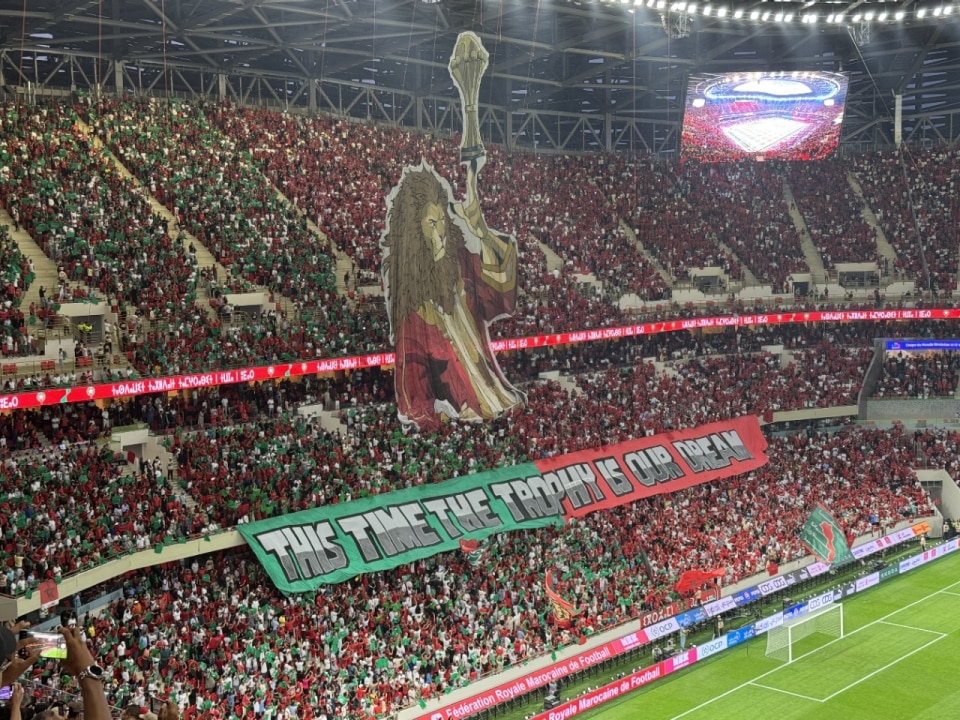
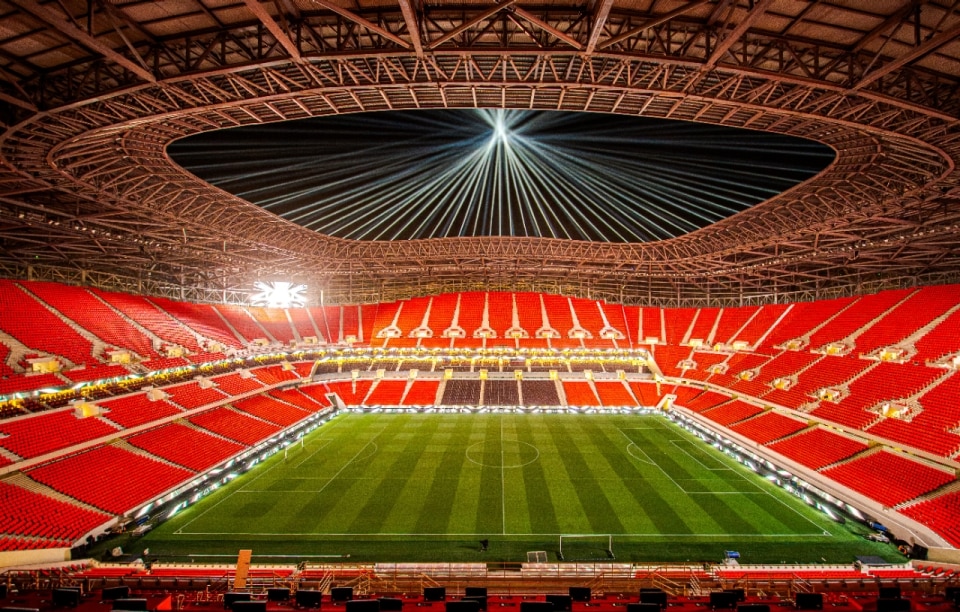
At the heart of the project is the bowl, designed to turn visitors’ emotion into an integral part of the experience. “Part of the design involved acoustic modelling and amplifying the passion of the fans — and there are no fans more passionate than the Moroccans,” Clément tells Domus. One of the project’s most distinctive features is the 23,000-seat south stand, the so-called “Kop.” The name is famously associated with Liverpool’s supporters’ stand, though few know that “Spion Kop” originally referred to a South African hill where the Boers dealt a heavy defeat to the British army — a term later adopted across global football culture.
Populous reinterprets it here with a very steep two-tier structure, the upper level suspended to create a sense of a “direct overlook” onto the goal, bringing fans closer to the pitch thanks to an eight-meter cantilever between the lower and upper tiers. In this way, the two-tier South Kop acts as a giant “loudspeaker,” producing a deliberately powerful acoustic effect.
A façade inspired by Morocco
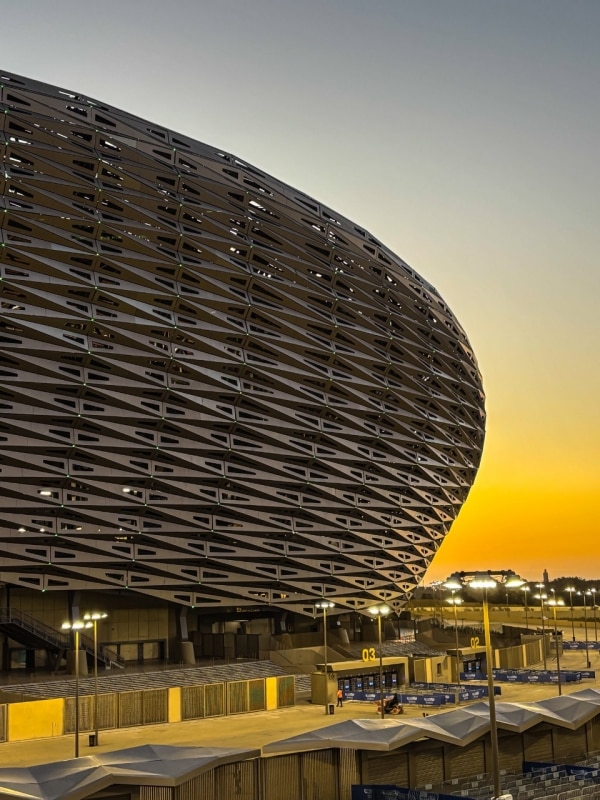
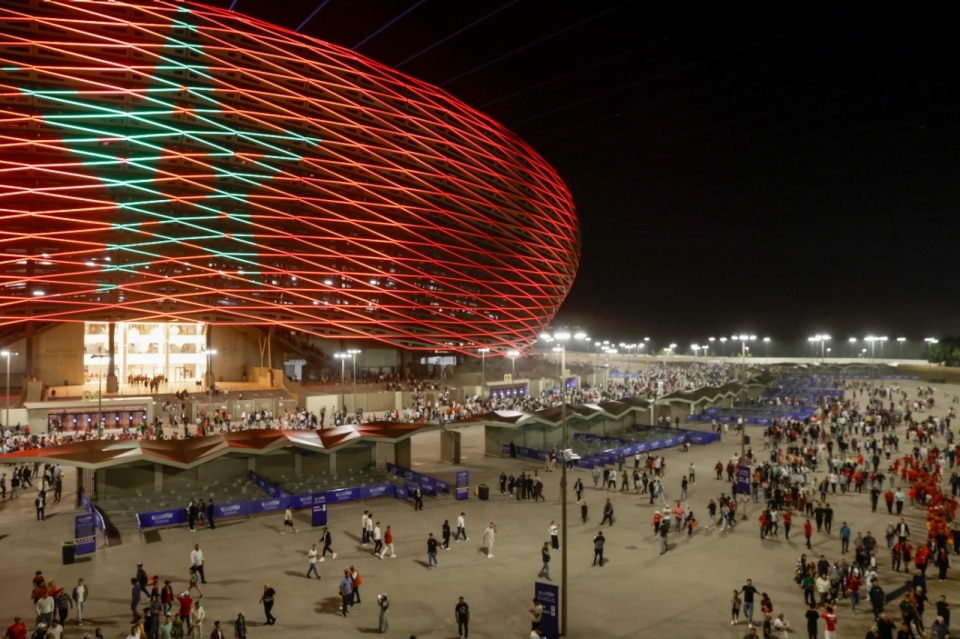
If the interior focuses on the intensity of the crowd, the exterior seeks strong visual identity — for the project, for Populous, and for the place it was built for. “We used parametric design to create an external façade pattern inspired by the woven palm leaves lining Rabat’s major boulevards, but also by traditional Moroccan craftsmanship, such as the ‘Point de Fez’ embroidery,” says Clément, describing Populous’s intention to digitally reinterpret traditional Moroccan motifs.
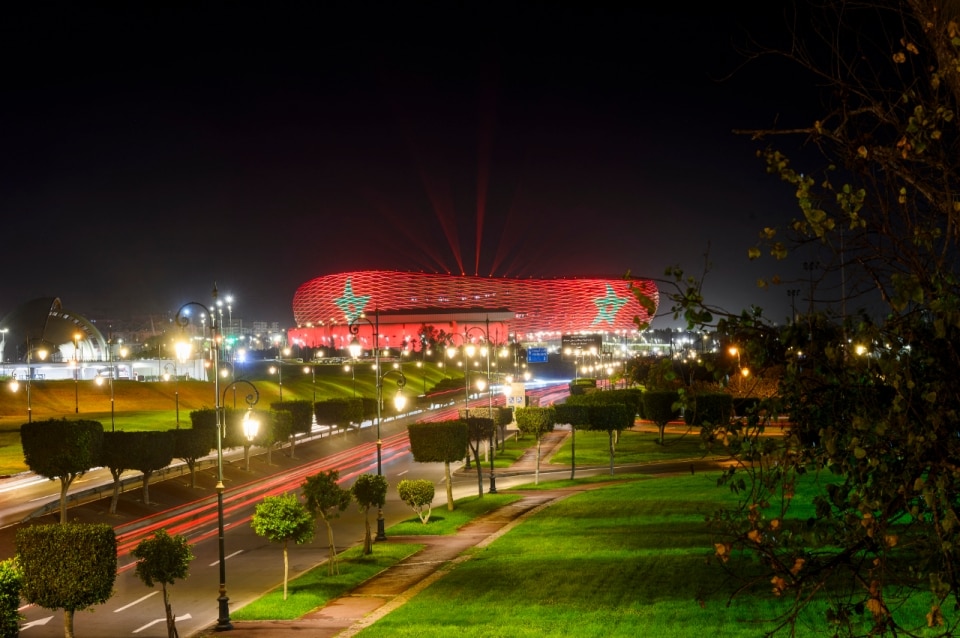
The façade is thus the project’s most symbolic element, and at night the surface lights up thanks to integrated LED pixels, turning into a three-dimensional screen, with lighting design by Lamalif Group. Using a system similar to that of Las Vegas’s remarkable Sphere — the world’s largest spherical structure, also designed by Populous — Clément explains that “these aren’t simple projections onto a surface: the surface itself is programmed and illuminated pixel by pixel, turning the stadium into a monumental 3D screen of its own.”
An architectural node for the future
Built in just two years, the Prince Moulay Abdellah Stadium sits at the center of a pivotal moment for Morocco, which is betting on infrastructure development and, consequently, economic growth. It is part of a national plan that includes the renovation or construction of major stadiums in cities such as Casablanca, Tangier, Marrakech, Fez, and Al Hoceima.
Moreover, the African Development Bank recently approved a €270-million loan to expand and modernize Morocco’s airport network — an initiative in which the 2030 World Cup clearly played a major role.
What remains to be seen is whether these new constructions, alongside the renovation of the nation’s architecture and infrastructure, will truly help Morocco meet its ambitions — and whether culture itself will play a significant role in this positive wave. Meanwhile, one question still lingers: whatever happened to the Grand Théâtre by Zaha Hadid Architects?
Opening image: Credit Lamalif & Populous