

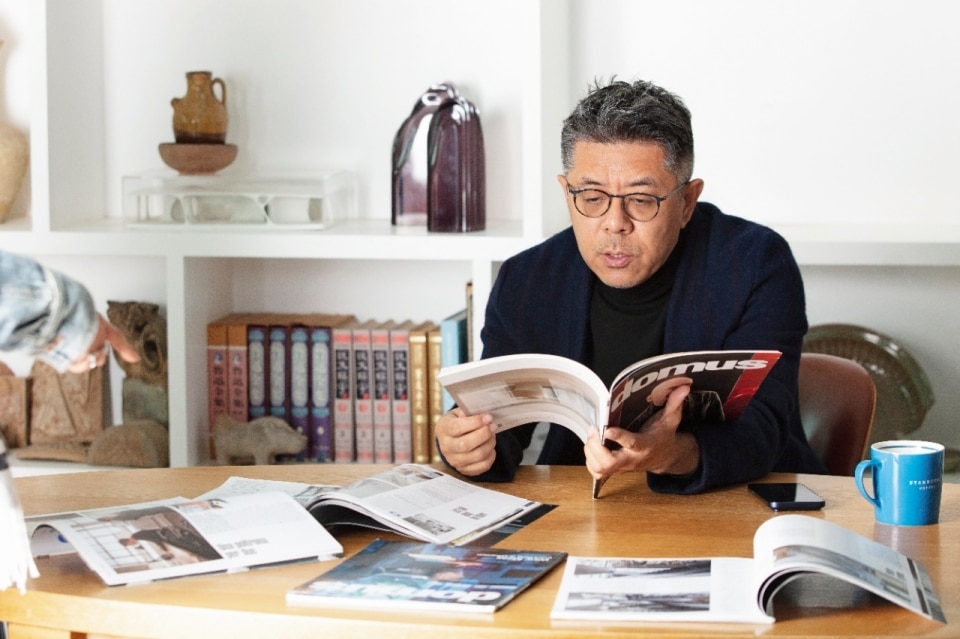
The founder of MAD, Ma Yansong (Beijing, 1975), is one of the most influential members of the new generation of global architects. He is also the first Chinese person to have built an iconic complex abroad, the Absolute Towers in Mississauga, Canada.
His vision is rooted in organicity and the need to establish a new relationship with nature, leading to a future where there is balance between society, city and environment. His original and contemporary interpretation of the Eastern sensibility for nature makes his approach countercurrent to Western modernity’s efficient square boxes. Ma Yansong attempts to melt the confines between the human-made and the non-anthropic to create settings that reflect the surrounding nature, and by consequence the spirit and soul of people.
Shan shui (literally “mountain” and “water”) is a traditional type of Chinese landscape painting with multiple levels of interpretation. Shanshui City (2015) is a book by Ma Yansong about his design philosophy, which is not only aesthetic but also conceptual. He wishes to promote the emotionally harmonious relationship between people and nature, which is typical of ancient Chinese culture, in the modern urban context.
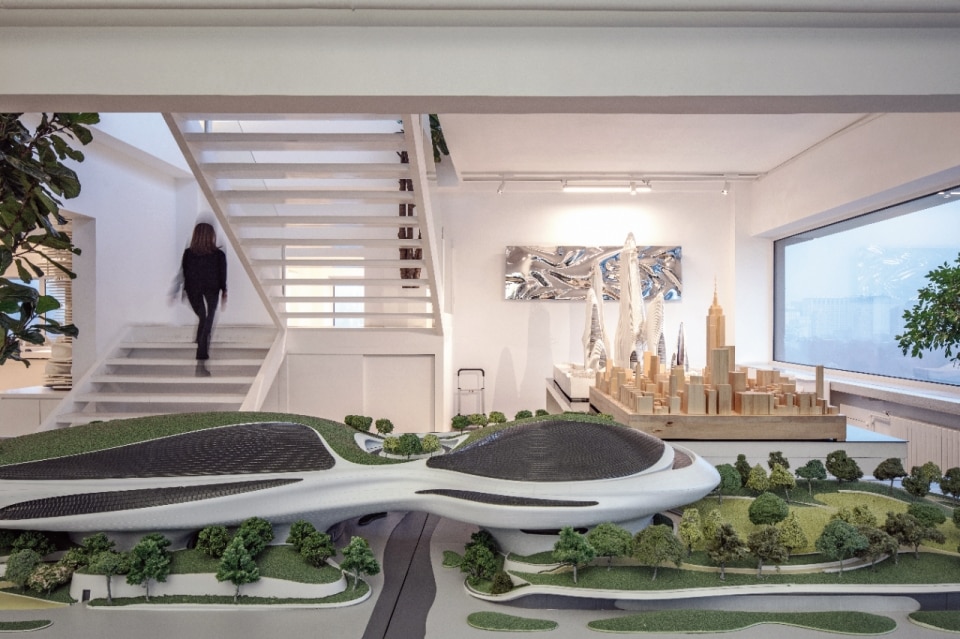
Many of his projects – including the Harbin Opera House in China, which fuses with the surrounding wetlands, and the Absolute Towers with their sinuous, fluid shapes – are reminiscent of mountains, waterfalls or corrugated tree-trunks, making them complex organic geometric structures. Ma’s conviction is that architecture should be less focused on capitalism, authority and technology and more focused on sentiment and human emotions.
Architecture should be centred on life, on being a cultural bridge that leads to hope and optimism. Therefore, its future should be based on open and free culture, not the narrow logics of the profession.
Ma Yansong
His thinking is substantialised in three offices (Beijing, Los Angeles and Rome), where it takes on the large scale of the megalopolis with the ambition to create public reference points like the recent Shenzhen Bay Culture Park and the soon-to-be inaugurated Lucas Museum of Narrative Art in Los Angeles. Their sculptural and visionary forms aim to become an integral part of the landscape and the human experience.
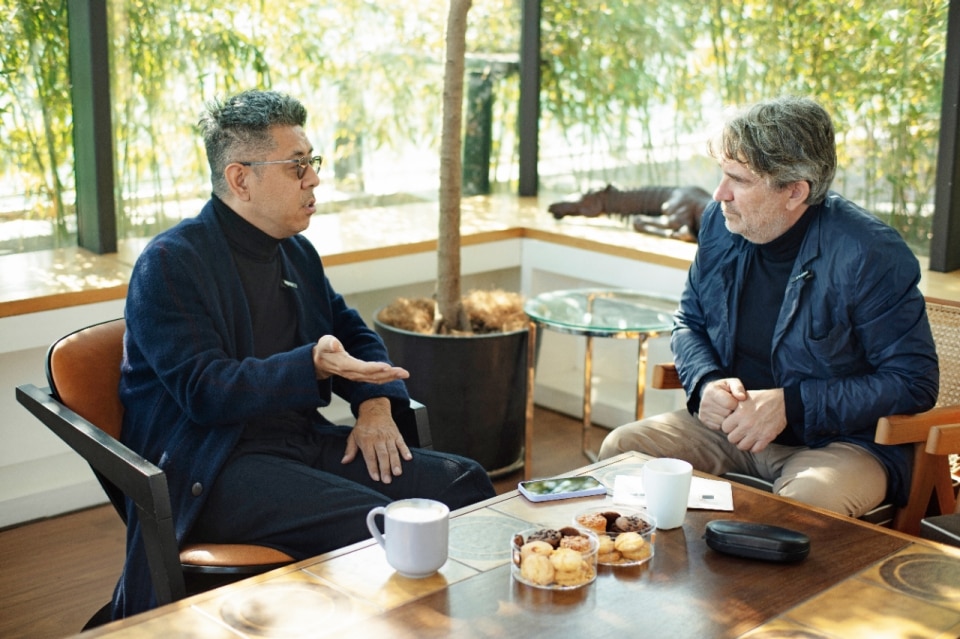
What made you accept the invitation to be the 2026 guest editor of Domus magazine?
Ever since I saw other big architects taking part in this initiative, I have aspired to participate. I’d like to share my vision with colleagues from around the world. I accepted because I feel an oncoming crisis of architectural practice and want to use Domus to express some ideas and discuss the state of our profession.
You are the youngest and the first Chinese guest editor. Bjarke Ingels was very happy when he heard we had invited you. How do you summarise your research into the relationship between nature and culture?
Before I became an architect, I wanted to be a movie director. I have always been attracted to imaginary and visionary stories. The conceptual aspect and the vision are key, in my case, even more important than construction. Growing up in Beijing, I was influenced by the ancient part of the city and by the mountains and lakes. I imagine a future that does not disavow memories from the past, such as the happiness of playing in a garden. I want to find a way to communicate with nature in the future designs of large-scale modern constructions.
You work in Asia, the United States and Europe. You have offices in those three continents. What is the relationship between the different studios and the work they do?
Everything began in 2005 when we won the competition for the Absolute Towers. It was a turning point because no China-based architect had ever worked that way in the West before. It showed MAD’s interest in a global cultural exchange.
My aim was to bring a new concept to these places. I asked myself what the contribution of young Chinese architects who had studied and learned so much from Western architecture could be. It would make the exchange between East and West a two-way road.
Intellectually, where do you place yourself compared to your guest-editor predecessors? Is architecture a political tool or a means to express one’s personality and values?
I seek change and new values. I am worried that the younger generations are losing interest in architecture. It might be because the profession is too conservative, too limited by its traditional definition. Young people feel they don’t have the power to change society.
I am looking for new definitions of architecture that can broaden the area of activity and make it more relevant for society.
You speak of a crisis in architecture. Carlo Ratti says the architect is no longer a leader but a member of an open, multidisciplinary work group. What is your point of view?
I think that is perfectly true. In the past, the architect worked on a brief defined by politicians or capitalists. Now, in China, with urban regeneration and the enormous dynamism that has been created, projects are so uncertain that no one can supply a concrete brief.
Architects must amplify their profession and have a say in spheres such as the economy, management and planning. With museums, for instance, the architect should influence the definition of the content and the experience before designing the building.
Much like Tadao Ando, you are focused on cultural projects. Where does this interest come from?
I enjoy the vision expressed in cultural projects. I consider cultural space as the key to people’s emotions and the duration of society. Architecture is a cultural profession.
In China we are having a debate. We want to be modern, but what will our future be like? We neither want to copy the West nor repeat the past. We must raise a child that is different from history and create something new. I am interested in not only constructing a building, but finding the culture that we must present and making it meaningful.
What is your day like?
When I’m in Beijing, I rise at 7am and go to the office. My days are very diverse, full of jet lag and meetings. When I travel, everything is more hectic. Recently I travelled to Rome, Copenhagen, Brazil and Japan for a documentary. I spoke to people to show the Chinese public what is behind architecture.
The big problem of cities is that they cover 7 per cent of the earth’s surface, produce 75 per cent of the gross domestic product and 75 per cent of the world’s pollution. What is the relationship between the city and the countryside in China?
The relationship between countryside and city is crucial in China because rapid urbanisation is underway. There has been much growth along the coast. A law was made to protect land to give the country food security.
I think it is right to concentrate development in the cities and leave the villages as places to preserve local culture, peoples, climates and history. I think it is wrong to bring modern urban culture to the countryside.
How do you see the future of architecture and society? Will there be more exchange or more separation?
In the long run, I think communication will change everything. Physical distance no longer has the same implications as it used to. The key is reciprocal understanding between people. This will do away with culture shock. In my architecture I always seek free space without borders or divisions. Physical freedom is a priority that leads to spiritual freedom. Culture must be open and free. Architecture, as a part of culture, can create places that unite people. This will contribute to comprehension of the past and hope in the future.
Opening image: Photo Li Yingwu