

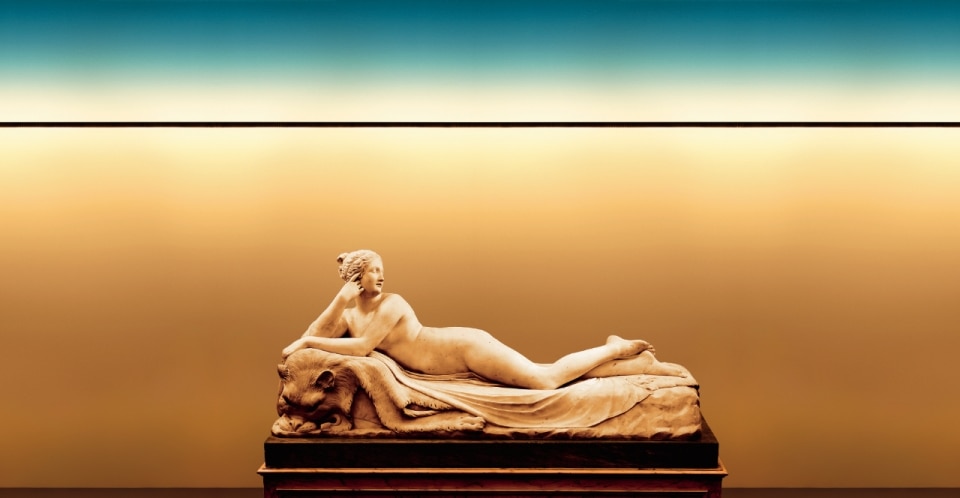
This is my final issue as guest editor of Domus.
The year 2025 has been a materialist odyssey in architecture, art and design. A reminder that society takes shape from the materials we collect and manipulate to create the world we want to live in. Our journey started from stone and earth, through metal and glass to wood and fabric, and on to plant and recycled materials. As a final stop, we chose the intangible, bucking the trend of the entire year, with projects untethered from their physical support.
The antithesis of solid material is immaterial abstraction. Speaking of objects regardless of their physical support and origin, this issue explores the highest level of abstraction, where it is ousted from any kind of expression.
Such as the use of the iconography of Jean Nouvel, replacing entire facades and surfaces with images. A design process that migrates into Photoshop, with the image as the origin instead of the representation, and with the architectural process becoming the material translation of the original image into reality. In their image overlay phase, Herzog & de Meuron, reduced the form of a building to the bare minimum to convert facades into figurations that put glass and concrete on the same plane: a canvas for art iconography. Jeffrey Kipnis, in his article The cunning of cosmetics (1997) calls it anorexic architecture.
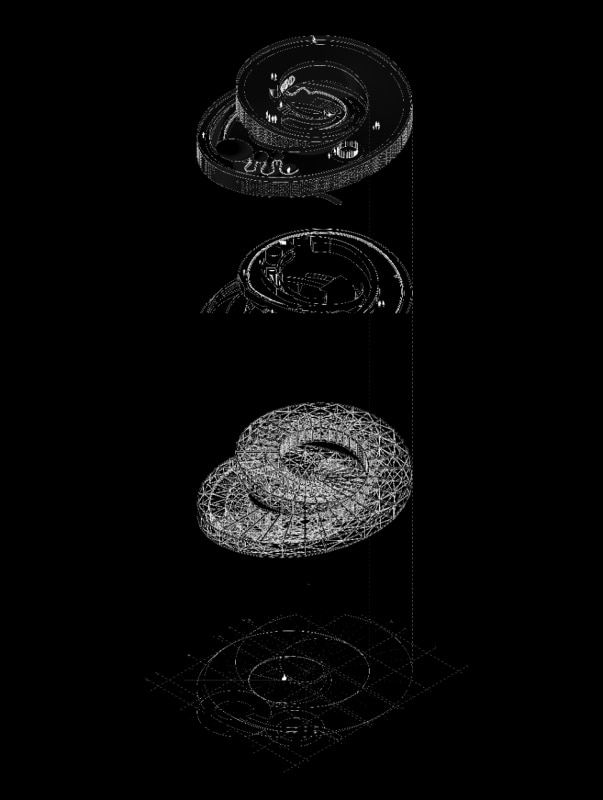
The immaterial can also be understood as a substance-less element of the natural world, such as light, sound, temperature, gravity or space.
Artists such as Olafur Eliasson and Studio Drift discover ways to make light, color and temperature evident, or to capture and reproduce the perceptual impact of flocks of starlings or windblown leaves.
Finally, the immaterial can be understood as design and intelligence applied, in their purest form, to the sphere of the virtual. My son Darwin turns seven this month and, as part of his cognitive growth, has transferred his passion for the Lego to the virtual world by discovering Minecraft which, in my opinion, is as close as we have to a desirable and habitable mirror world. It teaches young minds how everything we take for granted requires to be funded or excavated-to be harvested, processed, and recombined to become useful tools and technology. As such, it requires dedication, effort, patience and perseverance -- not to mention intelligence -- to an extent that makes the computer games of my childhood look like Pac-Mans, compared to what my son and his generation manage to manipulate in their minds.
The antithesis of solid material is immaterial abstraction. Considering something independently from its medium or source, this issue investigates the highest level of abstraction.
It would be almost anachronistic to pass an entire season of Domus without questioning the newest star of the global design and art scene: the artificial intelligence. As we all struggle to discover our role as designers-and even as Homo sapiens -in a world increasingly driven by increasingly powerful and widespread AI, I happen to consider my own personal evolutionary path as an architect along the lines of what awaits us all in the near future.
As a boy, I drew with pencils and watercolors. At the Academy of Fine Arts, I had to learn to do it with rulers and precise lines. I lost certain feelings I had with pencils, but a world of possibilities opened up for me to construct multiple perspectives and measurable axonometries.
Then I switched to computers and learned to draw with a mouse. I lost the tactility of the physical pen on paper, but I discovered 3D models, material mappings, natural lighting choices, surface textures and space.
Today I draw with 700 brilliant beautiful people. I have lost control of my hand on the pencil, but I have gained a universe of possibilities by interacting with all my experienced and careful form makers. It took me 25 years to assemble a team of designers with natural intelligence. Today, every young graduate has at his or her fingertips the productive and creative power of a global colossus of AI-powered designers, engineers, directors, researchers and so on. Although it is difficult to continue to believe in the continuation of our importance, there is no doubt that AI promises a new equality, one in which creative ability is not constrained by wealth, age, culture, or even intelligence.
To kick off this issue, we have Tobias Rees exploring quantum computing and consciousness. David Sheldon-Hicks writes about mapping the future in the great fictions of the big screen. We met with Olafur Eliasson to talk with him about his work making the immaterial tangible.
Matt Shaw describes the Sphere as a sort of final state of architecture, where all surfaces have been taken over by ephemeral content. AquaPraça by Höweler + Yoon and Carlo Ratti Associati is a floating square materialising the intangibility of rising water levels. Fran Silvestre’s Camiral House is both anti-tectonic and immaterial, making his built work indistinguishable from the abstract renders blurring the separation between fiction and fact. Mariko Mori’s Yuputira House combines abstract white finishes with curvilinear geometries to dissolve both form and substance. Carlos Bañón and Daeho Lee are both early pioneers in exploring the aesthetic potential of AI as a source of authorship, while Delfino Sisto Legnani documents the physical reality of AI infrastructure.
In a way, Anadol’s materialising of the virtual world represents for me the next frontier of architecture, art and design. And makes ‘immaterial’ the obvious ending to our materialist odyssey. From quartz to quantum.
Nendo minimizes the use of materials by reaching their physical limits. Retinaa's design for the new Swiss passport, on the other hand, explores graphic complexity in the service of security.
Humans since 1982 fuses analog and digital in the creation of artworks that emphasize time. Team-Lab experiments with immersiveness with its inhabitable artworks, while Reuben Wu deploys drones to design cathedrals of time and light. With their Molecular Landscapes, Evan Ingersoll and Gaël McGill give tangible mechanical reality to the complex internal processes of living cells. Zimoun uses ready-made materials to materialize the audible, and Anton Repponen stretches time into snapshots, Mondrian-style, of everyday moments. Ralph Nauta and Lonneke Gordijn analyze the oxymoronic character of their work, at the intersection of freedom and control, artificial nature and weightless mass.
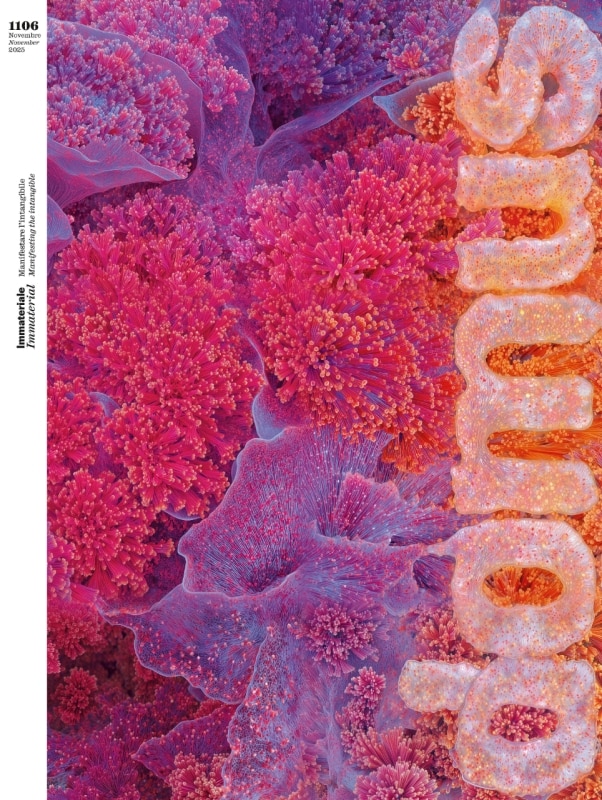
Finally, Refik Anadol gives material form to the digital with his free flow of AI-generated compositions. In his cover, he uses LLMs, large-scale language models, to create artificial choral constellations that remind us of the similarities between the natural algorithms of living systems and the digital computation of computer hardware. In a way, in my opinion, the materialization of Anadol's virtual world represents the future frontier of architecture, art and design, and makes immaterial the obvious end of our material odyssey. We go from quartz to quanta. Since I have been an architect, we have made great leaps forward thanks to the spread of CAD and BIM. The degree of sophistication in simulation, modulation and documentation has improved continuously.
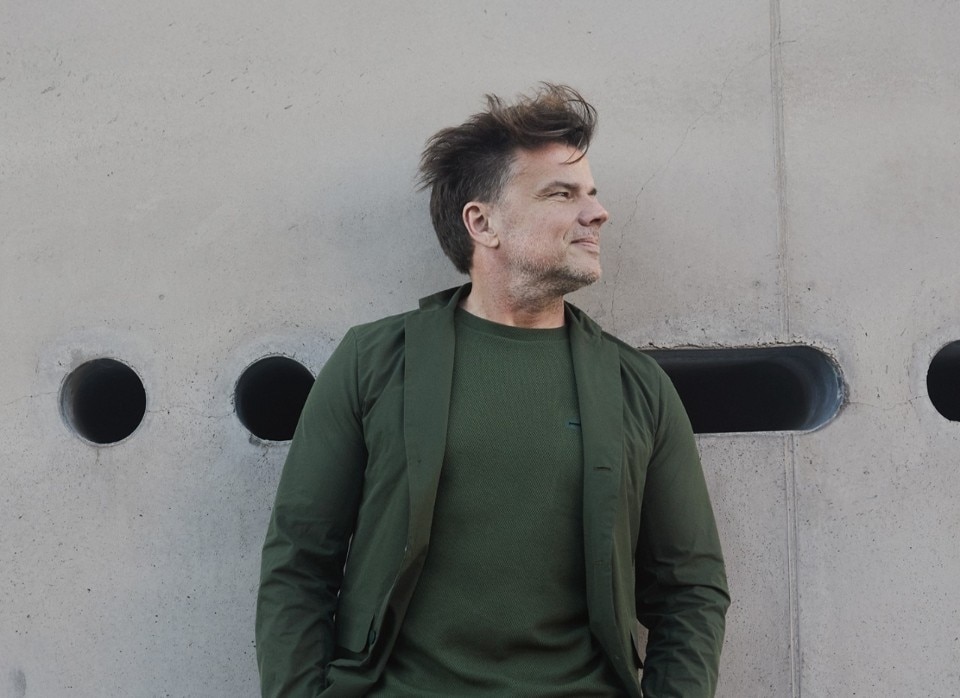
Even so, when it comes time to build, in most cases we still print large blueprints intended for hammerworkers.
Our design of the Denmark Pavilion at the Shanghai Expo was entirely drawn and documented in BIM, to millimeter tolerances, but despite the builders' assurances, when it came time to make the curved box girder the printed blueprints were transferred by hand with chalk onto the steel plate, and then cut and welded by hand. The precision and refinement of the intangible disintegrated upon first contact with the material world. A loss of fidelity that was finally whipped back into shape with great strokes of the sledgehammer. Today, it seems, we are on the cusp of the spread of robotic agents in everyday life.
During Herzog & de Meuron's phase of imprinting imagery, they reduced a building’s form to the bare minimum in favour of converting facades into figurative images rendering glass and concrete as equals: a canvas for artistic imagery.
Driverless Waymo cars in California, Roomba and lawn mowers, Tesla's Optimus, Icon's home 3D printers. When robot fabrication and construction reach the appropriate scale, we will be able to move seamlessly from data to matter, without loss of definition in translation.
AI in the material world will also remedy the staggering shortcomings of its current ability to design and understand architecture. Large language models are brilliant only when they have good data. A text is the end result of a text; an image is the end result of an image. The representation of a building stands, however to the building as a picture of a dish stands to the food it depicts: it says nothing about the taste and grain, the flavor and satisfaction of each bite. To understand a work of architecture, the multiplicity of data points, visual and physical, plans, sections, 3-D models, samples and images of materials must be connected.
The LLMs do not yet have consistent data, but when our robots, bipeds and drones, freely traverse the physical world, AI will begin to understand the meaning of architecture and urbanism. In my opinion, it is one of the biggest frontiers we have in front of us. In a way, it is Kurzweil's singularity for the world of form-making.
What happens when artificial and virtual take a physical dimension and have the ability to explore the natural environment and affect it? They bring the immaterial into the material world. Immaterialism.
To be guest editor of 2025 has been an honor and a privilege.
Thank you for your time and attention.
Bjarke Ingels has concluded for now.
Opening image: Bjarke Ingels Group for Artemide, the color spectrum of Dusk, wall washer by BIG, 2025. Courtesy Artemide