





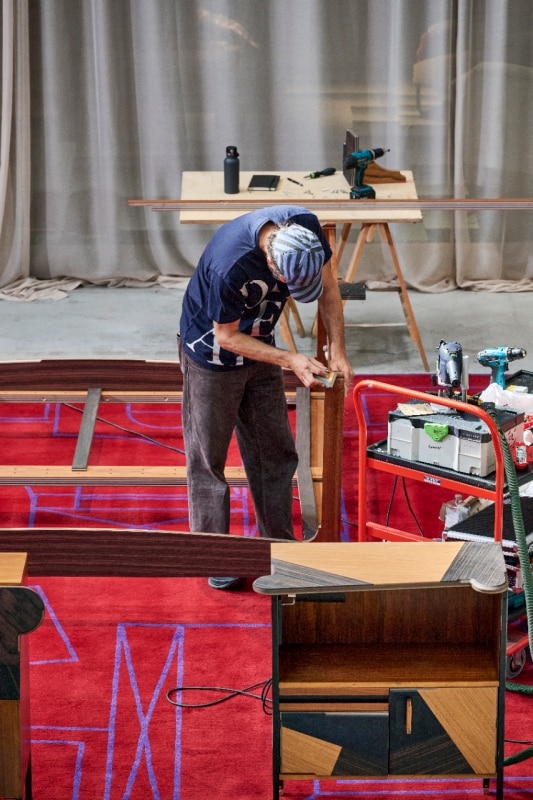
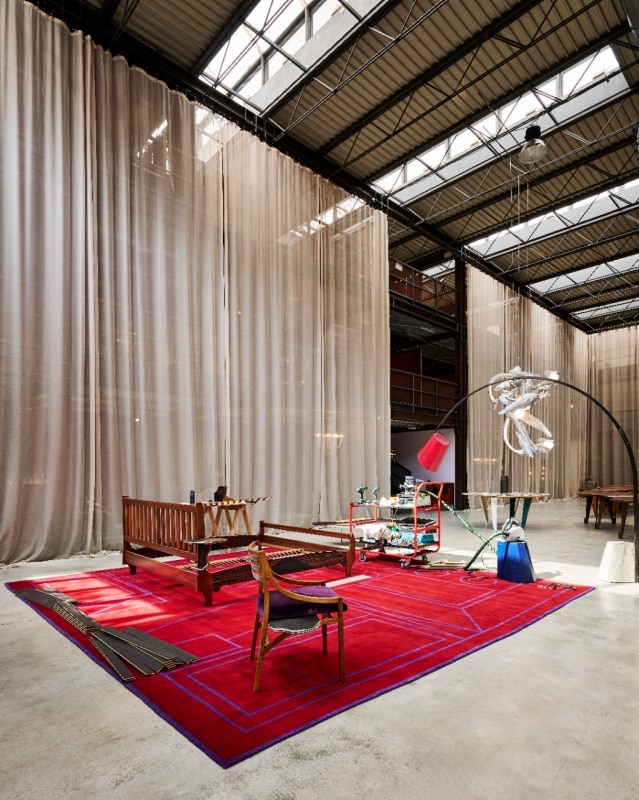


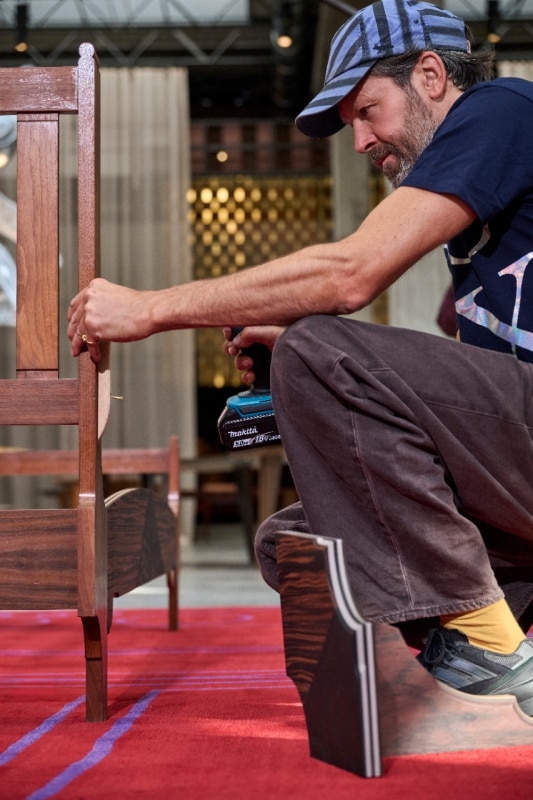
The “LT 29” bed that Franco Albini designed with Franca Helg in 1957, Ico Parisi’s Model 110 chairs in walnut and velvet for Cassina (1959), a wall lamp by Luigi Caccia Dominioni, and a 1960s side table by Fabricius & Kastholm—an emblem of Scandinavian modernism—are just some of the pieces from Nilufar’s mid-century collection that were completely dismantled, with the gallery owner’s permission. The reason? They have been reborn as entirely new, one-of-a-kind objects.
The mastermind behind this is no ordinary designer. Martino Gamper, perhaps the closest thing Italian design has to a trickster-artist, first gained fame with his 2007 project 100 Chairs in 100 Days, in which he reassembled a hundred different chairs over a hundred days—a performative act that became a manifesto of his approach to design.
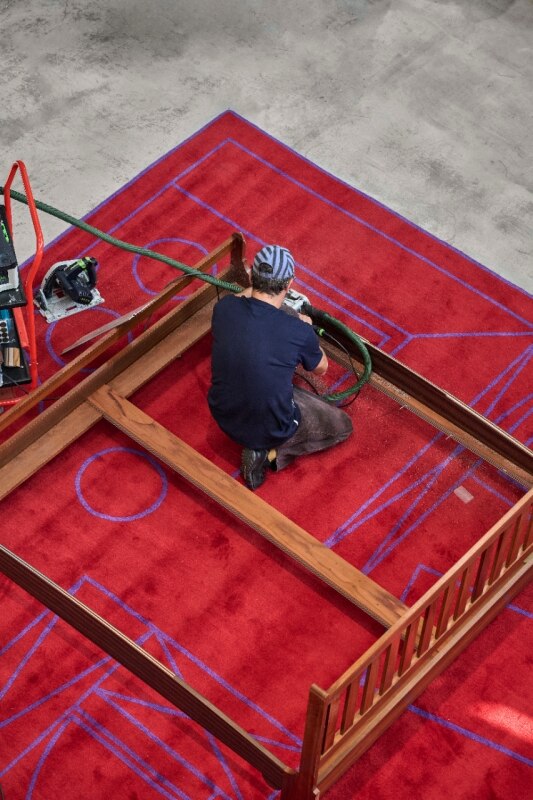
In his performances, which have traveled the world—from the Victoria & Albert Museum to London’s Serpentine Gallery—Gamper dismantles, destroys, recomposes, and hybrids everyday objects. Some are forgotten, discarded items; others—like in this case—are well-known, carefully preserved pieces. Objects that normally reside in design museums, collector catalogs, or the homes of those who happened upon them or purchased them with foresight.
But these works were not simply destroyed—they were disassembled and reborn. From the furniture of Ico Parisi, Franco Albini, Franca Helg, Fabricius & Kastholm, and Luigi Caccia Dominioni, new objects emerged, now on display at Nilufar Depot on Viale Lancetti in Milan, starting this month.
Martin Gamper's performance for ten years of Nilufar Depot. Video Mattia Cossi
The performance is provocative, playful, and inevitably divisive, yet it also represents a realistic stance on the potential future of design heritage. It reflects on the legacy of design within the very gallery that helped build it, opening the door to new ways of rewriting it.
The gesture evokes “creative reuse,” a concept familiar in art history but rarely applied in design. It recalls the radical practices of Gustav Metzger, with his Auto-Destructive Art, or Raphael Montañez Ortiz, who in the 1960s tore apart pianos and televisions as a critique of consumer society. A similar impulse can now be seen in the automotive world, where artist Akira Nakai routinely disassembles and radically transforms classic cars.
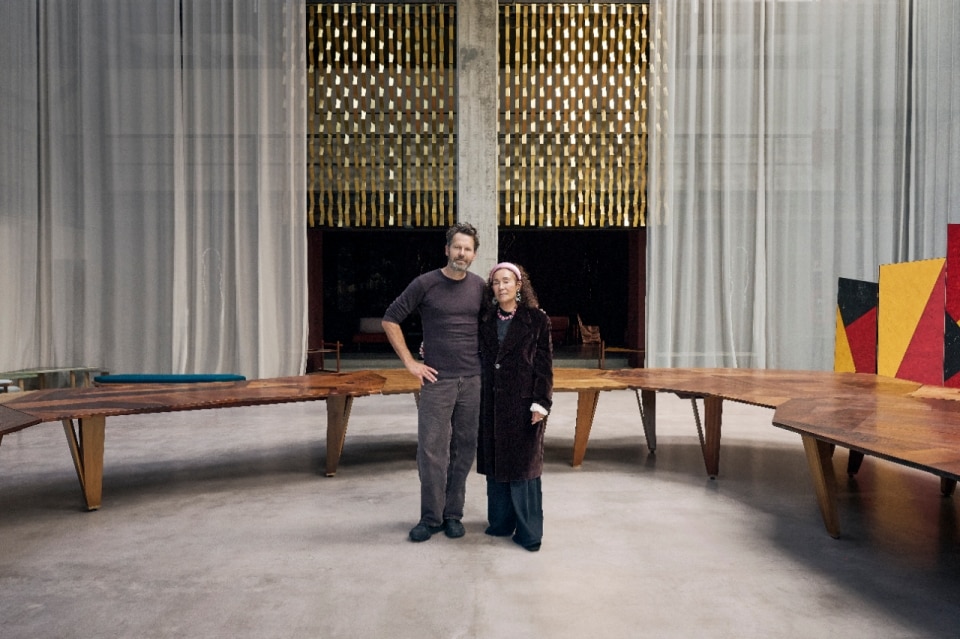
Above all, Gamper’s practice is intertwined with Nilufar Depot’s own history. Founded in 2005 as both an experimental workshop and a performance space—its architecture by Massimiliano Locatelli inspired by La Scala in Milan—the gallery has always provided a stage for ideas that would otherwise knock on the doors of institutional spaces and rarely gain entry.