

“The time has come to listen to the minor keys.” This is how the curatorial text by Koyo Kouoh, curator of the 61st Venice Art Biennale, comes to a close. She passed away suddenly last year. She is no longer here, but her vision endures.
Kouoh’s exhibition sets out to listen to the unknown, to connect with what cannot be seen, and — in a sense — to enter into dialogue with ghosts. Part magical realism, part musical spirituality, “In Minor Keys” will run in Venice from May 9 to November 22, 2026.
In music theory, minor keys are low, melancholic and dreamlike. They rarely dominate the foreground, yet they shape the emotional structure of a composition. For Kouoh, they become the point of departure for an exhibition that seeks to restore “harmonies that oppose the cacophony of the present,” “the songs of those who create beauty despite tragedy,” and convivial worlds that persist even in the most difficult moments.
But how do you build a Biennale tuned to minor keys?
A total of 111 artists will take over the Arsenale and the Giardini. They come from across the globe and are not always individual practitioners: the aim is to bring into the exhibition associations, collectives, schools and cultural initiatives that do not fully align with the traditional art system. “Minor frequencies are a rich idea of what the world means” — and it is up to the artists to give them form, like shamans or mediators between us and the invisible.
The time has come to listen to the minor keys.
Koyo Kouoh
Everything begins with a hand-drawn map by the curator — the first African woman to hold this role in the Biennale’s history. At its center sits the exhibition title; orbiting around it is a constellation of coordinates: the thematic sections structuring the artist selection, among the last decisions Kouoh was able to finalize.
Enchantment, procession and invocation — but also schools, sanctuaries, thresholds and gardens: less categories than imaginary architectures hosting artists such as Nick Cave, Ayed Yassin, Alfredo Jaar, Kennedy Yanko, Annalee Davis, Michaela Yearwood-Dan, Christen Holler, Laurie Anderson and Pauline Oliveros.
Two key innovations distinguish this edition. The first is the introduction of the “oases,” which punctuate the entire exhibition route: spaces dedicated to evoking presences and memories, where studios, apartments, talks and moments from major artists of the past take shape. Among them is Marcel Duchamp’s final studio — where the artist worked in secret for twenty years — alongside recreations of dance floors and itinerant rock parties.
The second is an extensive program of performances and activations unfolding throughout the opening week across all exhibition venues. One, in particular, is a poets’ procession dedicated to the curator.
The installation design for the Central Pavilion, by Wolff Architects, draws inspiration from two books — One Hundred Years of Solitude by Gabriel García Márquez and Beloved by Toni Morrison — prioritizing sensory experience over didactic display.
The result promises to be an informal, polyphonic and deliberately unruly exhibition. Not by chance, Biennale president Pietrangelo Buttafuoco suggests experiencing it while listening to Soul Sacrifice through headphones.
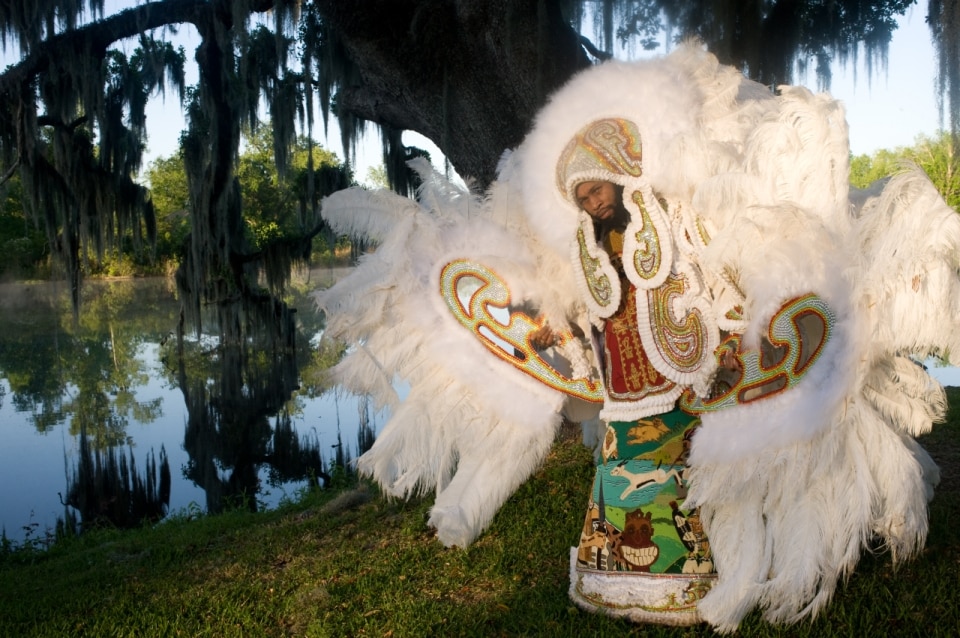
Immagine di apertura: Big Chief Demond Melancon, Second Chief of the Seminole Hunters wearing the Africa suit, 2011. Courtesy the artist