


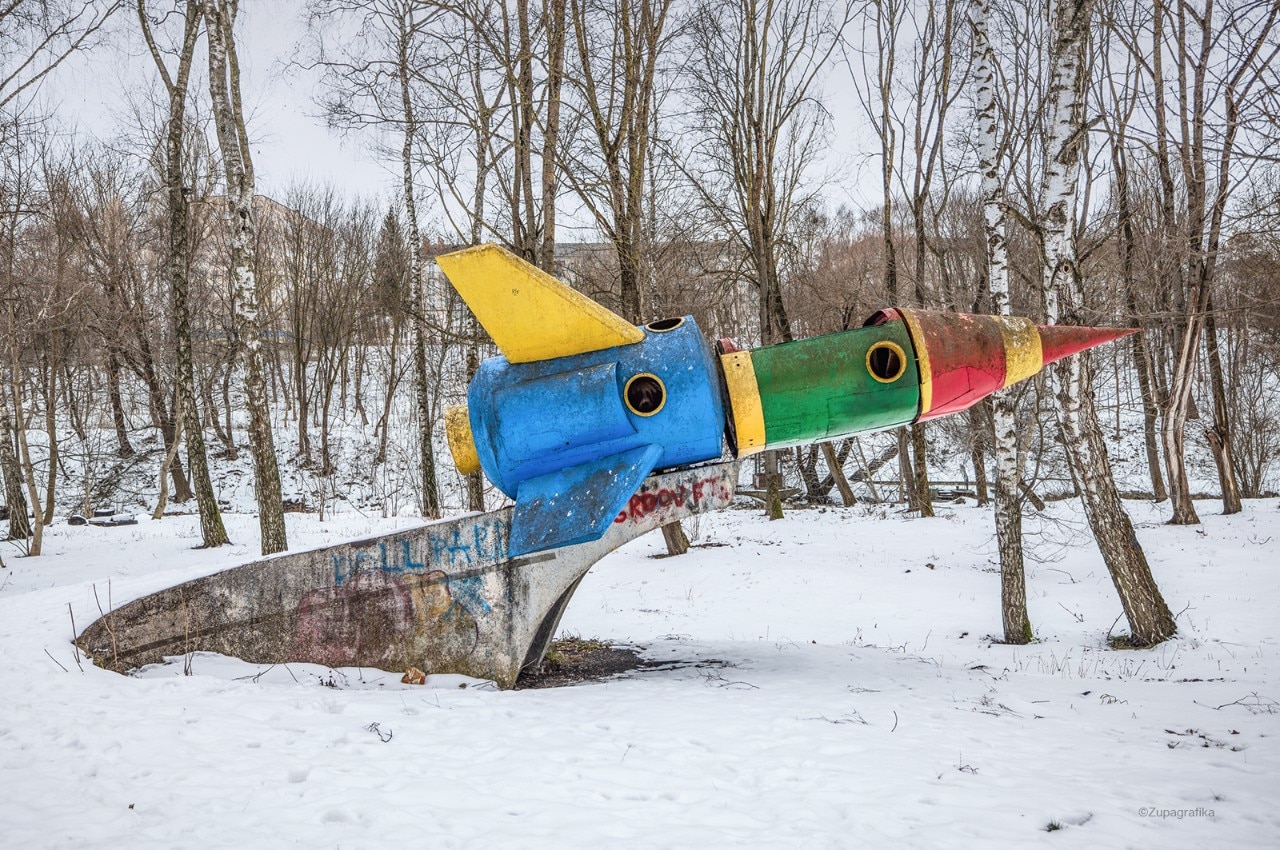

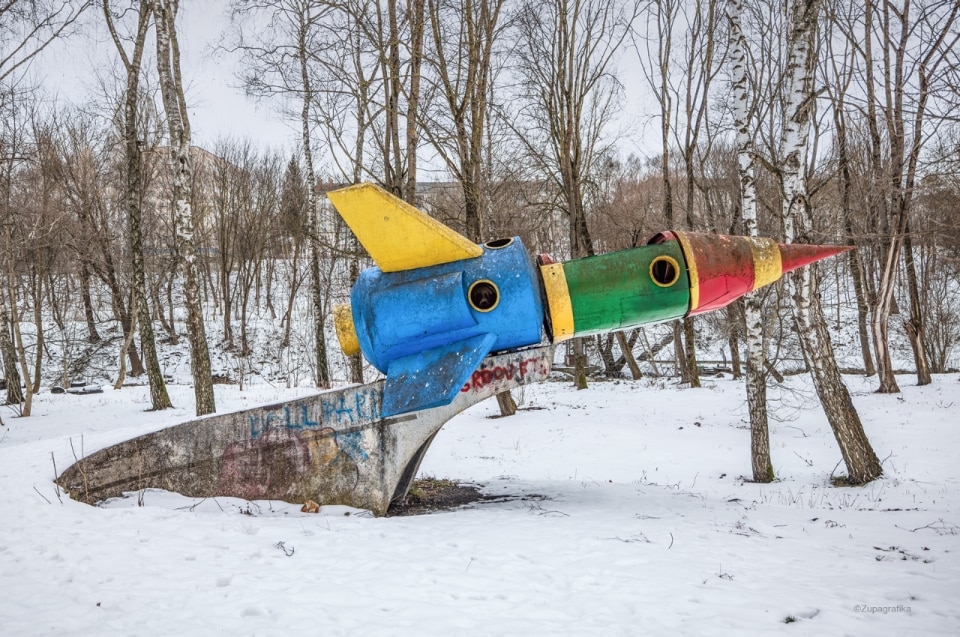
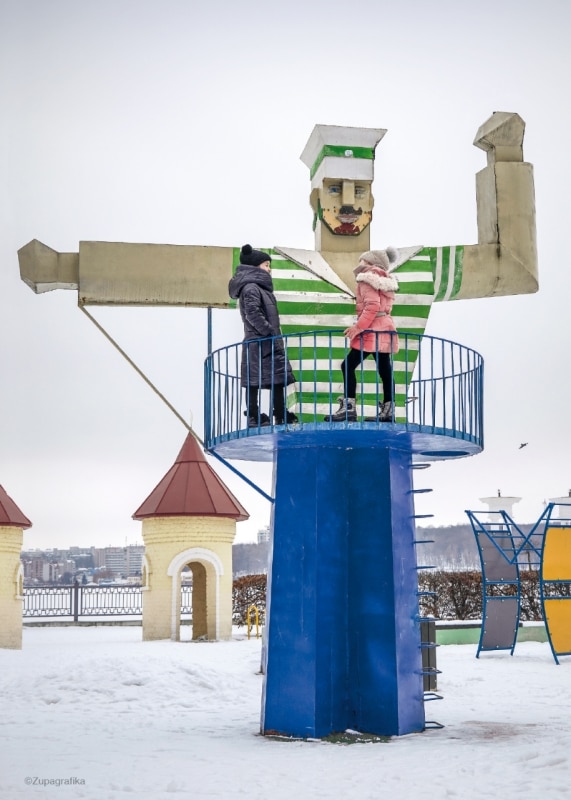
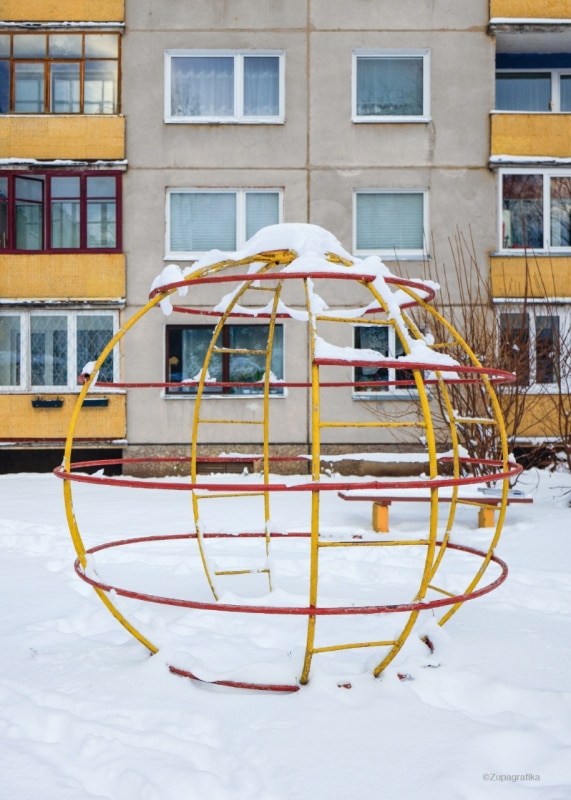
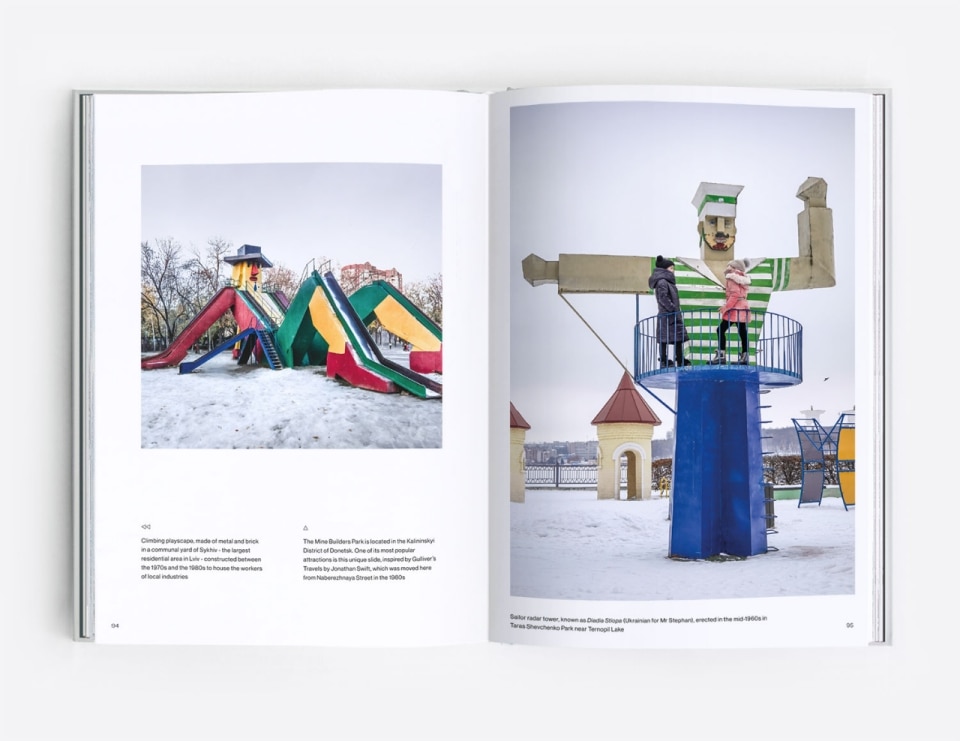
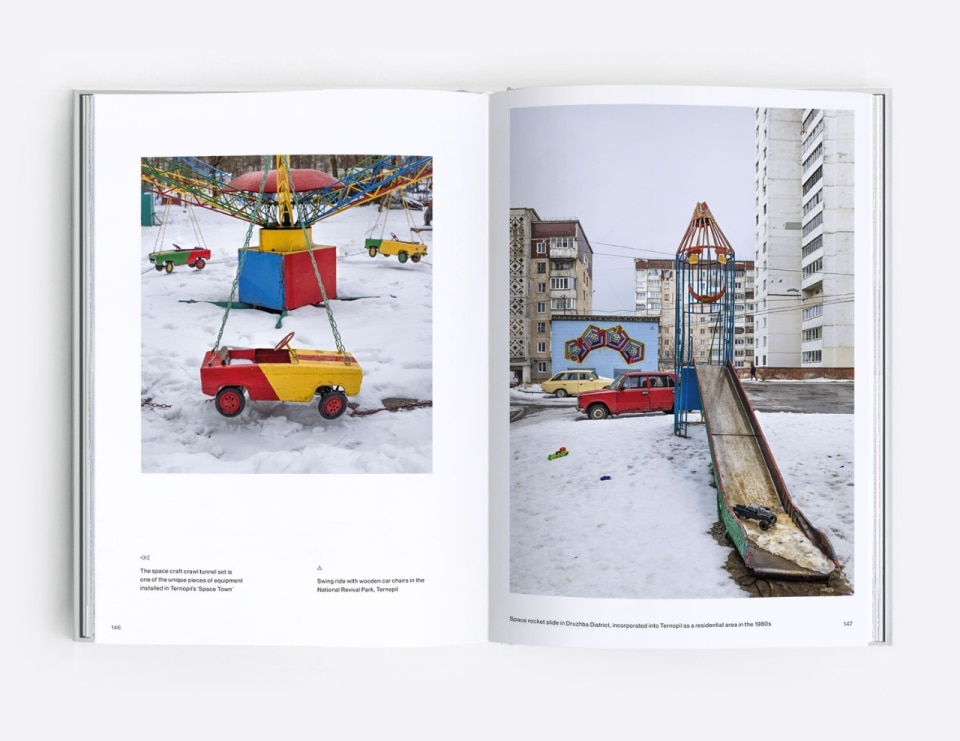
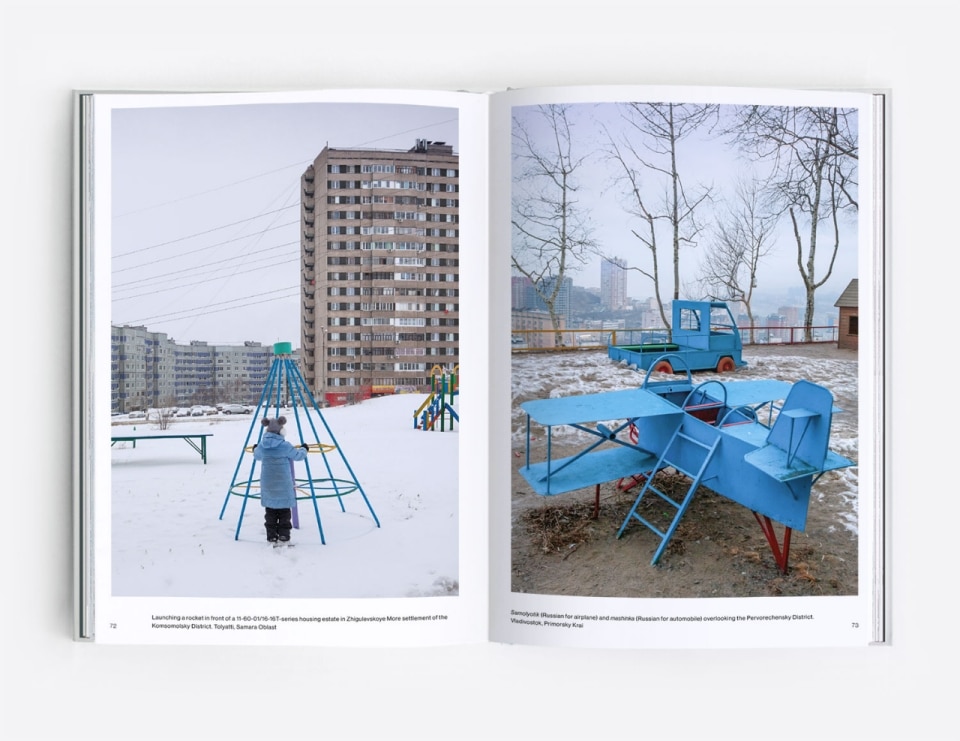
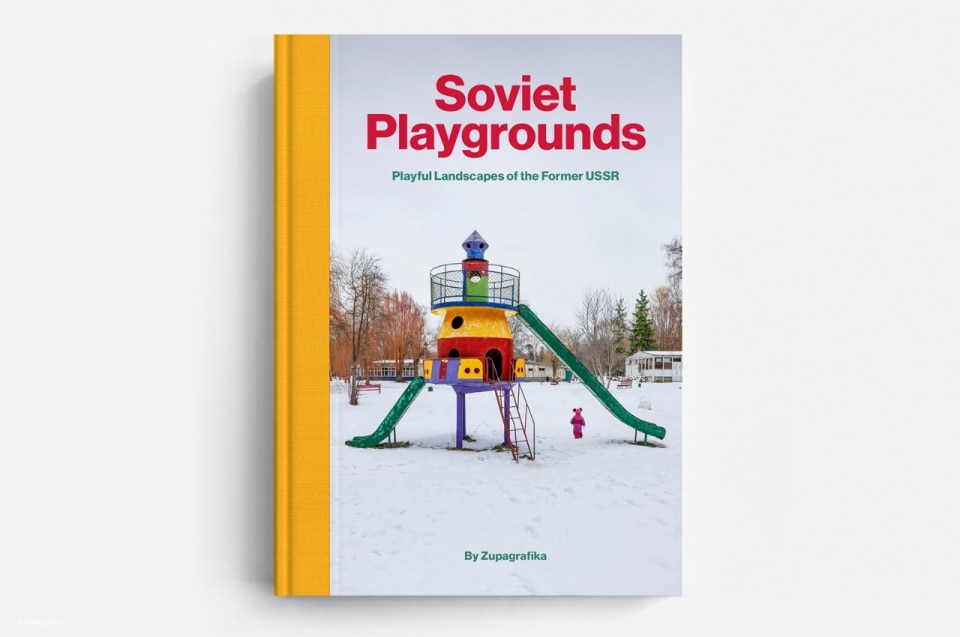
A ten-foot-tall rocket planted between prefabricated apartment blocks. A metal globe to climb as if it were the Earth seen from orbit. Spaceships, cosmic roundabouts, pyramids that resemble radar towers.
The photo series Soviet Playgrounds: Playful Landscapes of the Former USSR, published in 2022 by Zupagrafika (David Navarro and Martyna Sobecka), brings together more than 150 images taken across Ukraine, Lithuania, Latvia, Estonia, Russia, Belarus, Kazakhstan, Tajikistan, and Uzbekistan.
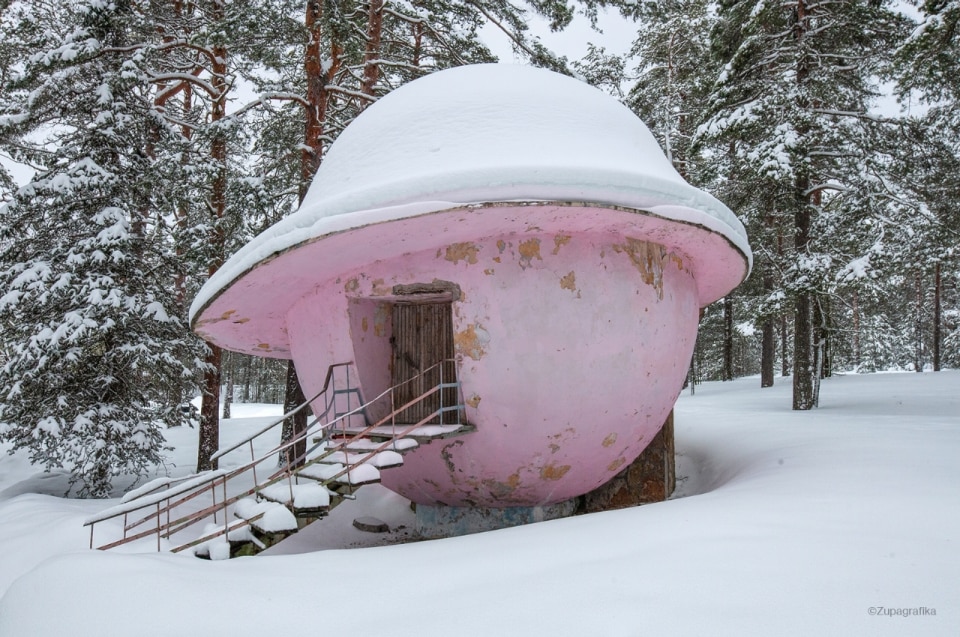
The project grew out of more than a decade of travel devoted to documenting modernist architecture across the former Eastern Bloc.
“Our interest has never been limited to buildings: we also pay close attention to the urban environment as a whole—from landscape architecture to everyday elements such as playgrounds, kiosks, and other shared spaces.”
“That’s how we began to encounter a wide variety of Soviet-era playgrounds in the communal spaces of mass housing estates.”
Many of the cosmos-inspired objects we photographed were installed during the Cold War–era space race.
David Navarro and Martyna Sobecka (Zupagrafika)
“Many of the cosmos-inspired objects we photographed and that now appear in this book were installed during the Cold War space race,” they explain. The adult utopia of technological supremacy translated into a tangible experience of space, while cosmic aesthetics permeated various spheres of material culture. Childhood, too, was drawn into this vision: children dreamed of becoming cosmonauts as they climbed rocket-shaped slides and globe structures, turning ideology into playful infrastructure.
Exploring the neighbourhoods
“The project was developed over several years and took us to numerous cities, towns, and villages across the former Soviet countries. Before setting off, we carried out extensive research and identified a number of sites.”
But a key part of their method lies in on-site exploration. “Our process leaves plenty of room for discovery. We like to take the time to walk through residential neighbourhoods, often letting chance guide us. That’s how we discovered many of the structures that later made their way into the book.”
Preliminary research is thus complemented by a more open-ended approach, shaped by detours and unplanned stops. “To complete the documentation, we also collaborated with local photographers, commissioning them to photograph sites we couldn’t reach ourselves and to provide a perspective rooted in the local context.”
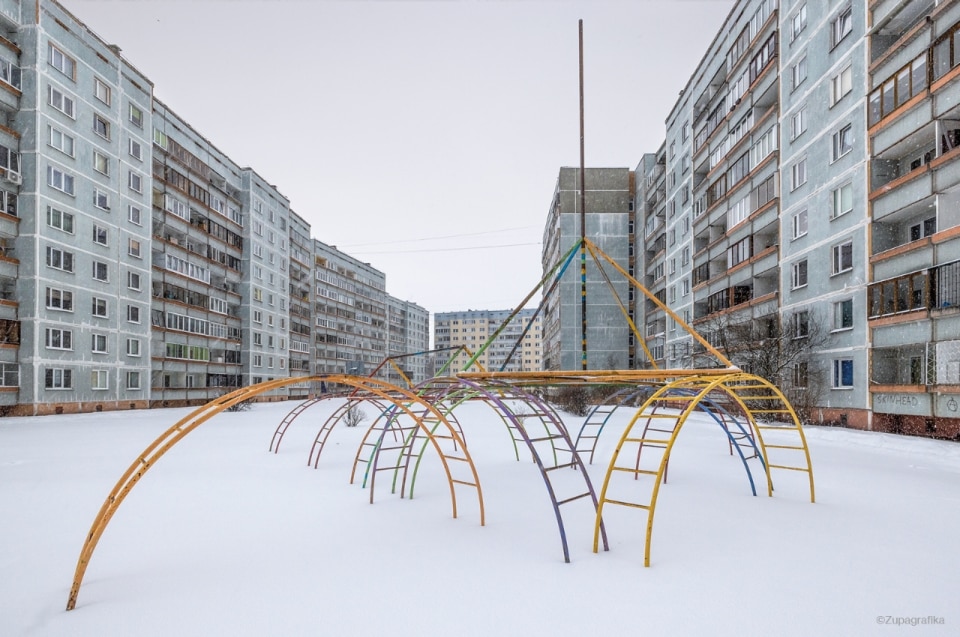
“It was interesting to observe that, although many playgrounds were designed according to standardized Soviet typologies, there were significant differences between countries, partly because much of the equipment was locally manufactured.”
In the Baltic states, geometric forms prevail: “pyramids, globes, rectangular climbing structures and Swedish walls.” In Ukraine, space-themed structures dominate, “with spaceships, rockets and slides often humanised through the addition of eyes and mouths.” There was also no shortage of unique pieces, including slides inspired not only by space, but also by characters such as Pinocchio or Gulliver’s Travels.
In Central Asia, the focus was on Baikonur, Kazakhstan—a city closely associated with the Soviet space programme—where “cosmos-inspired structures are particularly prevalent.” In Russia, numerous animal-shaped structures appear alongside rockets, especially in regions with strong agricultural traditions.
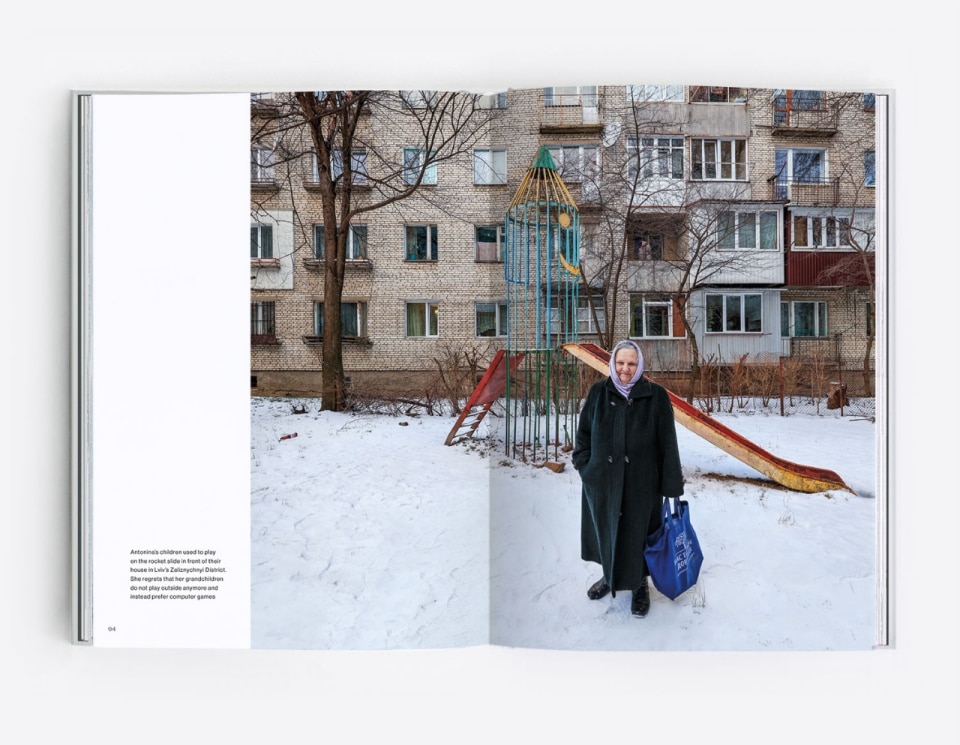
Residents of the neighbourhoods began telling us about their childhoods and how they used to play on the same rockets and slides they later saw their own children climbing.
David Navarro and Martyna Sobecka (Zupagrafika)
Making memory
Beyond documenting formal aspects, the project also captures a layer of generational memory.
“Residents of the neighbourhoods where the playgrounds are located began telling us about their childhoods and how they played on the same rockets, slides, and ‘globe’ structures that they later saw their children climb on.”
“They also complained about the poor maintenance of the equipment and the fact that their grandchildren no longer play outdoors but prefer smartphones.”
Many structures remain in use despite “hard metal or raw concrete elements that would likely raise safety concerns today.” Others have been removed or replaced; some, more recently, destroyed.
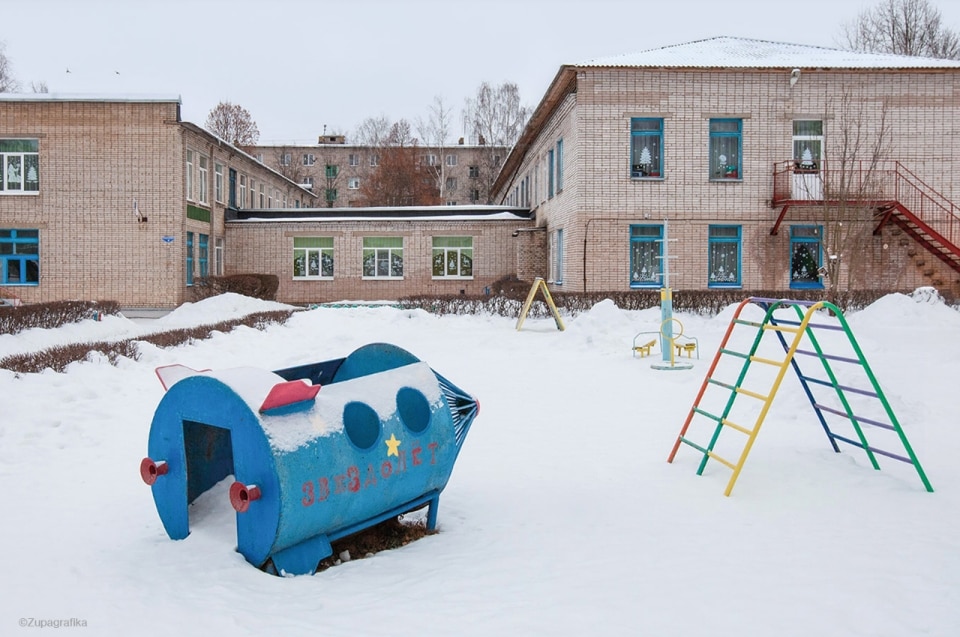
“The last photographs David took for Soviet Playgrounds were shot in Ternopil, just two weeks before the Russian invasion began,” Martyna says.
“The image shows a child holding a toy sword in front of a rocket-shaped slide. He was playing with his father, who kindly invited me to their apartment for coffee and told me about life in the Alyaska neighbourhood where they lived.”
Looking at the book today, they explain, “that photograph reads as the document of a specific moment in time. Even though only a few years have passed since its publication in 2022, the context has changed profoundly, reminding us how vulnerable shared spaces can be, as well as the habits and lives that surround them.”
The book ultimately stands as a reminder of that vulnerability—of shared spaces, and of the lives that unfold around them.
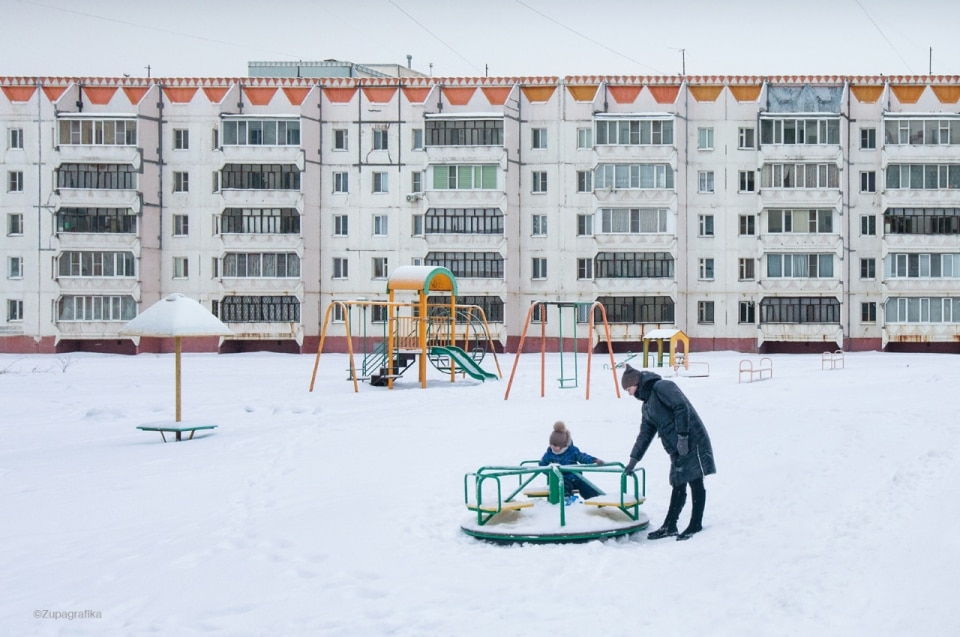
That photograph reads as the document of a specific moment in time.
David Navarro and Martyna Sobecka (Zupagrafika)
Zupagrafika
Founded in 2012 in Poznań, Zupagrafika began as a graphic design studio before evolving into an independent publishing house devoted to postwar modernist and brutalist architecture.
“From the beginning, we pursued self-initiated projects, creating illustrated cut-outs and photographing postwar modernist and brutalist architecture that fascinated us. We were particularly drawn to buildings that were disappearing in their original form.”
“Ultimately, we create objects we wish we could hold in our own hands: books that didn’t yet exist but felt necessary to us.”
The buildings they document are, in their words, “the anti-heroes of modern architecture,” capable of embodying “the dreams and ideals of a complex and controversial era.”