


We might think the sea is the only thing in the world that does not lie. Every other surface—canvas, stone, glass, the page—accepts being transformed, becoming something other than itself. Not the sea. The sea always and only gives you back yourself, amplified, exposed, without protection. Summer arrives and dismantles everything. The sea in summer does not speak in a whisper. It rumbles, it agitates, it stretches out in a silence that is louder than any noise and, in that silence, artists have always heard something they could not hear elsewhere. Something true. Something urgent. Something that dangerously resembled themselves.
Turner knew this with an almost lucid despair. His seas are not looked at: they are endured. They are mist and light and fear mixed in proportions that cannot be calculated, only felt. In those vortices of pigment, the white exploding at the center of the canvas, the gray thickening at the edges like a thought that cannot form, there is no longer a distinction between water and air, between inside and outside, between the painter and what he paints.
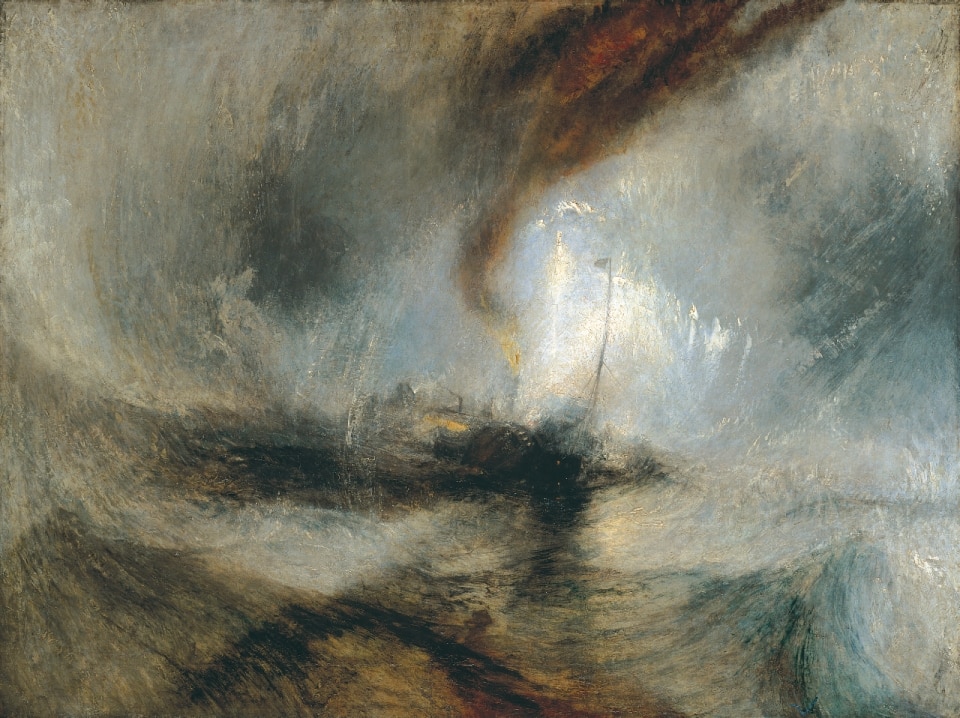
Turner had understood that the sea is not a subject. It is a state. And he was willing to lose himself in that state with a dedication bordering on mysticism, or perhaps eros, that same will for dissolution felt in front of what one loves too much to keep at a safe distance.
Hokusai, one of the most famous Japanese artists, drew The Great Wave off Kanagawa around 1831, when he was over seventy years old and in the midst of that season of life when one is finally lost enough to see clearly. It was the first of his Thirty-six Views of Mount Fuji, but Fuji, in that woodblock print that has become the most reproduced Japanese image in the world, is small. Distant. Almost irrelevant. What dominates is the wave, that crest curving with the perfect geometry of a threat, those fingers of foam reaching downward like claws, or like hands wanting to grasp something they already know cannot be grasped.
Matisse used to say he wanted an art like a good armchair, something in which one could rest from the hardships of existence.
The boats under the wave are there. You only see them later, when you stop being overwhelmed by the water and begin to look closely. The men maneuvering them keep low, contract, wait. They do not flee. They wait for the wave to pass, with that active resignation which is the oldest form of courage. Hokusai knew this feeling. In his life, he had changed his name more than thirty times, lived in poverty, lost everything, and started over multiple times. The wave was not a catastrophe; it was the normal condition of existence. Mount Fuji in the background, motionless and distant, is not salvation: it is simply what remains when everything else is agitated.
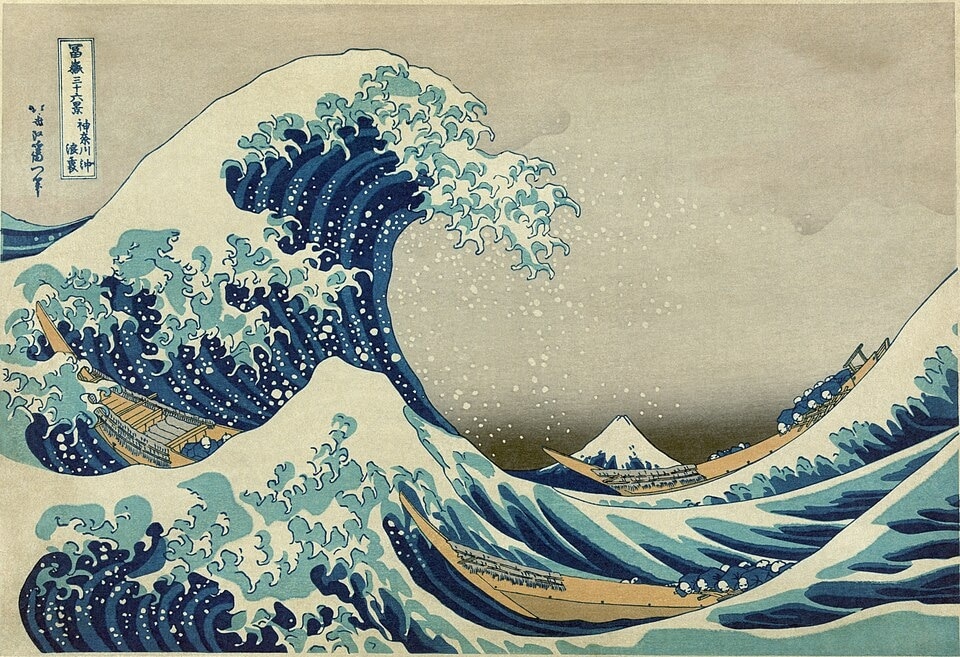
In that wave lies all the power of an old man who has not resigned himself to stop being overwhelmed by the world. A declaration of love for one's own helplessness—not defeat, but a chosen, conscious, almost voluptuous surrender. The work is clear and sharp only to those who have understood that the loss of control can be the highest form of lucidity.
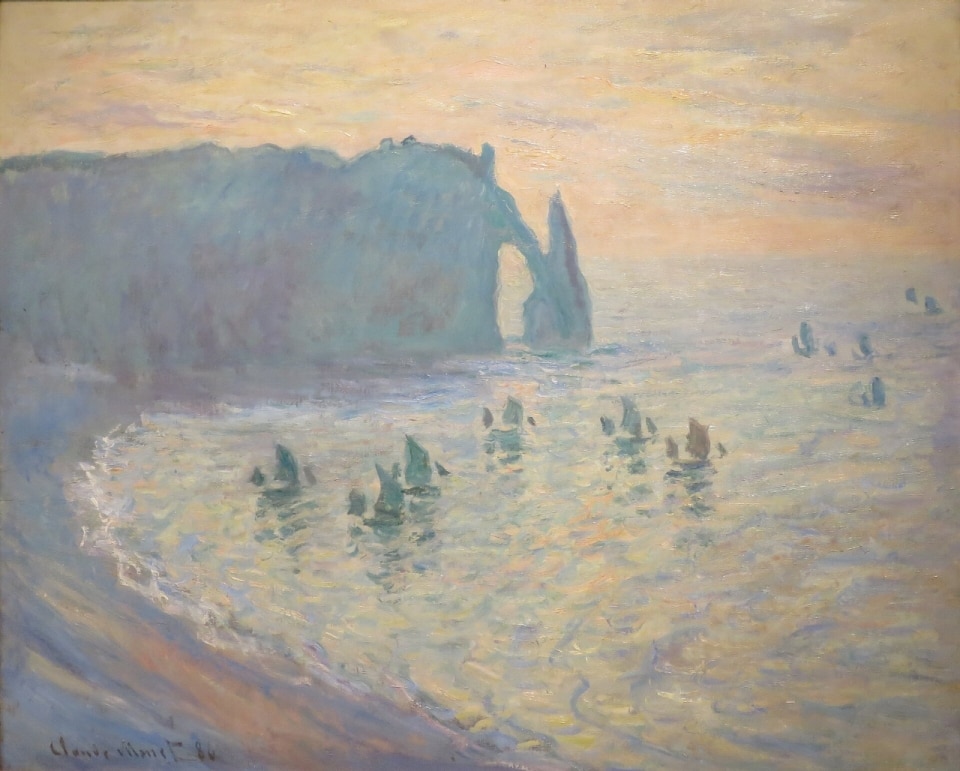
Claude Monet at Étretat returned every morning to the same cliff. He brought his canvases, his brushes, and painted. He painted the same opening in the white limestone, the Porte d'Aval, that natural arch over the sea which Maupassant compared to an elephant dipping its trunk into the water; the same light changing, however, always different, always new, always capable of surprising him. Between 1883 and 1886, he returned several times to the same cliffs, producing dozens of variations on the same subject with an obstinacy that his contemporaries struggled to understand and that we recognize today as one of the most radical gestures in the history of modern art.
He was not looking for the perfect view. He was looking for the perfect moment, with the awareness that it does not exist, that every morning is another morning, that the light at eight o'clock is never the same as the light at eight o'clock the day before. There is something moving in this return. Something that resembles loyalty not to a person but to an emotion: the decision to put oneself every day in the same position of vulnerability, knowing that one will never see the same thing, that one will never be safe from wonder. Wonder hurts. It has that sharp, almost unbearable quality of everything that is too beautiful to be contained by the eye. Monet knew it, and kept returning. Because, perhaps, certain pains are not meant to be healed, because they are not pains but a particular form of emotion.
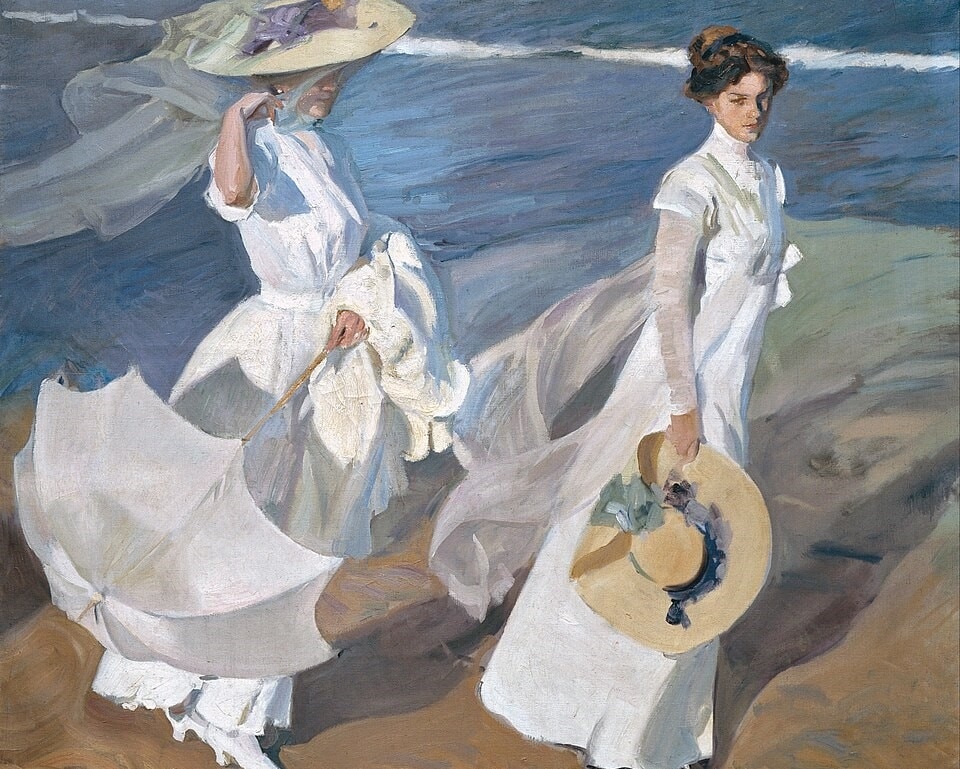
Joaquín Sorolla, on the other hand, lived inside summer as if it were his mother tongue, as if everything else—winter, rain, the gray of northern cities that so oppressed him during his study years in Paris and Rome—were merely a long exile. A Valencian, son of the Mediterranean, he had that light in his blood and painted it with a joyful ferocity that no other painter of his generation ever managed to equal. His bathers, the grand afternoon sun scenes, are not picturesque subjects. They are confessions of emotions.
Sorolla paints the foam on the water: not with academic patience, but with a loving violence of the brushes that feels almost physical. Observe how the light bounces off the white cloths of the children, the skirts of the mothers, the wet sand reflecting the sky like a broken mirror. Sorolla had understood something that few painters of his time dared to admit: that the body in summer, free, wet, exposed to the sun without mediation, is a philosophical, emotional issue, even before an aesthetic one. That skin under the sun says something about existence that drapery and indoor poses can never say. That joy is serious. That painting it requires at least as much courage as painting pain, perhaps more, because joy is harder to look in the face without lowering one's eyes.
Wonder hurts. It has that sharp, almost unbearable quality of everything that is too beautiful to be contained by the eye.
And then there is Matisse, who kept the sea outside the window while painting interiors. He arrived in Nice almost by chance; he had come for a few days, and stayed for decades. That light. That quality of air that only the Mediterranean produces, that luminous and at the same time transparent density that makes every color denser. In his Nice interiors, the windows wide open, the curtains moving, the women seated among arabesque fabrics and oversized flowers, and beyond, always beyond, the blue of the sea and the sky which sometimes blur into a single strip of absolute color—the sea is not the subject. But it is the condition of everything else. It is what allows that light to exist, those colors to vibrate at that frequency, those spaces to breathe with that particularity.
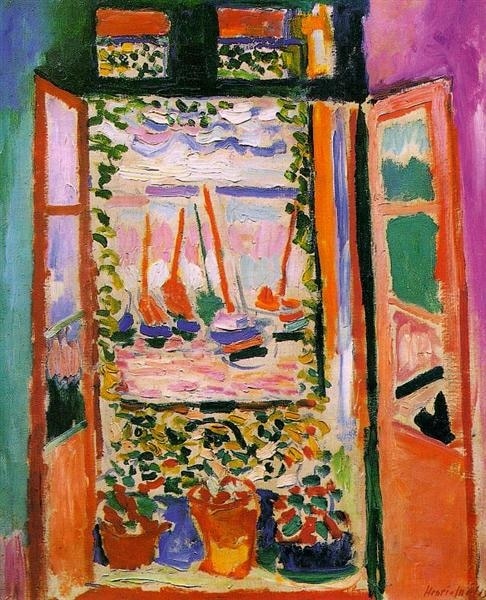
Matisse used to say he wanted an art like a good armchair, something in which one could rest from the hardships of existence. But his Nice interiors are not quiet: they are in balance. There is a subtle tension between inside and outside, between the warmth of the fabrics and the coolness coming through the open window, between the firmness of the women portrayed and the imperceptible movement of the curtains. The sea is there in that tension. It is its breath that regulates the rhythm of everything, like the breath of someone sleeping near you who, without you noticing, ends up synchronizing with yours.
And that is exactly what summer does. It slows time and accelerates the desire to look, to touch, to understand, to create. The sea is the place where this happens with the maximum intensity. Not because it is beautiful, even though it is beautiful. But because it is honest. Because it puts the body at the center of everything, and the body never lies. It does not know how to. It only knows how to feel. The coldness of the water at the first plunge, the heat of the sand on your back, the salt remaining on your lips like a memory that does not ask permission to stay.
The artists who loved the sea loved it like this: as one loves something that knows us better than we know ourselves. With that gratitude mixed with terror which is the signature of all important things. Every summer, punctual as a kept promise, the sea is still there. Waiting. It will answer us by showing us ourselves: amplified, exposed, true. Painted.
Featured image: Joaquín Sorolla y Bastida, *Strolling along the Seashore*, 1909. Photo from Wikimedia Commons