

A closed form. Smooth. Complete. As if someone had decided that humanity’s oldest question—life and death—deserved a nonverbal answer. A geometric one. The egg predates any system of thought that tried to explain it. It comes before myth. Before theology. Before philosophy. When the Greeks defined arché, the first principle from which everything originates, the cosmic egg had already been there for millennia. Incubated in Orphic cosmogonies. Painted on funerary amphorae. Placed in tombs as a ritual container. Christianity did not invent the symbol of Easter. It recognized it. The Resurrection is, after all, a hatching. And every painter who has placed an egg in a composition since then has had to reckon with that meaning—whether they intended to or not.
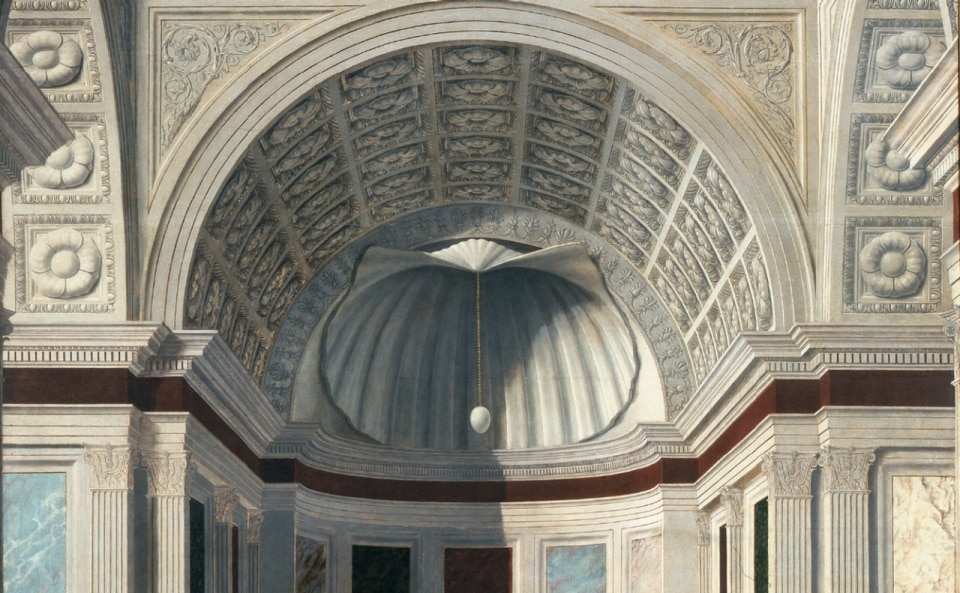
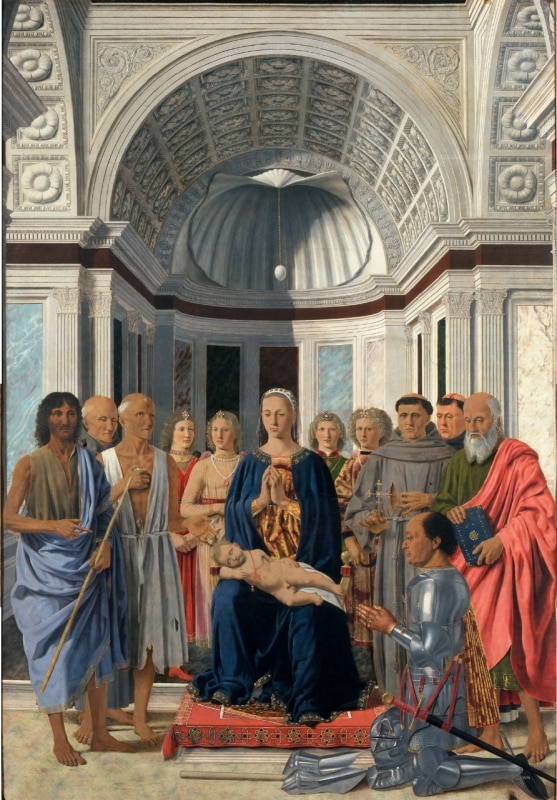
Piero della Francesca, in the Brera Altarpiece, commissioned by Federico da Montefeltro and now in Milan, suspends an ostrich egg from the shell-shaped apse above the Virgin’s head. With that gesture, he performs one of the most sophisticated acts of spatial construction in the Renaissance. The point is not only what the egg means. Interpretations multiply: the Immaculate Conception, cosmogony, rebirth. The point is where it sits, and what it does. Piero places it exactly at the apex of perspective, the vanishing point above. From there, the egg holds the entire composition together—not physically, but optically. Remove it, and the vault collapses into flatness. With it, space opens. It deepens. It gains measure.
The egg precedes any system of thought that has attempted to explain it.
Its placement is also scientifically precise. The egg is lit from the viewer’s right, while the shell behind it remains in shadow. This implies a real, measurable distance between the two. The Tuscan master never lies with light. And yet, consistent with its symbolic nature, the egg casts no shadow of its own. It is both physical and metaphysical. In the world, and outside it. Piero uses the geometry of reason to contain what reason cannot contain. The egg is the perfect vehicle: a rational form with unknowable content.
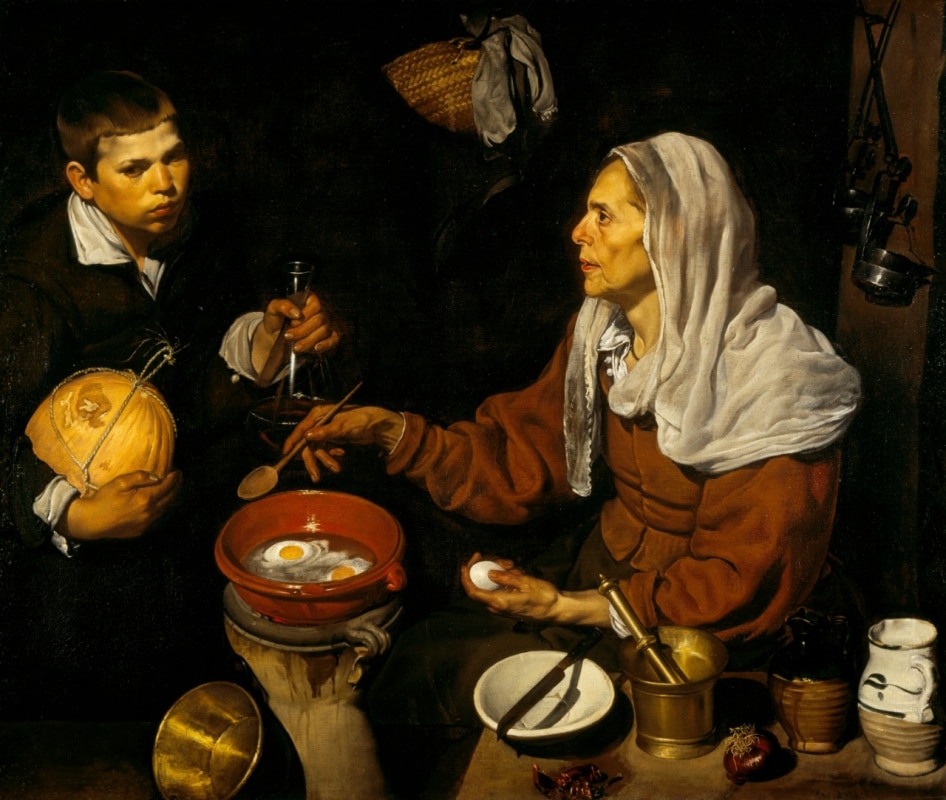
Diego Velázquez, in 1618, does something entirely different. And his difference is as exact a critical act as Piero’s. In Old Woman Frying Eggs, an early work from Seville, steeped in the raw, proud materiality of the bodegón, the egg loses all cosmic and philosophical attributes. It is food. Protein. A gesture. An old woman, hands shaped by labor, cracks a shell into a pan. A boy stands nearby, holding a melon and a jug. Velázquez pushes painting to a threshold it struggled to cross: the real without allegory. The ordinary without symbolic redemption. And yet, because great painting cannot help but transform what it touches, the quality of light on those surfaces—the almost meditative attention with which the brush records texture—gives the cooking egg a kind of dignity. In its own way, it becomes sacred. Not through myth. Through seeing.
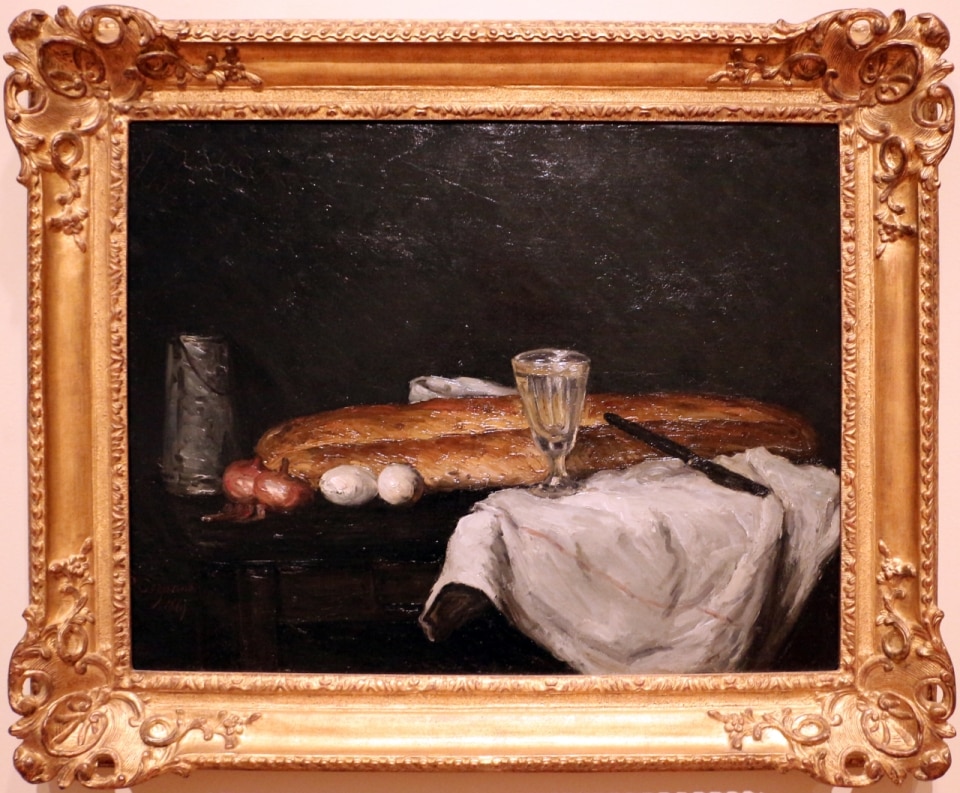
Paul Cézanne returns to the egg in 1865, in Still Life with Bread and Eggs. It is both an exercise in observation and a declaration of method. The setup carries a faint echo of Caravaggio: light striking the white surface of the egg from a precise angle, a dark ground pushing forms forward. But the tension already points toward the search for underlying geometric structure that would define Cézanne’s mature work. His egg is almost a cylinder. Almost a sphere. The world reduced to formal necessity. No symbolism. No narrative. Just a question: how do we see a thing? How do we render its presence on canvas? The egg, with its pure curvature, is the ideal test for anyone seeking an honest answer.
Velázquez brings painting to a threshold that painting itself was struggling to cross: the real without allegory, the everyday without symbolic redemption.
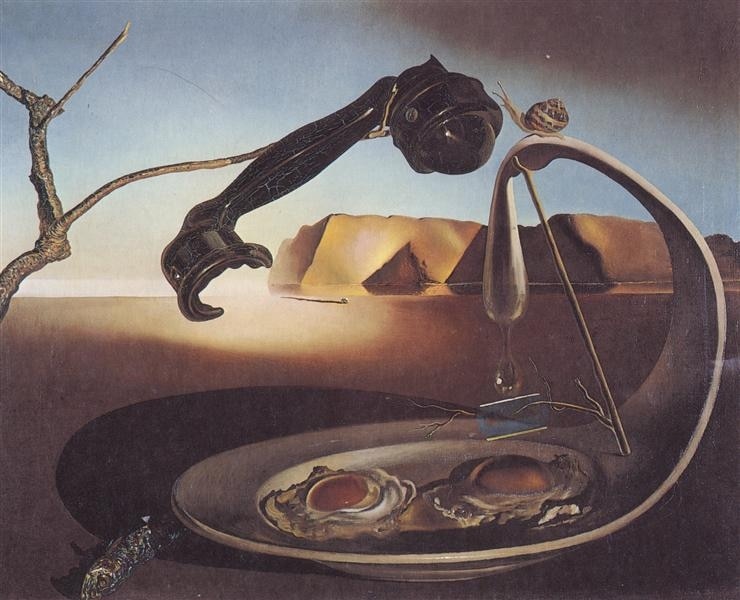
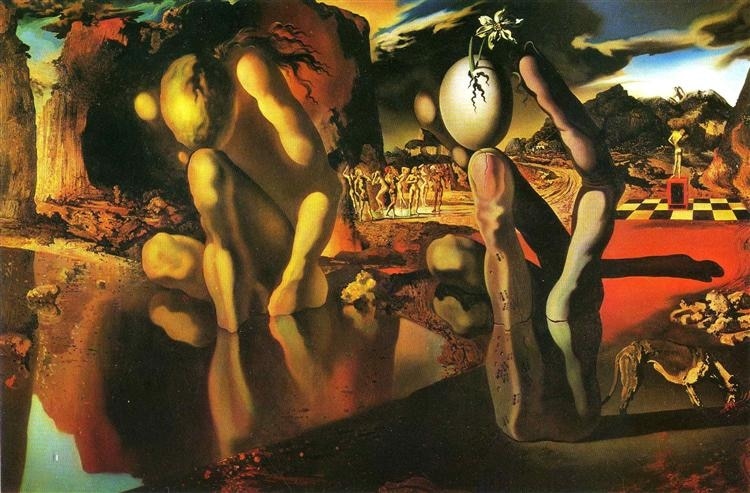
Salvador Dalí brings the egg into the unconscious with both erudition and provocation. In his famous surrealist canvas, the head of Narcissus transforms into an eggshell from which a flower emerges. A classical myth becomes the biology of the self. Elsewhere, a fried egg hangs in the sky. No pan. No fire. Suspended in midair, governed by dream logic. Dalí turns the symbol into psychic autobiography. The maternal womb as a private cosmos.
Piero Manzoni, in 1960, stamps eggs with his thumbprint. The gesture is Dada in intent, conceptual in effect. The egg is not painted. Not transformed. Not inserted into a composition. It is authenticated. The artist’s signature is enough to turn a natural object into a work of art. Manzoni pushes Duchamp’s ready-made logic to its limit. And to do so, he chooses the most archaic, most symbolically loaded object in Western iconography. The result is exact. The symbol of all origins becomes the support for a signature. The author replaces creation.
Finally, Andy Warhol. He takes the egg and strips it of its weight, only to fill it with surface. His groups of eggs reject depth. They are flat. They pursue repetition—of form, of symbol. The egg as module. As serial unit. A pop object, no different from a soup can or the face of Marilyn Monroe. Warhol does not celebrate the symbol. He puts it into production. And in doing so, paradoxically, he says something true about the Easter egg in the supermarket. The chocolate shell wrapped in colored foil. In the contemporary world, the Resurrection is also this. An endless series of things that look alike and are made to be sold.
So, what is inside something closed? Piero della Francesca filled it with geometry. Velázquez with vision. Dalí with dream. Warhol with repetition. Each of them represented an egg. Interpreted it. Disrupted it. Painted it. Modeled it. And still, the egg resists. It cannot be exhausted by any form imposed on it. Its force does not lie on the surface. It lies in the tension between inside and outside, between potential and completion.