


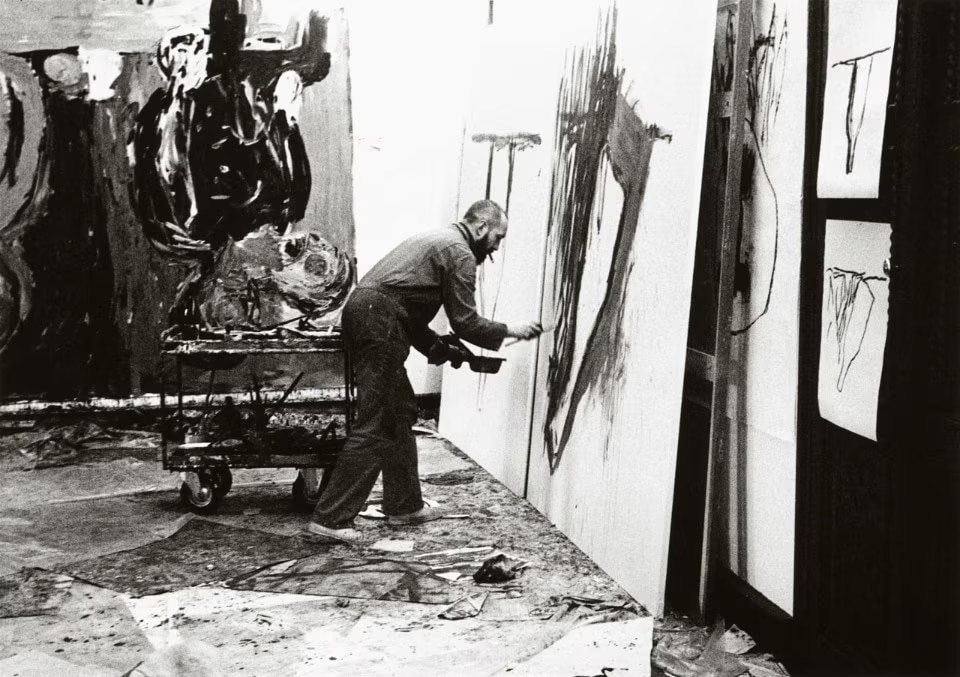
Georg Baselitz spent more than sixty years challenging painting from within. He did so without ever abandoning the figure, but by making it unstable, brutal, and often uncomfortable. Deformed bodies, defeated heroes, trees, eagles, nudes, self-portraits, inverted images: his entire body of work seems to stem from a question that runs through the second half of the European twentieth century, and postwar Germany in particular. How can one still paint after the catastrophe of history?
Born Hans-Georg Kern in 1938 in Deutschbaselitz, Saxony, Baselitz grew up first in Nazi Germany and then in East Germany. In 1957, he moved to West Berlin after being expelled from the academy in East Berlin. The name under which he would become famous also emerged from that rupture: Georg Baselitz, taken from his birthplace, as if transforming origin into artistic identity. A sensitivity to rupture, displacement, and discontinuity would stay with him throughout his life.
In the 1960s, while many artists were looking to American abstraction, minimalism, or Pop art, Baselitz chose a harsher path. He returned to the figure, but pushed it to its limit, until it seemed to explode.
His bodies are huge, damaged, exposed. They look like souls trapped in conglomerates of flesh, built from a rough, aggressive pictorial matter that is always left visible. His imagery refuses all decorum. In 1963, his first solo exhibition in West Berlin was seized on grounds of obscenity: the first sign of a body of work that would never be pacified, either formally or politically.
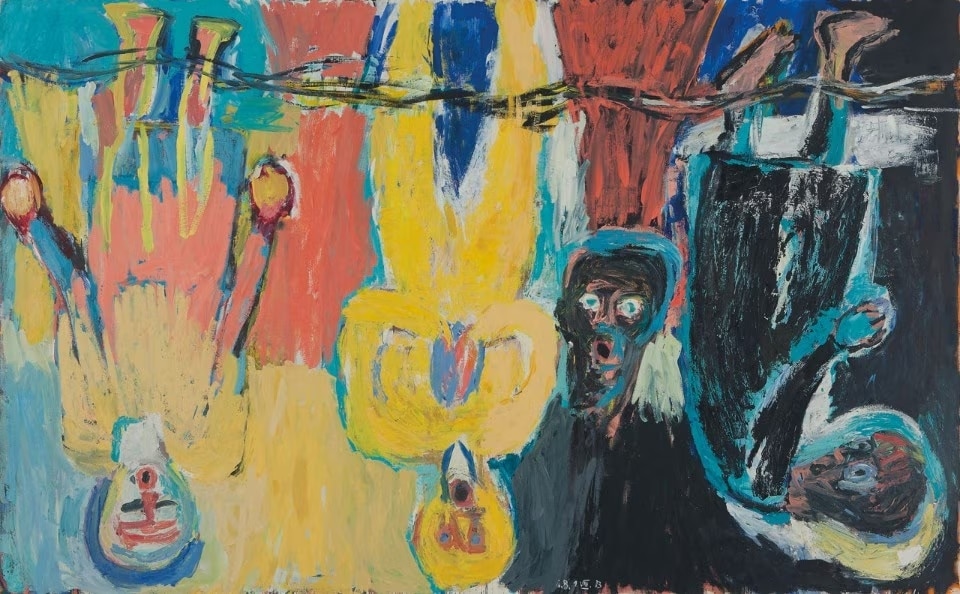
The first major cycle to define his language was the Heroes, made in the mid-1960s. They are monumental male figures, isolated in devastated landscapes, dressed in rags, with huge hands and feet — vulnerable and disproportionate. Baselitz called them heroes, but they are the opposite of celebratory heroism: veterans, survivors, wounded figures in a world that has lost all idea of greatness.
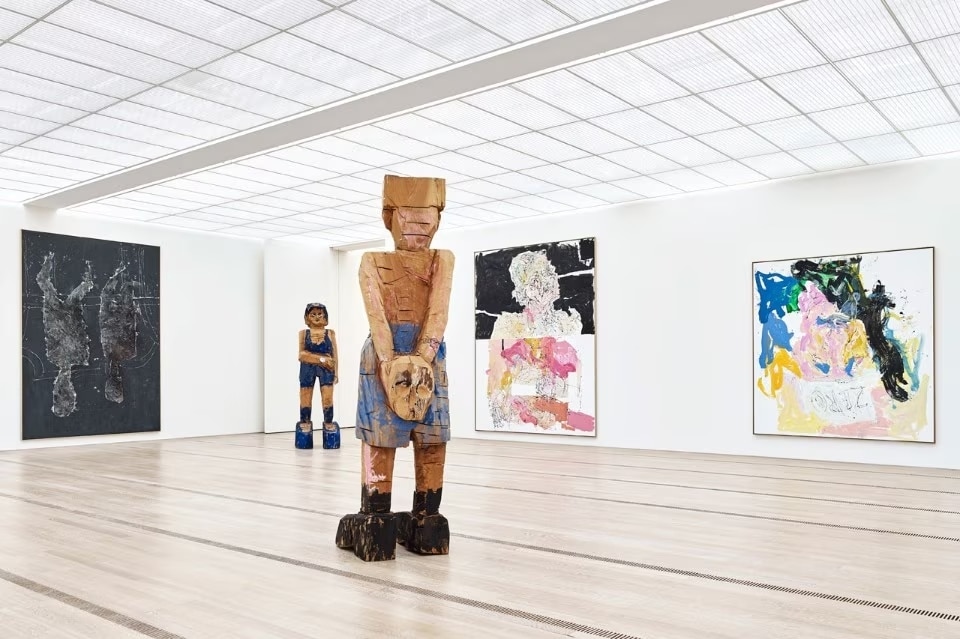
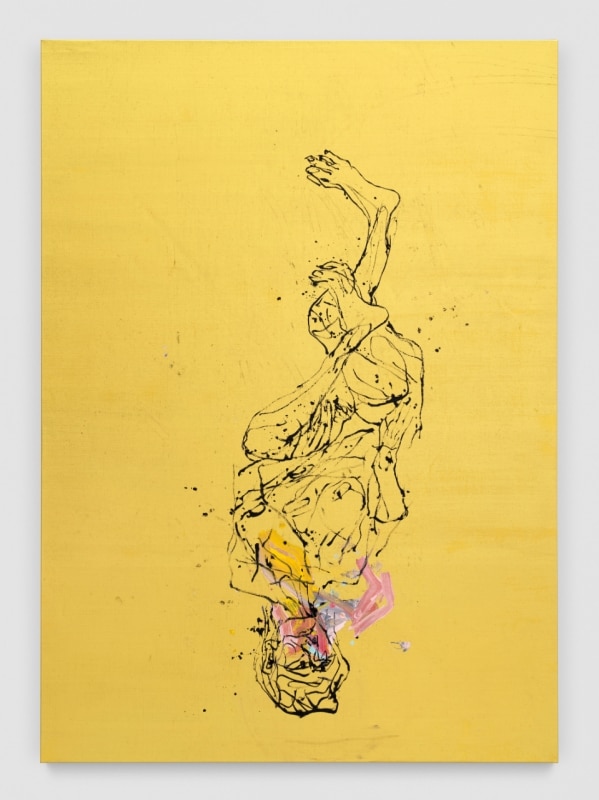
In 1969 came the gesture that would make him recognizable worldwide: Baselitz began painting his subjects upside down. Trees, figures, eagles, and bodies appeared on the canvas inverted. It was not an optical gimmick, but a radical decision. To turn the image upside down was to remove it from immediate reading, preventing the viewer from looking only for a narrative or a subject. The figure remained present, but it became painting first: surface, composition, matter, sign. In this way, Baselitz managed to hold together two poles that had seemed irreconcilable: the energy of figuration and the autonomy of the modern painting.
What counts most is finding new ways to get the world down in paint on my own terms.
Interview with Pamela Kort, Michael Werner Gallery, April, 2003.
From that moment on, inversion became his grammar. In the canvases of the 1970s and 1980s, the painting became gestural, physical, often violent. The subject remained recognizable, but always appeared disturbed: the painting did not represent the world so much as put it under pressure. The same happened in his wood sculptures, carved in a deliberately crude, frontal, almost archaic language.
From the 2000s onward, Baselitz often returned to his own images. With the Remix series, he revisited works, subjects, and motifs from the past, but lightened them, accelerated them, emptied them out. It was as if he were rereading his own pictorial history from a new distance, turning self-quotation into method.
Baselitz was a figurative painter who did not trust the figure, a deeply historical artist who always rejected the illustration of history. This is also why his work played a decisive role in the return of painting to the international stage in the 1970s and 1980s. His recognition came through the 1980 Venice Biennale and exhibitions such as A New Spirit in Painting at the Royal Academy in London and Zeitgeist in Berlin, as well as documenta 5 in 1972, documenta 7 in 1982, and major retrospectives at the Guggenheim in New York, the Royal Academy, the Centre Pompidou, and the Gallerie dell’Accademia in Venice.
Now that I am more or less at the end of my activity as a painter, I thought it was time to draw some sort of conclusion.
Georg Baselitz, on the occasion of Eroi d'Oro, Fondazione Giorgio Cini, 2026
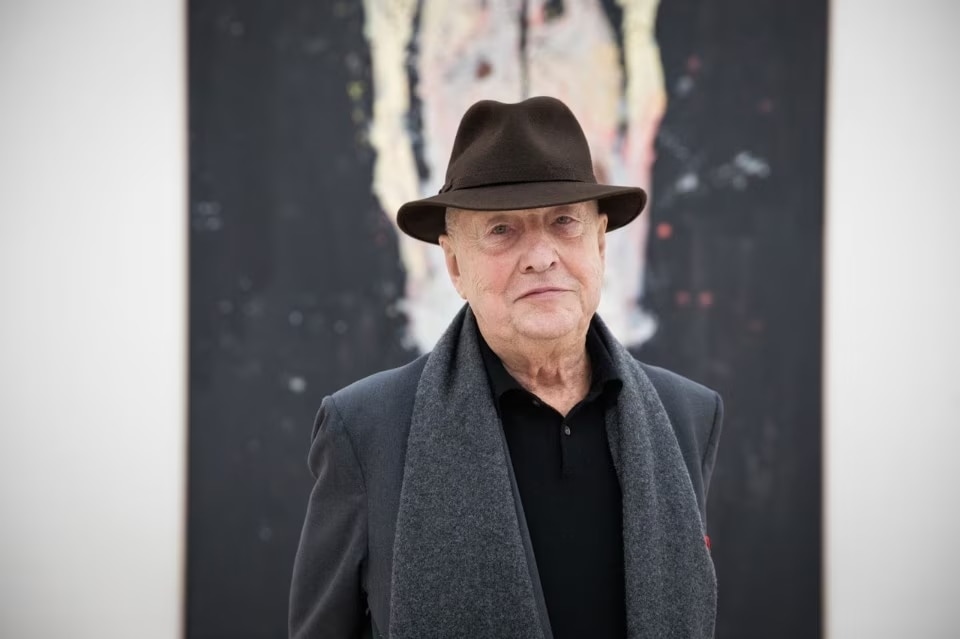
And it is in Venice that we meet him again, through the last exhibition he worked on — the first to unfold without him. Eroi d'oro is open at the Giorgio Cini Foundation from May 5 to September 27, 2026, coinciding with the 61st Venice Biennale. Curated by Luca Massimo Barbero and organized in partnership with Galerie Thaddaeus Ropac, the exhibition brings together very recent large-format paintings built on the contrast between the fragility of nude bodies and the compact light of gilded backgrounds.
In the press release, Baselitz describes these works as a possible “synthesis” after more than sixty years of work: “Now that I am more or less at the end of my activity as a painter, I thought it was time to draw some sort of conclusion.”
- Show:
- Georg Baselitz. Golden Heroes
- Dates:
- May 5-September 27, 2026
- Where:
- Giorgio Cini Foundation, Venice
- Cover image:
- Georg Baselitz in his studio at Schloss Derneburg, 1983. Photo © Daniel Blau, Munich