Niki de Saint Phalle died on May 21, 2002, in San Diego, where she had lived since the early ’90s, the Southern California climate being the best she could find for her respiratory condition. She was an outstanding woman, renowned for the brilliance of her poetic protest and visionary imagination and inspired by a boundless freedom of invention.
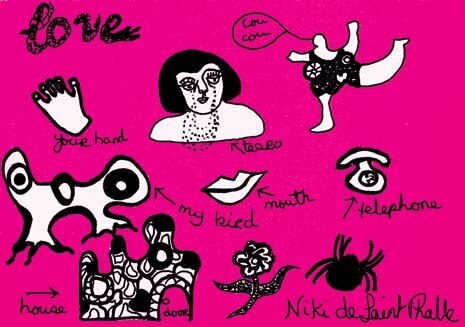
I first met her in 1960, when she formed a permanent partnership with Jean Tinguely. She was a woman of breathtaking beauty and unbridled existential independence of mind. At the age of 30 she had already had a remarkably eventful and troubled past, having rejected the patriarchal and bourgeois Franco-American circles in which she had grown up. She was married at the age of 18 to a young musician who became a writer, bore two children and had led a chaotic life in Paris and Europe since 1951. In 1955 she suffered a breakdown, but she recovered by concentrating hard on the art that soon became her primary vocation. In 1960 she not only came into Tinguely’s life but also into the existential compass of the Nouveaux Réalistes at the height of their poetic ferment. She was the only woman in the group and the strongest incarnation of its rebellion against society. Her Targets, shown at the J Gallery in Paris in 1961, made her world famous overnight. The painter shooting at clay reliefs containing bags of pigment was settling accounts with her own immediate past, and her liberated art became an explosion of colour and fantasy. Niki expressed her good-natured, triumphant feminism in the shape of buxom and cheerful spasmodic female figures called Nanas.
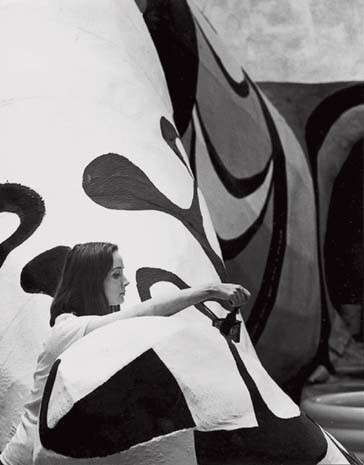
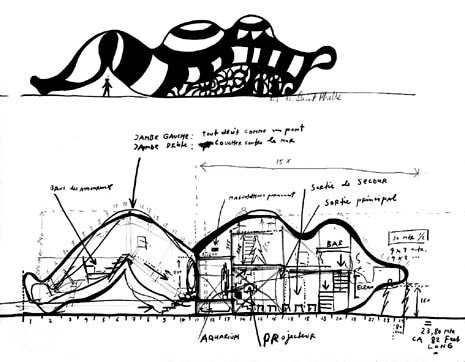
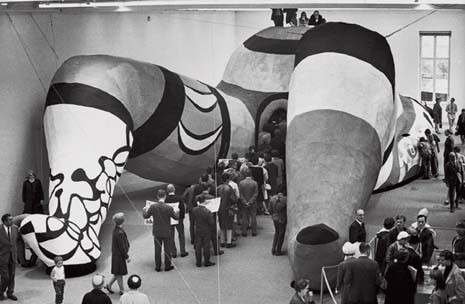
These soon became monumental sculptures, like the famous Hon (1966) in Stockholm, made with Tinguely and the Swedish sculptor Ultveldt. Her artistic association with Tinguely continued the following year with Fantastic Paradise for the French pavilion at the World Expo in Montreal and with the start of Cyclops, created by the Swiss sculptor at Milly-La Forêt. Their joint creations continued until the death of her companion in 1991. Together they produced the Stravinsky Fountain (1982) in front of the Centre Pompidou in Paris and the Château Chinon Fountain, commissioned by President Mitterand. Tinguely also worked with Niki on her magnum opus, the Giardino dei Tarocchi at Garavicchio in Maremma: a sculpture park with houses and temples inspired by the Arcani dei Tarocchi. This occupied much of her time during the ’80s and was opened to the public in 1998, after Mario Botta had designed the entrance to the gardens.
After Tinguely’s death, Niki moved to San Diego, where, despite her precarious health, she threw herself into an enormous creative output ranging from graphic art to writing and film-making.
The broad sweep of her oeuvre illustrates the poetic wealth of a career that culminated in a vision of great spiritual generosity, taking up the sense of rebellion expressed in her Targets and the optimistic feminism of her Nanas. Her life was exemplary, under the semblance of chaotic exuberance. Niki de Saint Phalle was a great figure in the art of her time, guided by an indomitable sense of freedom.