



There is a thread connecting the service station to twentieth-century architecture. Gio Ponti had already noted it in 1928, in the pages of Domus, when he described it as a new frontier of modernity. Indeed, these architectures of everyday life have often served as testing grounds for the language of the future: from the Fiat Tagliero station designed by Giuseppe Pettazzi in Asmara, Eritrea—now a UNESCO heritage site—to the refreshment stops that landed along the Autostrada dei Laghi, the highway that leads from Milan toward the water.
In 2020, the gas pump and its extraordinary architecture had just turned one hundred, and we had declared it doomed, assuming it would survive only as a mythological memory. Today we know that is not the case. The service station seems to have returned as a field of experimentation for architecture—only now, instead of gasoline, the charge is electric.
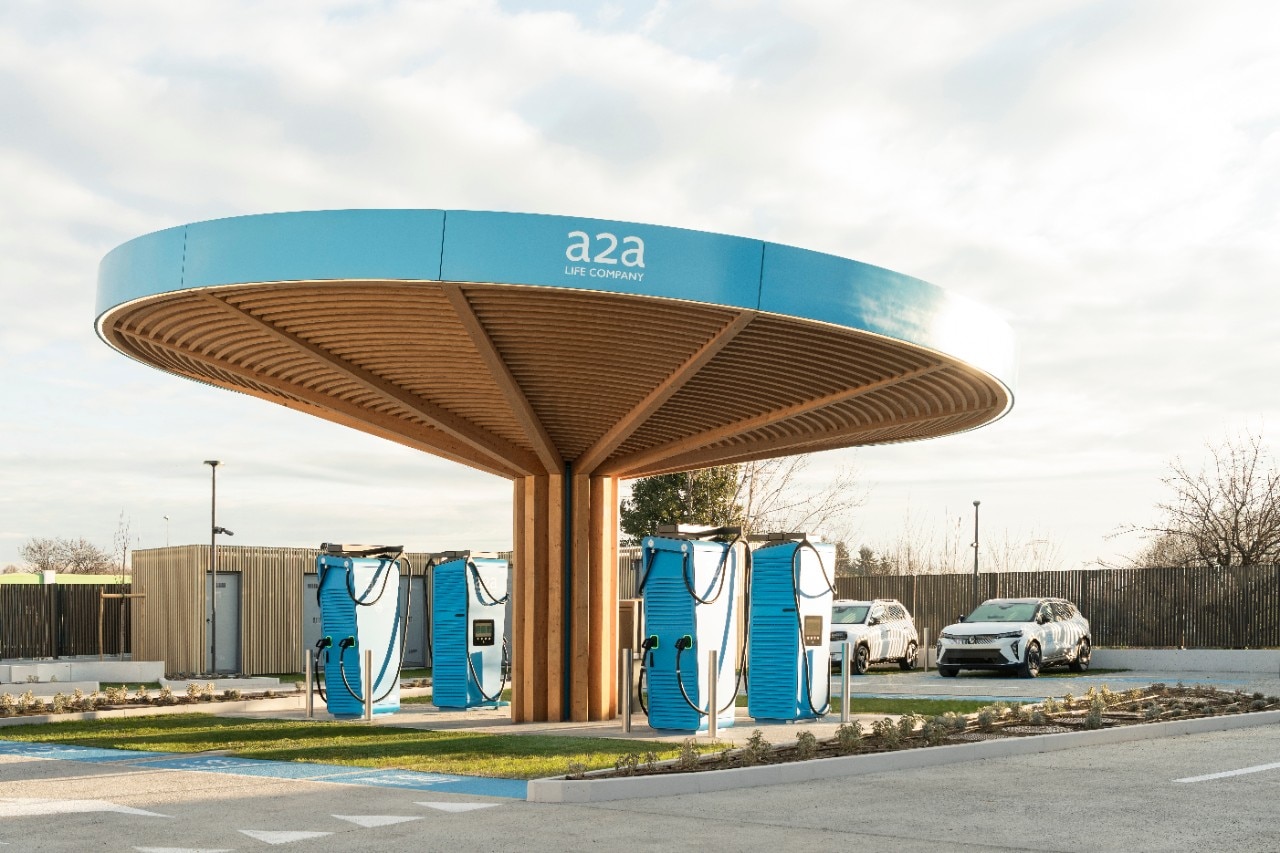
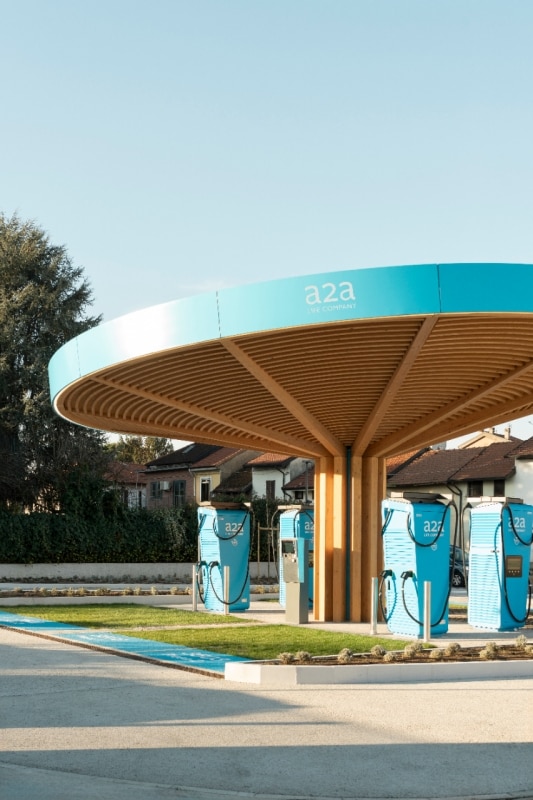
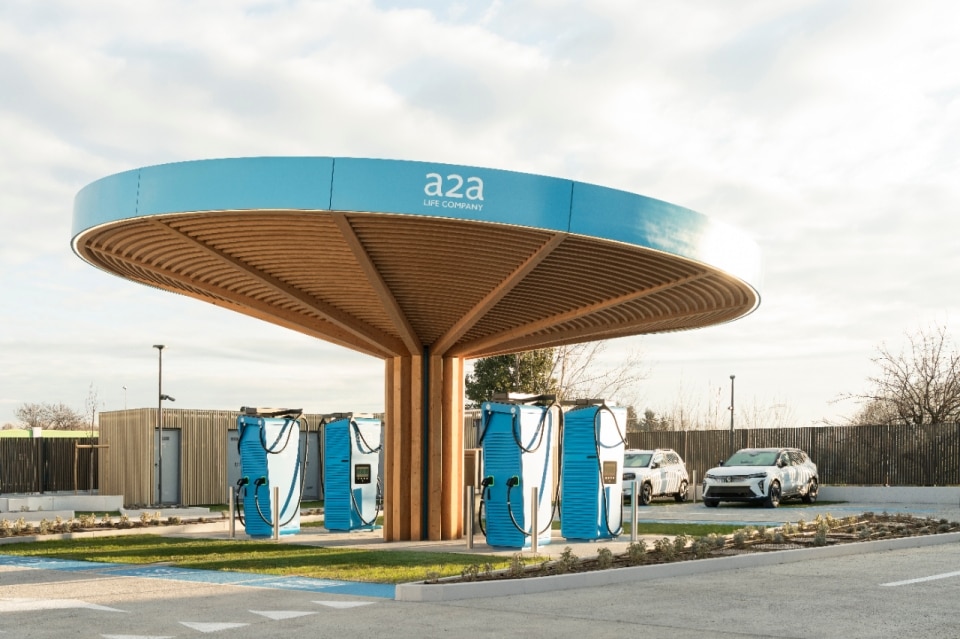
Confirming this is an all-Italian project: the Power Hub Monza, designed by Park for A2A. A compact and pop urban device, halfway between infrastructure and pavilion. An electric drive-in that looks like it has stepped out of an American film, shot in the Po Valley. And one that truly tries to deliver on its promise: redefining the archetype of the service station.
The commission comes from A2A, an Italian multi-utility company based in Milan with a strong presence in Lombardy, active in energy, networks, and environmental services. The goal is explicitly identity-driven: to build a “flagship space” that translates the brand’s values into physical space—decarbonization and the circular use of resources.
Park responds with an essential, instantly readable design that preserves the visual strength of the twentieth-century service station—geometric, two-dimensional, and memorable—while reinterpreting its contents, constructing a truly self-sufficient ecosystem around the architecture of stopping: a manifesto of the circular economy applied to public space.
Power Hub Monza generates what a service station usually consumes.
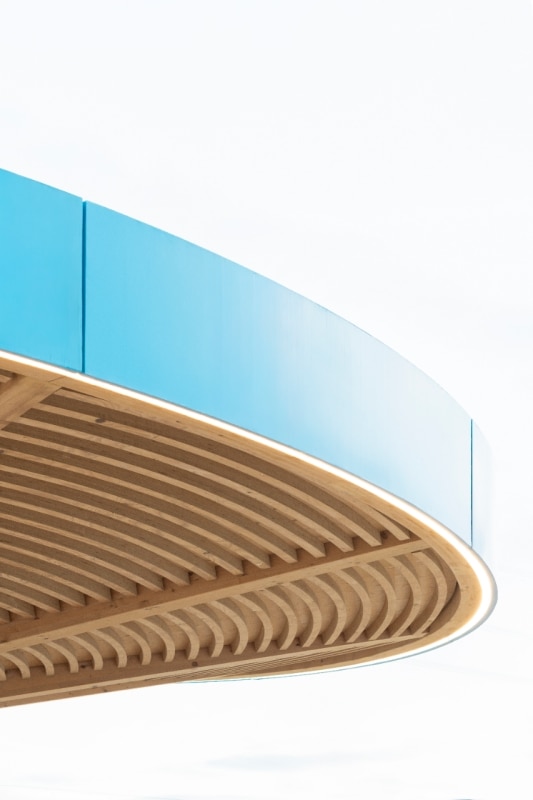
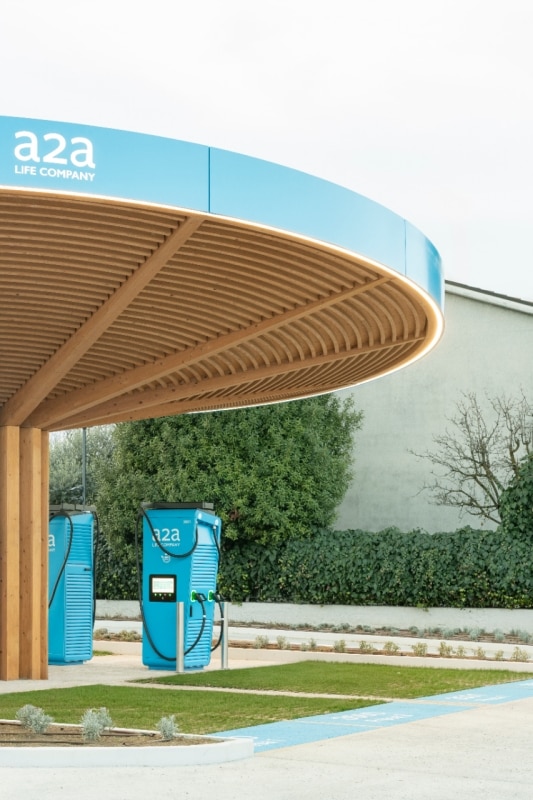
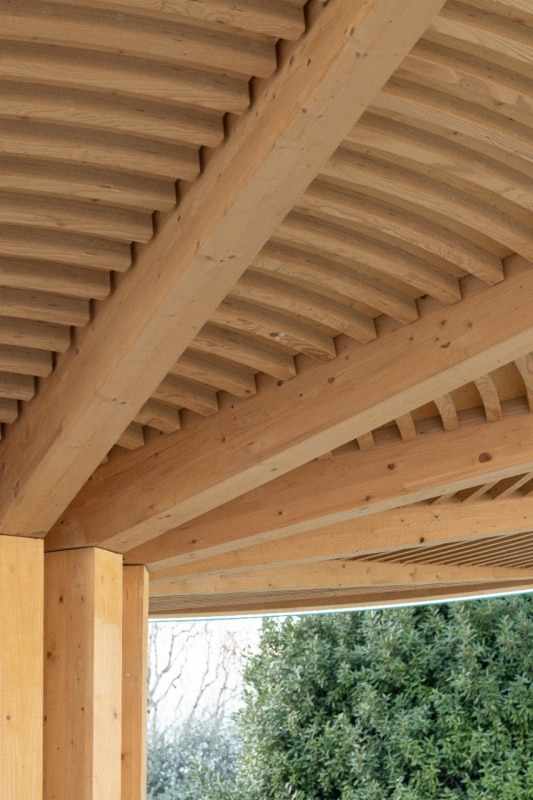
Everything revolves around a circular canopy made of laminated timber: twelve ribs anchored to a central core support a thin, light-blue roof, built from a renewable, low-carbon-emission material.
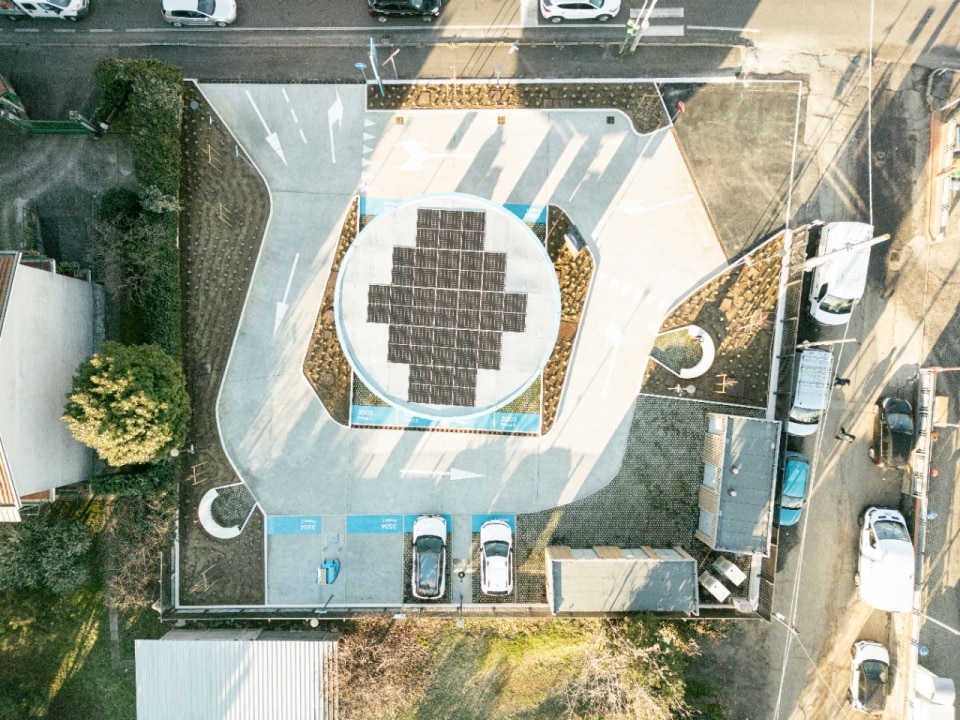
Above it, a photovoltaic system turns the surface into a small power plant that captures light. The slightly conical roof collects rainwater through an internal downspout, channeling it into dedicated tanks and reducing the structure’s dependence on irrigation networks.
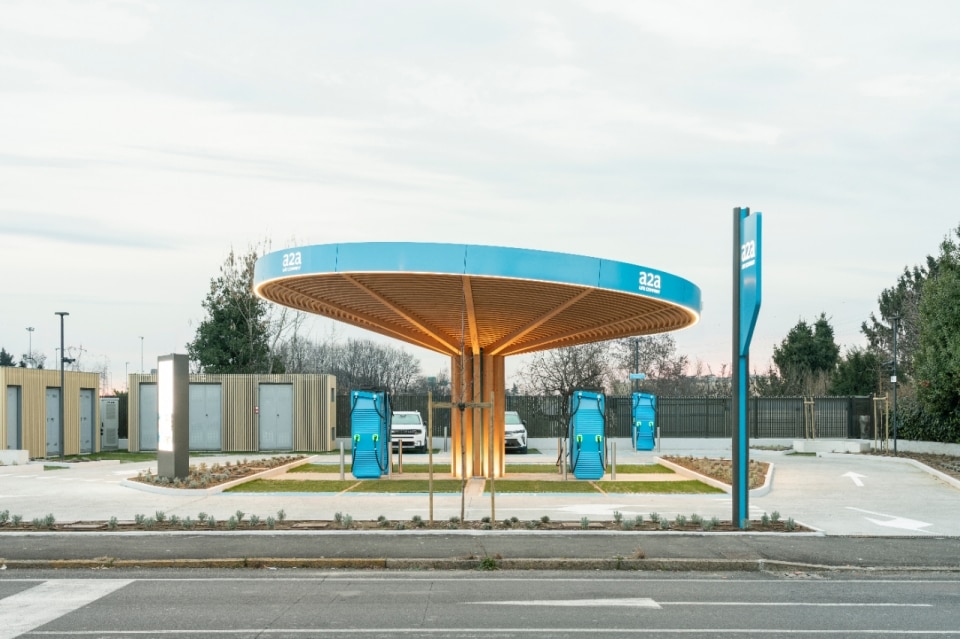
Around it, the project also works on the ground: permeable surfaces, draining pavements, and parking bays in grass pavers limit heat islands and restore porosity to a place that, by definition, tends to seal the soil.
Power Hub Monza generates what a service station usually consumes. It can be dismantled and reconfigured, like a pavilion. And it is likely that we will soon see similar ones outside Lombardy as well.
All images: Park, A2A Power Hub Monza, Monza, Italy, 2025. Photo Nicola Colella