


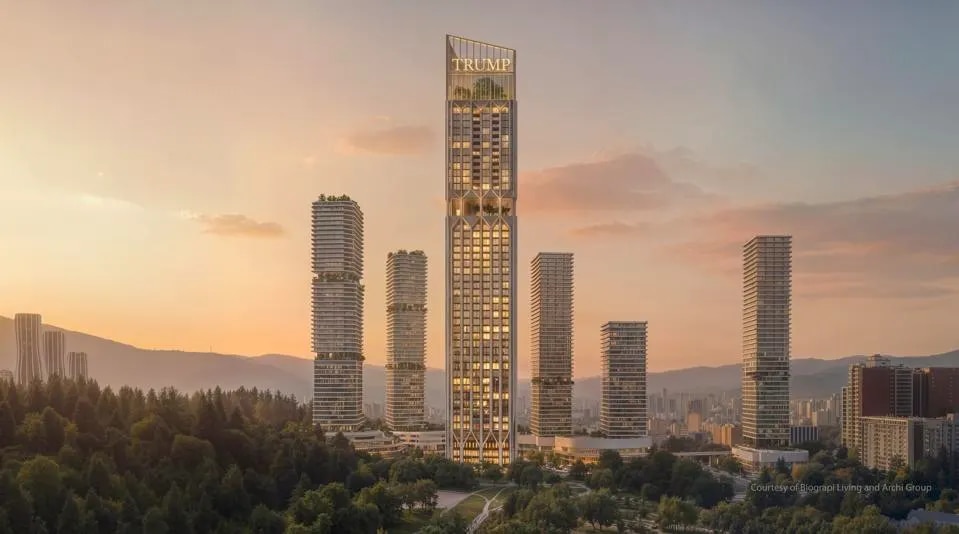
On 17 April 2026, The Trump Organization announced the new Trump Tower Tbilisi: a mixed-use skyscraper of approximately 70 storeys, designed by Gensler and destined to become the tallest building not only in Georgia, but in the entire Caucasus.
The announcement comes shortly after the cancellation of plans for a Trump International Hotel in Belgrade and relaunches the Trump franchise with one of its most significant additions. A global constellation recognisable like a fast-food or fast-fashion brand: five golden letters, in uppercase, as high as possible. But instead of mass products, The Trump Organization – “known for setting the benchmark of ultra-luxury living and architectural excellence,” its own announcement declares – exports “luxury residences, high-end retail, world-class dining and lifestyle amenities,” along with a promise of internationalisation, profit and legitimisation.
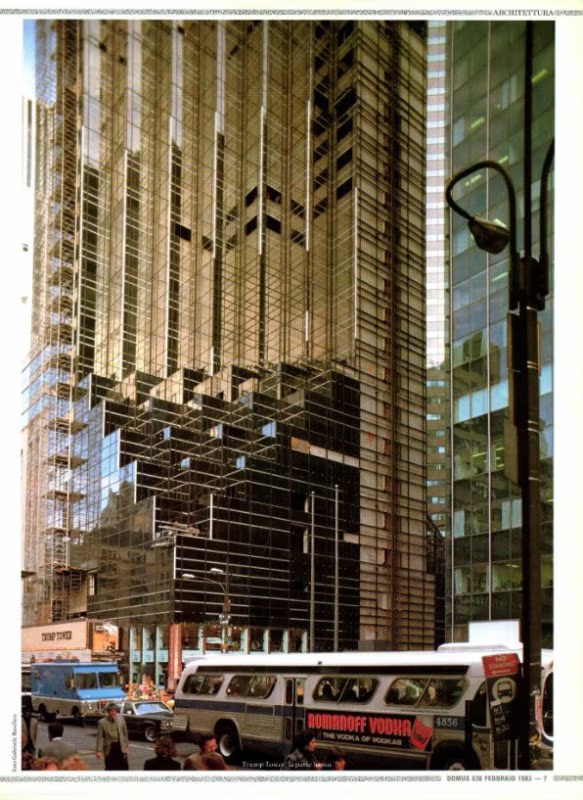
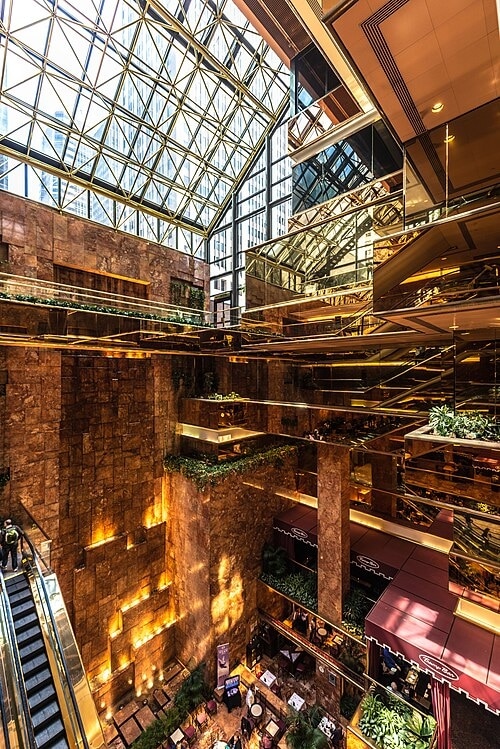
The first Trump Tower, built in New York in 1983, belonged to a specific moment in the city, when financial Manhattan invested in the verticality of the skyscraper as an icon of the new post-industrial economy. Domus, reporting on it at the time, cited the motto of the new real estate entrepreneurs: “good architecture is a solid investment.” Forty years later, the formula seems to have been simplified: architecture does not need to be “good,” it just needs to be recognisable, sellable, replicable.
The Trump Tower Tbilisi, more than an architecture, is the return of an old Georgian script and, at the same time, the updating of a global formula of real estate diplomacy.
Thus, the Trump brand has colonised Turkey, the Philippines, Uruguay and India, while Romania, Saudi Arabia and the United Arab Emirates are in its sights. Rather than focusing on the building itself, then, it is interesting to ask why this new “branch” is being announced today and specifically in Georgia.
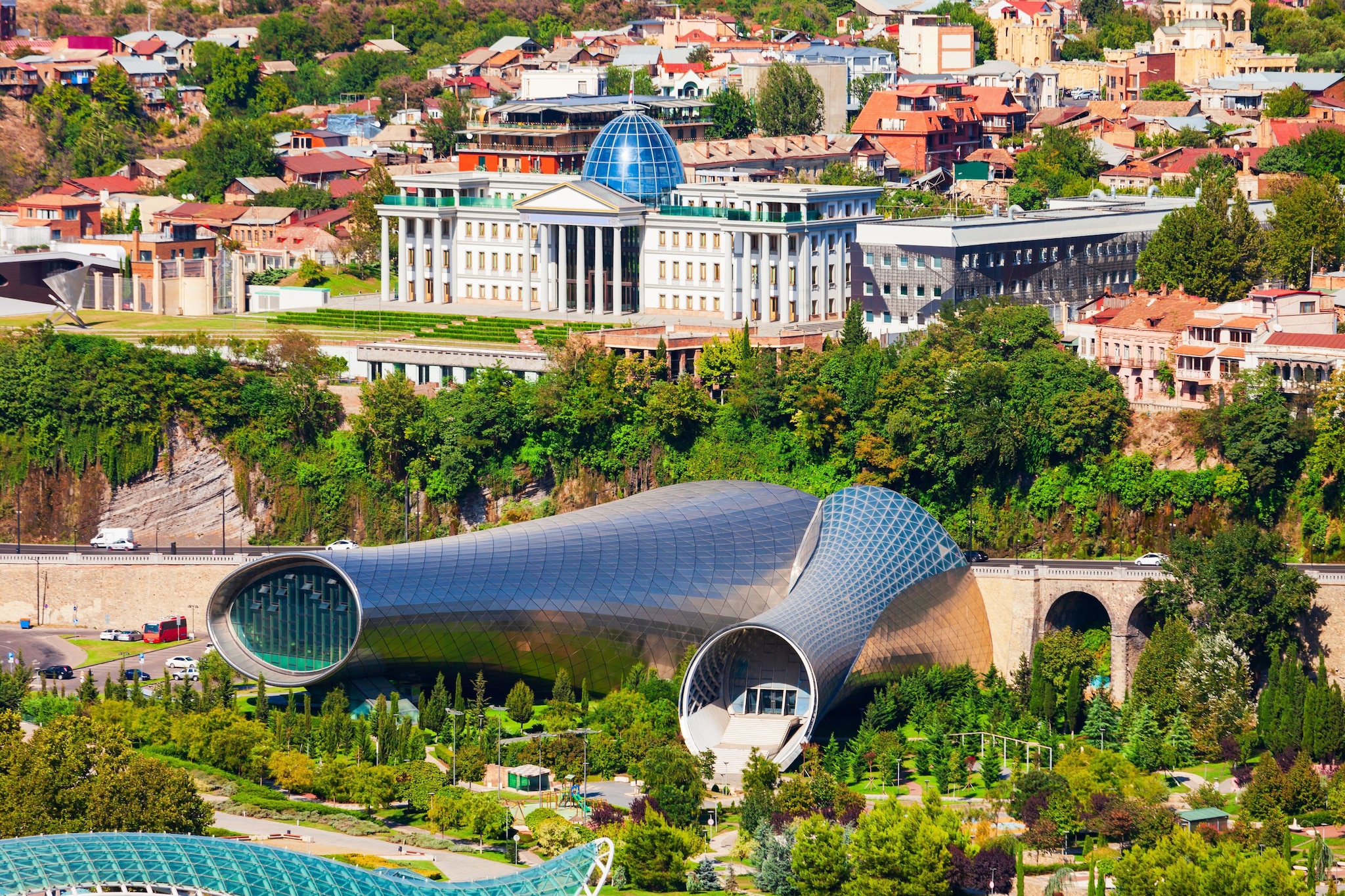



That is, why present Tbilisi as the “new commercial hub between Eastern Europe and Asia” at such a tense moment in relations between Georgia and the United States. At the end of 2024, the Biden administration suspended the strategic partnership with Georgia and sanctioned Bidzina Ivanishvili, founder of Georgian Dream, accused of supporting the country’s authoritarian and pro-Russian drift. Trump has not revoked those measures and has so far ignored Tbilisi on a diplomatic level.
The tower can therefore be read as an attempt to open a symbolic and economic pathway towards Washington: both to re-accredit themselves after the sanctions, and to avoid being marginalised by the Trump Route for International Peace and Prosperity, the connection between Armenia and Azerbaijan imagined as a node of the Middle Corridor between Central Asia and Europe.
A precedent called Batumi
To make this reading more plausible, there is a precedent. In 2012, Trump had already travelled to Georgia to announce, with then-president Mikheil Saakashvili, a 47-storey, 250-million-dollar Trump Tower in Batumi. According to Adam Davidson’s investigation in the New Yorker, that visit served to promote Saakashvili as a reformist and business-friendly leader. Georgian television celebrated the event by promising a second tower in Tbilisi; under a banner proclaiming “Trump invests in Georgia,” Saakashvili thanked the tycoon, who in turn spoke of the Georgian “great miracle.”
Forty years later, the formula seems to have been simplified: architecture does not need to be “good,” it just needs to be recognisable, sellable, replicable.
But even then, the real estate promise preceded the actual market. Giorgi Rtskhiladze, the mediator of the relationship with Trump, confirmed that in 2012 the luxury real estate market in Batumi was practically non-existent, but investors were convinced that a Trump-branded skyscraper would attract buyers. Instead of following demand and supply, Trump promised to dictate them: he sold a name, Georgia bought a narrative, the tower acted as an intermediary. After years of stalemate, the project was cancelled in 2017 with Trump’s arrival at the White House.
While during his first term The Trump Organization had stepped back from foreign deals to “avoid the appearance of potential conflicts of interest,” today that caution seems to have faded. According to Forbes, in 2024 Trump’s revenue from foreign licensing grew by 650%; the former head of the Office of Government Ethics, Walter Shaub, defined this new season as “the exact opposite of government ethics,” adding: “I suppose we would call it corruption.”
According to the Georgian press, the new tower is expected to rise in the area of the former Tbilisi hippodrome, on land linked to Ivanishvili. The very same Ivanishvili whom Biden sanctioned, and the same one who had dismissed the Batumi project: “Trump did not invest in Georgia,” he said at the time. “It was more like a trick. They gave him money, and they both played their part.” Today, similar accusations are aimed at him: Roman Gotsiridze, former head of the National Bank and MP, called the project “Bidzina Ivanishvili’s attempt to corrupt Trump.”
Making the project even more politically legible is the composition of the local partners, which includes Archi Group, one of the largest Georgian developers with over 18% market share, co-founded by Ilia Tsulaia, a Georgian Dream MP from 2016 to 2020.
Not that the opposition seems to have many alternatives, as demonstrated by the proposal of the Lelo/Strong Georgia party to name the controversial Anaklia port after Trump, ideally transforming it into the western “gateway” of the Trump Route.
The double face of Trump
To complicate the picture there is Gensler, presented by The Trump Organization as “the largest architecture firm in the world.” Author of projects such as Shanghai Tower and CityCenter Las Vegas, the firm transforms – or at least cloaks – what might appear as pure real estate licensing into an operation equipped with the consolidated grammar of global architecture: mixed-use, commercial podia, amenities, integrated greenery, landmarks for the skyline.
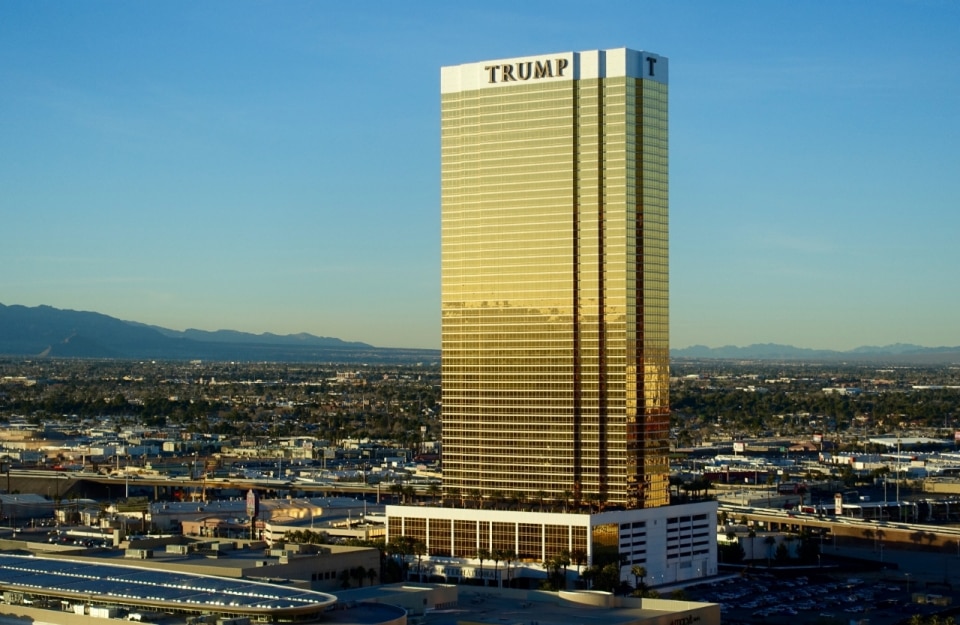
This confirms the dualism between the political Trump, who promotes a return to a classical and pre-modernist public architecture through the aesthetic program of Making Federal Architecture Beautiful Again, and the real estate Trump, who instead continues to build the world with glass and steel, rational volumes and contemporary forms.
Of the Tbilisi project, we currently have promotional formulas and a rendering, which shows – in addition to the multi-storey “TRUMP” lettering – gothic arches at the base and trees on the roof and inside an atrium in the upper half. Behind the protagonist skyscraper, five others stand out – unbranded and therefore lower and anonymous – composing the complex of The Tbilisi Downtown, a 2-billion-dollar development. Rather than the first New York tower, the project recalls Television City, the mega-development proposed by Trump in 1974 on the West Side of Manhattan: a super-block of extremely tall towers, including a 150-storey building then imagined as the tallest in the world. Real estate and architecture critic Michael Sorkin wrote in the Village Voice: “Trump’s third try for the world’s tallest building… was there ever a man more obsessed with getting it up in public?”
For now, Trump will have to settle for the tallest building in the Caucasus. The Trump Tower Tbilisi, more than an architecture, is the return of an old Georgian script and, at the same time, the updating of a global formula of real estate diplomacy: the skyscraper as a franchise, licensing as urban planning, architecture as a respectable interface between capital, reputation and power. A monument to one’s own surname remains perhaps the most conspicuous way to mix foreign policy and business.
Opening image: Entrance to Trump Tower on Fifth Avenue, New York. Photo: Ajay Suresh. Via Wikimedia Commons