


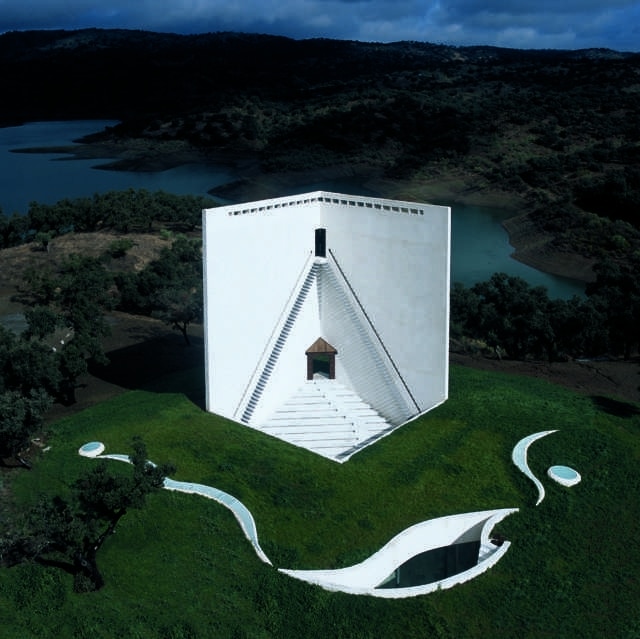
Forty kilometers from the chaotic heart of Seville stands a truly unique building: the Casa de Retiro Espiritual by Emilio Ambasz, the Argentine architect and designer widely regarded as a pioneer of green architecture.
Designed in 1975 but completed only in 2000, the house quickly became a symbol of Ambasz’s radical and visionary approach to architecture. It was later selected as a central work in the exhibition “In Depth” at Museum of Modern Art in New York between 2005 and 2006.
Today, fifty years after it was first conceived, the Casa de Retiro Espiritual still speaks to how radically we can imagine — and transform — the spaces we inhabit.
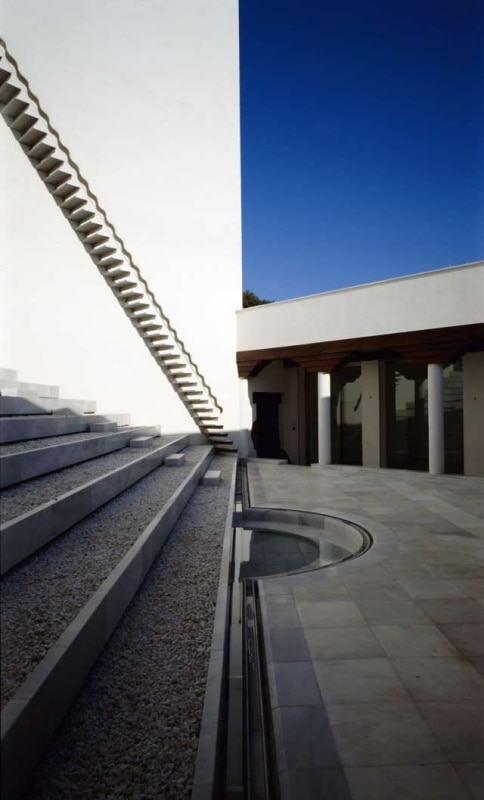
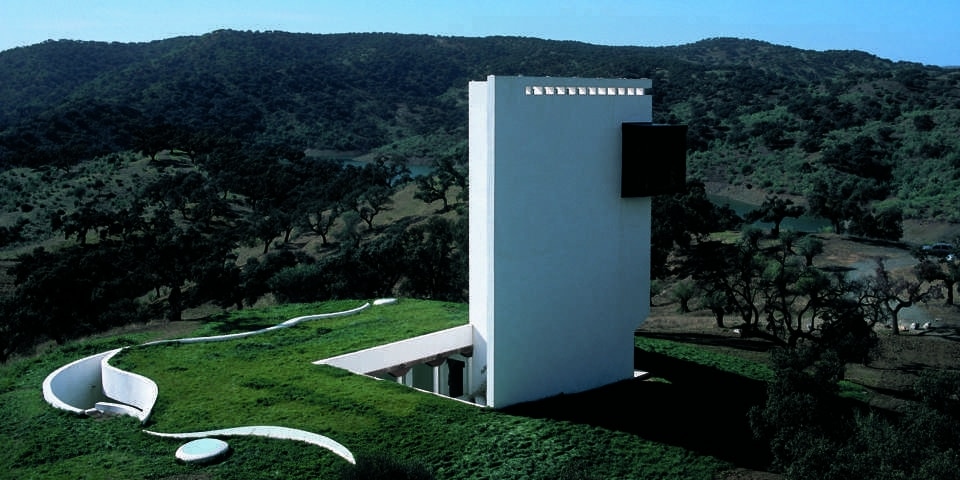
The building sits at the center of a vast estate. All around lie the green hills of Andalusia and, further in the distance, the Embalse de la Minilla, a large artificial lake. From the road, only a thin, pale rectangle is visible far away — almost like a sheet of white paper suspended in the wind. In stark contrast to the constantly moving city, the Casa de Retiro Espiritual, commissioned by a private client, was conceived as a quiet weekend retreat.
If a work of architecture does not touch the heart, it is just another building.
Emilio Ambasz
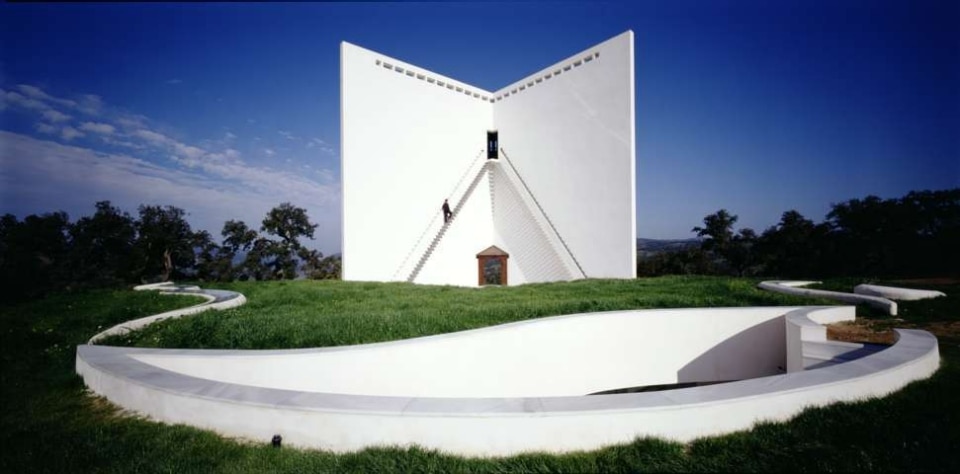
The layout draws inspiration from traditional Andalusian houses, typically organized around a central courtyard — but with a decisive twist. Ambasz’s design is enclosed on only two sides, defined by two tall walls forming a right angle. Above these walls, however, there is no roof. The remaining edges of the courtyard unfold organically through undulating volumes that echo the gentle shapes of the surrounding hills.
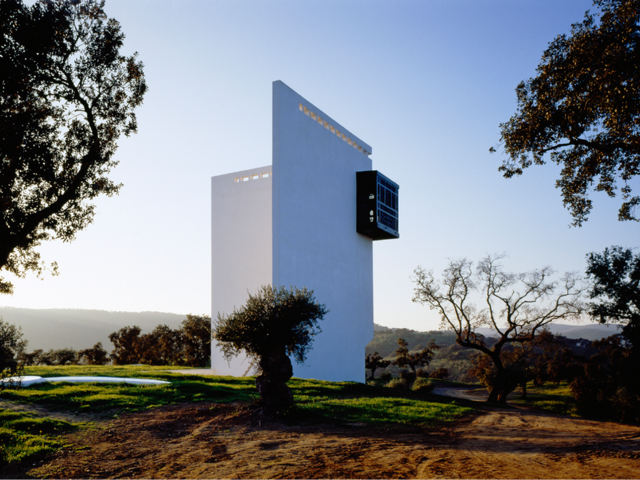
The Casa de Retiro Espiritual is the opposite of what it appears to be. The walls exist, yet they do not enclose the living space; instead, the architecture merges with the landscape. The interior rooms also open toward the courtyard, drawing light from it.
Covered with soil from the site, these spaces are almost invisible from the outside. This solution not only integrates the house into the landscape but also provides natural climate control, especially important during Spain’s hot summers. Conceived in the 1970s, Ambasz’s intuition anticipated by decades many sustainability practices that are now considered standard.
Far from being a secondary aspect, this idea of sustainability would become a cornerstone of Ambasz’s work. His vision of the relationship between architecture and environment was far freer than that of many of his contemporaries. At a time when numerous radical projects staged dystopian futures, Ambasz instead sought reconciliation between nature and architecture, creating works that are at once monumental and introspective.
“I see architecture as the search for a spiritual home,” he said. “An architect can be the guardian of the desert of man-made cities, or the magician who creates eternal forms. But the task remains the same: to give poetic form to the pragmatic. If a work of architecture does not touch the heart, it is just another building.”
Half a century after its first drawing, the Casa de Retiro Espiritual still stands as a lens through which to read Ambasz’s later work — and as a powerful demonstration that the way we inhabit space can, and must, be continually questioned and reimagined.