In–finite Architectures 2

In Santiago de Compostela, the City of Culture by Peter Eisenman.

Santiago is a small city. It has just over 100,000 inhabitants, but twice this many people flow into the city every day. Having a university and being a major tourist destination of northern Spain, Santiago is the administrative capital of the autonomous region of Galicia. The city lies in the middle of an old mountain range, weathered into gentle, rolling hills that are always green thanks to frequent rain. One of them, a scant two kilometres from the old city centre, is Mount Gaiás, where the Ciudad de la Cultura, or City of Culture , is under construction, visible from many parts of the city.

The history of the City of Culture started in Bilbao, where the Guggenheim Museum has averaged more than one million visitors per year since it opened in 1997, a great boon to the Basque economy and society. The Bilbao Guggenheim has been the drive behind the transformation of a city that was weighted down by its steel manufacturing past; it has attracted fresh businesses and tourism for the whole region.

Seeing the advantages, most politicians are now pursuing the same formula in their own regions. In 1999, an international competition for the design of a City of Culture in Santiago was proposed to 11 architects—Ricardo Bofill, Peter Eisenman, José Manuel Gallego, Annette Gigon & Mike Guyer, Steven Holl, Rem Koolhaas, Daniel Libeskind, Juan Navarro Baldeweg, Jean Nouvel, Dominique Perrault and César Portela. Their proposals with respective models are kept on display in an underground space at the new complex. Each project clearly reflects the creative mind behind it; each is entirely different. Possibly the most evocative is Eisenman's, which seems to fit in best with its surroundings thanks to an organic, sculptural appearance that is at once a link to the environment and an elegant referral to the city. The wooden model in itself heralded a fine project.
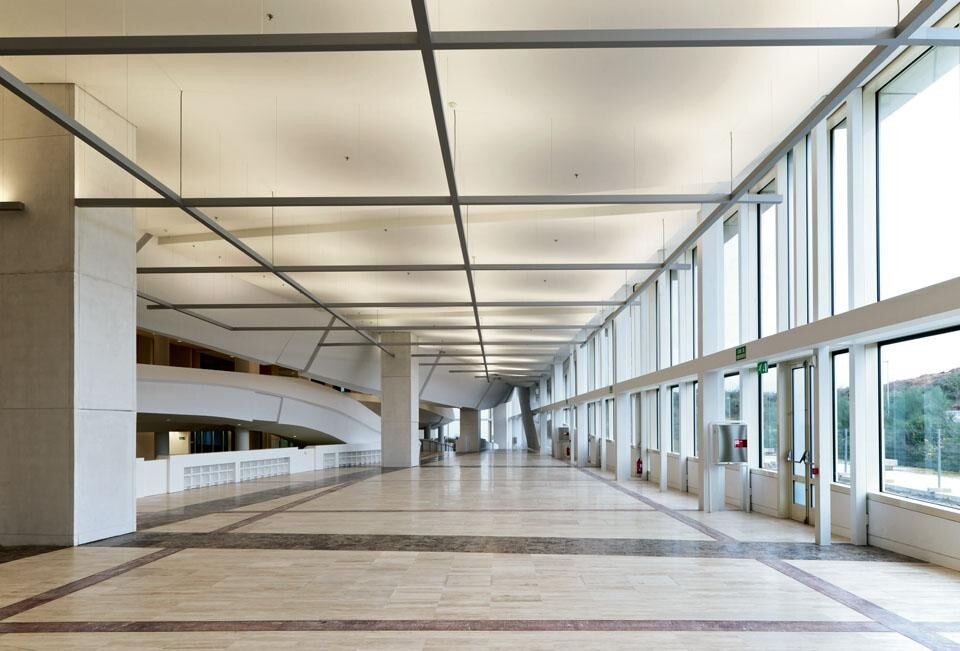
The language of geometry attempts to give cohesion to the complex; it is everywhere present in the roofs, the interior volumes, and the smallest details of the pavement.
More specifically, the proposal results from combining several points of reference: the urban layout of the medieval city of Santiago and the truncated hill of Mount Gaiás, where the complex stands. The two are woven together like a Scottish tartan in a functional scheme that moulds itself flowing over the land. The final reference is a pilgrim's scallop shell, which I fail to find in the project despite my best efforts. These intertwined features have been turned into a huge sprawl of architecture, a product of overwhelming complexity.

The figures are just as staggering: the site extends over 680,000 square metres, of which 220,000 square metres are being used for urban development; buildings occupy an area of 60,000 square metres, with a total constructed surface area of 140,000 square metres. The construction work should have finished in 2005, but the library (15,202 m2) and archives (11,225 m2) were opened on January 11, 2011, while the museum (20,734 m2), a music and performance centre (34,430 m2), an international art centre (13,685 m2) and general amenities (6,291 m2) have yet to be completed. It is hoped that the entire complex will be finished by 2017, with an overall cost that is said (off the record) to exceed 500 million euros—five times the original estimate.

The main question may well be, does this make sense after all the political and financial considerations have been made, given the current difficult situation and the constantly changing programme? If we only analyze the architectural project itself, the answer is more complicated because we are looking at a well-approached but sadly unresolved problem.
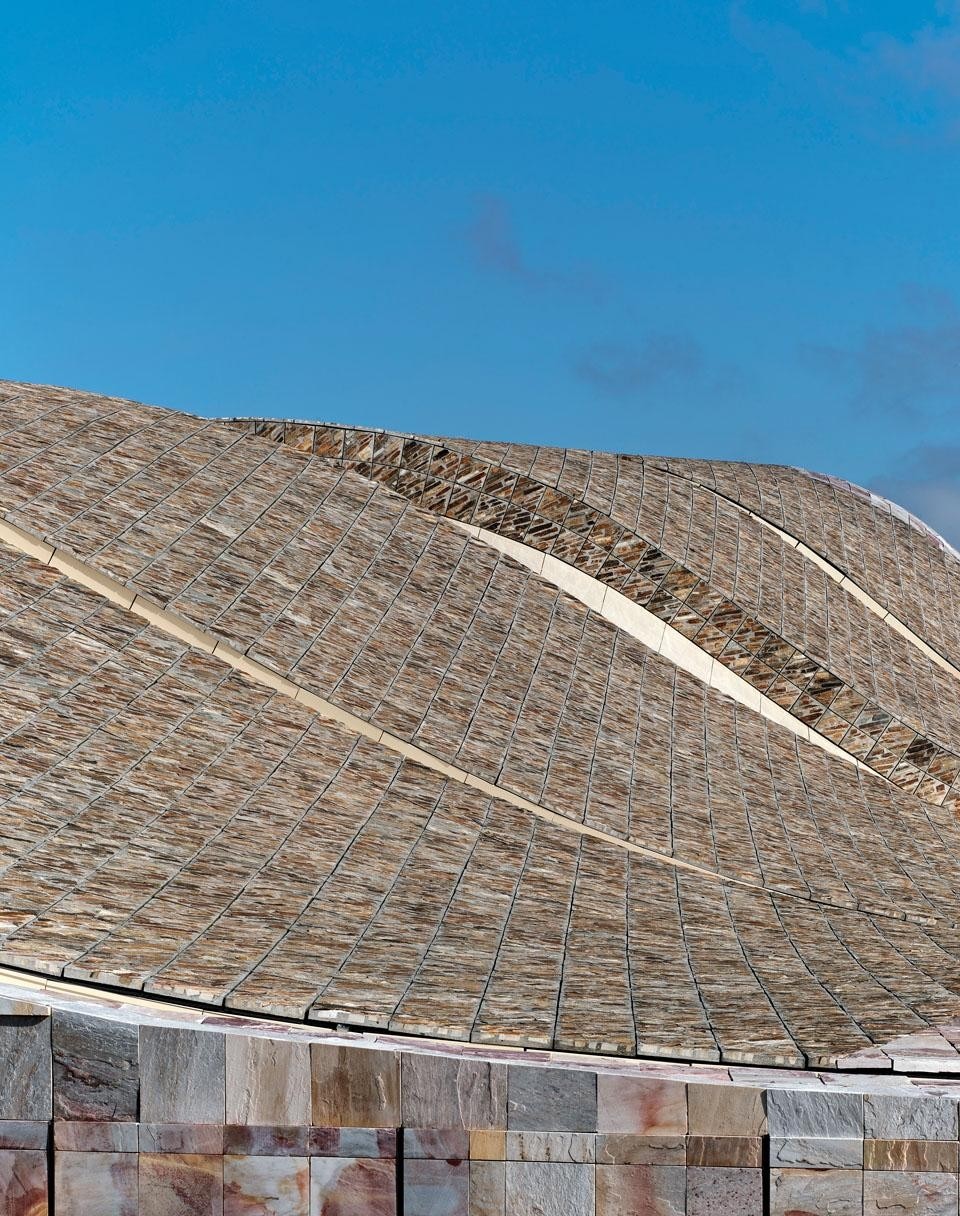
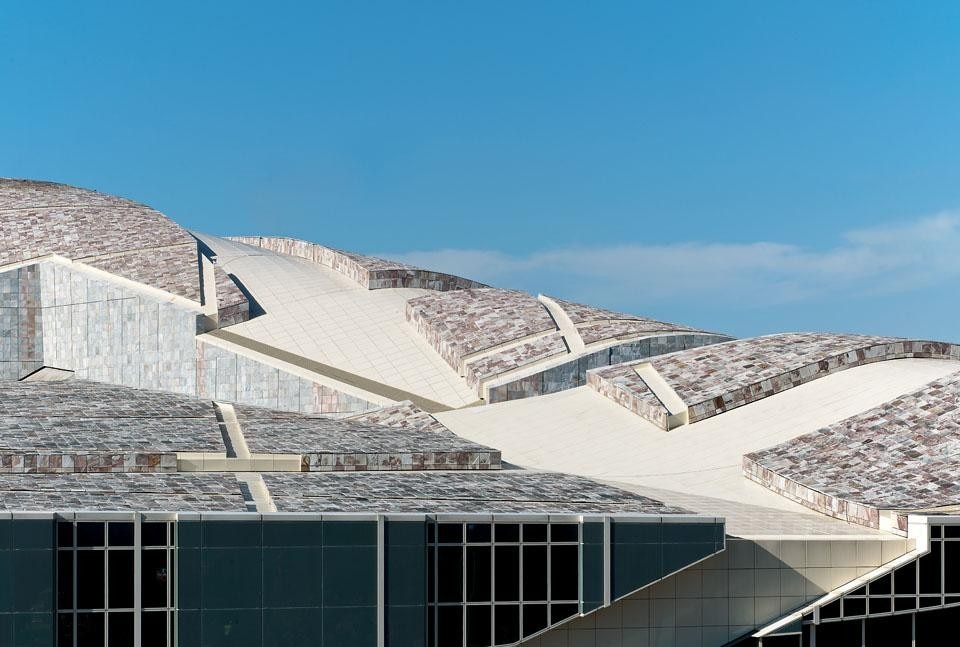
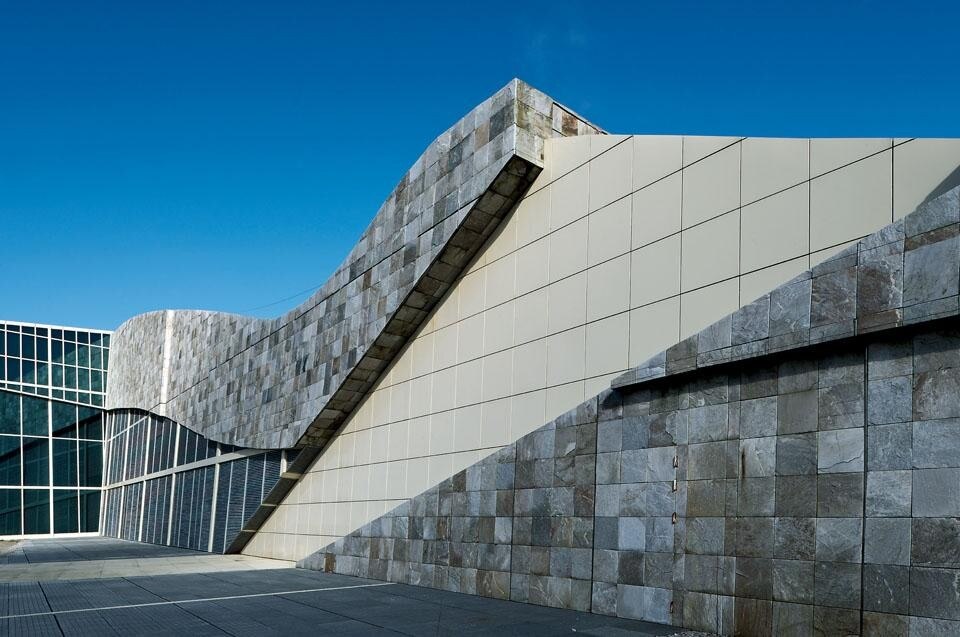
Geometry is the dominant theme of the whole project, both inside and out, starting from the general plan in which imaginary lines—Eisenman’s reference to ancient local pilgrimage routes—are superimposed on a Cartesian grid and then distorted by the orography of Mount Gaiás. This texture is also applied to the roofs. Installed on a metal frame, they are faced in stone engraved with a geometric pattern.
The project has developed into an act of faith, with Eisenman as its perpetual preacher. With moving candour, a "chapel" has been erected at the side of the road in one of the deserted constructed areas. Here, the architect conducts his ceremony, using a huge flat screen. At the back of the room, huge models and audio-visual displays, also shown at the Venice Biennale, seek to explain the project to converted visitors. Liturgy hangs in the air.

But architecture is born more out of reason than faith.

The initial idea of removing the top of the mountain and re-creating it with buildings involved the removal of one million cubic metres of soil and has produced some enormous and intriguing humps on Mount Gaiás. Despite efforts to disguise them beneath a mantle of stone, they do not blend in with the landscape. There is an issue of scale that not even time will resolve. The presumption that the concept behind the superimposition of all the interwoven elements will solve every problem is a naïve dream that can only end in tears. Instead of converging, the composition patterns tend either to break away from each other or clash.
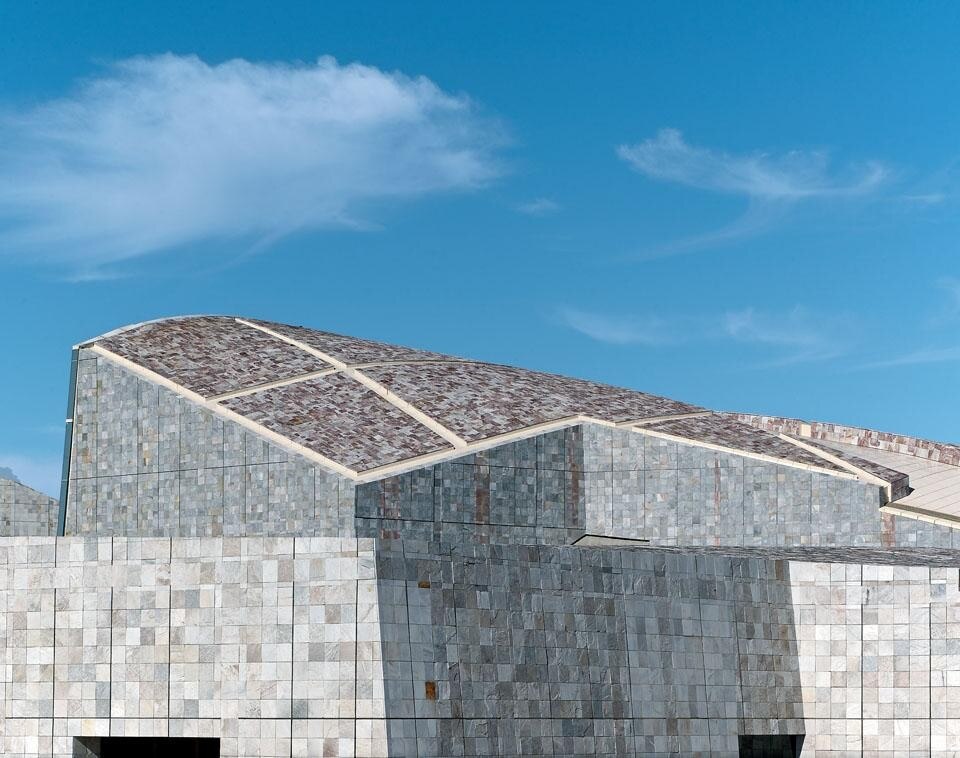
This leaves major parts of the buildings unresolved and another act of faith based on false ceilings and wall cladding is required in an attempt to remedy the impossible. Hundreds of built cubic metres remain sterile, concealed in hidden areas or assigned to unlikely functions.
The presumption that the concept behind the superimposition of all the interwoven elements will solve every problem is a naïve dream that can only end in tears. Instead of converging, the composition patterns tend either to break away from each other or clash.
Construction work began in 2001; the complex houses a library, an archive, a museum dedicated to Galicia, a musical centre, an international art centre, and general services.
The geometric statement, or rather the imposition of a geometric weave, tries to lend cohesion to the whole. It is present in the roofs, the interiors and even the tiniest details of the flooring but, despite its predominance, it is too weak to offset the force of the constructed mass. In the end, we see two conflicting proposals applied indoors and out, which turn the whole concept into little more than a decorative anecdote.

On the day of its inauguration, Peter Eisenman explained to television cameras how "in 50 years' time, this complex will be a Mecca for people who want to know what architecture was like at the start of the 21st century." A strange definition for a building designed in 1999, with serious shortcomings in terms of sustainability and vague content.
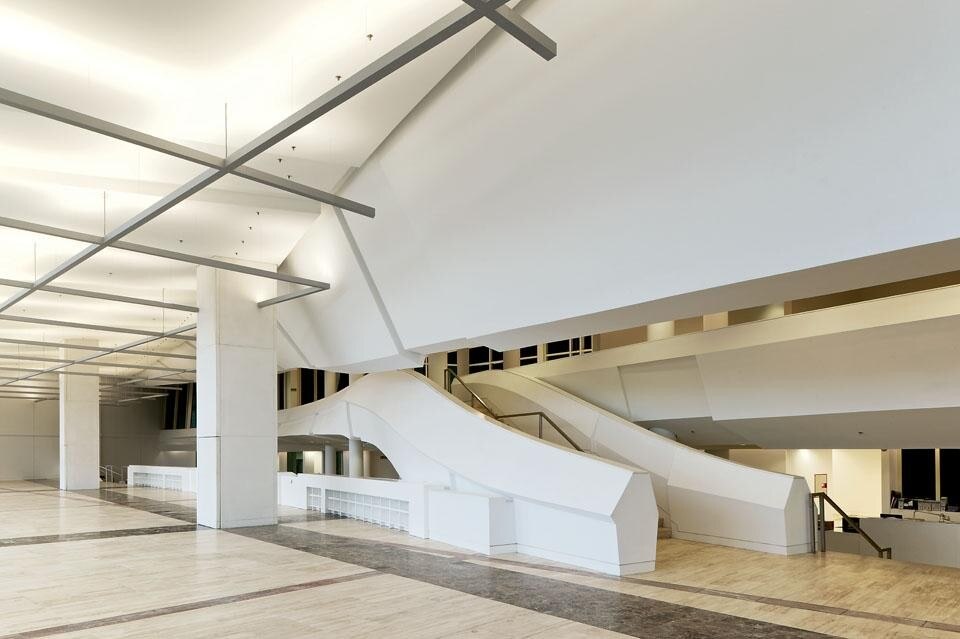
The complex occupies an area of 60,000 sq. metres, with a total area of 140,000 sq. metres under development.
Born in 1932, Peter Eisenman is a practitioner, educator and theorist of architecture. In 1967, he founded the Institute for Architecture and Urban Studies. He was a recipient of the Leone d'Oro career award at the 2004 Venice Biennale and is currently the inaugural Charles Gwathmey Professor at the Yale School of Architecture. His book Written Into the Void: Selected Writings, 1990–2004 came out in 2007.
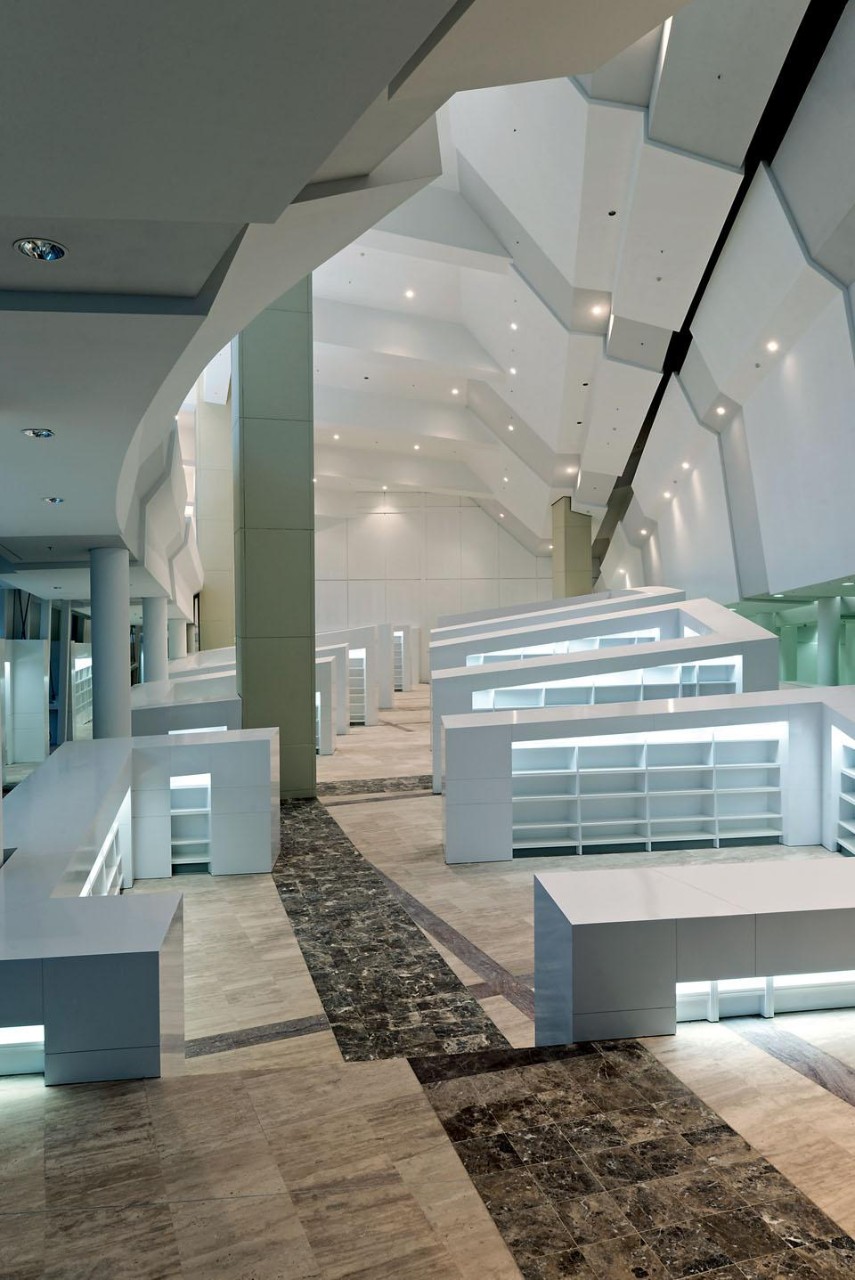
The library and archives opened in early 2011. Still under construction are the museum, music and performance centre, international art centre, and their general support services.
The interior of the library and newspaper archive.

Latest on Architecture

Latest on Domus

China Germany India Mexico, Central America and Caribbean Sri Lanka Korea icon-camera close icon-comments icon-down-sm icon-download icon-facebook icon-heart icon-heart icon-next-sm icon-next icon-pinterest icon-play icon-plus icon-prev-sm icon-prev Search icon-twitter icon-views icon-instagram