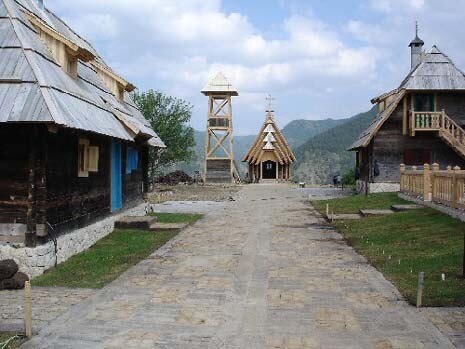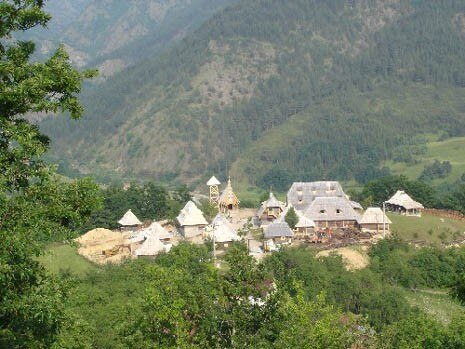
December will see the release in Italy too of the latest film by Emir Kusturica, presented at the last Cannes Festival, Life is a Miracle. Once more, as with all his films, production times were long, outside all world standards for film production. Filming lasted 14 months and, this time, the schedule was partly dictated by the local weather conditions where the film was being made. Winter snowfalls abound on the Mokra Gora mountains, in the Serb Republic, on the border with Bosnia. This forest is unique in Europe, with three different tree species managing to co-exist, three species that only manage to grow together in the same habitat in these mountains. It was there that Kusturica, while filming, decided to construct an entire village.
I met Emir on the night of 13 July in Lyons. The No Smoking Orchestra concert had just ended with fireworks announcing the 14 July celebrations; the audience that filled the Roman theatre would not stop dancing and kept calling for music. I have had an opportunity to follow the projects that Kusturica has carried forward outside the cinema in recent years close up, and I wanted him to tell me where the idea of building a village came from, how it is linked to his latest film and what he hopes it will become. These are his words:
“If I think of Underground (the film that won the Golden Palm at the 1995 Cannes Festival), I cannot fail to admit that Life is a Miracle is a symptom of a reascent, a return to the open air; my film is always the same; it is the same film I have always made and that I will continue to make for the rest of my life. It is simply the usual framework with the odd variation. The cinema is my means of expression. If I were an architect, if I were exclusively a musician, I would always do the same thing: fight my sad, dark side by setting up this sort of carnival fiesta to improve and make my life and those of others more enjoyable. This is the general idea I have had since I was very young. The aim of my aesthetics is to help the natural environment around me and live my life focusing on happiness, trying to trigger positive reactions in those around me. The cinema is a direct means of communication that reaches many people and influences people’s lives. We should not, however, forget that a film is defined by a rigid architectural structure. If it were not, the film would be like a house that seems about to collapse any minute, and you realise it even if it doesn’t show. I say this because space and time are the cinema’s essential tools; if you do not accept this, you will never make a film. If you do not have a precise definition of space, you will never construct a film, and timeless space has no meaning. The cinema is the most obvious confirmation of this fact.
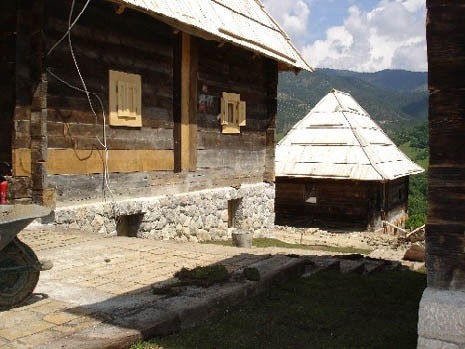
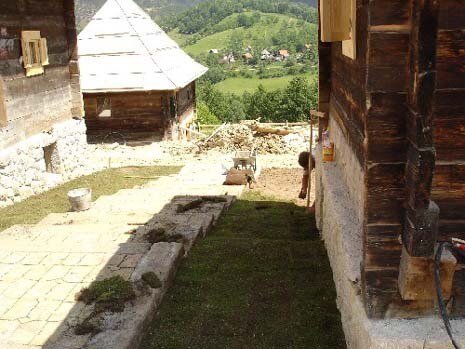
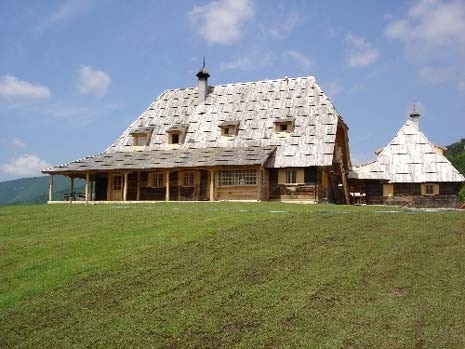
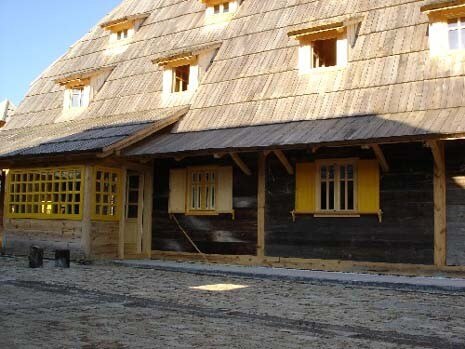
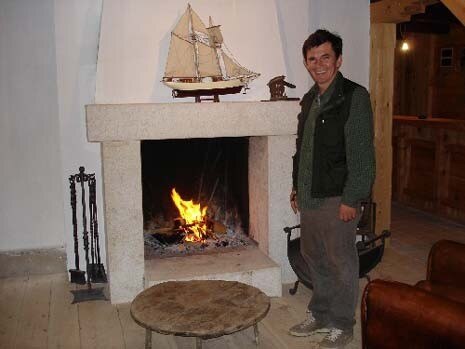
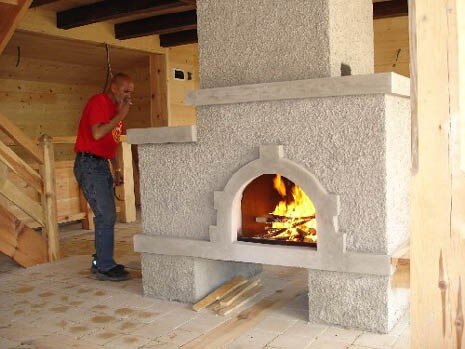
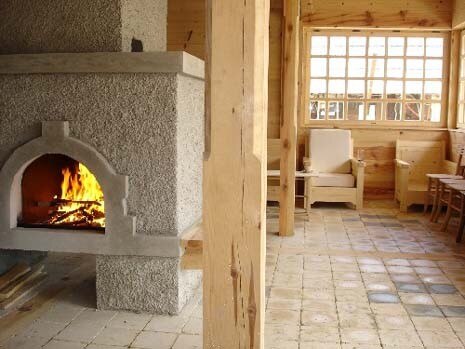
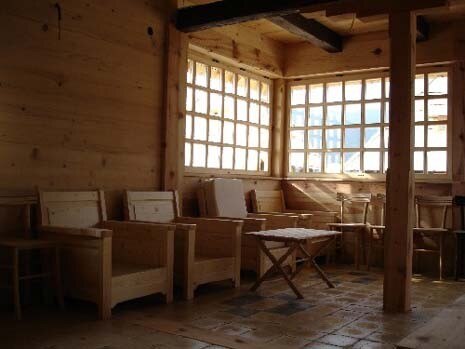
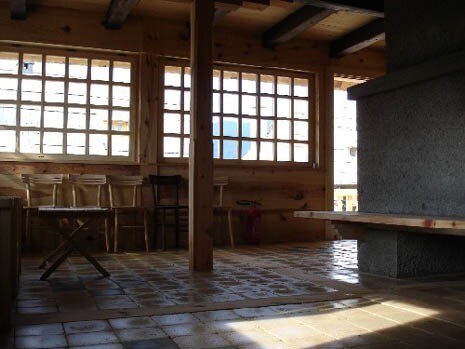
The village I am building is the best film I have ever made; yes, it is a film you can walk through and touch! It is certainly conditioned by my romanticism, my vision of space, a sort of fairytale in which beauty is separate and defended by the rest of the world. The most wonderful thing is the material we used: I bought some old deserted wooden houses typical of the area, dismantled them and reconstructed them in the village. I completely rethought the interiors. Any architect could have designed the village, maybe better than it is, but never like that. Now visitors seeing it for the first time ask me what film I am going to make there. We should remember that, during the Renaissance, every square was a stage where the people moved about; they would pass through going to work and again on their way back, sad, slowed down, happy. I understood this looking at Italian squares and I wanted to create a mixture of Renaissance and baroque with a simple attractive appearance, just like the old houses I used. They are incredibly simple but monumental and exciting at the same time. All this is a film made without celluloid - the manner in which I used the surrounding hills, the creation of the empty spaces…
I do not know who will live there yet, but I imagine a group of people will stay and work there permanently; we have envisaged the possibility of accommodating up to 50 people, as many as can come in a coach and for whom I want to organise a number of activities and seminars. We will fill their time so that they will not find the time to switch on the television and watch a soap opera. This idea is very similar to that of the 1960s’ communes but we know full well that it is impossible to make so many people live together in such a small place for more than three months without them starting to argue furiously. It will be a place that holds seminars so that the people can have a pleasant experience learning to make pottery, jam, beer and to make a film. We are thinking of 4/5 standard subjects around which to create workshops. I want to call it The Friends of the Arts and Cinema Club! The truth is that I am still searching for a name and at the moment I have the amusing idea of calling it Kunstendorf, but I am not fully convinced yet. I cannot wait to go back to the village. It is like going back to a new-old place; it is a bit like the fairytale place we have all dreamed of … and I feel that I am making progress - from the virtual world of shadows in the dark towards the real world.”
Emir Kusturica is Honorary Chairman of the Fondazione Edison in Parma, which has followed his realisation of small-large projects over and above his work as a film director since 1999. The Fondazione Edison collaborates in the conception and organisation of the seminars to be held in the village as soon as work is complete; it also organised and promoted the first European tour of the No Smoking Orchestra in 1999/2000; it co-produced a short documentary film Super 8 Stories in 2001, which, almost like a personal diary, describes the backstage activities of the No Smoking tour; it produced the two contemporary art installations that Emir has created in recent years: in 2000 Underground, an installation for the Stanze e Segreti exhibition, held at the Rotonda della Besana in Milan by Cosmit to a project by Luigi Settembrini and curated by Achille Bonito Oliva; and the large installation A Land looking for a Continent created with Mladen Materic for the Valencia Biennial in 2001, directed by Luigi Settembrini.
These experiences have brought him closer to the public and pushed his interest towards the creation of a space in which to reflect and study this link:
“Music and art installations enable you to feel the other part, the subliminal one. When you are on a boat gazing at the sun setting on the horizon, you realise there is something else behind the sun. What? Beyond, there is a sense that can be acquired organically through the catharsis produced by the music and the artistic creation and it redefines the whole story.”
All these projects help him fight the monster that has always terrified him: cultural globalisation. He has always sought to stress his interest in a certain degree of globalisation, which he deems necessary, but he reminds us that it is what used to be known as “internationalism”. What he continues to fight against is, instead, what he called cultural “colonisation”; it makes people believe that they must lose their identity in order to become a part of the world, when actually the loss of identity makes us permeable to the culture imposed by the economically stronger countries. We are moving towards a society in which culture is no longer considered an integral part of a country’s identity. The global world. He greatly fears this and says: “I want to know the difference between the humidity of my skin and that of another’s, not so that this may become a weapon against the other but in order to know what I can contribute to the world”.
His renewed interest in nature goes in this direction again: “Nature is the subject we must fight for today. I have lost the will to fight to preserve life in the cities; that is why I have moved to the village beside the forest. Last winter, while we were constructing the village, I went for a short walk in the snow, going just a hundred metres or so from the constructions, and I encountered a wolf. The wolf looked at me without moving and without showing any fear and I was not afraid either. This was because I had no weapon of which it could smell the oil on me. So, we looked at each other and I discovered the nature of nature: if you do not attack nature, but encounter it, you will not be a victim of it the way nature is the victim of humanity. What is still left of the fascinating natural cycle is what you can still fight for and of which you can be a part. This is the meaning encountering a wolf has in today’s life. In this country (France), there are no wolves left; they have killed them all. There are still many in my country, former Yugoslavia, so you can still understand that true nature breathes, that the cycle exists and that you can be a part of it even if you are a hunter, a good hunter, who helps to maintain a balance, which is part of the natural cycle of things”.
F.S.
The camera leads us through an intricate system of underground passages and caves, travelled by vans, carts, mules, soldiers and wayfarers, which – we discover – winds unendingly through the subsoil of all Europe. Or it scours desolate steppes to the rhythm of a military march, before stopping at points where banquets, celebrations and weddings explode like flames. Or it wanders through the camp of a group of gypsies, and suddenly rises from the ground, taking off behind the rising body of a young Rom. Then, from on high, it observes the poor suburban margins of one of our cities. These were the images going over in my mind shortly before meeting Emir Kusturica in Rome. I thought of his mysterious, swarming landscapes, of the nomad and mixed-blood people that lives there and how much it had helped us – far more than learned commentators – to decipher the geopolitical kaleidoscope of the Balkans. I was thinking about how – apart from his (controversial) stances on the war that retraced the former Yugoslavia - Kusturica and his “history-love films” have implicitly give us a perception of the various sensibilities that are aroused in the peoples that inhabit those lands, so near and yet so far.
I was also thinking how the relationship between cinema and architecture – the object of tedious academic dispute – can suddenly come alive when fuelled by a cinema such as his - a flow of moving images capable of conveying scraps of direct experience via the manipulation of time. This cinema is so good at editing (as explained in a fine essay by Caterina Duzzi) that it forces us to swallow slices of space in a flash; or holds us in a tense delirium freezing the gaze on one place for interminable minutes, before perhaps prompting a little introspection, inside the chambers of our childhood memory.
In the last 20 years, Kusturica has taken us on a journey and given us pieces of memory. A useful memory that will never leave us.
In Rome, Emir Kusturica had come to speak of something else, however. He projected pictures of the village that had just been finished – to his design and concept – on a small plateau amid the forests enveloping the mountains around Belgrade on the large screen of the former Aquarium (transformed into a hub of discussion and events by the Architects’ Association and the city authorities).
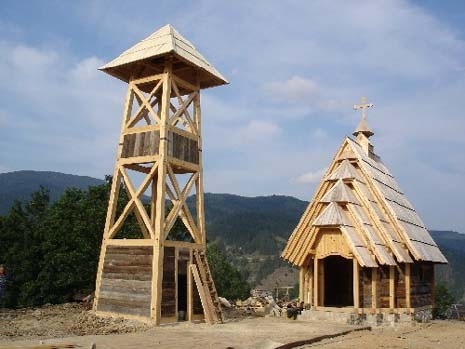
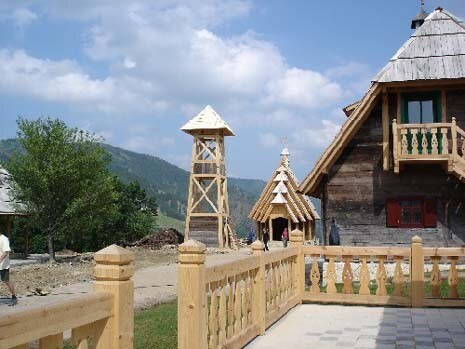
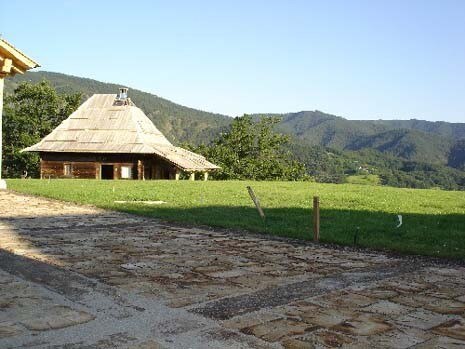
It is a village for 50 inhabitants, built with wood (three types of tree) from the forest and by retrieving parts and beams from old mountain dwellings. The houses – all in an unlikely “vernacular-baroque style” with gable roofs, are arranged around a main street that ends with the view of an orthodox church, also in wood. Also in wood is the unsettling watchtower beside the church.
The idea of the village originated while he was making his latest film Life is a Miracle, presented at the last Cannes Festival and set in this very region. A few weeks ago, Francesca Sorace prompted Kusturica to explain the genesis of his constructed Utopia:
“The village I am building is the best film I have ever made; yes, it is a film you can walk through and touch! It is certainly conditioned by my romanticism, my vision of space, a sort of fairytale in which beauty is separate and defended by the rest of the world… Any architect could have designed the village, maybe better than it is, but never like that. Now visitors seeing it for the first time ask me what film I am going to make there. We should remember that, during the Renaissance, every square was a stage where the people moved about; they would pass through going to work and again on their way back, sad, slowed down, happy. I understood this looking at Italian squares and I wanted to create a mixture of Renaissance and baroque with a simple attractive appearance, just like the old houses I used. They are incredibly simple but monumental and exciting at the same time. All this is a film made without celluloid - the manner in which I used the surrounding hills, the creation of the empty spaces…”
But the village in Kusturica’s style is neither a film nor even a personal whim. It will accommodate 50 people (“as many as can come in a coach”) and be governed by a mayor (him) who, instead of being chosen by his citizens, there can be chosen freely, totally undemocratically”. It will have an educational vocation. It will be “a place that holds seminars so that the people can have a pleasant experience learning to make pottery, jam, beer and to make a film. We are thinking of 4/5 standard subjects around which to create workshops. I want to call it The Friends of the Arts and Cinema Club!”
I tried asking Kusturiza what part of his inner world his model-village sprang from. Where this Serbian-style version of a hybrid of Serravalle shopping outlets and tropical holiday village originated. Where, above all, would the protagonists of his films find a space: Azra the Rom, Marko the commander, Jelena the bride or Malik the young sleepwalker. Where would that sea-roving and grotesque humanity be accommodated; where would the weddings be celebrated, the parties held, the suicides... Basically, how could that regimented and monotonous space accommodate the rhizomatic and unconquerable life that flows through his films, and also right outside the wooden walls of his village. Nothing. The film director born in the Sarajevo hills was not in the least interested in talking about it. For once, the reality was stronger than any picture or word.
Then, as I was leaving the room, I realised my mistake.
This closed autarchic settlement, a celebration in wood and stone of an imaginary local identity, yet certainly inspired by Great Serbian mythology, is merely the umpteenth confirmation that - as Kusturica has himself repeatedly argued - “the cinema is always larger than life”. Perhaps that village, apart from all its aims and programmes, will end up being the set of a future film. Who knows, then, whether in a few months or years, a caravan of gypsies, street artists, ex-soldiers and prostitutes will chance to climb up to that plateau and have fun wrecking that poor wooden ghetto. Freeing who lives there and who conceived it from their obsessions.
S.B.