The final phase of Vienna’s sprawling new museum quarter, housed in what were once the stables of the Hapsburg’s imperial palace, is the opening of the new home of the city’s architecture centre, the AZW. One by one a series of new museums has opened since the summer (see Domus 841). The new architecture centre transforms an institution that has until now been operating from temporary premises, pushing it into a new stage in its development.
The new 2 000 square metre centre opened last month with a gala preview for its first show, followed on the next day by a party that spilled out into the open air in the museum’s courtyard.
Dietmar Steiner, the centre’s director has been working on the project since 1992, and has established the institution with an energetic exhibitions programme, international conferences, student seminars, a lecture programme and a web site. He has also embarked on the creation of an archive, acquiring the Friedrich Achleitner collection, perhaps the most important documentary record of Austrian architecture. A tight budget meant the scaling back of plans to mark the opening of the new building with a major inaugural show. Instead Steiner has curated What is Architecture? a deliberately low key exhibition that reflects his conviction that spectacle is a distraction from understanding. Given the popular success of the centre since its original establishment, its a line that he can afford to take.
The original idea was for a show on minimalism. Its substitute, What is Architecture? is a polemical attempt to draw attention to the essence of architecture, and the way that it is mediated, exploring territory that is usually beyond the scope of such shows. Divided into eight distinct sections, each part is juxtaposed with a specially commissioned work of art that attempts to shed light on the intentions of the architects whose work is featured. One section features work by John Pawson and Richard Gluckman’s store for Helmut Lang in New York to illustrate the maxim, Nothing is not just nothing. Another, entitled Das Innere Bild – The Interior Image – displays among other things, a project by Adolf Loos for his own tomb. In the section entitled Places/Non Places you see a representation of the original shed in which Silicon Valley was born, as well as the garage in which Hewlett and Packard first worked, alongside children’s tree houses built for play in the woods.
The most symbolic installation is in the High Tech/Low Tech section in which Dominique Perrault’s factory for Aplix is featured. Its endless facade manages to be simultaneously both attention grabbing and self-effacing. In many cases the exhibits attempt to portray architecture in ways that do not coincide with the officially sanctioned view of the owner or architect. They seek to show architecture as it is actually experienced, rather than the image that architects carefully construct of their own work. As the exhibition makes clear, it is an approach that is not without its problems. Not least for the legal difficulties, primarily connected with issues of copyright and privacy that face any unofficial, independent interpretation of architecture. The video films shown in the display have in several cases had to rely on stealth for their realisation. Permission to photograph private buildings depends on securing their owner’s consent. "If it is no longer possible to interpret architecture independently, then that is in itself a highly significant statement about the state of architecture", says Steiner, who is fully prepared for trouble from architects upset about the way that their work is portrayed in the show.
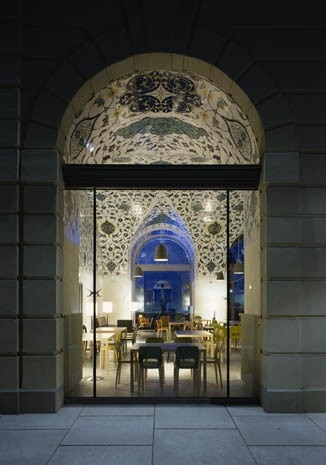
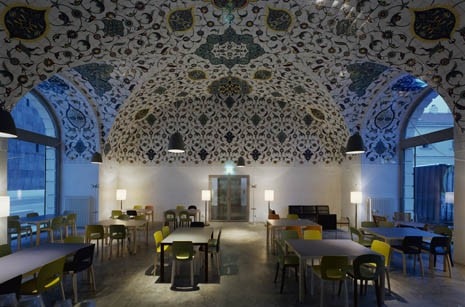
The installation is designed by architects Eichinger Knechtl who have done their best to interpret Steiner’s concerns and get away from the bland neutrality of the conventional white cube museum style interior. Instead they have tried to give each of the various spaces within the centre its own identity. The new hall which accommodates the exhibition is painted a vivid orange. Alongside it is the Octagon, the location of the centre’s library, open to the public, and the F3 space, which as in Formula 3 motor racing is intended for architecture students to practice training laps around the exhibition circuit. Steiner commissioned the French architects Anne Lacaton and Jean Philippe Vassal to design the centre’s cafe/bar. Its the one area in the centre in which he has been prepared to countenance a more high profile approach. He was looking to bring architecture from outside Austria to Vienna to create an atmosphere consciously open to possibilities and experiment. And Lacaton and Vassal have responded with an intriguing probing of Vienna’s history and its particular sensitivities. This was after all the city that marked the westernmost limit of Turkish territorial ambition in Europe, a fact that is alluded to by the architects in their use of Turkish style decorative ceramic tiles applied to vaulted ceilings of the restaurant, a historical provocation given that it is situated in a baroque building originally built just after the besieging Turkish army was pushed back. After this decorative detour, the architects have remembered their roots in architectural austerity, with a poured concrete floor, and bare walls that conceal the kitchen with a deliberately provisional look.
The cafe is named Una, after its proprietor and chef, Una Abraham, who is coincidentally the daughter of Raimund Abraham, one of Austria’s best known architects. The quality of its food, and the atmospheric appeal of its surroundings are likely to make it the most popular cafe in the whole of the Museum Quarter. And in the last analysis the cafe can be seen as the logical answer to the question posed by the centre’s first exhibition. What is architecture? It depends on that special conjunction of the physical, the sensual and the convivial, just like the cafe.
Sturm der Ruhe. What is architecture?
Architekturzentrum Wien
Until 4 March 2001
This article will be published in Domus's November issue, available on the newsstands