

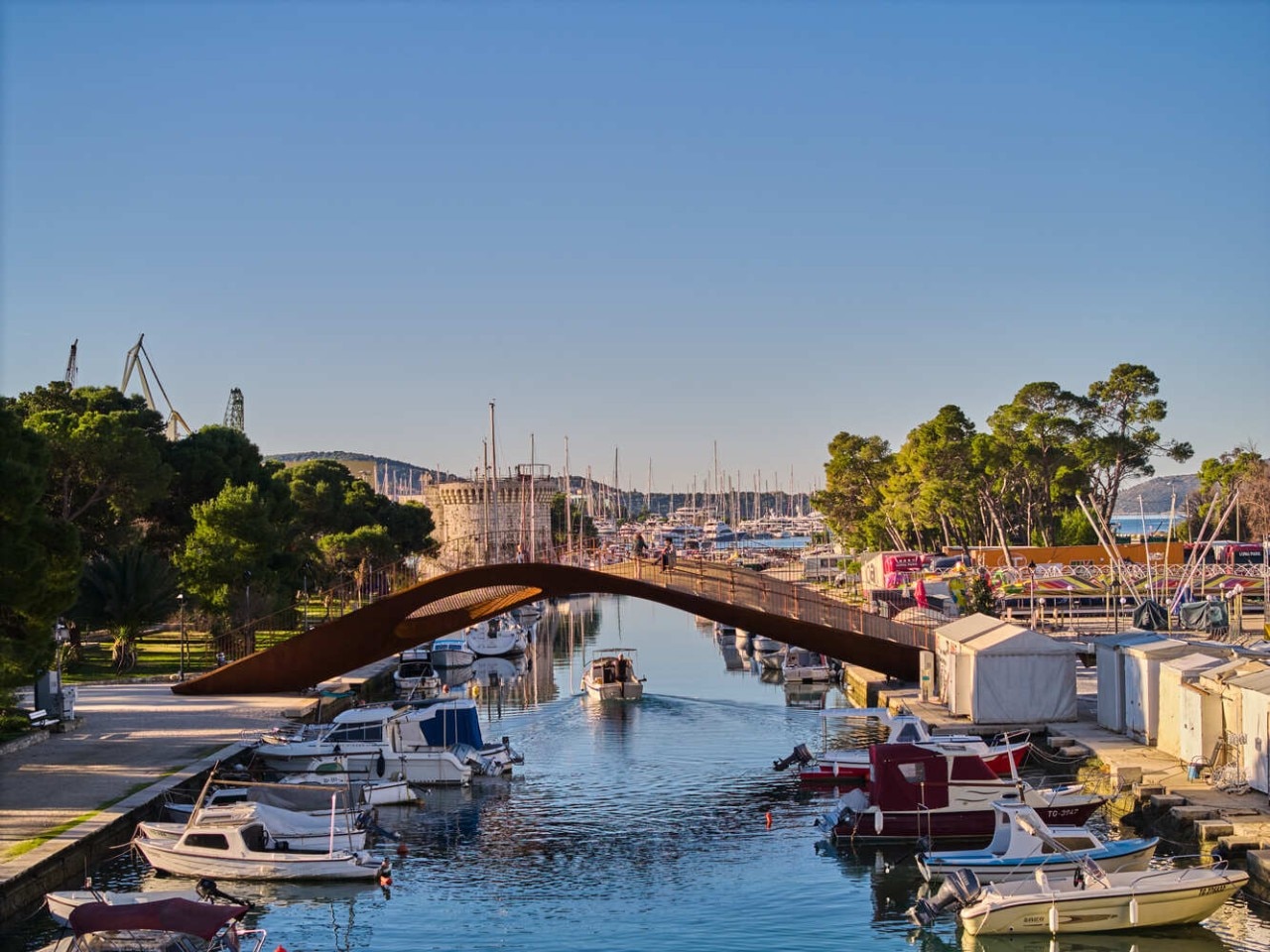


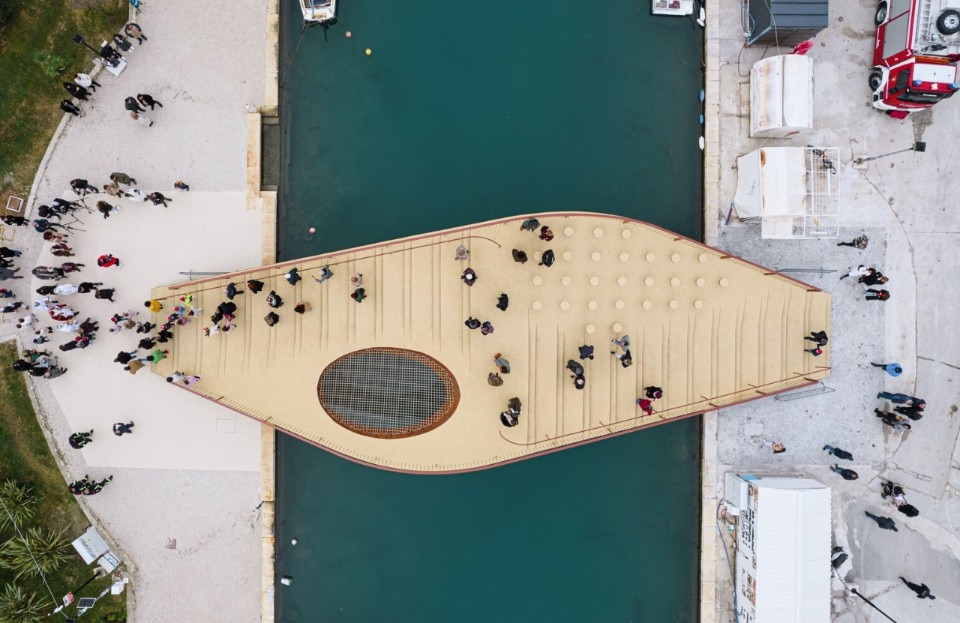







In the historic centre of Trogir, a Croatian city overlooking the Adriatic Sea and recognised as a UNESCO heritage site, a new pedestrian bridge redefines the relationship between infrastructure and public space. Designed by Prostorne Taktike, the Bridge over Foša connects the medieval core to the green area of Fortin Park, crossing the sea channel that separates them.
The bridge, developed as a thin steel shell with an asymmetrical hyperbolic geometry, fits into the urban context without compromising its legibility. Its variable profile allows views of the city’s main historical landmarks to be preserved, while the highest point of the structure acts as a discrete threshold between the two banks.

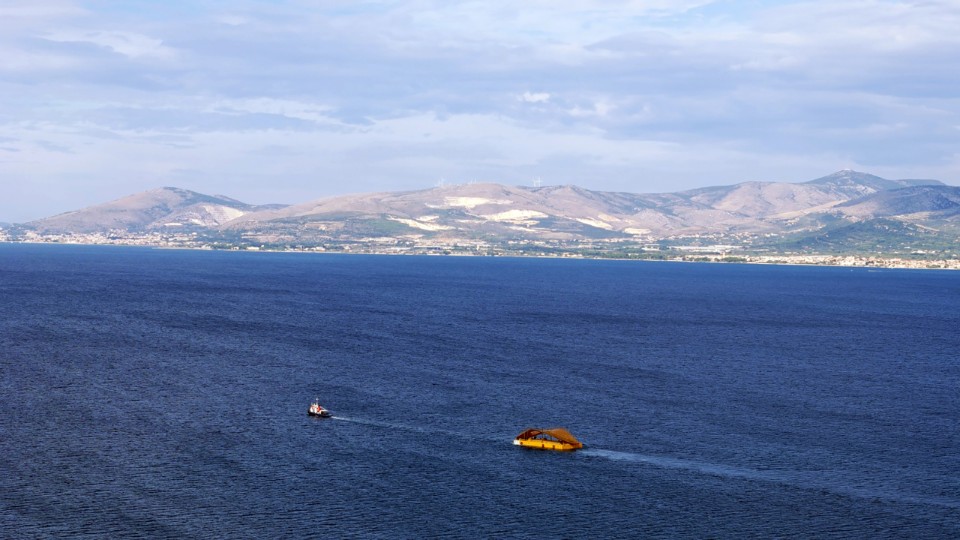
The construction explicitly recalls the local shipbuilding tradition. The entire deck, formed of flat steel plates organised according to an internal caisson system, follows the principle of the double hull typical of naval engineering. Produced in a shipyard near Trogir as a monolithic element, the bridge was transported by sea and positioned in a single day, minimising its impact on the surrounding urban context.
The choice of materials also reflects a sensitive and durable approach. The external cladding, composed of a three-component metal-based finish, allows the steel to develop a Corten-like patina over time, in chromatic continuity with the pre-existing elements.
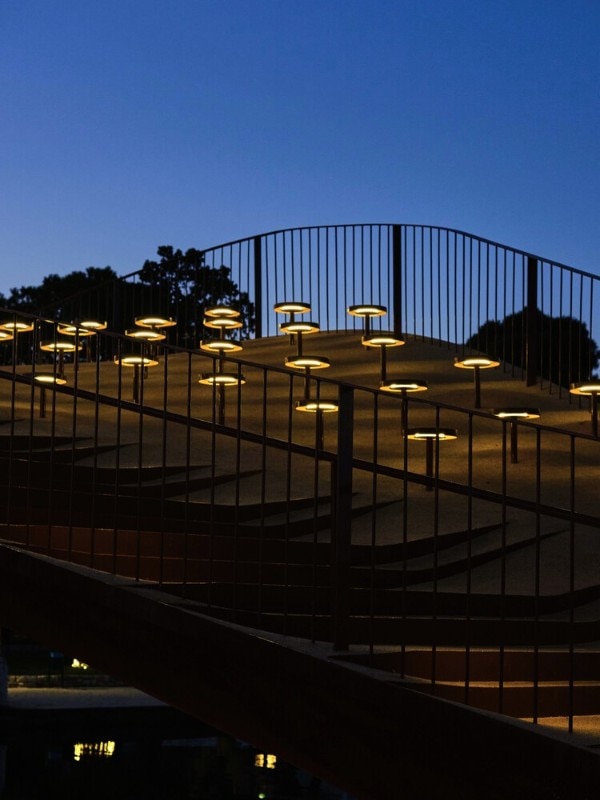
The pedestrian experience is articulated along an accessible ramp that incorporates sections with non-slip steps and informal seating areas. On the north side, more sloping sections accommodate seating areas, while an integrated network of perforated panels overlooks the park, providing meeting spaces and elevated viewpoints. The perforations reduce the visual impact and lighten the perceived mass.
The intervention focuses on structural efficiency, reduced environmental impact and urban coherence. The use of local and recycled materials, combined with off-site prefabrication, contributes to containing emissions and enhancing the technical knowledge of the area.