



The increasing urban population concentration demands a smarter evolution of networks and the development of crucial nodes to enhance the functioning of cities, especially considering the growing density of urban areas. Mobility, transport, and various services on the territory, such as energy, water, waste, and data and telecommunications, perform better when interconnected, integrated, and governed with monitored flows and organized hierarchies.
Urban development faces two key challenges. First, the growth and increasing demand have led to greater complexity, which requires careful management. Second, the risks arise from non-integrated systems, causing redundancies and dangerous autonomies that must be addressed and minimized. Examples can be found across all sectors, significantly impacting the economy and the quality of urban life. The concept of “networking” – borrowed from a different context – involves creating well-functioning company production clusters and systems. This approach generates articulated, structured, and extensive operating networks that efficiently distribute both physical and intangible flows. In other contexts, networks serve the purposes of protection, collection, shelter, and acting as barriers – all essential values in today’s world.
However, area and urban infrastructural systems still seem distant from achieving the virtuous “network-functioning” necessary for better performance, optimized consumption, zero waste, reduced dispersion, and minimal land occupation. We have not fully utilized the potential of digital technology or harnessed the benefits of integrated and multidisciplinary planning, programming, and design, both at the urban and individual building levels. The challenges faced by DomusAir in finding models and best practices to feature on its pages highlight the journey ahead. Despite comforting future scenarios, it is essential to promote a strong culture of networks. The vast amount of available data, combined with easily accessible information from relevant databases, has the potential to inform projects with exceptional performance benefits.
We have not fully utilized the potential of digital technology or harnessed the benefits of integrated and multidisciplinary planning, programming, and design, both at the urban and individual building levels.
Whether it’s transport, water, energy, or waste, networks and their nodes are the essential infrastructure that can optimize settlements and services, efficiently structuring territories and cities while effectively monitoring consumption and impacts. The approach that emphasizes the importance of networks and nodes for project quality also applies to buildings and building systems. This approach is now supported by complex modeling and data that characterize each component of architecture, structures, and systems. Examining a city through network layers offers essential insights for measuring citizens’ well-being and establishing a robust economic framework in the medium and long term. Mappings and flow monitoring practices ensure the measurability of quantity and performance, covering areas like mobility, service, green initiatives, energy, and digital systems.
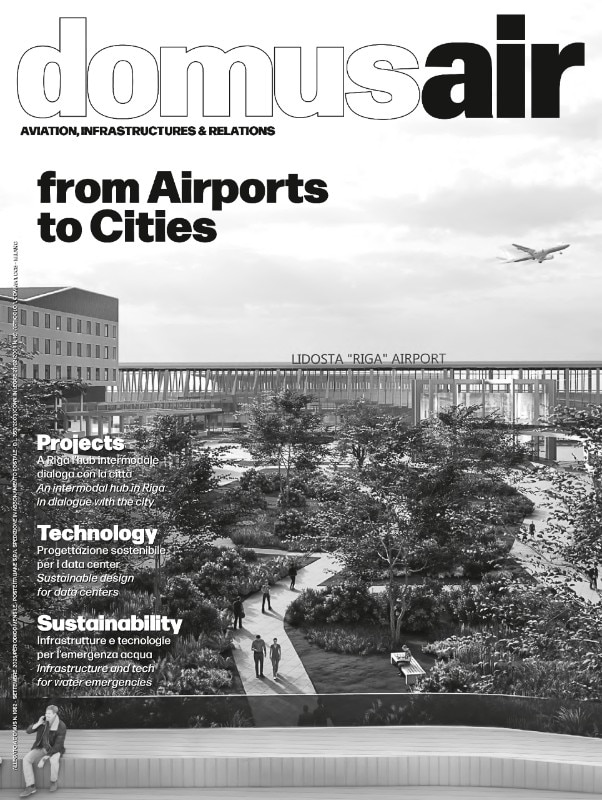
With the increasing risks associated with climate change, including extreme weather events and rising temperatures, the need for reevaluating entire networks and nodes has become more critical and urgent than ever before. In light of these issues, airports are viewed as laboratories for innovation and experimentation with technological and operational solutions. As complex traffic hubs, they prioritize accessibility and seamless exchange between various modes of transport. Additionally, as significant consumers of energy with a considerable impact on the environment and their surrounding areas, airports are dedicated to making progress on multiple fronts, including infrastructure, energy, digital technology, and sustainability practices. They actively engage in networks and maintain strong relations with their local territories.