


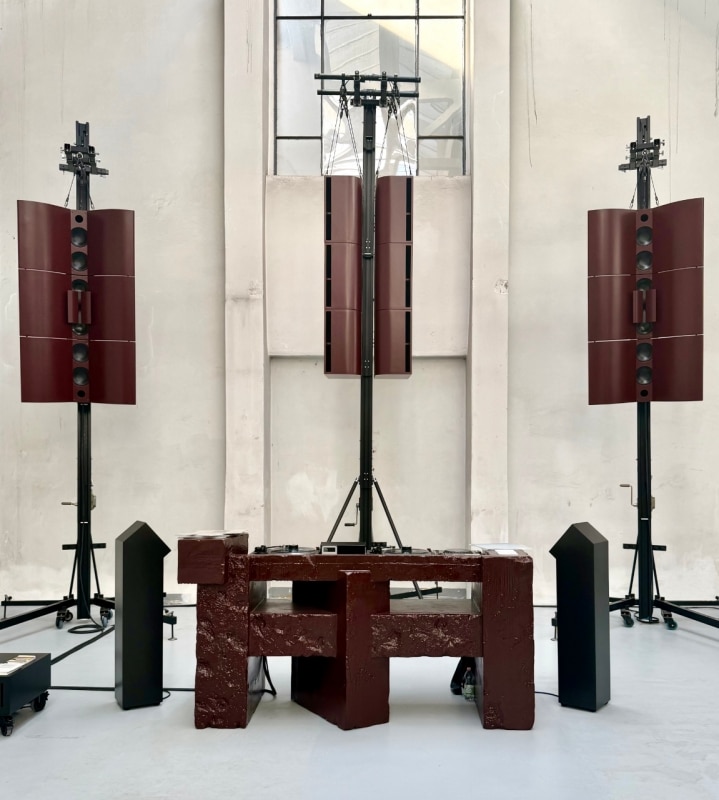
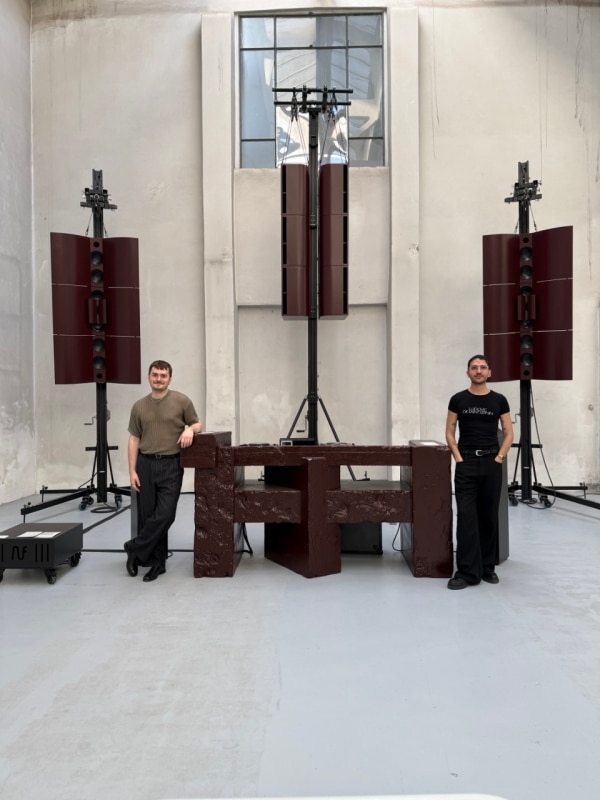
A cross at the end of an impossibly long nave, inside what used to be a disused automotive bearing factory but now feels almost sacred: this is where Yont Studio, the Berlin-based practice founded by designer Serdar Ayvaz, unveiled one of the most powerful sound systems we have seen — and are likely to see in the coming months. A symbol of the present moment.
Yont at Milan Design Week
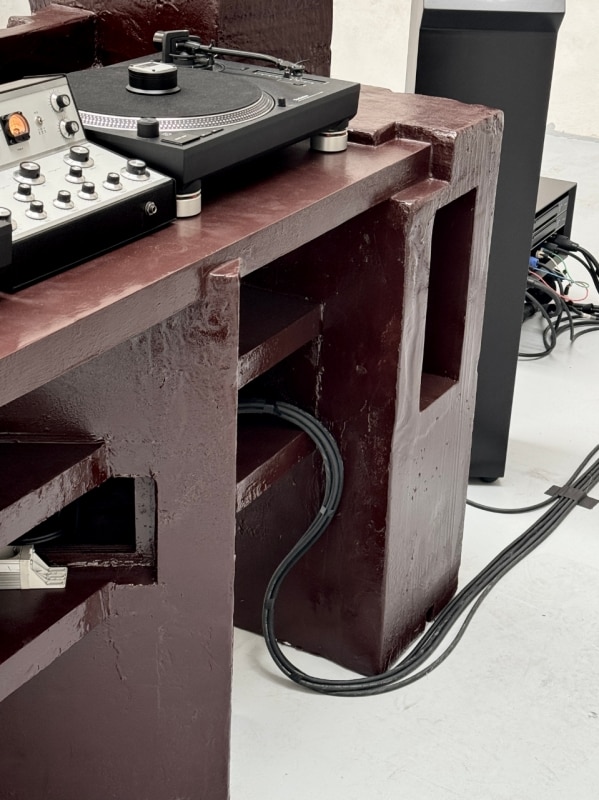
A brutalist DJ booth, glossy and dark — almost burgundy — stood between two speakers developed with New Fidelity and paired with analog mixers by Varia Instruments. Yont presented the installation inside Deoron, the independent exhibition platform that reactivated an industrial space during Milan Design Week, transforming it into a hybrid environment somewhere between a club and an exhibition.
“The burgundy color was a response to the city and the space. It reminded us of Milan: its cafés, its churches, its public interiors,” Ayvaz told Domus. The abandoned factory setting intensified the object’s presence. This was not simply a machine for playing music, but a spatial device capable of organizing the audience’s behavior around itself, supported by an intense program of sound performances.
We like to think of our DJ booths as archaeological pieces — objects that tell unexpected stories connected to music.
Serdar Ayvaz, Yont Studio
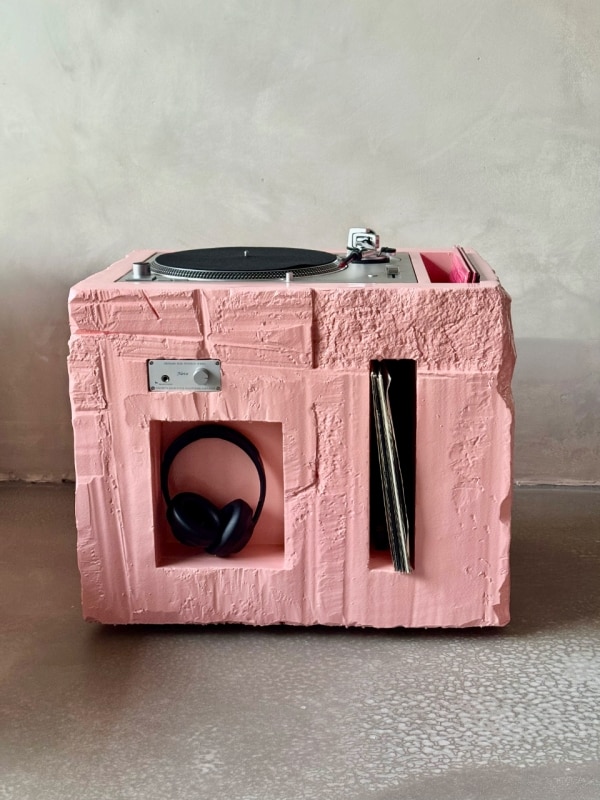
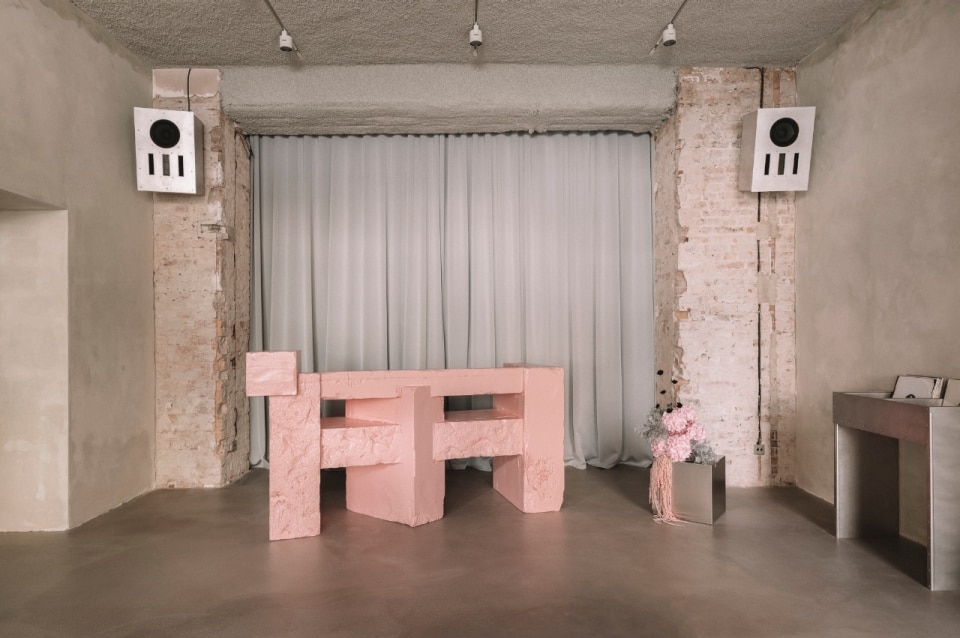
In Milan’s Isola district, Yont also presented a second project: the Brutalist Pink Vinyl Listening Station, originally developed for a hybrid space in Berlin combining a record store and an installation. Here, the visual language shifts radically.
The project takes the form of a monolithic, almost sculptural structure entirely rendered in pink, integrating turntables and a listening system into a single compact volume. More than furniture, it feels autonomous — a block that appears to emerge from an underground or archaeological context. The bunker-like aesthetic remains, but translated into a hyper-saturated, almost pop palette.
Berlin and the architecture of sound
Yont repeatedly uses the term “brutalist,” even when it may initially seem out of place. But what does it actually mean to design a “brutalist” DJ booth? “We work in a city where brutalism is central to music culture. Brutalist spaces are used as clubs, as listening environments. There is a rawness, an exposed materiality that is fundamental for us.”
The burgundy color was a response to the city and the space. It made us think of Milan: its cafés, its churches, its public interiors.
Serdar Ayvaz, Yont Studio
The implicit reference is to places like Berghain, the German capital’s most iconic nightclub, where concrete, emptiness, and sound combine into a fully immersive experience. In Yont’s work, this aesthetic becomes a series of objects that resemble artifacts from dancefloor culture. “We like to think of our DJ booths as archaeological pieces — objects that tell unexpected stories connected to music.”
Sound systems are the new popular culture
Behind these installations lies more than formal experimentation. They also express a precise position on the role of sound within contemporary design.
“It’s a paradigm shift,” the studio explains. “Spaces dedicated to electronic music listening are becoming the center of popular culture. People are increasingly drawn to the acoustic and experiential value of a project.”
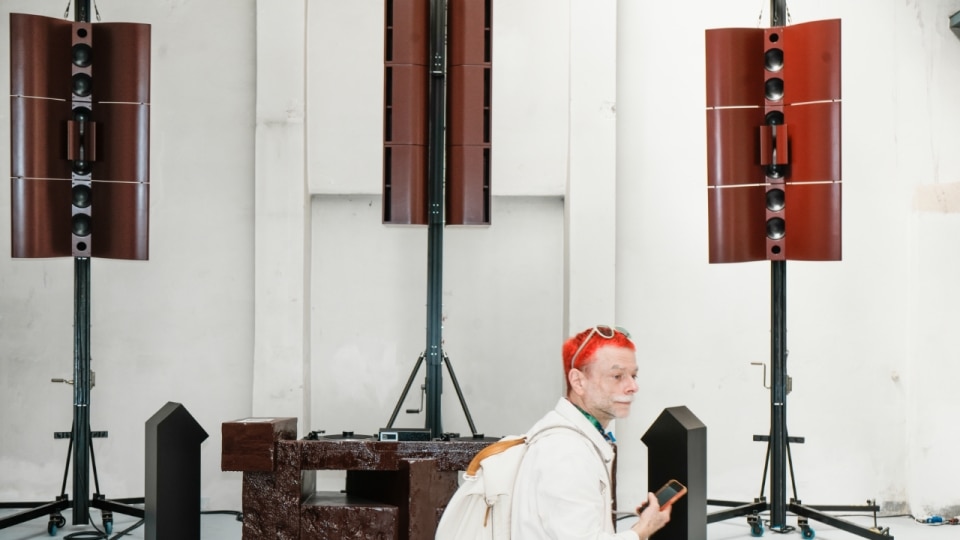
The shift is now unmistakable. Turntables, listening bars, micro-clubs, and immersive environments have colonized showrooms and installations alike, transforming sound from a secondary feature into the true anchor of space itself.
From the club to the design project
Contemporary design is increasingly absorbing practices that, until recently, belonged to highly specific subcultures. Whether this is ultimately positive or not remains open to debate. For Yont, however, it is “definitely something positive.”
For the Berlin studio, the relationship with sound was almost inevitable. Yont emerged from an architectural background but developed within the music culture of the German capital. “When you live in Berlin, it’s impossible to avoid music. It’s part of everyday life.”
This also explains the studio’s interest in hybrid formats — somewhere between object, space, and performative device — and in constructing environments that function as contemporary rituals. Unsurprisingly, the designers openly describe the experience as “ritualistic”: the sound system is not just technology, but a cultural infrastructure capable of transforming a place into a temporary community, even if only for the duration of a DJ set.
The new centrality of sound feels inevitable
Until a few years ago, audio was treated as a complement — the almost invisible soundtrack of domestic interiors, exhibitions, fairs, and bars. Today, it has unquestionably become the protagonist. Cities such as Milan quickly recognized this transformation, driven by the rise of listening bars and hybrid spaces merging retail, club culture, and installation design.
Where community is lacking, sound creates it. And that community increasingly seeks an aesthetic connected to the clubs of the past — one shaped by liberation, rawness, and collective experience. The new centrality of sound feels inevitable, much like electronic music in Berlin. And in that sense, Yont has arrived at exactly the right moment.
Opening image: Brutalist DJ Booth. Courtesy Yont Studio