


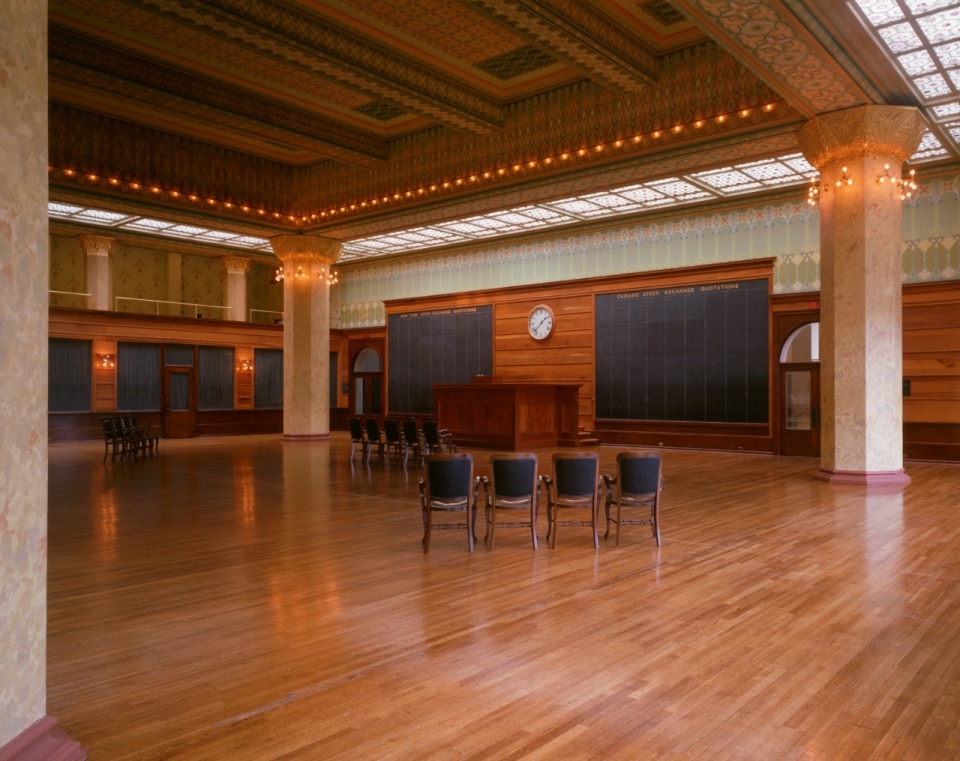
This is not the first time this room has survived its own disappearance. And it may not be the last. The trading room of the Chicago Stock Exchange, one of the most celebrated interiors designed by Louis Sullivan, could soon be dismantled — or worse, dispersed — to make way for the expansion of the Art Institute of Chicago.
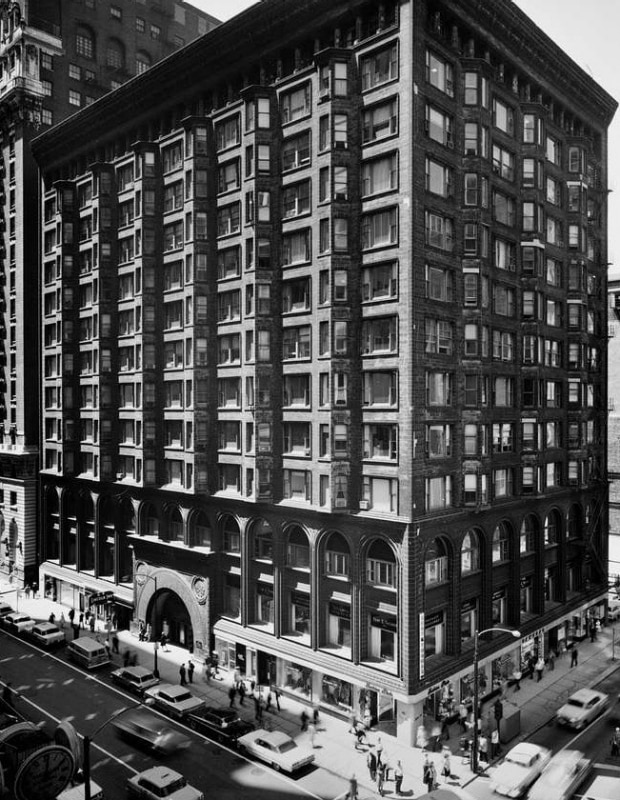
In 1894, in Chicago, the Chicago Stock Exchange was completed, one of the most representative buildings of Louis Sullivan’s work (1856–1924), the “father of skyscrapers” and mentor to Frank Lloyd Wright in his early years. The building emerged in a city that had already made architectural history a few years earlier with William Le Baron Jenney’s Home Insurance Building, considered the first skyscraper in the world. Designed together with Dankmar Adler, the Chicago Stock Exchange was innovative for its steel structure and for the presence of elevators — still a relatively new feature for buildings of this scale — but it was above all its façade that made it unmistakable, richly decorated with terracotta elements.
A demolition that never ended
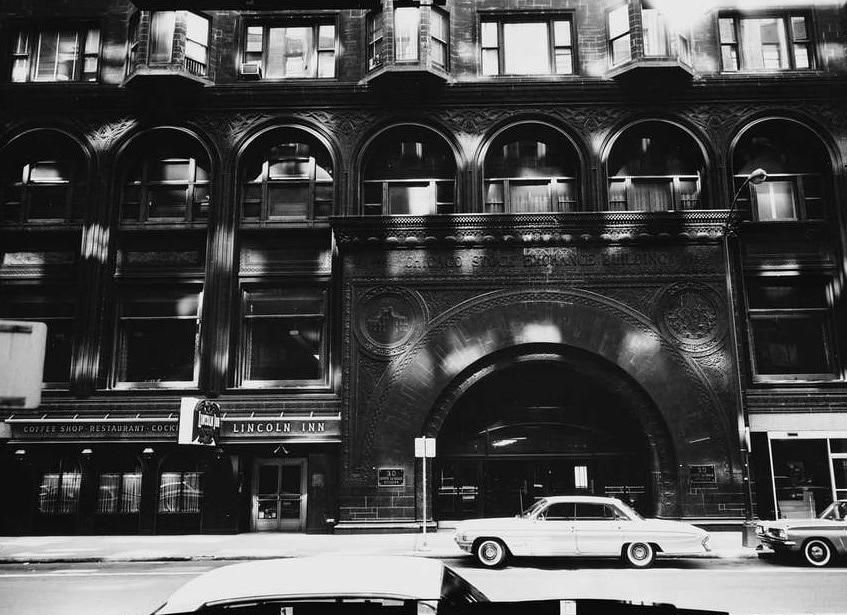
The story of the building, however, was not a straightforward one. By the 1970s, it had fallen into disrepair, and the owners complained about unsustainable maintenance costs. The decision was made to demolish it and replace it with a new skyscraper. Architects, scholars, and enthusiasts mobilized to preserve this important trace of Sullivan’s work, but they were unable to prevent its demolition in 1972. They did, however, manage to symbolically preserve the entrance arch and the building’s most emblematic space: the trading room.
The building was born in a city that had already written architectural history a few years earlier with William Le Baron Jenney's Home Insurance Building, considered the first skyscraper in history.
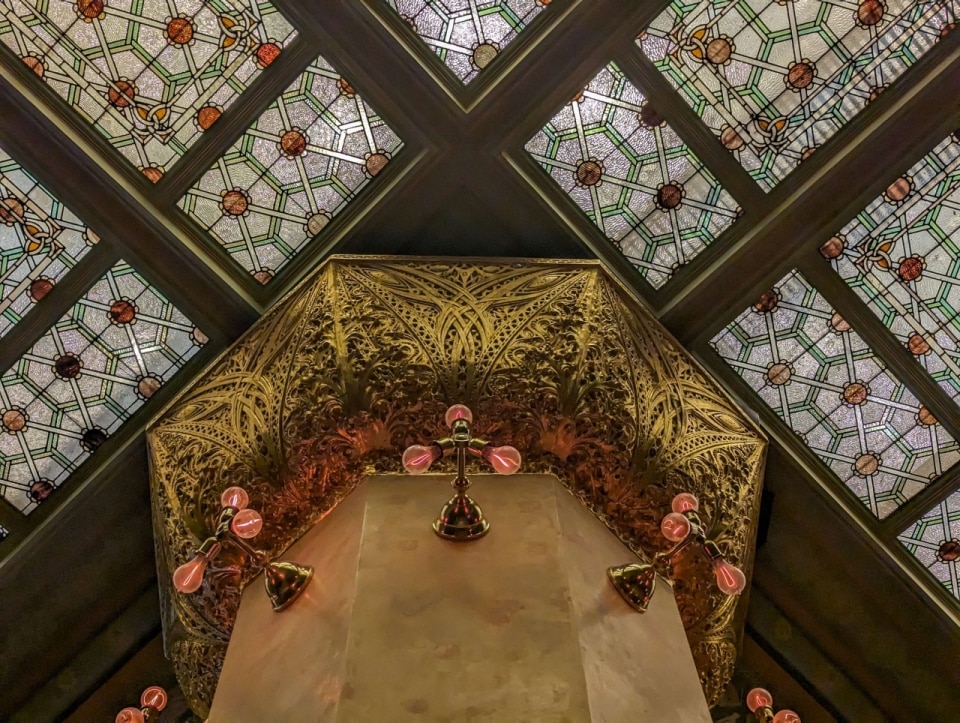
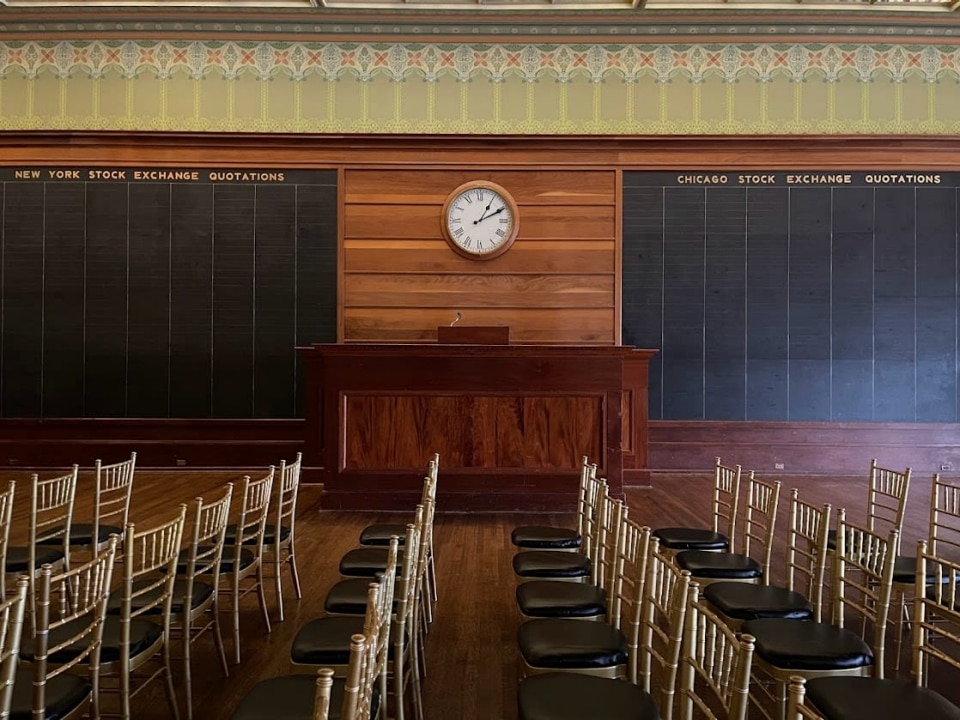
This double-height interior was the beating heart of the city’s stock exchange activities. Its proportions were monumental, its decoration extraordinary: capitals, stenciled walls in fifty-two shades of gold, green, and yellow, and stained-glass windows filtering light through stylized vegetal patterns.
In the early 1970s, photographer Richard Nickel and architect John Vinci undertook a meticulous documentation and mapping of every element of the room, cataloguing everything before the bulldozers arrived. In 1977, the trading room was faithfully reconstructed in a wing of the Art Institute of Chicago and opened to the public. Other fragments of the building found new homes elsewhere: balustrades, architectural elements, and parts of elevators are now distributed across various museums, while the original entrance arch is still installed outside the museum, on Columbus Drive.
A rescue that becomes a problem
Today, half a century after that rescue, the trading room is once again under threat. In 2024, the Art Institute of Chicago received a $75 million donation to fund a major expansion of the museum, whose masterplan has been entrusted to the Spanish firm Barozzi Veiga. The area considered most suitable for the intervention is precisely the eastern wing of the building, the one that houses the room.
The museum has publicly stated that its priority will be to identify a suitable new location for the trading room, but these assurances have not been enough to dispel concerns. Preservation Chicago has responded by placing the room on its annual list of the city’s most endangered historic sites, launching a petition addressed to the Chicago City Council and proposing an alternative to the project, identifying a different potential area for expansion.
Its proportions were monumental, its decoration extraordinary: capitals, stenciled walls in fifty-two shades of gold, green, and yellow, and stained glass windows that filtered light through stylized plant motifs.
Disassembling the same architecture twice
Meanwhile, the building that replaced the Chicago Stock Exchange in the 1970s — an office block in glass and steel typical of the International Style — could itself now be demolished to make way for the new intervention. The architecture that once replaced a masterpiece risks becoming, in turn, a transitional layer.
What truly changes, however, is the fate of the room. Dismantled once to be saved, reconstructed as a museum fragment of a vanished building, it now risks losing its context once again. And perhaps, this time, something more.