

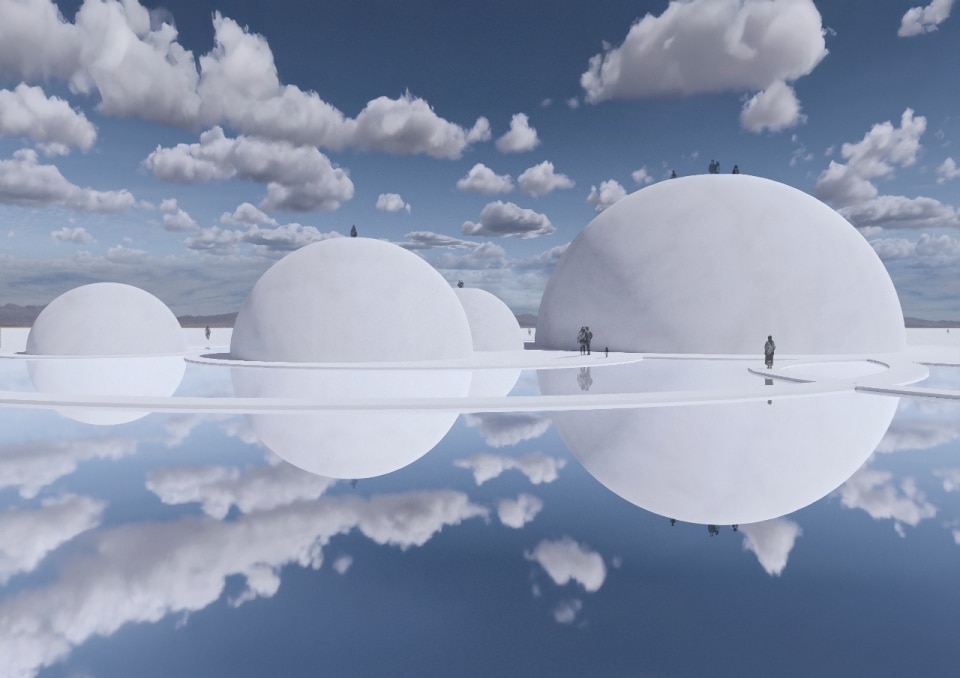
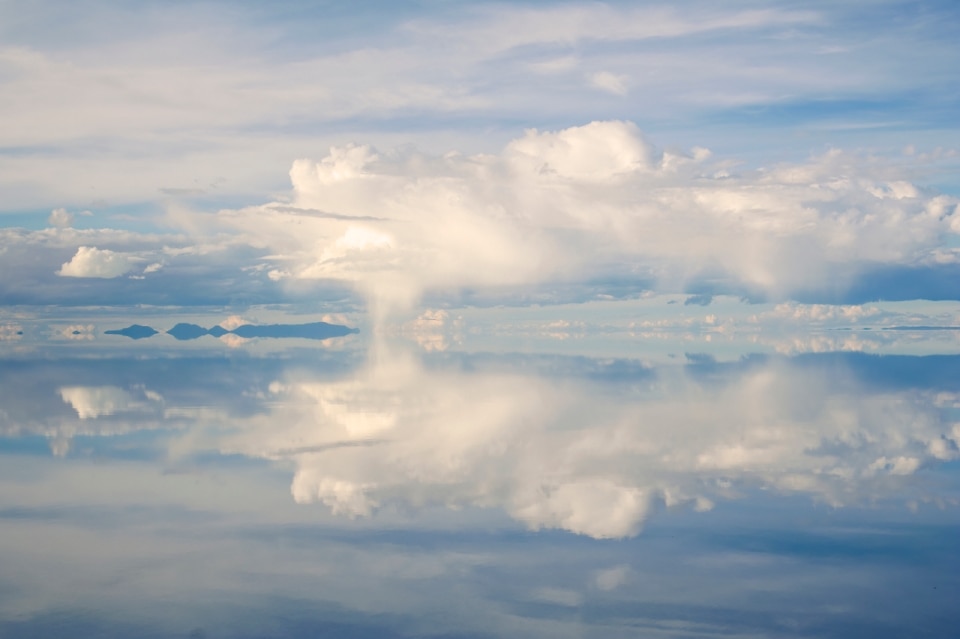
In the northern reaches of the Argentine Puna, where sky and earth dissolve into a dazzling whiteness and the water’s surface of the Salinas Grandes reflects the clouds stretching endlessly above, El Santuario del Agua (The Sanctuary of Water), Tomás Saraceno’s new project conceived together with the eleven Indigenous communities of the region, is set to take shape by the end of 2026.
The Sanctuary, envisioned as a multidimensional project of participatory architecture aimed at challenging the extractivist mining practices that are draining Andean ecosystems, will rise within an endorheic basin, where water never reaches the sea but continuously transforms through slow, ancient processes of evaporation and crystallisation. In this environmentally fragile context, water represents a unifying nexus across multiple realms — spiritual, cultural, social, economic, and political — “an essential living being”, as the Indigenous communities united under the name Red Atacama explain, “a source of life and connection with the cosmos”.
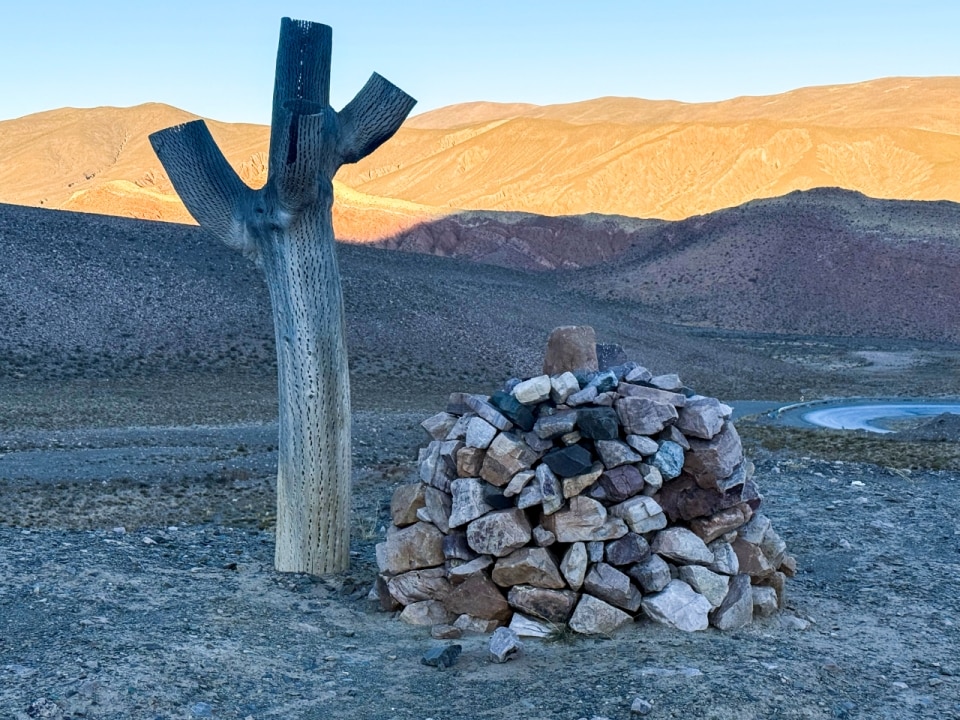
Rooted in this relationship of interdependence between water and territory, life and cosmos, material and immaterial, the installation will be built around a large reflective artificial pool conceived as the perceptual and symbolic core of the entire complex. Orbital pathways will unfold around it, together with five large salt apachetas — inspired by the stone cairns of Andean mountain trails, a relational gesture of reciprocity — with varying diameters and heights reaching up to fifteen meters, some of which will be accessible as elevated viewpoints.
The apachetas not only mark the path; they bless it. They are our spiritual beacons.
Red Atacama
The five structures, named according to Andean cosmology, aim to establish a symbolic dialogue between cosmic and earthly cycles, generating a landscape capable of offering tangible support to local communities through a new shared governance framework. The project is the result of a decades-long collaboration between the artist, the Aerocene Foundation — committed to eco-social justice — and the communities of the territory, developed through assemblies, encounters, and co-design processes with the Kolla and Atacama peoples, millenary custodians of the hydrological and spiritual balance of the Salinas Grandes. It is therefore not an externally imposed intervention, but a device built over time, rooted in local knowledge and in the cultural continuity of the place.
The economic model fostered by the project will be based on low-impact, fully self-managed tourism, with the aim of generating autonomous income, local employment, and long-term care practices for a territory at risk. The Andean salt flats of Argentina indeed host one of the world’s largest lithium reserves, whose industrial extraction entails the evaporation of millions of liters of freshwater from aquifers that may take centuries to replenish, further destabilizing already fragile water cycles.

Within this framework, El Santuario del Agua also marks a pivotal moment in the artist’s trajectory. As early as 2020, Saraceno launched the solar balloon Fly with Aerocene Pacha over the salt flats, bringing global attention to the message “Water and life are worth more than lithium”: a poetic and political statement that now finds in the Sanctuary a spatial and enduring translation — a symbol of resistance and awareness regarding the rights of nature, Indigenous sovereignty, and the protection of vital water cycles.
Opening image: Salinas Grandes, Argentina. © Photography by Studio Tomás Saraceno