


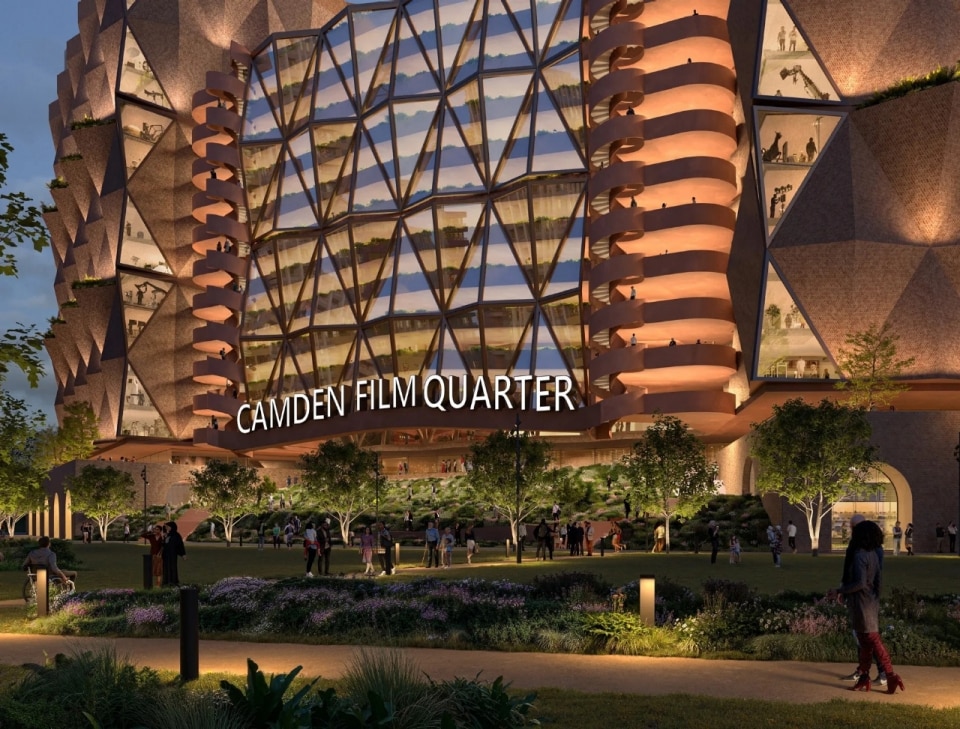
The London Borough of Camden is known as a brassy patchwork of pop cultural influence, from the regal gothic revival architecture of St Pancras Station, seared into memory by popular literature and cinema, to the subversive thud of its 1970s alternative punk and post-punk culture. In a rounded capture of the arts—from architecture to music to literature and more—the borough has been a backdrop to a matchless range of visual and aural expression, from classical to fringe culture, and everything in between.
It may now become London’s ticket into the niche annals of architecturally significant film studios—a tradition shaped by a handful of film set masterplans around the world. These include the 1937 rationalist design for Cinecittà in Rome, commissioned by Luigi Freddi, head of the Direzione Generale per la Cinematografia under Mussolini’s government. Or Paris’ industrial Art‑Déco renovation, La Cité du Cinéma, in Saint-Denis, originally stewarded by Luc Besson, one of the key authors of the 1990s’ ‘cinéma du look’. And the more recent Wildflower Studios in Astoria, New York, designed by BIG and backed by Robert DeNiro. The Camden Film Quarter in London will be designed by SPPARC, the architects working with Heatherwick Studio on the extension of London’s Olympia Park – another realm of promised public amenity and activation – built to a similarly robust budget.
The Camden Film Quarter could change the history of London’s film industry, creating a new district of studios, homes, creative workspaces and public spaces.
Like the Wildflower Studios in New York, the Camden project will stack studio space vertically. In sections submitted for planning earlier this month, the studio spaces are shown to begin at basement levels, with subterranean volumes seemingly able to accommodate a T-Rex before moving upwards into a giant lobby, parking levels for transport vehicles, three goliath levels of studio space, and finally a roof level for mixed-uses. Beyond its “11 state-of-the-art film and television studios”, the quarter’s proposed plans will stretch to include around 500 new homes, new creative workspaces, public parks, and education facilities in partnership with the National Film & Television School (NFTS) and the London Screen Academy (LSA).
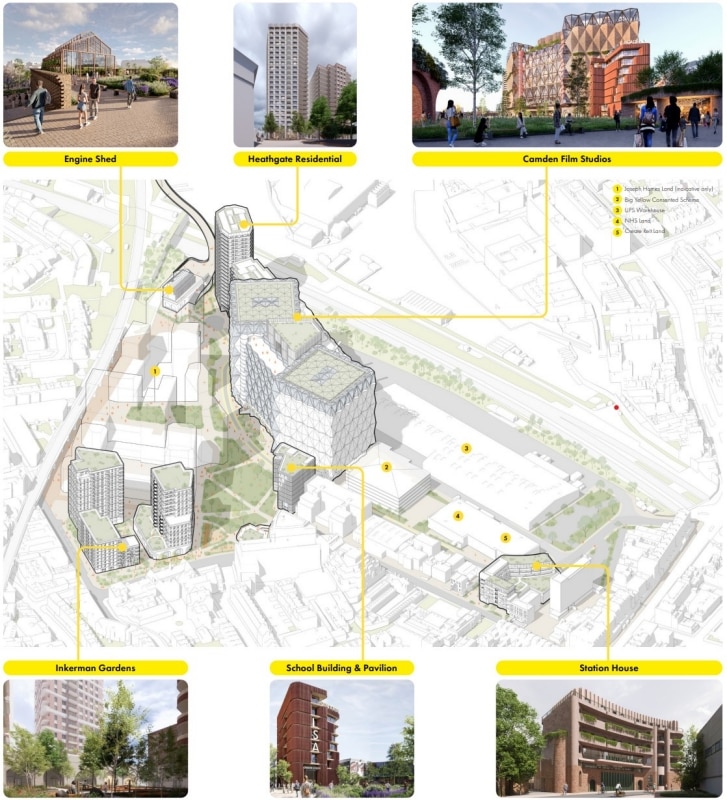
The quarter is planned to be sited in Kentish Town, Hampstead’s roguish southeasterly neighbour, defined by Victorian and Edwardian terraces, interwar flats, estates, local pubs, and small music venues. The design is said to be influenced by the region’s industrial heritage and surrounding conservation areas, with the behemoth masterplan aiming to “[translate] these references into a contemporary architectural language”.
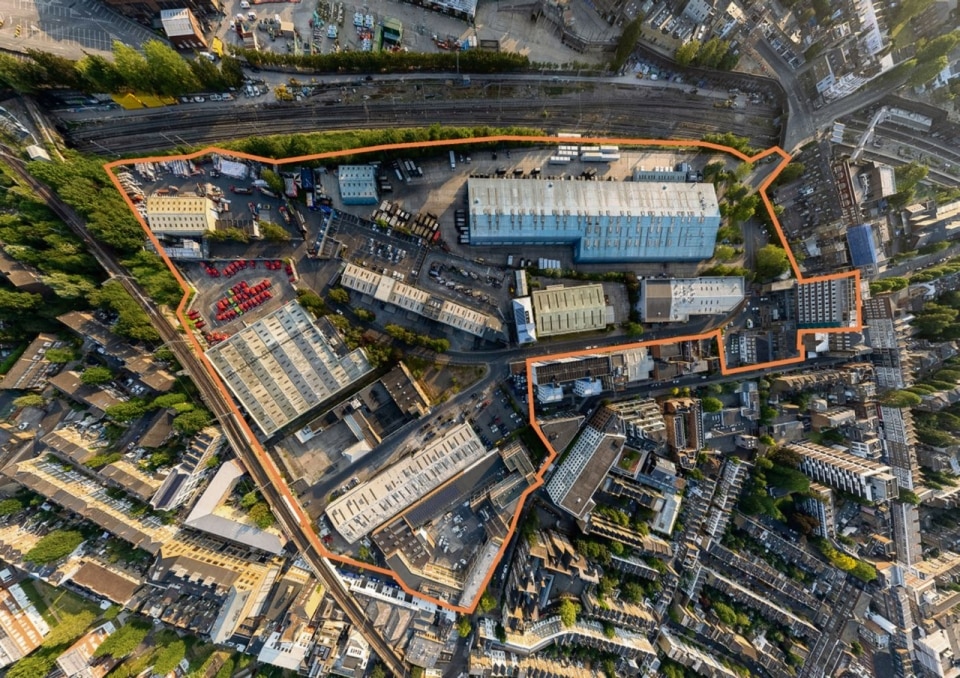
The new film quarter will replace an industrial estate north of Regis Road. The entire masterplan is envisioned to cover 23 acres, having significant impact on the urban composition of the area. A missive from Camden Council in 2023 ensured that “every stage of the project [would be] subject to planning and consultation with the local community”, characterising the development – which is being led by real-estate investment firm Yoo Capital – as an opportunity to generate training and employment opportunities in the creative industries for residents, to deliver “genuinely affordable” new homes, and to build a new “zero emissions” neighbourhood.
The cacophonic blend of Camden’s loud colours, winding canals, and dark, dusty masonry buildings has been its own film set to some of cinema’s iconic mainstream and cult scenes. In the 90s, the metal staircase running up to Winston’s dope den in Guy Ritchie’s Lock, Stock and Two Smoking Barrels hailed from Stables Market on Chalk Farm Road, while Camden Town Tube station opened the sequence to Gwenyth Paltrow’s dual reality in Sliding Doors. Later in the bigger blockbuster variety of the 00s, About a Boy and Mission: Impossible – Fallout found their scenes from within the borough.
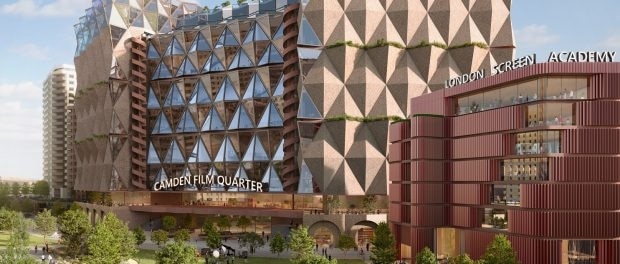
The strident character of this part of London – which is amongst the densest of the capital’s boroughs – offers so much variety and visual richness, it begs the question whether there is need to take the film studio indoors. Yet, the team behind the Camden Film Quarter – with its rhombus-patterned facade, whimsically giant twirling columns, and Hollywood style entrance marquee – describe it as a place that could go beyond just changing a neighbourhood. Instead, its promise is to transform the city’s role within the global business of film-making – fulfilling the world’s dreamy and ongoing ambition to give shape to human imagination.
All images: Masterplan of the Camden Film Quarter. Courtesy Camden Film Quarter / SPPARC / Yoo Capital