

Winner of a 1949 Ministry of Education competition for a "mass-producible rural school with classroom and teacher accommodation", the Ateliers Jean Prouvé built two of them, one in Vantoux in Moselle and the other in Bouqueval, near Paris. Like the school, the accommodation followed the portico principle patented by Prouvé in 1939 and used in a range of postwar programs, notably in the housing field. The Métropole House (architect Henri Prouvé) had been finalized in 1948. Adaptable to any site, it came in two sizes, 8x8 meters and 8x12 meters. The second of these, displayed at the Home Show in Paris in 1950, was the teacher's house. Its all-steel structure comprised two load-bearing portal frames which defined the interior space while leaving total freedom for the layout. The envelope used double-sided facade panels with integrated sash windows and shutters retracting into ribbed aluminum housings. There was also a glassed-in winter garden and a roof of juxtaposable aluminum roofing slabs. User comfort was given close consideration: the interior was easy on the eye, notably thanks to the use of wood, and temperature control went well beyond the standard specifications of the time. Despite Prouvé's keenness to become involved in housing production on a mass scale in the early 1950s, ultimately only fifteen examples of the Métropole House were built, mainly as part of the "Sans Souci" housing estate at Meudon-la-Forêt.

Prouvé Metropole Aluminum House
On the occasion of the 2011 FIAC Galerie Patrick Seguin presents for the first time Jean Prouvé's 8 x 12 meter aluminium Metropole House (Nancy-1949).

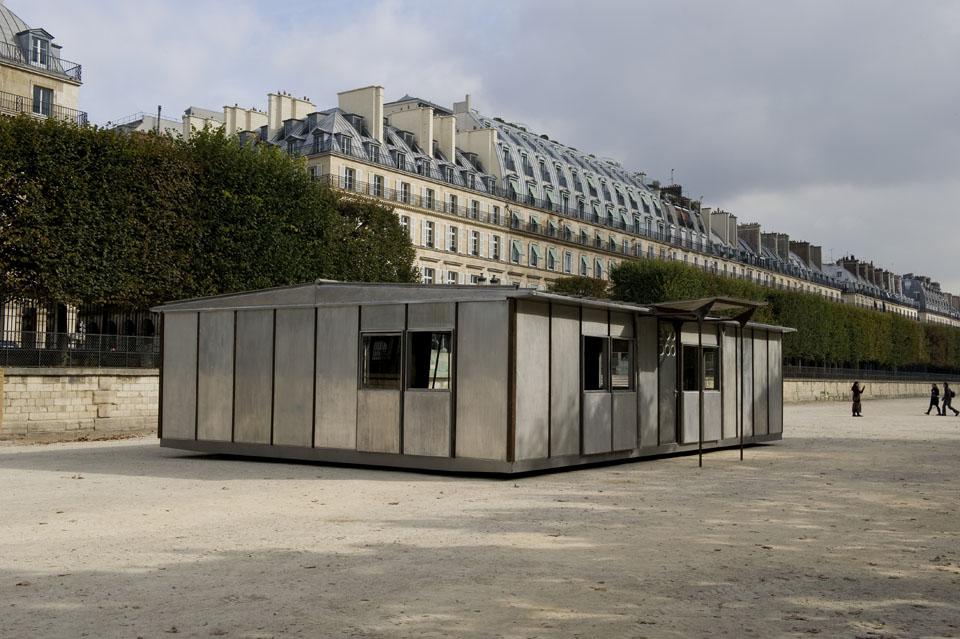
Winner of a 1949 Ministry of Education competition for a "mass-producible rural school with classroom and teacher accommodation", the Ateliers Jean Prouvé built two of them, one in Vantoux in Moselle and the other in Bouqueval, near Paris. Like the school, the accommodation followed the portico principle patented by Prouvé in 1939 and used in a range of postwar programs, notably in the housing field. The Métropole House (architect Henri Prouvé) had been finalized in 1948. Adaptable to any site, it came in two sizes, 8x8 meters and 8x12 meters. The second of these, displayed at the Home Show in Paris in 1950, was the teacher's house. Its all-steel structure comprised two load-bearing portal frames which defined the interior space while leaving total freedom for the layout. The envelope used double-sided facade panels with integrated sash windows and shutters retracting into ribbed aluminum housings. There was also a glassed-in winter garden and a roof of juxtaposable aluminum roofing slabs. User comfort was given close consideration: the interior was easy on the eye, notably thanks to the use of wood, and temperature control went well beyond the standard specifications of the time. Despite Prouvé's keenness to become involved in housing production on a mass scale in the early 1950s, ultimately only fifteen examples of the Métropole House were built, mainly as part of the "Sans Souci" housing estate at Meudon-la-Forêt.