


.jpg.foto.rmedium.png)
.jpg.foto.rmedium.png)
.jpg.foto.rmedium.png)
.jpg.foto.rmedium.png)
.jpg.foto.rmedium.png)
.jpg.foto.rmedium.png)
.jpg.foto.rmedium.png)
.jpg.foto.rmedium.png)
.jpg.foto.rmedium.png)
.jpg.foto.rmedium.png)
.jpg.foto.rmedium.png)
.jpg.foto.rmedium.png)
.jpg.foto.rmedium.png)
a.jpg.foto.rmedium.png)
.jpg.foto.rmedium.png)
.jpg.foto.rmedium.png)
.jpg.foto.rmedium.png)
.jpg.foto.rmedium.png)
.jpg.foto.rmedium.png)
a.jpg.foto.rmedium.png)
b.jpg.foto.rmedium.png)
.jpg.foto.rmedium.png)
.jpg.foto.rmedium.png)


In Doma House, Matsumoto and Ohno have managed to keep alive the essence of the traditional Japanese house, made of thresholds, filters and tatami mats. The house is no longer a sequence of closed rooms, but a fluid organism that integrates garden and interior. The project stems from the need to accommodate the grandmother and grandson's family under one roof, without losing the connection to the original house. The pre-existing layout followed a typical Japanese canon: two eight-tatami rooms facing a garden to the southeast via an engawa, the corridor-veranda that served as a threshold, and a living room located on the eastern side, with private rooms to the northeast.
.jpg.foto.rmedium.jpg)
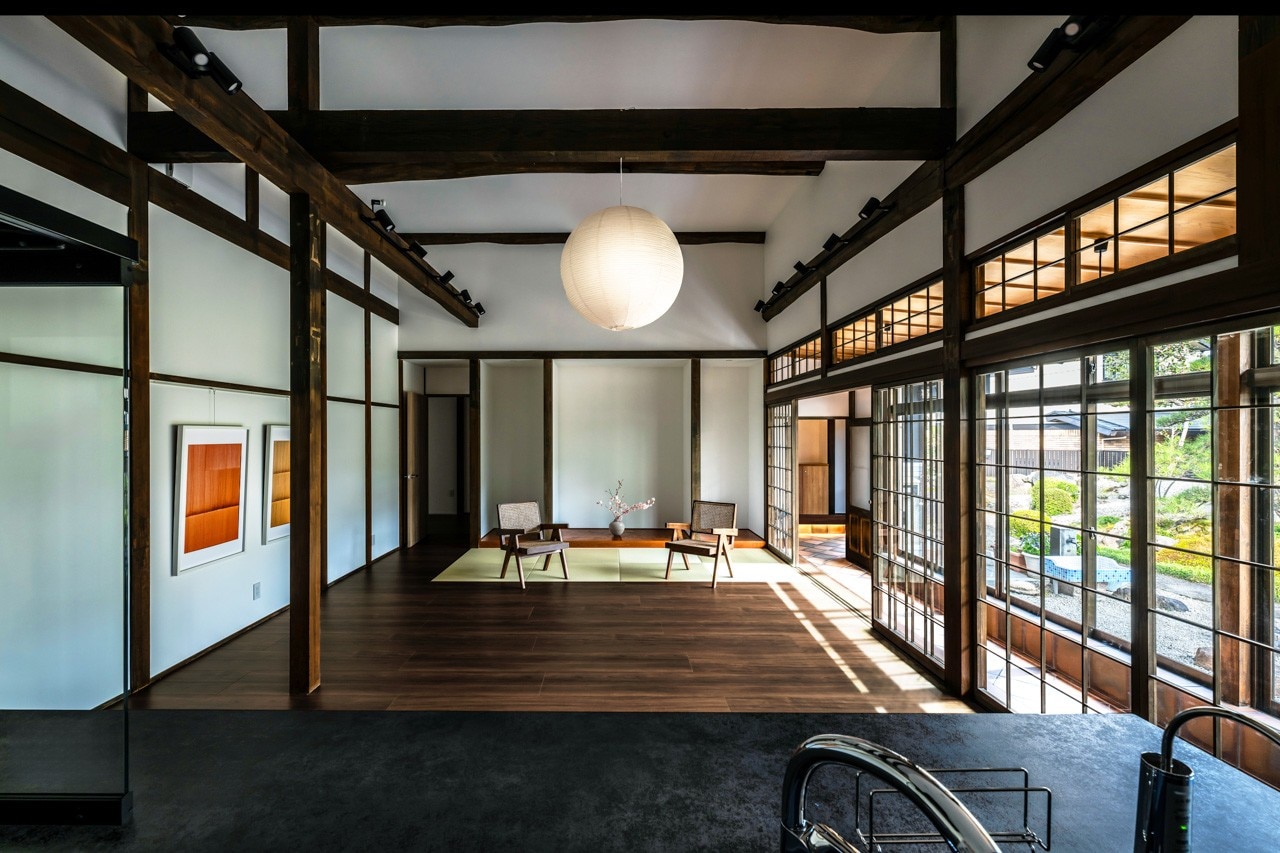
The transformation intervenes precisely on these typological nodes. The two tatami rooms have been combined into one large central room, reversing the logic of compartmentalization to create a single room that becomes the hub of daily life.
The engawa, on the other hand, has been reimagined as a doma, the traditional semi-open space obtained by lowering the floor level by 40 cm; a gesture that enriches the perception of space and multiplies uses. In fact, the doma becomes an intermediate environment, suspended between inside and outside: it can be an informal living room, a place for children to play, a space for conversation, but also a gallery for the ceramic products of the client, the owner of a tile company.
In the new windows and doors, rice paper has been replaced by acrylic panels that, together with a contemporary version of traditional shōji, maintain the sense of transparency that characterized the spaces of the old house.
.jpg.foto.rmedium.jpg)
The doma becomes an environmental filter as well: insulating layers are inserted under the flooring to prevent winter cooling, while the ceramic tile finish stores heat in the cold months and restores coolness in summer. Roof overhangs shield summer radiation, while winter's grazing light is captured by ceramic surfaces that diffuse a natural warmth. Where before the engawa constituted a closed threshold separating the garden from the domestic experience, today the space opens up, capturing views and amplifying brightness. Where before the two tatami rooms separated spaces, today one large room houses the kitchen, reimagined as the center of domestic life.
The craftspeople’s hand is present everywhere: from the ceramics unique in their firing hues, made with ancient earths from the region, to the wall covered with tiles from Awaji, to the glazed mosaics created directly by the client.