




There is a persistent, vital thread running through the work of Joris Laarman—Dutch, born in 1979: the idea that design should not merely represent its own time, but actively construct the codes of what is yet to come. It is an almost biological tension, a way of looking at objects as evolving organisms.
Since 2004, from his lab in Zaandam—half an hour from central Amsterdam—an experimental workshop somewhere between a Renaissance bottega, a high-tech start-up and a research centre, Laarman has orchestrated a team (he always speaks in the plural) of designers, engineers and craftspeople who test materials, model algorithms and produce forms in which nature, culture and technology converse without hierarchy.
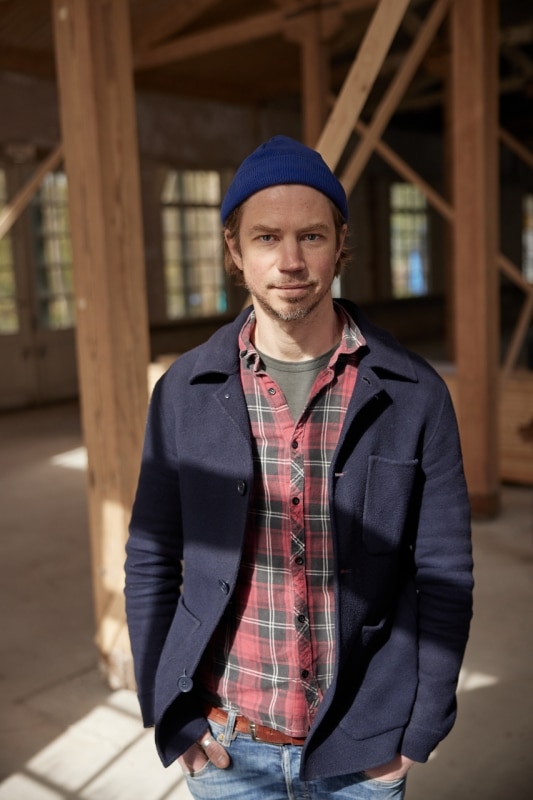
He graduated cum laude from the Design Academy Eindhoven in 2003, and from the outset his ideas were clear. “I tend to look at the world in terms of macro-history, because everything becomes more fascinating through that lens. I am drawn to historical patterns as much as to fact-based science fiction. The present only exists thanks to our past and the future we are actively shaping. From the object’s point of view, everything I create refers to historical concepts. My graduation project from 23 years ago, Reinventing Functionality (Ed., a radiator/ornament first published by Domus in 2003), was a response to modernism’s rejection of ornament; the Bone Chair, created the following year, is essentially a high-tech interpretation of Art Nouveau. Both projects are not about style, but about a hidden logic. The Vortex bookcases are literally a play between ornament and functionality. The Maker Chairs translate modernist ideas of self-fabrication—from Rietveld to Enzo Mari—into the digital age.”
I am satisfied with my work when it is full of content, like a three-dimensional poem. A single object that carries many stories within it.
Joris Laarman
The collaboration with Friedman Benda began in 2004, a year after the end of his studies, and continues to this day, marking a crucial turning point in Laarman’s international growth. Two years later, in 2006, the Bone Chair, shown for the first time at Design Miami, won the award for Best Contemporary Work. In 2010, the iconic New York gallery presented Joris Laarman Lab, his first solo exhibition: the culmination of five years of research and experimentation, including—alongside the Bone series—the Cumulus and Starlings tables, cementing his status as one of the most radical voices in contemporary computational design.
The Bone Chair and the Bone Chaise—the former already included in the exhibition Design and the Elastic Mind at MoMA in New York, curated by Paola Antonelli in 2008—use software originally developed for General Motors that simulates bone mineralisation, generating lightweight structures based on an evolutionary rather than decorative logic. It is a way of legitimising beauty through performance rather than style. The entire project is grounded in rigorous digital iterations and an idea of form that translates natural processes into functional sculptures: work driven by obsessive investigation and experimentation, with an almost hypnotic appeal.
Meanwhile, a new chapter is taking shape in New York, following the first encounter between Joris Laarman and Marc Benda in 2004. In 2026, the gallery will present Laarman’s first solo exhibition in twelve years (8 May – 13 June 2026, 515 W 26th St, New York, NY): a return that coincides with a symbolic moment. 2026 also marks the twentieth anniversary of the Bone Chair. This new exhibition—still without a definitive title—will unveil, for the first time in over a decade, two entirely new bodies of work. If Bone inaugurated a season of evolutionary logics applied to design, these new works appear to push that same intuition even further—towards objects that do not describe the future, but cultivate it.
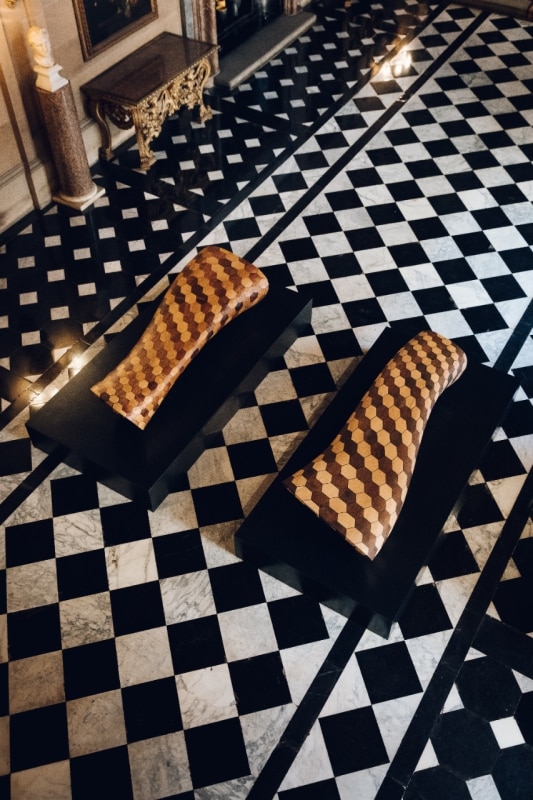
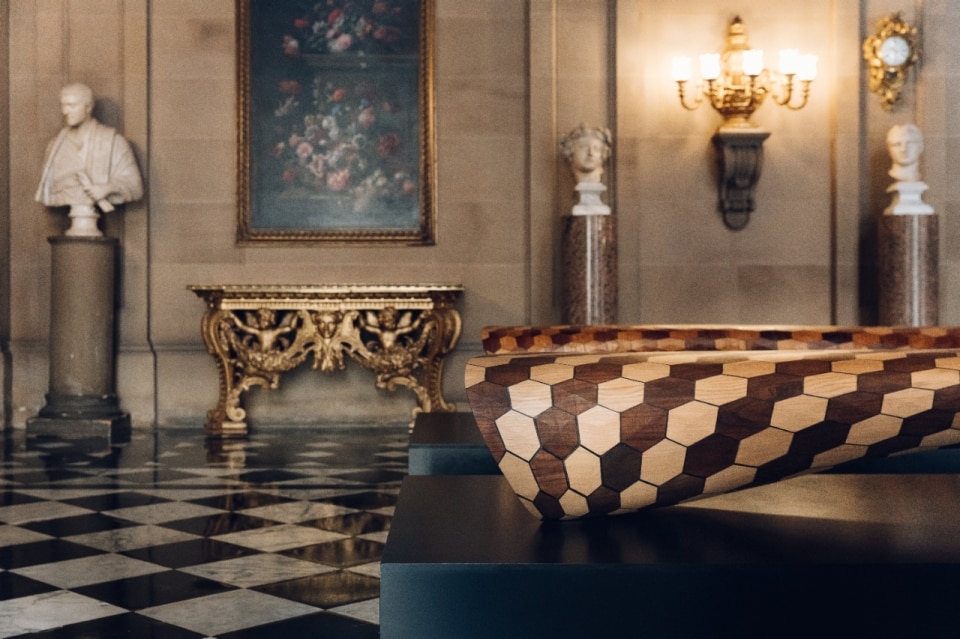
While the Bone collection explores structural lightness, the Makerchairs project (2014) radicalises the concept of modularity. The seats—such as the Makerchair Hexagon or the Makerchair Diamond—are composed of dozens, or even hundreds, of elements, each milled or printed separately, forming a constructive mosaic that combines precision engineering with painstaking craftsmanship. The design resembles a three-dimensional puzzle: an open, replicable system that anticipates a future in which digital production and craftsmanship collaborate rather than compete.
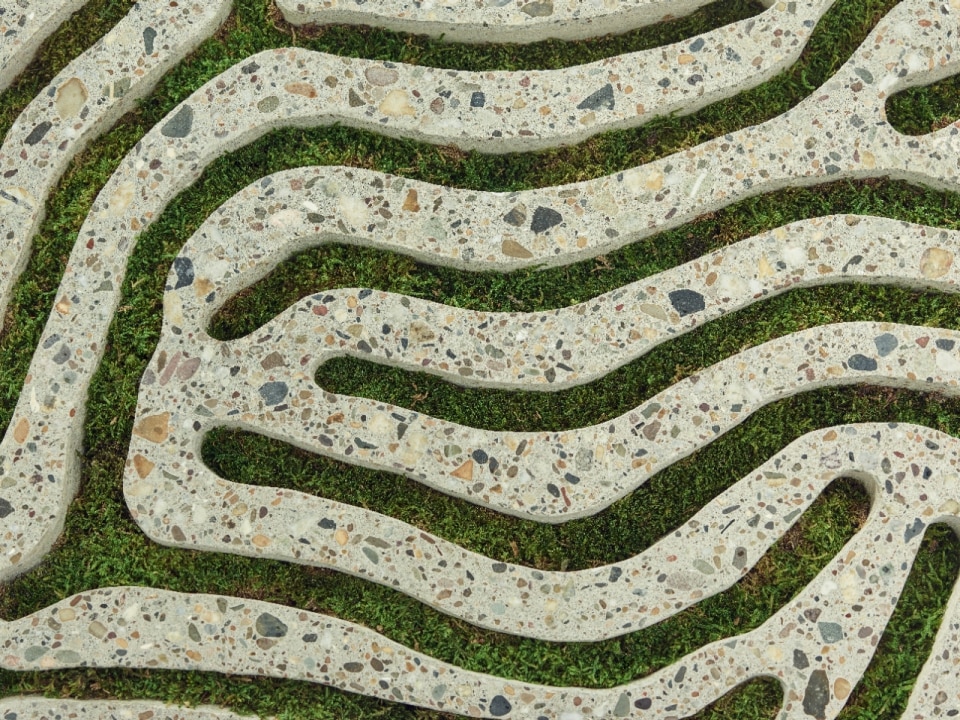
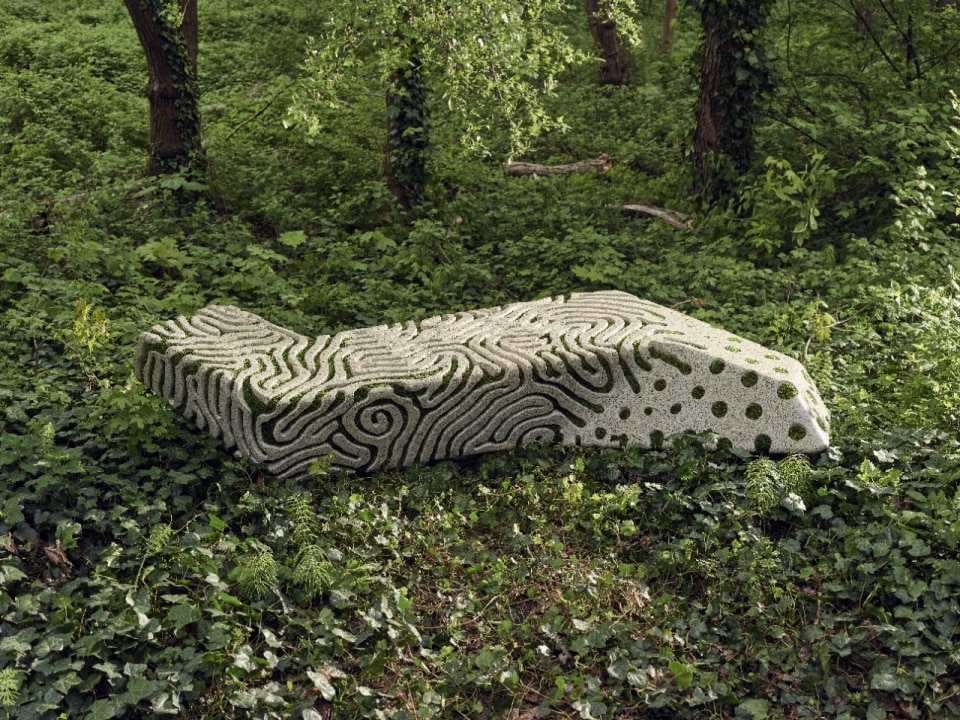
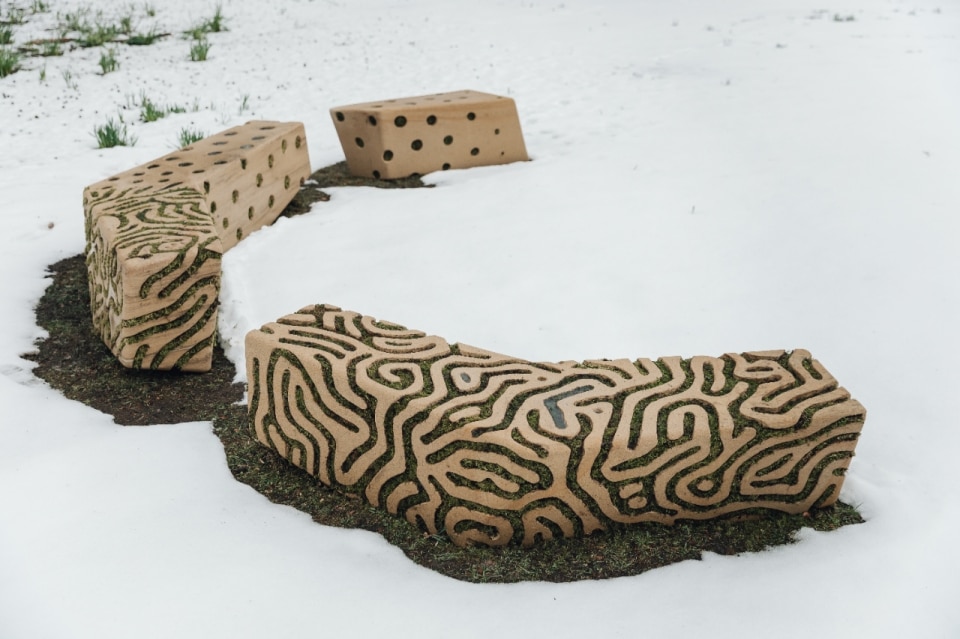
Yet Laarman’s research does not operate solely within the domain of computation. In recent years, the designer has turned his attention to what grows, mutates and coexists—and therefore evolves. The Symbio Benches (2024), stone or recycled concrete structures designed to host mosses and lichens, propose a post-humanist conception of public furniture: no longer surfaces that resist nature, but supports that invite it to take root, grow and slowly transform the object. A work to be built together.
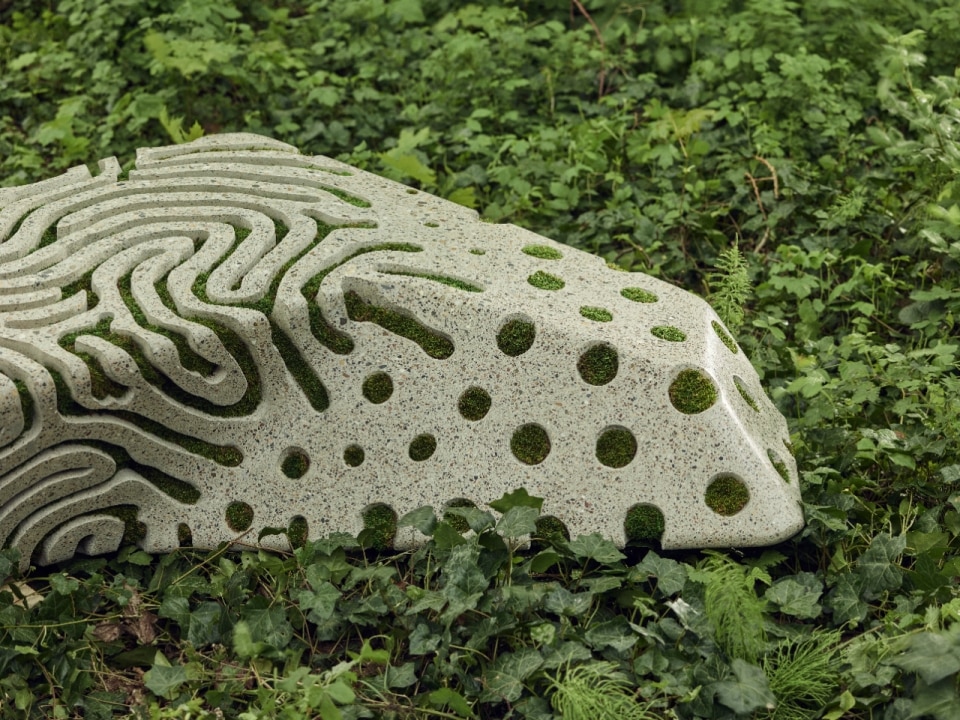
“In recent years, much of our work has revolved around the idea of the Simbiocene, a speculative era first proposed by Australian philosopher Glenn Albrecht, imagined as the period following the Anthropocene, in which nature, culture and technology merge into a new creative era of symbiosis. Since nature operates through circular, iterative evolutionary processes, these same ideas naturally permeate our practice,” the author explains.
“Our Symbio benches, for example, combine research into the highly graphic algorithmic patterns of British mathematician and philosopher Alan Turing with real ecological habitats that host bryophytes and lichens. Lichens, in particular, can grow extremely slowly—sometimes only a millimetre per year—so a work may take decades to become fully covered, if it ever truly does. But iteration is present in every experimental work we create. It is often the only way to tame a new process, a new technique or a new material and transform it into a coherent formal language or a new body of work. Nature is never permanent, and embracing this concept is deeply inspiring.”
Laarman and his collaborators consider this project as one centred on long, slow processes—processes of growth, erosion and iteration—treating the object as “a seasonal organism”.
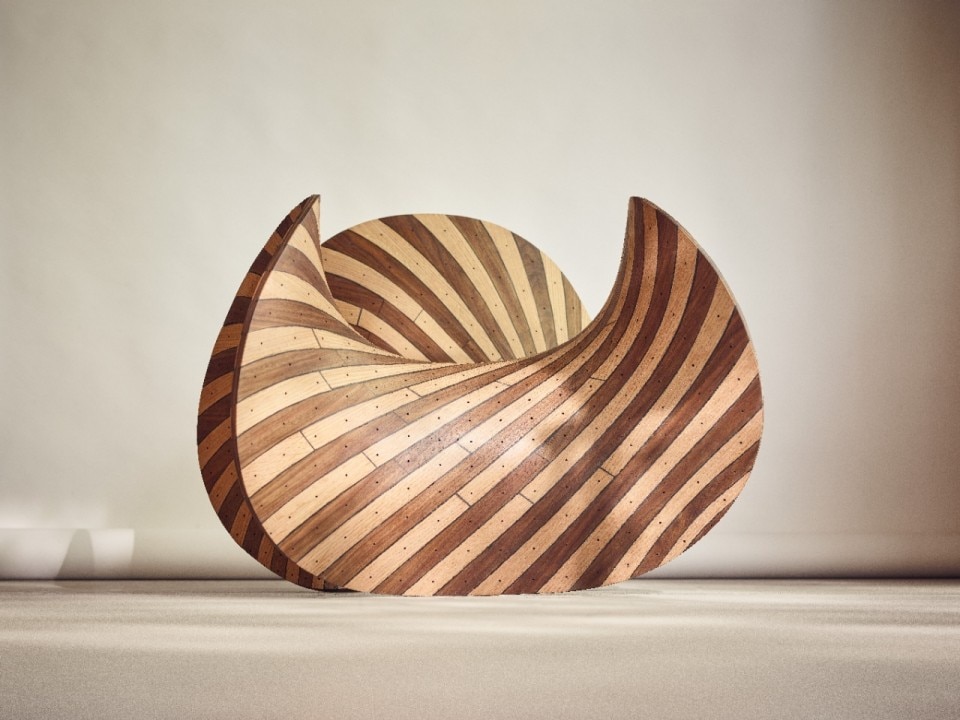
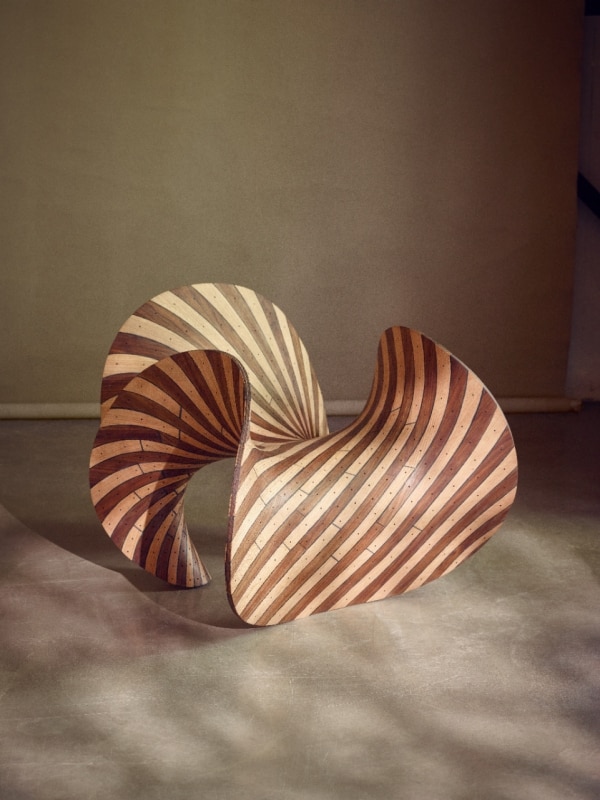
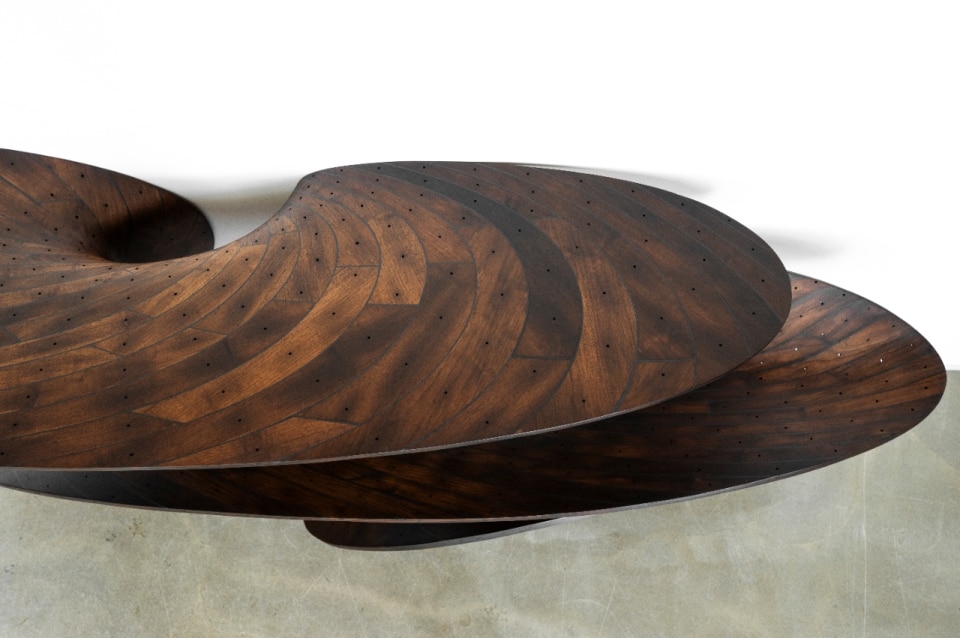
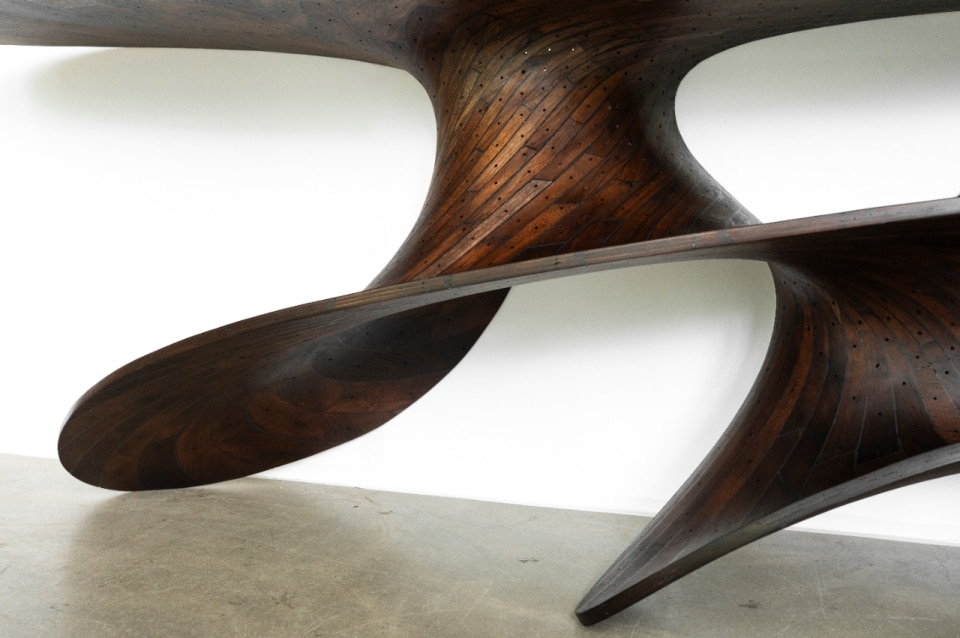
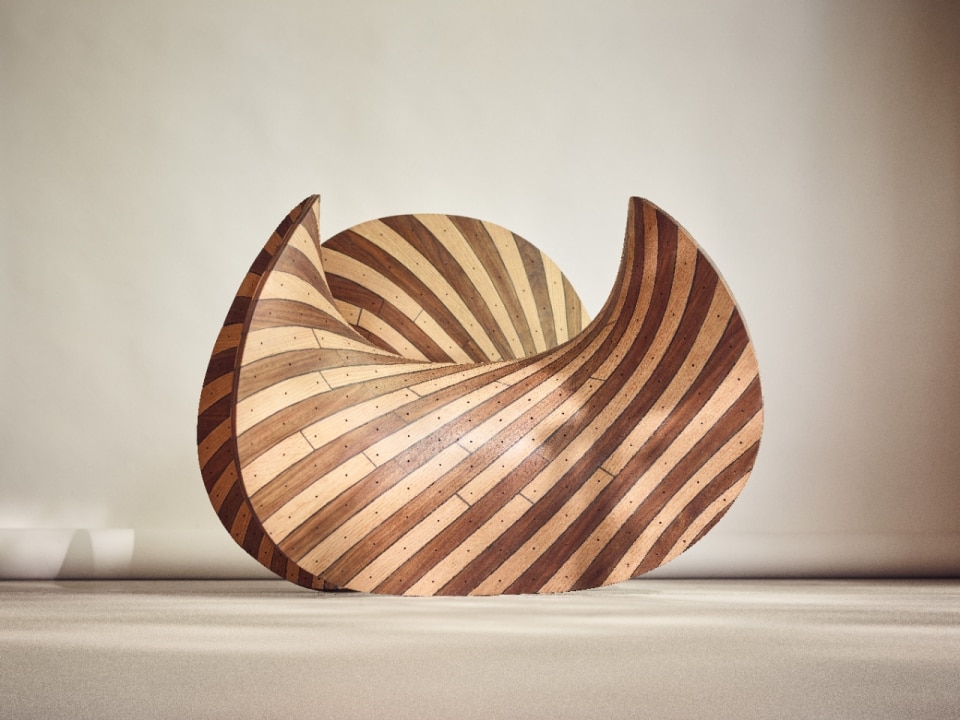
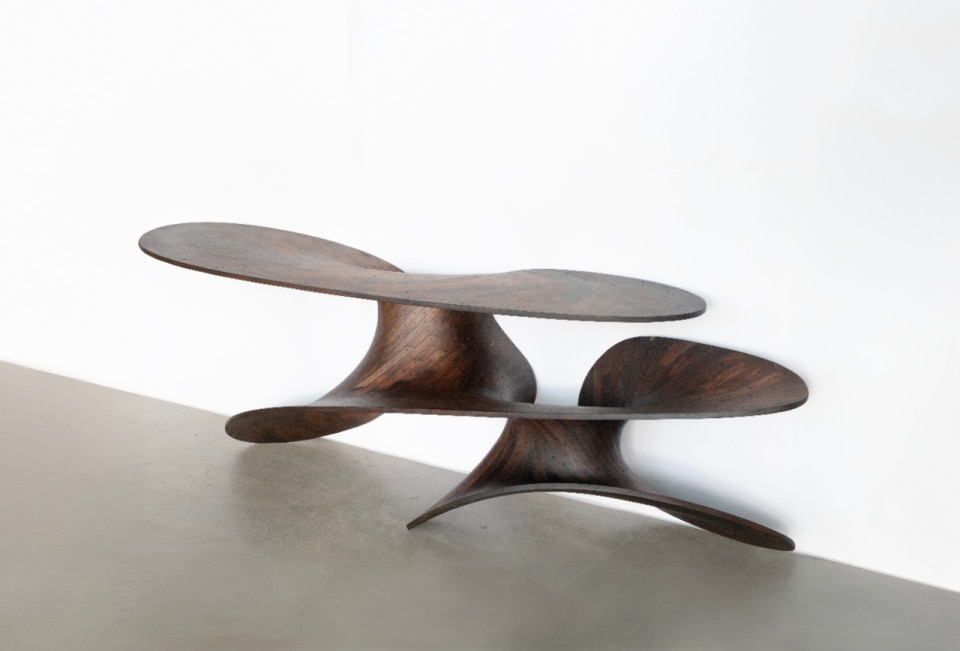
The Ply Loop Chair is another fundamental piece in the studio’s trajectory: a continuous spiral in oak and walnut, held together by a bio-resin developed with Plantics, a 100% bio-based thermosetting resin that is fully biodegradable and infinitely recyclable. It is an object that seems to come from a physics laboratory rather than a carpentry workshop, yet it emerges directly from the logic of the material itself. And then there is the digital vertigo of the Voxel Tables (2023): pixelated architectures built voxel by voxel, as if furniture had passed through a 1990s video game before returning to the physical world. The table, made of resin and neodymium (chemical element, atomic number 60), is a surface oscillating between baroque ornament and extreme computational modelling.
“Our work on Ply Loop reflects on the history of plywood, which is ultimately the history of glue. By replacing carcinogenic urea-formaldehyde-based adhesives with a new bio-based resin that is biodegradable under natural conditions—namely Plantics—and combining it with computational design and digital fabrication, plywood is ready for a new era of symbiosis.”

I am not entirely sure how to define Joris Laarman—a designer, a researcher, a mind shaped within and for our time—so I ask him whether he has his own definition of what it means to be a designer. “I think that all creative people are essentially authors. In the age of artificial intelligence, human-made objects—works that communicate from person to person—are becoming increasingly valuable to me. Artificial intelligence can generate very beautiful things, but they are often intrinsically boring because there is no one behind them trying to communicate something on an emotional level. I want to know who created that specific thing and why that person felt such a strong need to make it. I am satisfied with my work when it is full of content, like a three-dimensional poem. A single object that carries many stories within it.”
I belong to the last generation that remembers a completely analog world, and I feel a responsibility to carry certain qualities of that world into the future.
Joris Laarman
He adds: “As a creative mind, I filter reality through my own lens and transform it into something I feel is worth sharing—in fact, Anita (Ed., Anita Star, partner) and I have been developing a screenplay around this theme for many years, in the little free time we have. I belong to the last generation that remembers a completely analog world, and I feel a responsibility to carry certain qualities of that world into the future. I try to work with progress and tradition in a way that creates a particular tension. To embrace the future without losing the invaluable treasures of the past. I enjoy merging opposing forces: analog and digital, the artist’s hand and computational precision, function and ornament, craftsmanship and digital fabrication, nature and culture.”
Reflecting on everything he has produced so far, looking back—but only for a moment—the theme he has explored over all these years can be summed up as a constant experimentation with a world conceived “as a theatre that hosts a performance between progressive and conservative forces, and that can be found everywhere in the web of life. In nature, in culture, in politics. This tension has always fascinated me. My work is a continuous work in progress that reflects on this ever-evolving spectacle,” he concludes.
Looking at Laarman’s work means entering territories in which the traditional definition of design—if there ever was one—begins to falter. It is technology that gets its hands dirty with soil, biology that becomes algorithm, convention that accepts the unpredictability of the future. Each object is a prototype of possible worlds, close to and distant from one another. And perhaps this is the most urgent lesson of all: that innovation does not lie in moving forward at all costs, but in finding the point at which past and future cease to be opposing directions.