


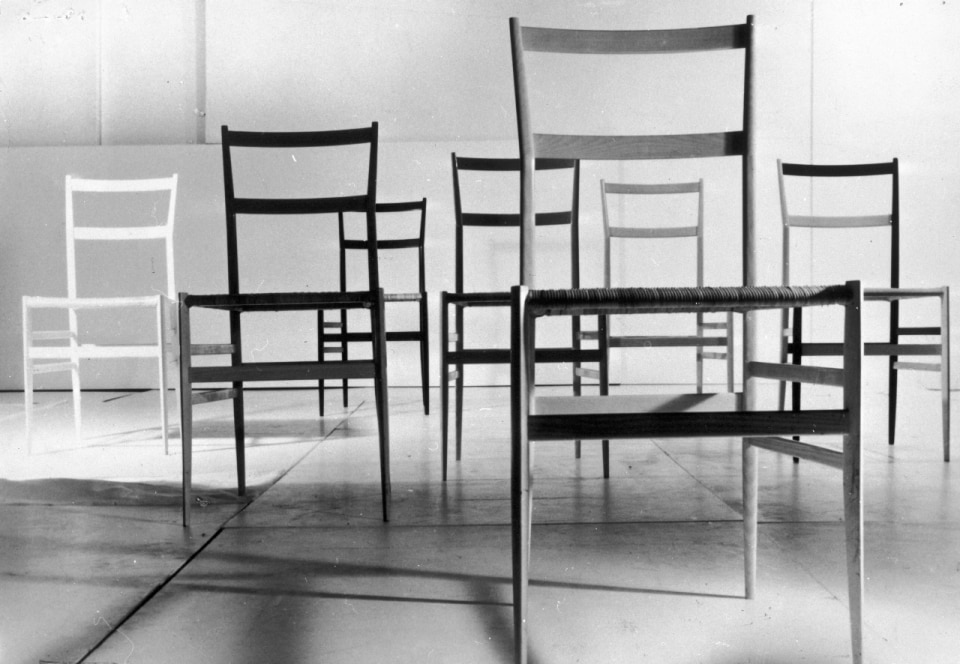
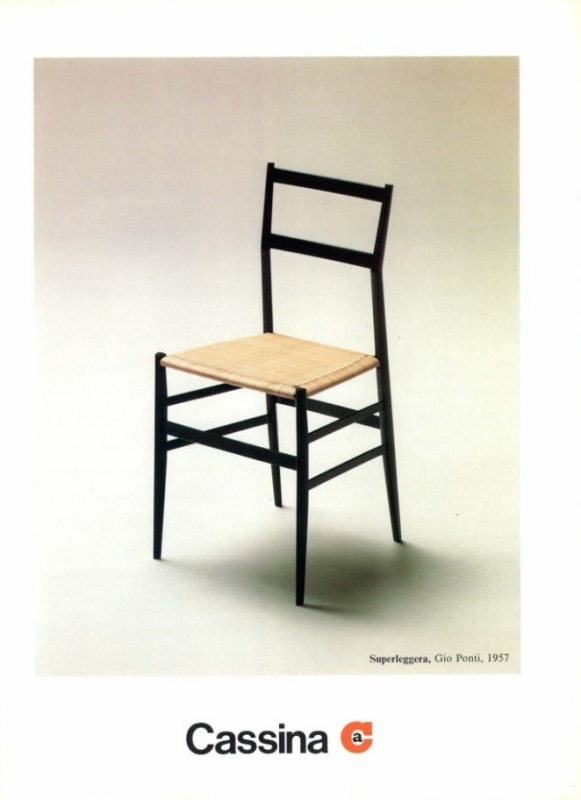
Weighing just 1.7 kilograms, Gio Ponti’s Superleggera is one of the architect’s best-known designs—and one of the most successful and enduring objects in Italian design history—for a very specific reason: it was conceived to eliminate everything that wasn’t strictly necessary. Next year it will turn seventy, and unsurprisingly it belongs to the permanent collections of MoMA and the Museo del Design Italiano at Triennale Milano.
Cassina began producing the chair in 1957, but the project dates back to 1955 and has even deeper roots. Ponti looked to the tradition of the Chiavarina, the Ligurian chair that filled Italian dining rooms for decades and that, through a curious cultural trajectory, has recently even appeared on the Super Bowl stage. This was not a nostalgic reference, but rather a direct engagement with an archetype—one in which Ponti saw a clear potential for modernity.
That archetype became the starting point for one of Ponti’s signature acts of subtraction, a design approach that ran consistently through his career in both architecture and product design. The same idea of lightness appears in Milan’s Pirelli Tower, expressed through large spans free of intermediate walls and concrete corners carved away around the stairwells, as well as in the Concattedrale Gran Madre di Dio in Taranto, where it takes the form of a perforated façade pierced by light. Whether working on buildings or objects, subtraction was Ponti’s tool for reaching the very essence of a project.
In semi-darkness it will be even lighter because it will stand on only two legs.
Gio Ponti
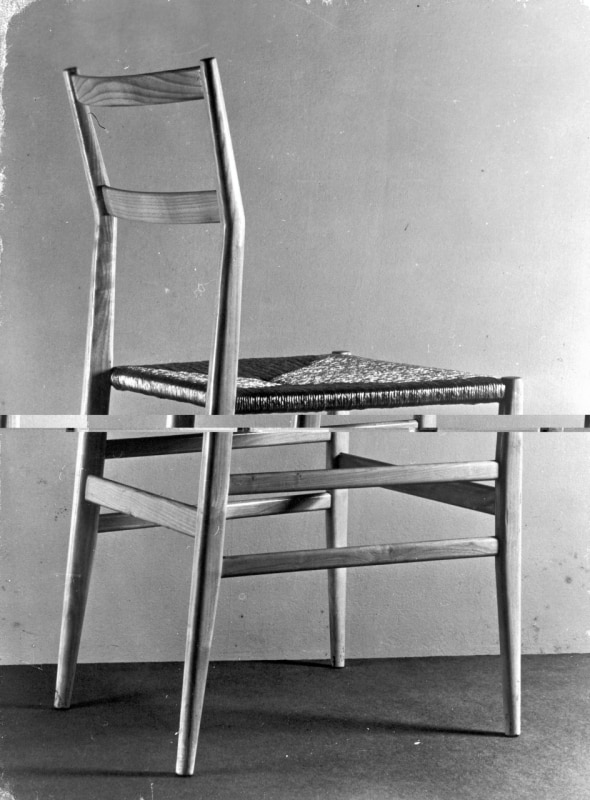
The chair’s structure is made of solid ash wood, with triangular-section legs measuring just 18 millimetres across—an extreme solution that minimizes material without compromising strength. The seat, traditionally woven in Indian cane, can also be padded and upholstered, as in the new version introduced for the chair’s sixtieth anniversary. The backrest is gently curved, reflecting an attention to ergonomics that Ponti was unwilling to sacrifice. The result is a chair that looks slender and delicate but is, in reality, remarkably sturdy.
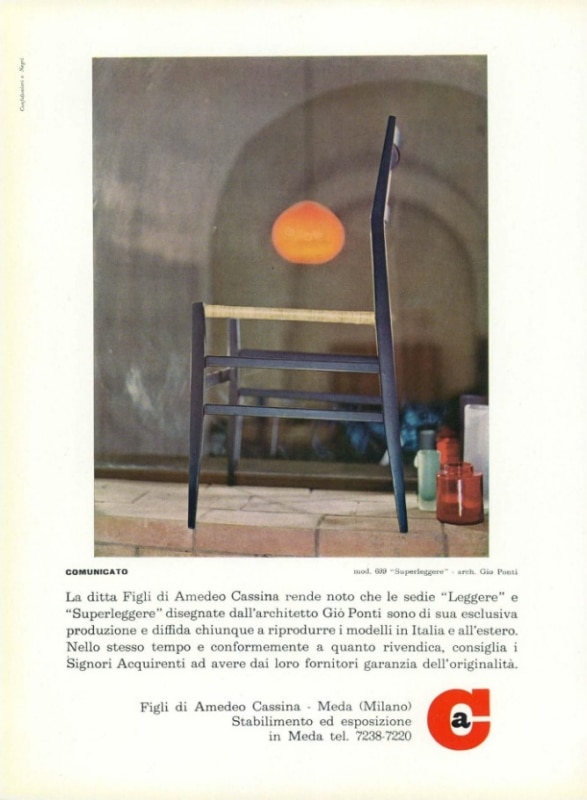
“In low light it will be even lighter, because it will seem to stand on just two legs,” Ponti once said when presenting the design—a design that has proven capable of withstanding not only physical loads but also the passage of time. The Superleggera’s success was immediate and difficult to contain, to the point that in 1960 Cassina felt “forced” to publish a very explicit notice in Domus: “The company Figli di Amedeo Cassina announces that the ‘Leggera’ and ‘Superleggera’ chairs designed by architect Gio Ponti are of its exclusive production, and it warns anyone against reproducing these models in Italy or abroad.”
Beyond the many copies of the original, the chair became a manifesto for a design philosophy devoted to essentialism, and it has never stopped being revisited, studied, and reinterpreted. At Milan Design Week 2019, the exhibition Supercolla presented 31 versions of the chair subjected to every kind of stress: wrapped in cellophane, burned, pierced, dismantled—as if it were an object solid enough to endure even desecration.
In the recent reinstallation of the Museo del Design Italiano at Triennale Milano, curators Marco Sammicheli and Marilia Pederbelli placed the Superleggera at the centre of a section dedicated to lightness, which they describe as “a theme that cuts across every era, and a field of research many designers have engaged with over time.” An interactive display allows visitors to physically test the chair’s weight using a scale: a Superleggera on one side, a two-kilogram dumbbell on the other. In the background, other chairs—the Air-Chair by Jasper Morrison, the Ghost by Cini Boeri, and the Foglia by Marco Ferreri—create a direct comparison, measured not in kilograms but, fittingly, in Superleggeras, as if it were the standard unit of reference for design.
There will likely be more re-editions and new promotional images in the future, but what endures in collective memory is a single, iconic photograph by Giorgio Casali that perfectly encapsulates the project: a child lifting the chair with just one finger.
Opening image: Gio Ponti, Superleggera. Archivio Domus - © Editoriale Domus S.p.A.