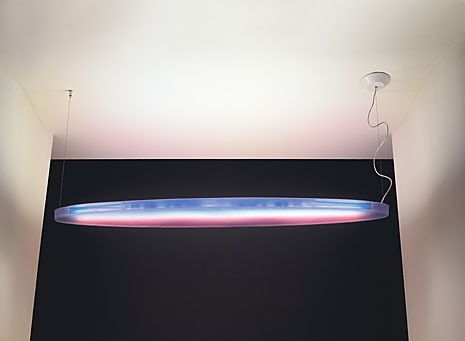
A lamp that produces variable white light of different intensity and colour shading is not just an object that communicates something; it deals directly with our physical and mental wellbeing. White reclaims its form and variation, after having been reduced to a single, flat, crushed shade without depth by the Modern Movement’s chromophobia in our cities. Light is subtler than massage. Trials for a 3d white. Edited by Loredana Mascheroni. Photography by Donato Di Bello.
Light as narration for the Self
Paolo Inghilleri
The places of the city, the buildings, the domestic and work spaces, and the objects that surround us, possess profound functions; not only from the point of view of architecture and design but also in terms of psychology, sociology, anthropology and biomedicine. From this point of view, objects can be considered as records of our emotions and values. This reflection lead to Artemide’s Human Light project, which began about ten years ago and is now in the third stage with My White Light. This research project involved architects and designers such as Branzi, De Lucchi, Manzini, Nicolin and Santachiara, who formed a group coordinated by Carlotta de Bevilacqua. They were flanked by a varied team, lead by myself, of university psychologists, anthropologists, philosophers and doctors of medicine. We began to think that the designer (and manufacturer) should place more attention on light itself rather than focusing merely on the lamp. Light, along with the objects that emit it and the spaces it fills, is thus seen as an essential means in the relationship between thepersonal self and the outside, private and social world. From the point of view of design, the over-distinct divisions between the different spaces of our lives (home, work, leisure) are overcome while light can facilitate links between the various aspects of existence, between the different parts of our psychic world, from the most rational to the most emotive. The possibility, I might say almost the necessity, of being able to personalise light so that it can be inwardly connected to the Self, underpinned the Metamorfosi project, its technology and its products. Sophisticated technology was placed at the service of a product that seemed fully and simultaneously to fulfil the functions of three types of design. Later, Donald A. Norman, in Emotional Design, was to call these three types visceral design (attentive to physical and natural form), behavioural design (attentive to the functions and use of objects and places), and reflexive design (linked to the message, communication, meaning and culture). The unifying element in our study was the person, with his or her psychological aspects, the body, his or her cultural background and story. This is summed up in the idea and term proposed by Carlotta de Bevilacqua: Human Light. In the years that followed, the reflection on design and theory widened. Thus the A.L.S.O. project was born. Its salient aspect was to introduce the theme of polysensoriality into the Metamorfosi project. Light, air and sound were studied and integrated in terms of biopsychic well-being. It was in the wake of these considerations, and in complete harmony with some of the most important movements of our society, that My White Light came into being. This is the latest project of Artemide was developed in collaboration with researchers at the Università degli Studi di Milano. It is in face of the porosity and fragility of contemporaneity that new values and new certainties, not stereotyped but the result of active choices and behaviours that are also sensitive to the Other, are beginning to be sought. This is also starting to apply to the use of objects. Indeed, to quote an interesting sociological term, we could say that solid objects are being sought for a liquid society. As far as light is concerned, this is how we should see the rediscovered interest that designers and manufacturers are showing in basic elements such as white light. These elements are essential from the perceptive and also psychic point of view. I believe this white light keeps intact all the possibilities of flexibility, differentiated intensity and links with the emotions, but which, unlike Metamorfosi, does not emphasize so much the mimetic side, that of the reproduction of personal and natural known environments, as the active construction of environmental meaning. This subjective construction of the environment is cognitive, rational, affective and emotional; it is made up of conscious and unconscious projections of the Self. At the same time it is characterised by organised cognitive experiences, that have a bearing on the culture to which we belong. New objects must therefore induce a viable appropriation of places, new forms of belonging And uses of spaces (from urban to domestic or working environments), marked by a simplicity which must not be ingenuous but derived from deep and therefore complex mechanisms.
Paolo Inghilleri A doctor and specialist in psychology, he is professor of Social Psychology in the Department of Literature and Philosophy at the Università degli Studi di Milano. His researches concern the relation between biology, mind and culture, optimal experience, creativity and environmental psychology.
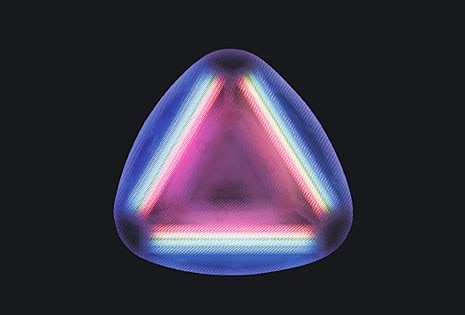
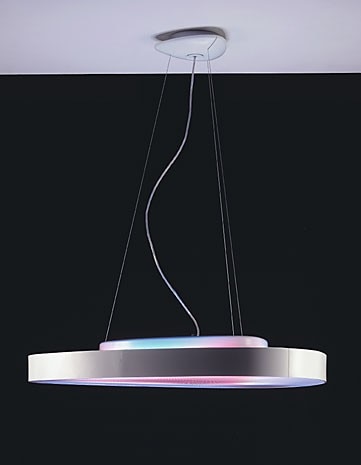
Trifluo: Franco Raggi
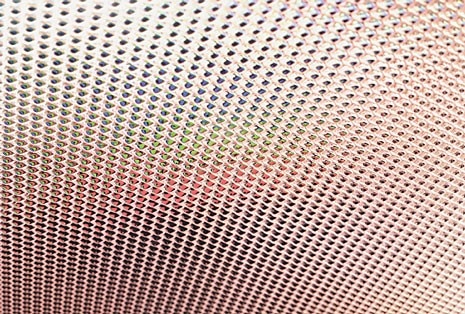
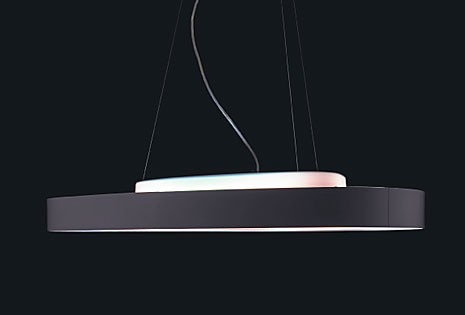
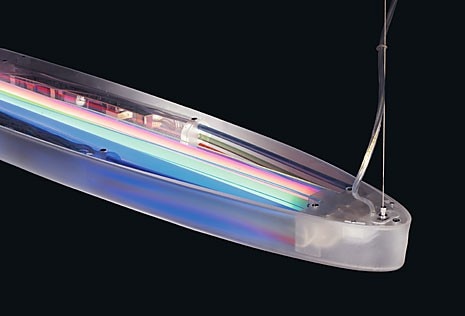
In addition to Sarissa, designed by Michele De Lucchi and Philippe Nigro, and Trifluo by Franco Raggi (these pages), My White Light includes four other versions: Orgia by Ernesto Gismondi, Attalo by Wilmotte & Associés, Lara by Michele De Lucchi and Philippe Nigro, Metacolor by Ernesto Gismondi. My White Light is a lighting system that uses fluorescent sources (RGB (red, green, blue) to create infinite shades of white light, in its diverse intensities and varieties of colour temperatures. The three fluorescent tubes are mixed by means of the prismatic methacrylate sheet (detail left) applied to the lower part of the diffuser. The functions are operated by means of a user-friendly twin-faced remote control. One side has just two switches on it, which adjust the intensity and ‘warmth’ of the white; the other has a third switch, to select the colour option. An electronic card allows the type range of light to be programmed for the whole day.