Modular cell fabrics
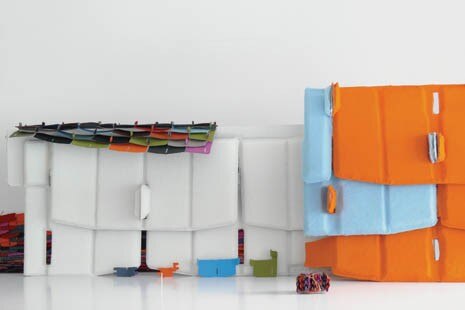
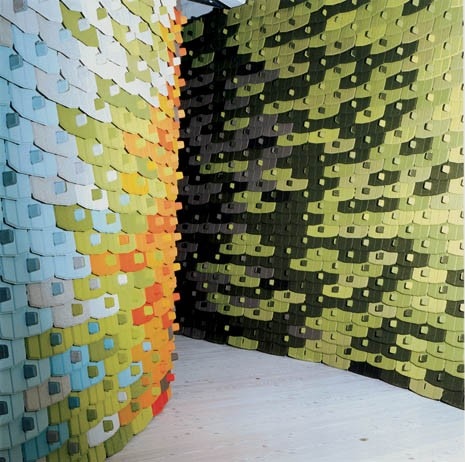
The textile brick designed by Erwan e Ronan Bouroullec for Kvadrat is the latest step in their process of deconstructing space. That process is now eroding the delimitation of space by such restraints as walls, doors and passageways – all hitherto regarded as closed and permanently fixed entities – which can instead be transformed into free configurations.
On one hand the aversion to fixed and definitive arrangements. On the other, a vision of open, free space, always ready to assume fresh configurations and different uses. This has always been the keynote of the Brittany-born brothers’ work. From their project for an open working environment developed with Vitra (the very long Joint table, on which workstations can be dismantled and recreated), to their early research into manufacturing modules that grow in space like creepers.
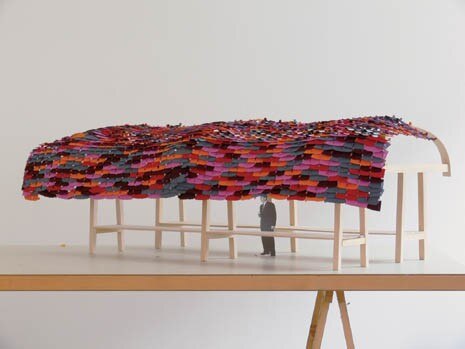
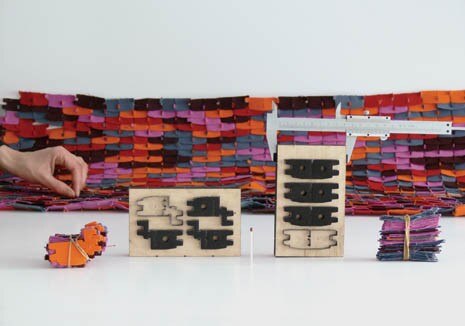
This rejection of permanently closed form has marked their work in a wide variety of fields: from carpets that can be rearranged ad infinitum thanks to their long connecting zips, to metal chairs decorated with motifs reproducing the vibration of colour for an unstable, active and ever-changing perception. In this latest episode, the Bouroullec brothers have collaborated with Kvadrat (one of the world’s leading manufacturers of textile furnishings with 2,400,000 metres of fabric per year) to mass-produce a textile module using industrial processes. The soft brick is in fact self-organised in a continuous surface. This determines its growth in space according to the context.
The sound quality of space
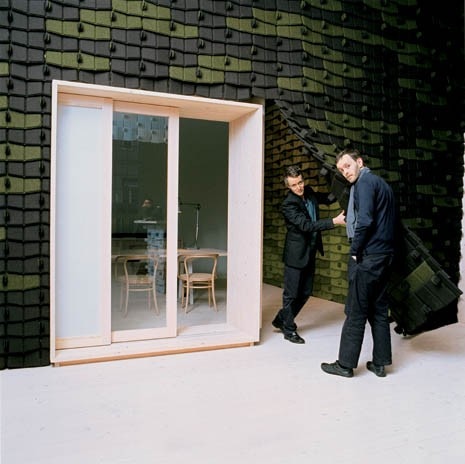
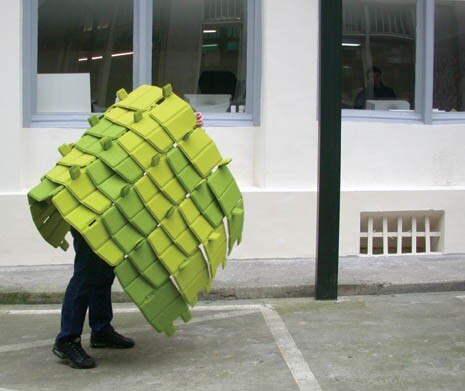
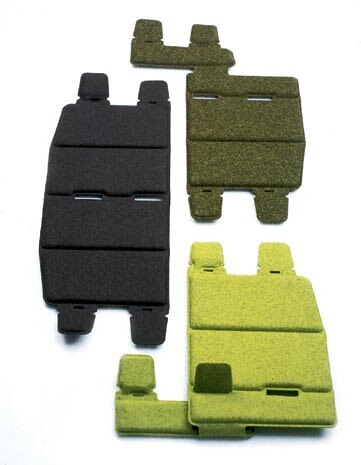
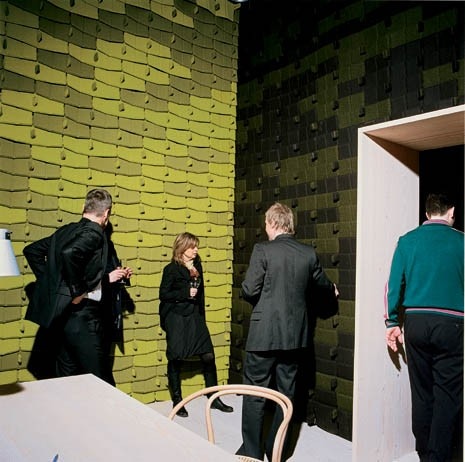
The brick’s basic module has no clearly perceptible form as such. Rather, its design springs from the scope for connection offered by its actual geometry. Once aggregated into a settled combination, the basic module tends to lose its separate identity and merge into a continuous flow. This gives it an indistinct and mutant perception, similar to the skin of a Jurassic animal. Each unit is a “fabric sandwich” containing a soft and highly deadening layer of cellular foam. In this way, areas enclosed by the flexible textile brick surfaces acquire a special sound quality that tends to create a muffled, protected, inward and warm sensation of that space.
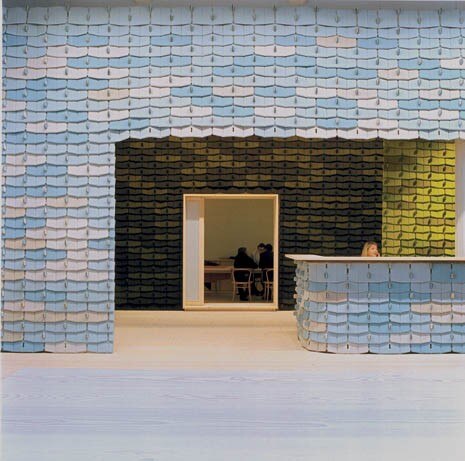
The interior seems to reduce sound and to be isolated in itself. It is as if the textile wrapping utilises the capacity of sound to be deadened and reverberated by the fabric, in order to circumscribe the space. Space as a place of possible relations With their interior design of a fabric showroom, the Bouroullec brothers have succeeded in narrowing the free, regular plan space at the entrance. It then winds in a progression of more intimate and secluded, or wider and brighter spaces. Eventually it becomes denser or more rarefied in relation to the more traditional elements of interior design: walls, doors, spare space, services, offices… Each of these is treated as an episode in its own right, free at any moment to be replanned differently, thus adapting to changing interiors. In this way the space is broken down into autonomous and freely connectable episodes.
In studying the alterations of space generated by the combination of constantly mobile elements, the Bouroullec brothers have also tackled, together with the wall theme, that other consolidated element, the door. Generally formed by a break in the wall, this element is transformed into a physical presence: an item of furniture occupying the space with its mass. Thus the door, too, is subjected to the same “revision” that gives it the form of an ulterior mobile element. As a result the threshold and passage to an enclosed, protected interior is actually turned into micro-architecture. F.P.