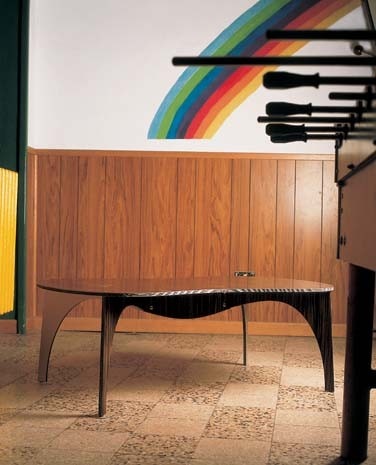
Hidden likes to have it both ways. Based in Holland, the firm was founded by Leon van Gerwen in 1999 to translate ideas and experiments into production. But not at the price of too much interference or compromise. Ron Arad, Christophe Pillet, N2, Richard Hutten, Dumoffice and Kombinat have participated in the Hidden venture from the start.
Since Ron Arad became Hidden’s art director, he has made manufacturing a priority. He sees the firm as a way through the barriers against younger designers represented by what he calls ‘industrial discrimination’. Moreover, it should mediate between the standpoint of design, production laws and the unexpressed desires (or resistance) of consumers. ‘The important thing was to make it real, not just an idea. Too often one sees a lot of things fabricated, but not manufactured’, he says.
For his first collection with Hidden, Arad has coined the word Troppotypes, an acid comment on the cynical reliance of too many companies on attention-grabbing prototypes that they know full well will never go into real production.
‘The idea is to have a company that grows together with its designers’. As such it becomes a vehicle or means to an end, something that actually does not exist in the current manufacturing system. It ought to allow new designers to emerge and continue to design challenging and original products.
Arad believes the difficulty of breaking into the world of production is one of the weaknesses of a system that hesitates to ‘authorize’ unknown designers. It is not disposed to accept new names outside that lucky, unbeatable generation of the masters. Businesses are cautious about allowing access to their production lines to people whom they have not worked with before or who have not designed and manufactured something already, barring the way to all except a few reassuring designers: the result is widespread uniformity and the monotony of almost identical products. Promoting new thinking in design by allowing mass-production to have the authority of natural selection guarantees the survival of the species.
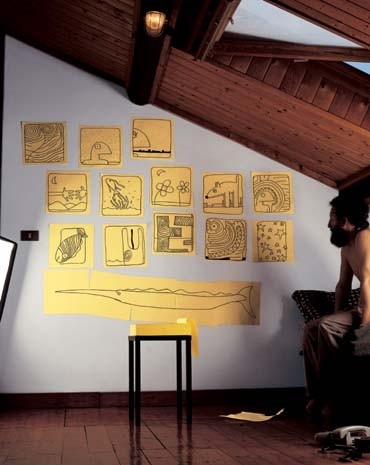
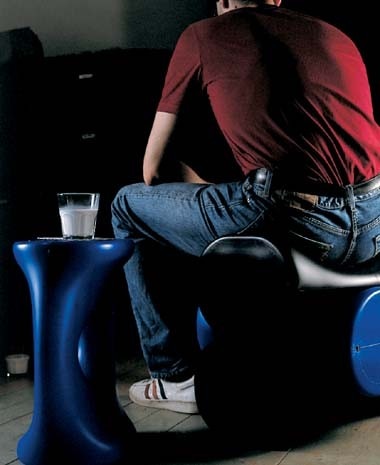
‘Established manufacturers need new designers, even though they don’t really think so’. Arad has brought together a group of young designers, including Arash Kaynama, Yuko Tsurumaru, Daniel Charny, Gabriel Klasmer, Dunne & Raby and El Ultimo Grito. Many are former students of his at the Royal College of Art. He knew their work and their tendency to try to capture the obscure side of the life of objects. Their experiments have been translated into the recognizable forms of real products: vases, tables and chairs that maintain a functional and formal relationship with the everyday world.
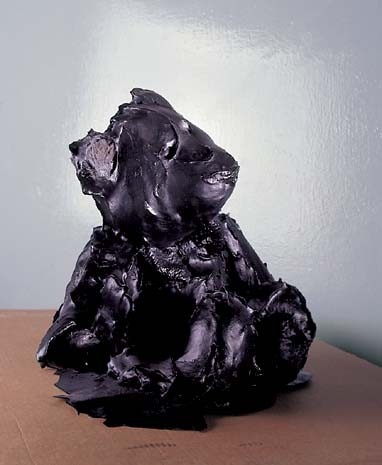
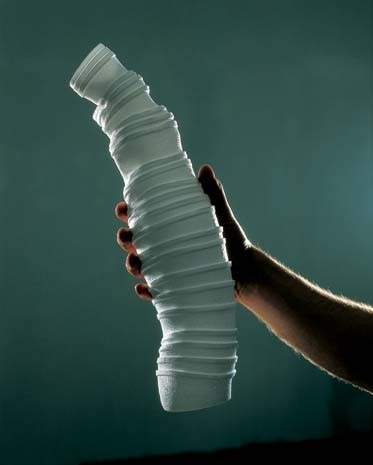
Paul Cocksedge, for example, took on the task of studying growth mechanisms, allowing his family of organic forms to act according to internal laws of change. Thus the designer remains outside the process of formal definition. He is more interested in studying the behaviour of the material and following its formal consequences. ‘I let the material dictate the form’, the designer says. ‘I was interested in letting the material do what it wanted to. The result always has been engrossing forms’. The point of departure is a polystyrene cup that Cocksedge uses as a common intermediate product; he exploits its basic form, a truncated cone, in diverse combinations. In this way, by merely devising a process that triggers transformation (a simple change in temperature), he has conceived a system that seems to have borrowed its rules from the natural world. This allows him to watch the mutation of the form in all of its configurations.
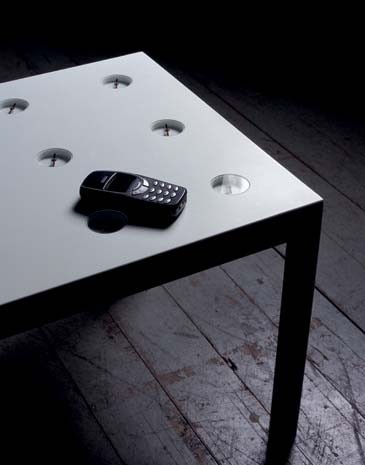
Anthony Dunne and Fiona Raby introduce another viewpoint. Interested in the pervasive presence of electronics in everyday life, for years they have been studying an invisible landscape. Though it is inaccessible to our senses, it can be understood by means of laws that help predict its behaviour. It is a terrain pervaded by the actions of forces (such as electromagnetic fields) of which we frequently know nothing and can barely perceive.
Convinced that ‘beneath the glossy surface of official design lurks a dark and strange world driven by real human needs’, Dunne and Raby decided that the representation of the ‘secret life of objects’ could become a tale in which ‘electronics are co-stars in a noir thriller’. They introduced their ideas to a broader audience in a book entitled Design Noir, an homage to the mysterious side of things that design unveils.