Jean Prouvé and Vitra

Prouvé’s second life
Deyan Sudjic talks with Rolf Fehlbaum
Photography by Lee Funnell

Rolf Fehlbaum has a genuine love for the work of Jean Prouvé, whom he has always seen as a reflection of a sensibility that is close to, if different from, Charles and Ray Eames, the historic figures who have become so closely associated with Vitra. For Fehlbaum, the Eameses were at the lighter end of the aesthetic spectrum, and Prouvé was at the heavy end. But both managed to achieve a timeless quality based on a certain restrained feeling for the organic qualities of technology. The very first piece that Fehlbaum bought for the Vitra Design Museum’s collection was a Prouvé chair. Every day at home he eats off a Prouvé Trapese table, which spans a hulking 3.3 metres. But it has taken almost 20 years for Vitra to begin manufacturing the work of the man Fehlbaum calls ‘the least discovered of the great 20th-century designers’.

The problem was not so much the issue of the licensing rights – which until recently have belonged to a German firm that made strictly limited re-editions of just a few of Prouvé’s designs – but the engaging sense of inquiry that Fehlbaum brings to everything that he does. It was important to Fehlbaum to get the philosophical and ethical issues ironed out before rushing into production. Fehlbaum’s own Prouvé pieces show their age. They are chipped and worn by use and the passage of time. Would they lose their charm fresh from the icy perfection of the factory, their metal finished in epoxy coating rather than lacquer? The only way to find out was to make them. Was the technology that Prouvé had used still relevant? Happily, the answer turned out to be yes. ‘Laser cutting and computer-driven machines make it possible to do things that weren’t economic to do manually any more’. And most fundamental, was there any point in putting a 70-year-old design into production? ‘Many re-editions are really unnecessary’, says Fehlbaum. ‘Why would anybody but a collector want a Frank Lloyd Wright side chair, for example?’ For Fehlbaum the only justification for rescuing a piece from the museums and collectors is if it can still be regarded as contemporary, even if it is from another time. He finds the continuing relevance of Prouvé in the rough, mechanical quality of his work, which he sees as having affinity with both the Eameses and Vitra’s own way of doing things. ‘Great design always fulfils two criteria, which might seem to be contradictory: it must have the feeling of following the rules of necessity, and at the same time it must express a sense of the personal’. It was only after having resolved these questions in his own mind that Fehlbaum began to consider the technical details.

Exactly which pieces – and which versions – would form part of the Prouvé edition? In many cases, despite the full co-operation of the Prouvé family, it is hard to be precise about which of a number of variations of a particular design should be regarded as authoritative. The first group is made up of four tables (Fehlbaum’s particular enthusiasm), three chairs, a lamp and a knife, and there is more to come.
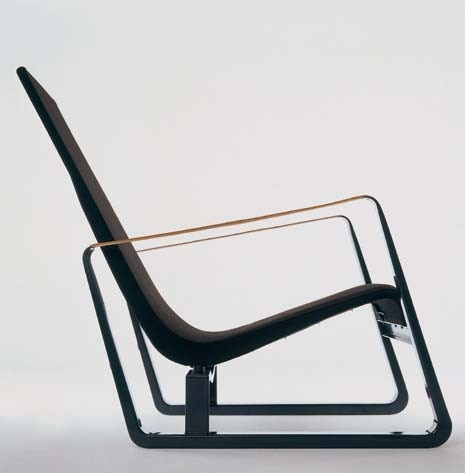
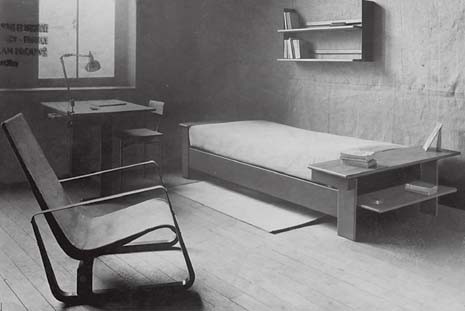
In 1930 Prouvé won the competition to furnish the Cité Universitaire of Nancy. On that occasion he developed the model of the Cité armchair, of which he was to make numerous variants in the course of time
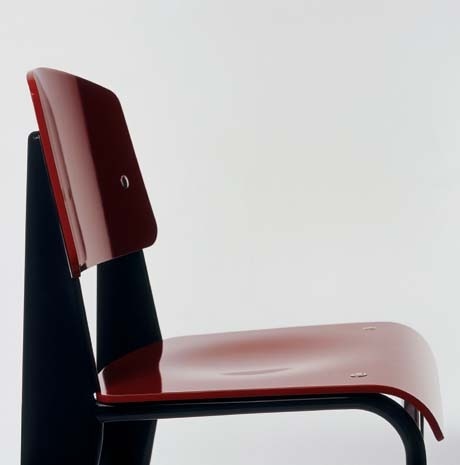
The Standard chair was manufactured in numerous variants of materials and techniques, left and below. The first models appeared concurrently with the furniture project for the Paris Electric Company, 1934-35, and for the National Technical School of Metz, 1935-38
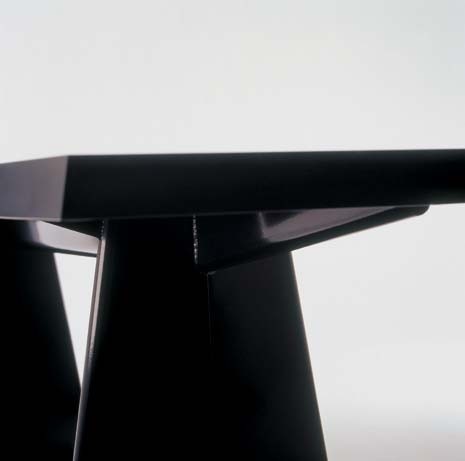
The Trapèze table, left, over three metres long, was part of the project for the Cité Universitaire d’Antony: it best expresses the technical properties of plate metal
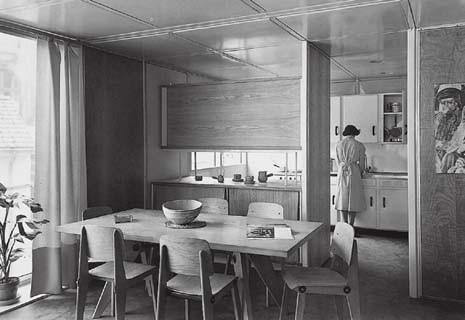
Interior of a Mètropole house with axial portico, 1950. When Les Ateliers Jean Prouvé was founded in 1931, the firm was devoted exclusively to the production of ‘metal constructions, industrialized housing’ and ‘folding furniture made in a blend of metal and wood’. Prouvé’s fully vertical approach to construction envisaged no separation between furniture and the home
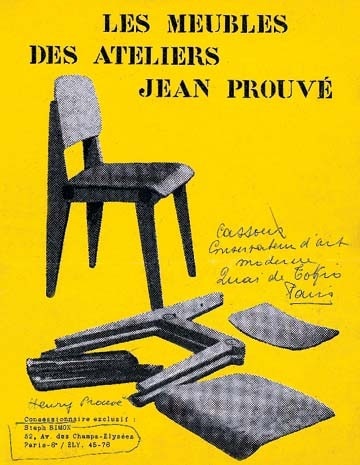
Original catalogue of the ‘folding furniture made entirely of light and glazed metal’ by Les Ateliers Jean Prouvé. The forms of Prouvés furniture were inspired by the new architecture of the time and by the necessity to economize. In 1945 the Paris gallery Steph Simon became the firm’s sole agent
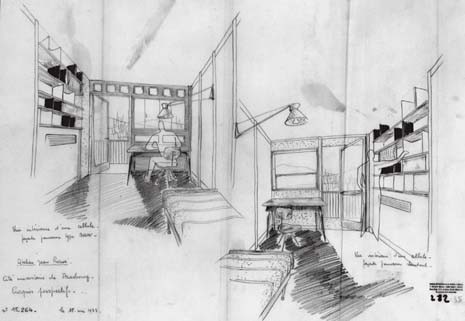
In the early 1950s André Bloc, editor of the magazine <i>L’architecture d’aujourd’hui</i>, asked Prouvé to collaborate with Charlotte Perriand and Sonia Delaunay on the d’Antony furniture program for the Cité Universitaire. For the project, which aimed for a synthesis of the arts, he designed a number of items including the furnishings for the dormitories, above, that would become icons of the merging of industry, furniture and the plastic arts. Models of his standard products were adapted to furnish the common rooms. Fond Jean Prouvé ADMM/S.C.E. Jean Prouvé. Tout droits réservés
In the early 1950s André Bloc, editor of the magazine L’architecture d’aujourd’hui, asked Prouvé to collaborate with Charlotte Perriand and Sonia Delaunay on the d’Antony furniture program for the Cité Universitaire. For the project, which aimed for a synthesis of the arts, he designed a number of items including the furnishings for the dormitories, above, that would become icons of the merging of industry, furniture and the plastic arts. Models of his standard products were adapted to furnish the common rooms. Fond Jean Prouvé ADMM/S.C.E. Jean Prouvé. Tout droits réservés
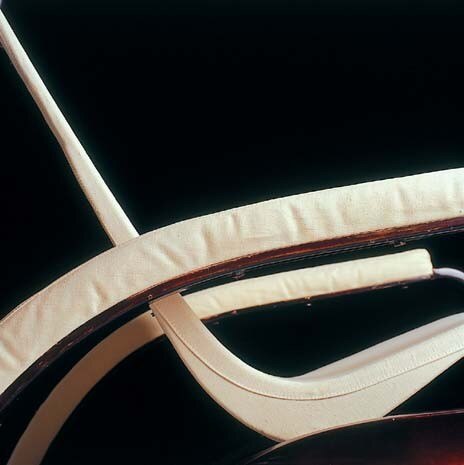
The metal armchair plays a significant role in the evolution of Prouvés thinking about form and furniture. There slowly emerges the definition of a standard seat type that can be freely applied as an interchangeable element, as in the Grand Repos adjustable armchair of 1930, a model in the collection of the Vitra Design Museum
Armchair designed for the students rooms at the Cité Universitaire of Nancy in 1930. Fond Jean Prouvé ADMM/S.C.E. Jean Prouvé. Tout droits réservés
Prouvé explored the aesthetic potential of metal plate with means suited to industrial production, as demonstrated by the car-body paints used to glaze the surfaces of the table shown at the 9th Milan Triennale in 1951
The embossed finishes of the Pointe Diamant sideboard of 1950-52
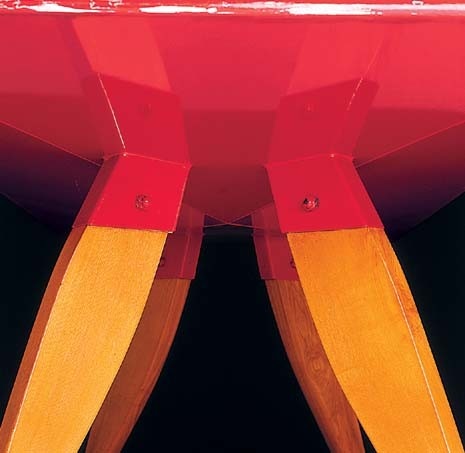
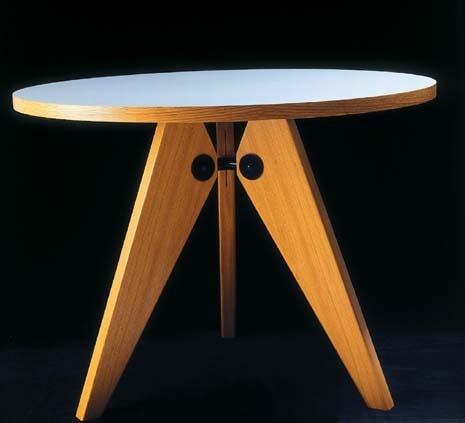
The four-legged metal table and the three-legged wooden table are variants of the same manufacturing principle developed by Prouvé using different construction materials and processes. The original models for the series first appeared in 1941/42 in various projects for l’Établissements Solvay

Latest on Design

Latest on Domus

China Germany India Mexico, Central America and Caribbean Sri Lanka Korea icon-camera close icon-comments icon-down-sm icon-download icon-facebook icon-heart icon-heart icon-next-sm icon-next icon-pinterest icon-play icon-plus icon-prev-sm icon-prev Search icon-twitter icon-views icon-instagram