


There is a fundamental difference between beauty and ugliness, just as there is between emptiness and fullness, silence and noise, light and shadow. Yet that distinction has become increasingly unstable over time. It resembles a line drawn in sand: visible from a distance, fragile up close, erased by the first market wind that blows through. There was a time when those equipped with the right cultural vocabulary could recognize beauty simply by looking. Today, looking is no longer enough. Images must be decoded because something has inserted itself between us and them – a silent impostor that has mastered the language of beauty without ever possessing its essence. That impostor is kitsch.
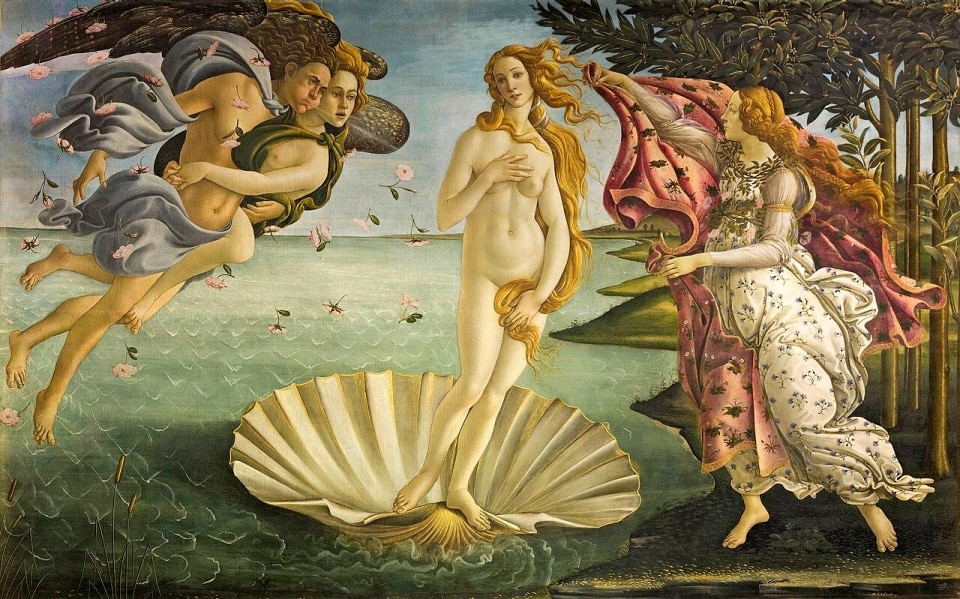
To understand what has been lost, it helps to return to Florence and to Botticelli’s Primavera, to the Venus born not from the sea but from the Neoplatonic philosophy of Marsilio Ficino. The figure whose golden hair ripples across the painted surface is not an image of comforting beauty. She is a theophany.Botticelli paints a body that does not – and cannot – exist in nature. Her narrow shoulders, elongated neck, and anatomically impossible contrapposto violate every rule of physical realism because realism is not the point. His ambition is not to imitate the visible world but to give form to an idea.
Venus is beautiful because she is true, not because she is pleasing. She embodies Beauty as a metaphysical principle, a bridge between the material world and the realm of ideas. Before she reassures, she unsettles. Before she invites admiration, she demands contemplation. Looking at her requires an act of ascent.
Long before it became an aesthetic category, kitsch was a dismissive term. In late nineteenth-century Munich, it referred to inexpensive works sold in street markets and souvenir shops. Even its German etymology carries a judgment, suggesting the act of scraping together or gathering refuse. The verdict is already embedded in the word itself: art pretending to be art, imitation disguised as originality. Hermann Broch famously described kitsch as the aestheticization of ethics – the attempt to clothe lofty values in sentimental and predictable forms. Leo Popper later observed that this process ultimately transforms emotion itself into a commodity, packaged for immediate consumption.
The real lesson is that true beauty has never ceased to be an act of courage.
This is precisely the distinction we struggle to recognize today. Kitsch is not ugliness, despite what many still believe. Ugliness possesses its own tragic dignity and an unmistakable ontological status. It stands in opposition to beauty the way night stands in opposition to day, and through that opposition it acquires meaning. Francisco Goya understood this better than almost anyone. His Caprichos, populated by monsters, witches, and donkeys dressed as scholars, stand alongside his Majas as equally important works because they do not flee from ugliness. They inhabit it. They investigate it as a legitimate territory of human knowledge. Kitsch operates differently. It is beauty emptied of risk.
Umberto Eco articulated this with remarkable precision. Kitsch abandons criticism and irony in favor of immediate emotional gratification. Its power lies in eliminating ambiguity. It offers itself already interpreted, already understood – an aesthetic experience designed for viewers who wish only to feel, never to question. Jean Baudrillard would later recognize the same mechanism in the logic of the simulacrum: an image that no longer points beyond itself, that simulates depth while existing only on the surface of signs.

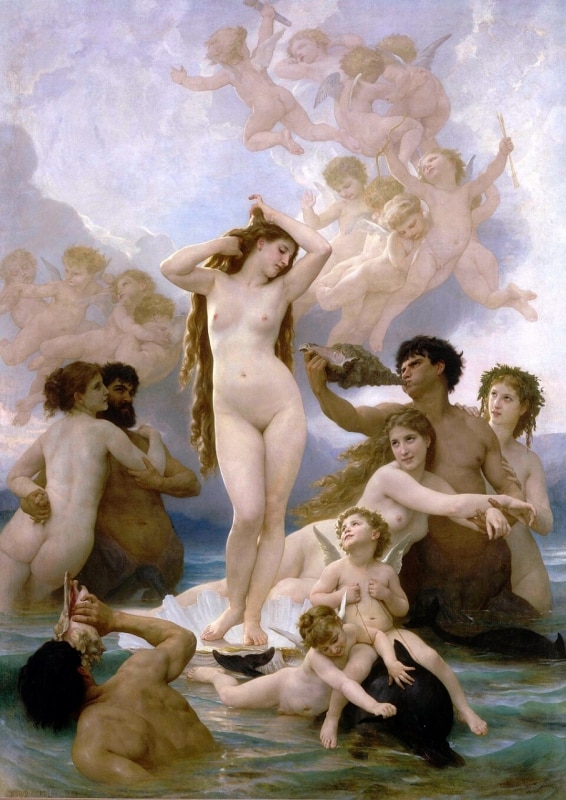
Comparing works of art makes this distinction easier to grasp, provided we remain historically honest. Botticelli’s Venus and Bouguereau’s Venus – the latter’s academic perfection being simply the coherent result of a different cultural evolution and a different relationship between painting and the bourgeois world – help us understand that beauty changes, but remains whole, elegant, and never entirely accessible to everyone.
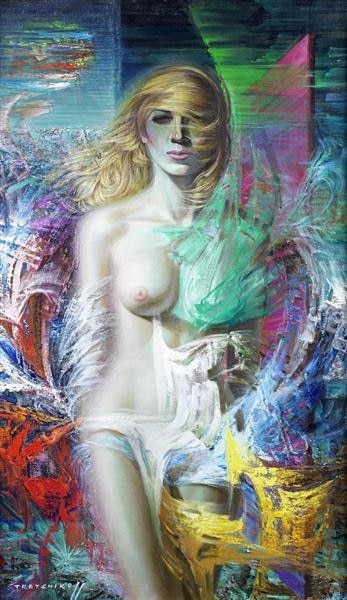
The true counterpoint, however, must be sought elsewhere: in the contemporary female imagery that now dominates social media, in the endless production of faces smoothed by filters, enlarged eyes, and softly vacant expressions. In recent years, this visual language has been joined by a second manifestation of the same kitsch: bodies sculpted to the point of hypertrophy and displayed as trophies. Enormous thighs, sharply defined abdominal muscles in every frame, skin stretched over musculature that no longer expresses vitality but performance. Often these bodies are further marked by decorative tattoos that cover the skin like labels – a form of packaging for the body, designed to be photographed rather than experienced.
And while it used to be enough simply to look in order to recognize something—provided one had the cultural background—today we almost have to decipher it, because a third element has crept in between us and the images: a silent impostor that has stolen the gestures of beauty without ever having grasped its essence—kitsch.
It is an aesthetic that confuses ostentation with elegance, muscular performance with grace. While Botticelli’s Venus proposes a form of femininity built on delicate lines, balance, and a modesty that is already a form of thought, contemporary social-media imagery presents a showcase body: hyper-defined and hyper-exposed, constructed not to be contemplated but to certify, in real time, belonging to an aesthetic standard that has replaced grace with demonstrative power. This is where the true kitsch of our time lies. Not in technique itself, which is, in fact, extraordinarily sophisticated, algorithmic, and capable of correcting every imperfection in real time, but in the complete absence of risk and mystery. Botticelli’s Venus, with her impossible anatomy and almost ascetic pallor, proposes a vision of the body that unsettles before it pleases. The sculpted and tattooed body flowing through the digital feed proposes nothing, questions nothing; it exists only to obtain immediate and already anticipated approval.
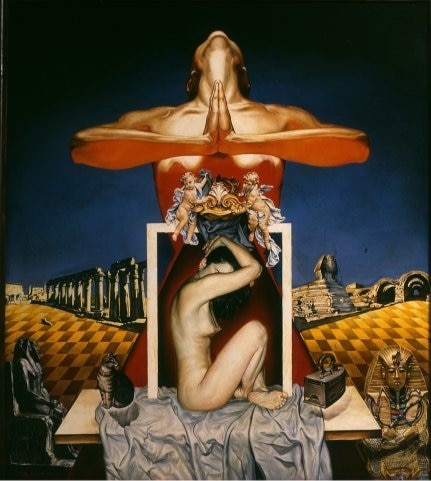
For the sake of intellectual honesty, it should be acknowledged that the twentieth century greatly complicated this landscape. Pop art – Warhol, Lichtenstein, and others – borrowed the language of commercial culture and relocated it inside the museum, destabilizing every hierarchy between high and low, original and derivative. But this was an evolution of art itself. From that point onward, kitsch ceased to be merely a flaw and began, in the right hands, to function as a critical device. Jeff Koons elevated it into a system: hyperreal sculptures, pastel colors, carefully calculated nostalgia. Maurizio Cattelan dismantled it and staged it as a self-aware form of theatrical absurdity.
This is where a third category enters the discussion, distinct from both beauty and naïve kitsch: camp. Camp is kitsch that looks at itself in the mirror and laughs, overturning hierarchies of taste through irony. If kitsch mistakes itself for the sublime, camp knows perfectly well that it is not. The social-media showcase body, however, does not play this game. It does not use irony. It does not question itself. It does not even know that it is kitsch. It is naïve kitsch in its purest form, simply updated for the language of the algorithm.
There is finally another difference, one that concerns materiality. Botticelli’s tempera, with its extraordinarily subtle layers of pigment, preserves the trace of the hand and the uncertainty of the gesture. Digital kitsch, by contrast, no longer even possesses a surface to cross. It is pure light, pure correction: a body-image that has eliminated every trace of time and effort required to create it. It offers the same immediate gratification that makes an image viral within an hour and forgotten within a day.
Perhaps the true lesson is that authentic beauty has never ceased to be an act of courage. It requires the painter’s audacity to transform reality in order to reveal an idea, and it requires the viewer’s courage to allow themselves to be affected by what they see. Contemporary kitsch, by contrast, is the abandonment of both forms of courage: the courage of those who create images without risking anything, and the courage of those who look without wanting to be changed. There is, therefore, a fundamental difference between beauty and ugliness. But the distinction that truly separates the images of our time is another: the difference between what still dares to question us – like Venus suspended upon her shell – and what is satisfied, with perfect and harmless lightness, simply to please us. Perhaps.
Opening image: Sandro Botticelli, The Birth of Venus, c. 1485. Photo from Wikipedia