


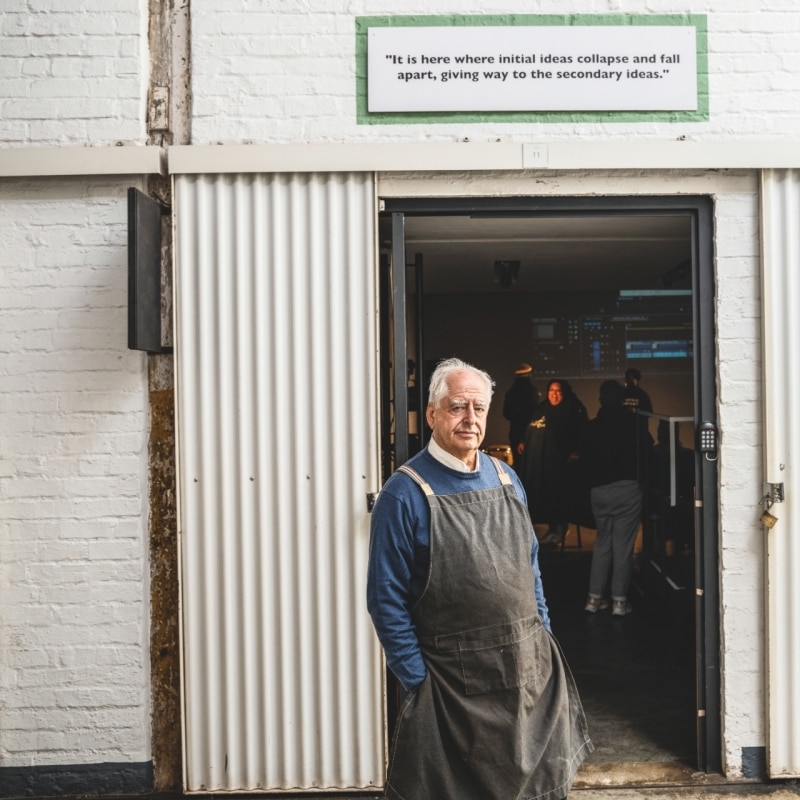
Drawing artist, director, set designer, performer: for over forty years, William Kentridge has been one of the most multifaceted and influential figures in contemporary art. Born in Johannesburg in 1955 and raised in apartheid South Africa, with both parents lawyers and activists – his father, Sydney Kentridge, is known for having defended Nelson Mandela – Kentridge has built a body of work that brings together historical memory and imagination.
At the heart of his practice remains drawing, which can be revised and continuously rewritten, marked by the shadows of erasures. It is both a way of working and a way of thinking: the entry point into his world, from which films, installations, theatre productions and performances unfold.
On the occasion of the presentation of “William Kentridge”, the first title in Skira Editore’s “Milestones – At the Heart of Creation” series, we met the South African artist, who is also currently featured in two exhibitions in Milan.
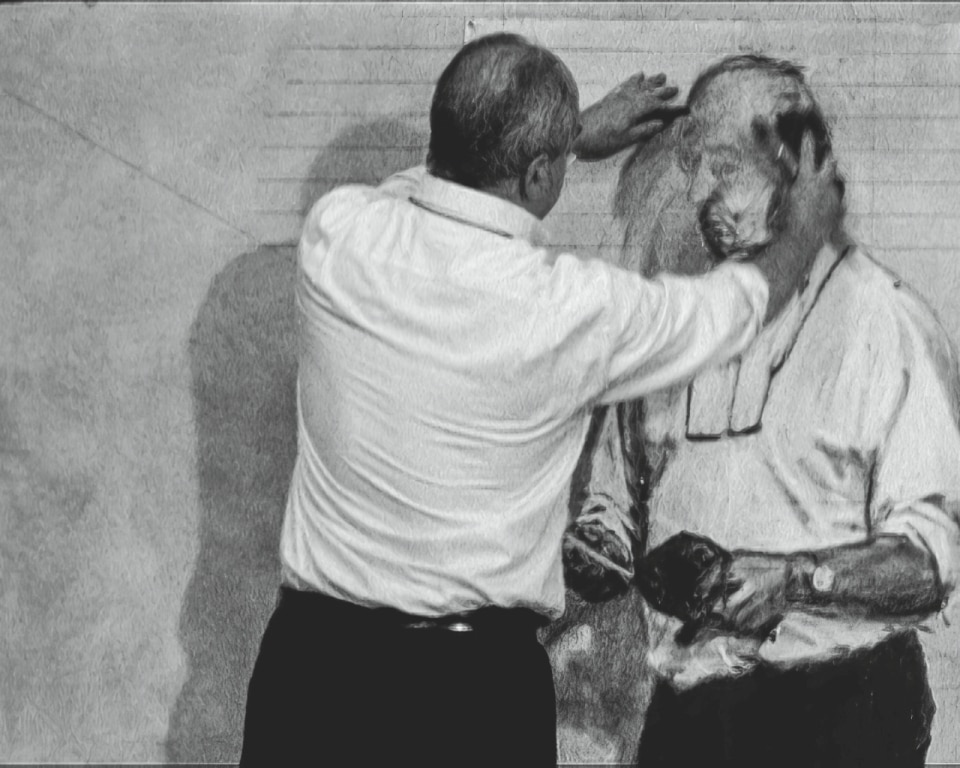
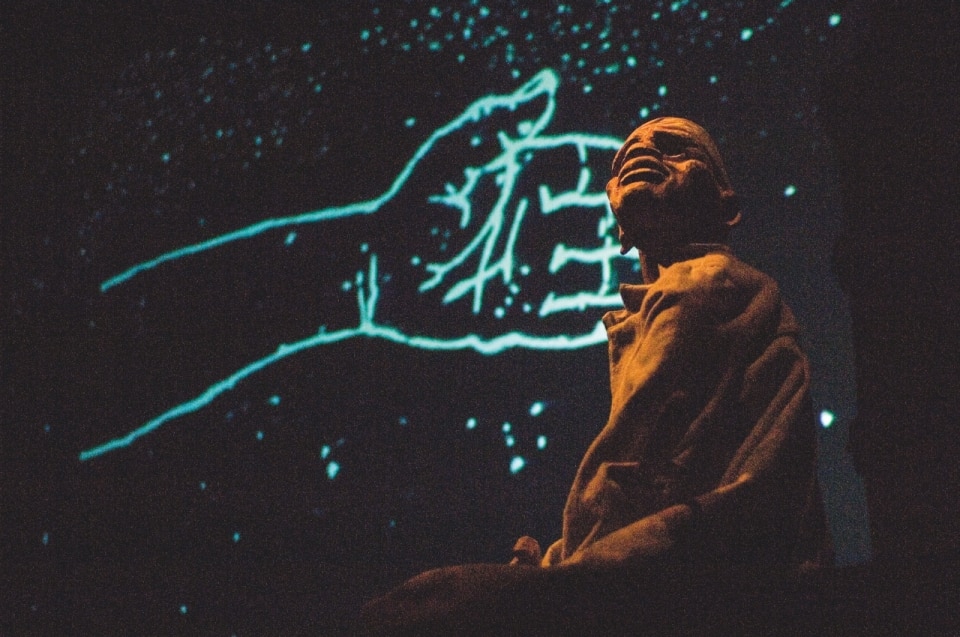
In the exhibition “Sharpen Your Philosophy” at Galleria Lia Rumma, Kentridge presents a wide body of recent works including drawings, sculptures, dioramas and video installations, exploring themes such as uprooting, identity and the unstable nature of knowledge. At the same time, in the spaces of Palazzo Citterio, “More Sweetly Play the Dance and Remembering Morandi” pays tribute to Giorgio Morandi as part of the broader programme of the exhibition “Metafisica/Metafisiche” at Palazzo Reale.
Productive procrastination, the walking around, the circling of the studio, walking around is smart and necessary, but for me it's a kind of an inevitable part of the work, gathering the energy before things start.
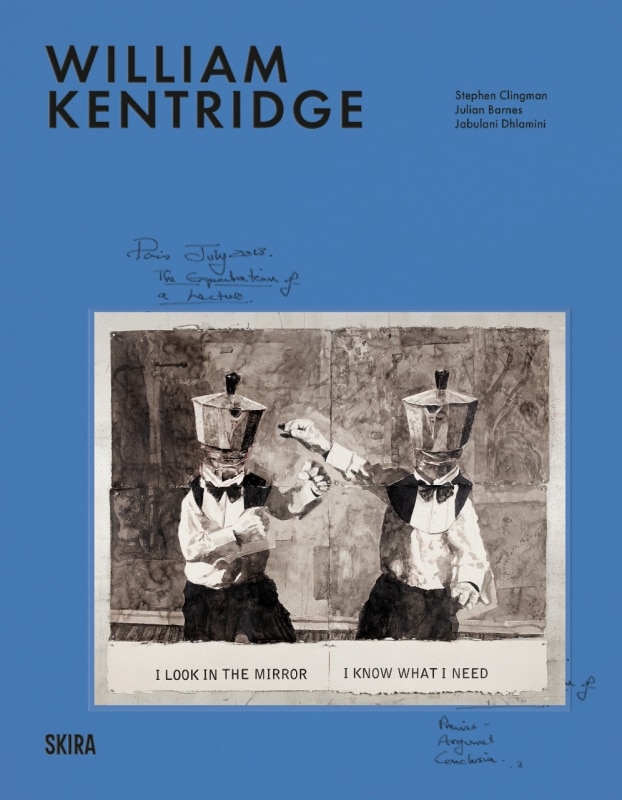
As in the works on display, the book – which retraces the artist’s entire career, from family album photographs to the key concepts behind his thinking, including an essay by scholar Stephen Clingman and an exceptional conversation with writer Julian Barnes – highlights a fundamental aspect of Kentridge’s work: the idea that meaning does not lie solely in the finished artwork, but in the process that produces it, in the exploration of side paths, mistakes and deviations.
It is precisely this attention to what happens outside the rules – what Kentridge himself calls “the less good ideas” – that shapes his creative process and emerges clearly in the artist’s own words.
Procrastinating means preparing for action
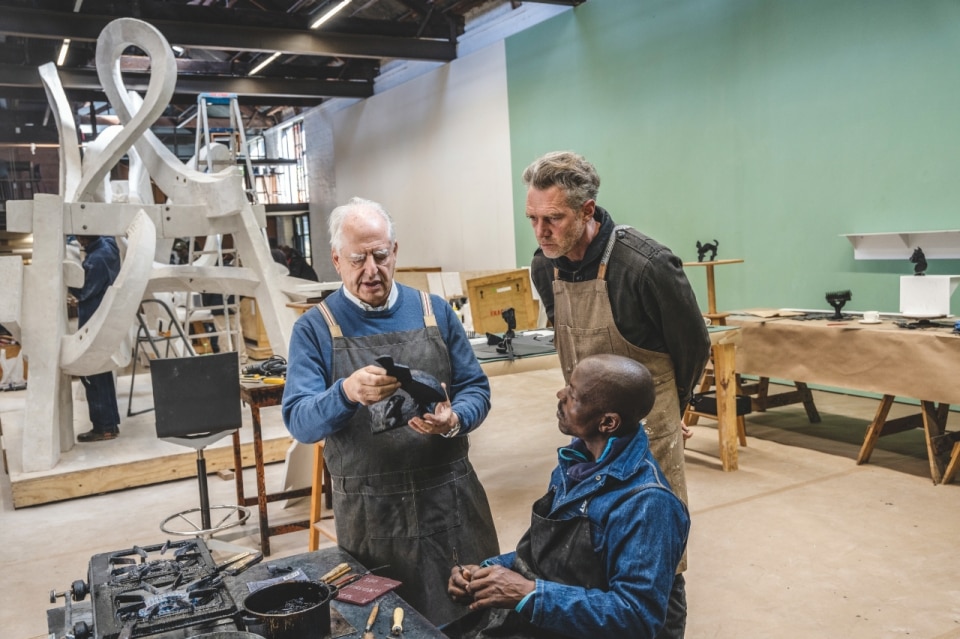
"Productive procrastination, the walking around, the circling of the studio, walking around is smart and necessary, but for me it's a kind of an inevitable part of the work, gathering the energy before things start". This is how Kentridge describes to Domus the phase that precedes drawing, shifting the focus away from the creative act itself. "Physically that's usually a walk around the studio, so your eye takes in work that you've done the day before, things that are pinned to the studio wall, things half-completed".
In this suspended moment, what matters is the openness of perception and thought, expanding the space of possible action. "So there is a kind of peripheral vision to what you've been making" he explains, "and there's also a kind of peripheral thinking to the ideas behind this".
It is a phase in which nothing has yet been decided, yet everything must accumulate energy and intensity. "It's a kind of invisible preamble to a drawing: much like even though we're not aware of the thinking we do before we speak, we rely on our tongue and our brain to come up with sentences as they emerge from our mouths, rather than practicing them in advance, but there is a thinking process obviously happening behind our conscious mind.[...] For me it's a bit like standing at the edge of a swimming pool knowing you're going to swim, but not quite making the movement to get into the pool"
Even this conversation belongs to that liminal space. Kentridge answered our questions through a recorded message sent from his studio in Johannesburg. "on a bright summer's morning, the leaves shining with bright green outside the window where I speak," he tells us. "This recording of this conversation now, of this interview now, in a way is one of the procrastinations. There's a drawing waiting to be begun on the table in the studio, part of an animation of an old-fashioned adding machine, but until I know quite what comes out of the adding machine, I'm putting off the beginning of the drawing. And this recording is one such procrastination".
William Kentridge’s milestones
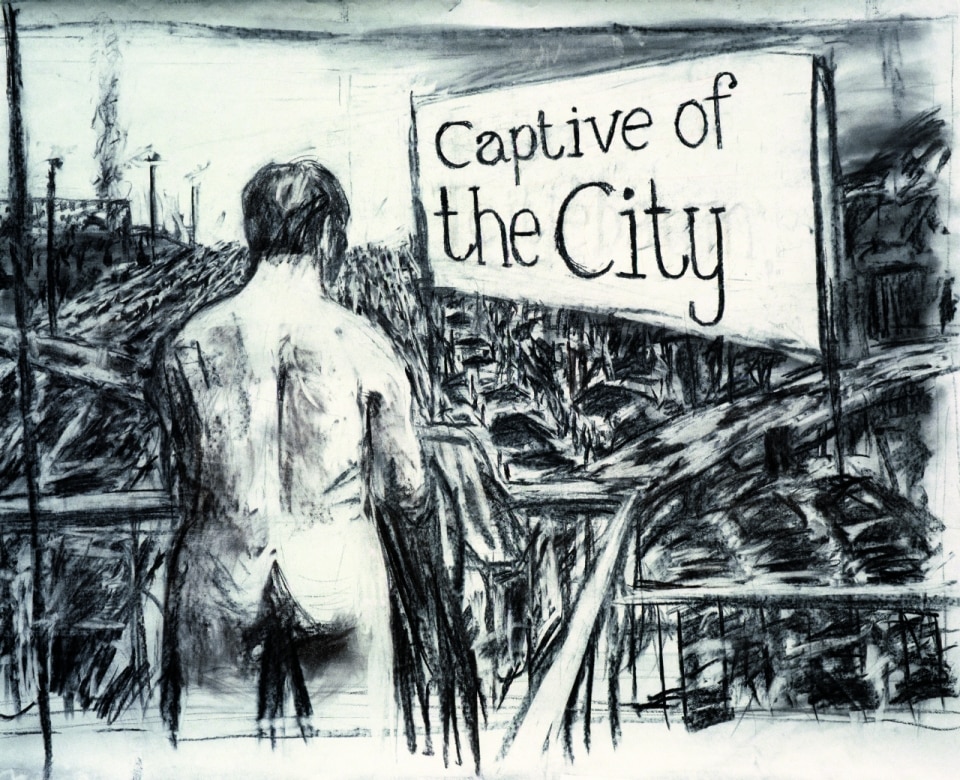
When attention shifts from daily practice to the broader trajectory of his work, the same openness to multiple possibilities emerges in what Kentridge identifies as the “milestones” of his career, as recounted in the book. "In my case were fairly obvious and easy ones that had to do with shifts in material, from charcoal drawing to animation, from charcoal drawing and animation to theatre work, from that to installations that were made from the theatre productions".
So there is a kind of peripheral vision to what you've been making, and there's also a kind of peripheral thinking to the ideas behind this.
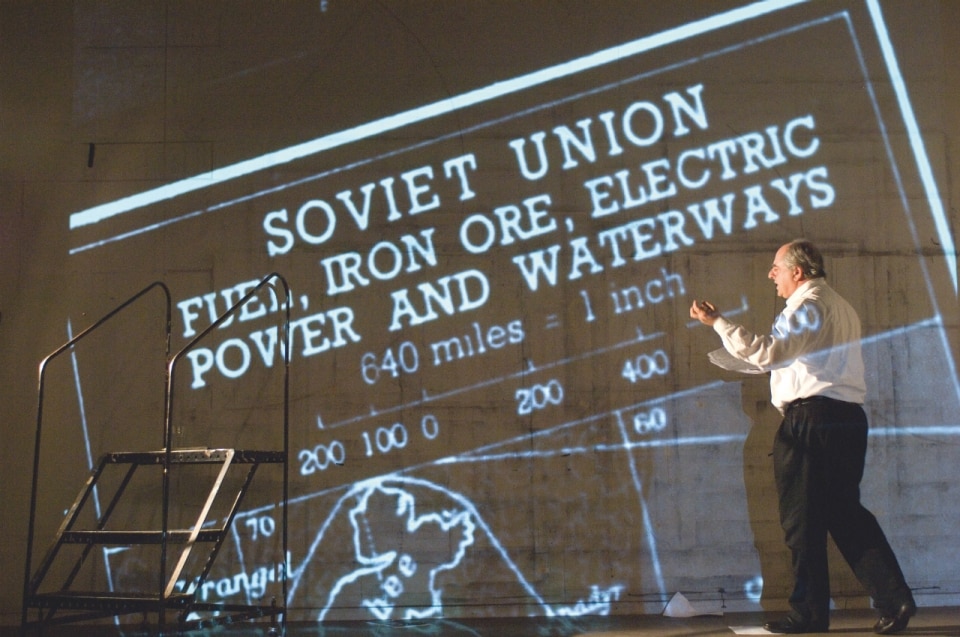
Alongside these passages, however, Kentridge identifies two less predictable turning points. The first stems from a practical realization: the sheer number of artist talks that accumulate over the course of a career. "understanding the number of artist talks that one was due to give during a lifetime working in the studio, and deciding rather than these being just an interruption to work, they could be turned into artworks in themselves, which is how the formal performative lectures develop". An example is the series Self-Portrait As A Coffee-Pot, available on Mubi, created during the pandemic while Kentridge was working in isolation in his studio.
The second turning point is the Centre for the Less Good Idea, founded ten years ago in Johannesburg. "It's both a space made for others but also for myself. There are many projects I do that have their heart in that centre". It is a place where the creative process can remain open-ended and unfinished, where ideas do not need to prove their success immediately in order to exist.
As also emerges in the interview with Denise Wendel-Poray, editor of the Skira volume, it is worth noting that many turning points in the artist’s career did not arise from success or sudden insights, but rather from abandonments and failed “plan A” paths. Letting go of the traditional idea of the artist as a painter working with oil on canvas, or realizing early during his studies that he was not destined to become an actor, opened unexpected directions.
Dada, then and now
William Kentridge’s work is strongly influenced by the Dada movement. His artworks echo the irrationality of conflicts and wars, the injustice of oppression, and the persistence of memory. In a new work presented in the volume, Dada Tree, references to Dada, Mayakovsky, the Marx Brothers, war and the absurd appear, while more than a century later the early twentieth century resonates strongly in collective memory.
Dadaism emerged at a time when words and images had lost credibility. It is within this context that Kentridge draws a parallel with Dada—not because of a historical coincidence, but because of a shared condition: "a world in which language becomes unword from itself, from the world in which words shift their meanings or lose meaning altogether, where an artificial intelligence can construct completely fake narratives that are indistinguishable from evidence-based sayings". What matters most to Kentridge is the openness that Dada introduced into artistic practice.
"Before the era of Dada," he notes, "if you were an artist essentially in the Western tradition, you were working with oil paint on canvas and you made images. Dada showed that to be an artist your material could be a painting, but it could be a poem, it could be a performance, it could be a sound piece. Even though the Dadas were doing it to kind of proclaim what they were doing as non-art, it's been encompassed and celebrated by artists and given whole new terrain for artists to work in".
Humor and the absurd as tools for understanding history
When asked whether humor can be seen as a form of survival in contemporary times, Kentridge highlights the relationship between humor and the absurd, clarifying that the absurd "is not a joke" but rather "a logic in the world gone awry is often the most accurate way of trying to understand or depict social phenomena".
Where an artificial intelligence can construct completely fake narratives that are indistinguishable from evidence-based sayings.
The absurd allows for a radical shift in scale, though not necessarily a simplification. Kentridge offers the example of major historical events condensed into the story of a single individual: "we have the entire Second World War reduced to the story of one man: is he a good Nazi? Is he a bad Nazi? What will he do?" This shift enables "a more immediate emotional connection" while remaining aware that such a perspective "does not even begin to address the massive nature of historical and social crimes." Within this tension, humor and the absurd function as tools of distance—not to lighten the narrative, but to move it away from direct experience and avoid the illusion of fully containing or explaining it.
Images and truth: from early collage to artificial intelligence
In his conversation with Julian Barnes in the book, in the section dedicated to memory and imagination, Kentridge describes an experiment involving the manipulation of family photo albums, demonstrating how fabricated photographs can generate suggestions capable of altering memories. Reflecting on how such mechanisms could be used by totalitarian regimes to impose counterfactual narratives, Kentridge calls attention to the relationship between past and present.
AI, he argues, "makes clearer and exaggerates the way in which our knowledge of the world and history is a construction rather than a discovery. We know that the past is always shaped by the present. In other words, we look at old painting in terms of what we see in contemporary paintings. We go backwards and they affect and influence. So the past is always influenced retrospectively. One can say that Chardin is influenced by Morandi, and Morandi's influenced by Philip Guston, because that's the order in which we see these points of connection".
And as for image manipulation, he says: "From the very beginning of photography there were two streams: there was a stream that used photography to try to capture exactly what was happening in the world, and the other that immediately thought that photography was something to be manipulated, to be changed. So even the very early, very beautiful Gustave Le Gray photographs of seascapes were constructions. One photographic negative of the sky and a different one of the sea. This occasion not only by a desire to invent nature, but to acknowledge the limits of photographic film and of plates at that time."
The construction of images, Kentridge reminds us, is therefore not a new phenomenon. Even the great landscapes of European painting were always assembled from fragments. What has changed, if anything, is the visibility of the process. "There was a moment, I suppose the beginning of the 20th century, with collage around 1905, where the conscious putting together of fragments became the work itself. Before that, this construction of collage was kind of hidden, and obviously today with AI and Photoshop and filters it gets harder and harder to detect. But that moment of showing process, and the activity of construction for me is a heroic moment that we need to hang on to".
Opening image: William Kentridge nel suo studio. Foto: Jabolani Dhlamini, courtesy Kentridge Studio