


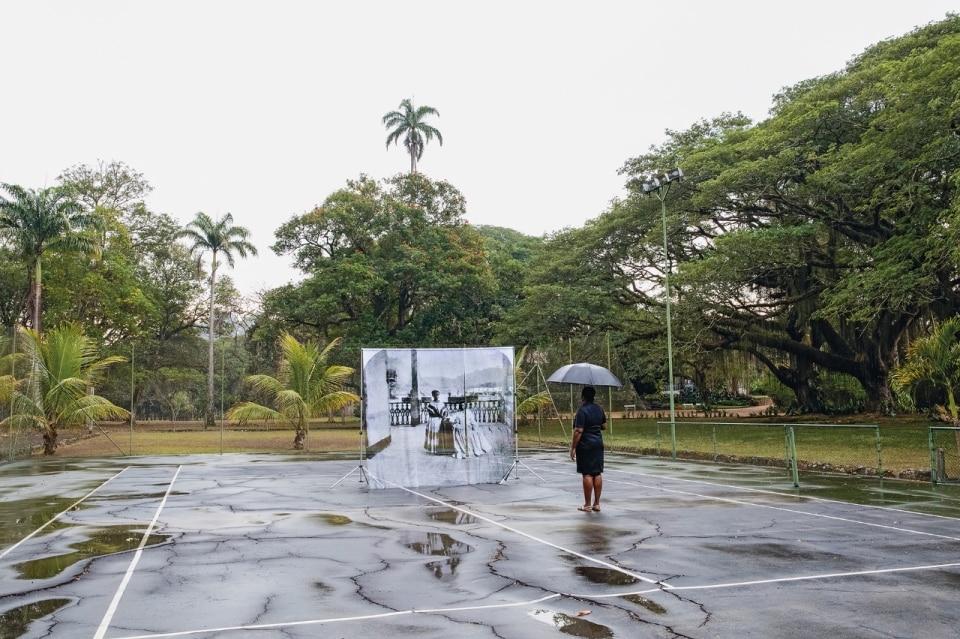
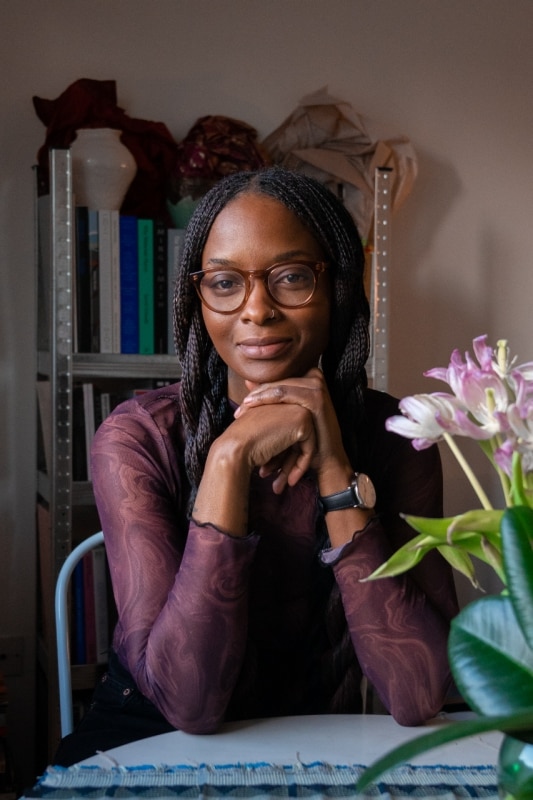
The city as an archive of the diaspora, a place where urban memories, colonial legacies, and transoceanic cultural influences distill into a symbolic, discursive, and transversal space. This is the focus of “Echoes in the Present”, the exhibition curated by Jareh Das for Frieze London, opening at Regent’s Park on October 15. An independent curator and scholar of the diaspora, Jareh Das explores in this show the historical and contemporary connections between West Africa and Brazil through works that interrogate urban space. Here, Dakar, Lagos, Luanda, Salvador, and São Paulo become critical devices in which architectural stratifications, material fragments, and artistic practices render submerged histories visible.
Lagos, Salvador, Luanda, Dakar, and São Paulo are undergoing postcolonial reorganization processes. Their architectures distill traces of intertwined histories across continents.
Jareh Das
“Everything started with a project launched in Dakar with Galerie Atiss,” explains Jareh Das, reached in London while already installing the exhibition. “With the founder Aïssa Dione, we wanted to reflect on the post-independence period and major cultural festivals, such as the Festival of Black Arts in Dakar, which from the 1960s and 70s up to the 2000s brought together African and Afro-Brazilian communities. There was a historical moment when Dakar, Lagos, Salvador, and Rio were active nodes of artistic and political exchange. We wanted to reopen that dialogue today, particularly in Dakar, where these resonances have faded,” continues the curator, emphasizing the central role of the city in the Frieze London exhibition.
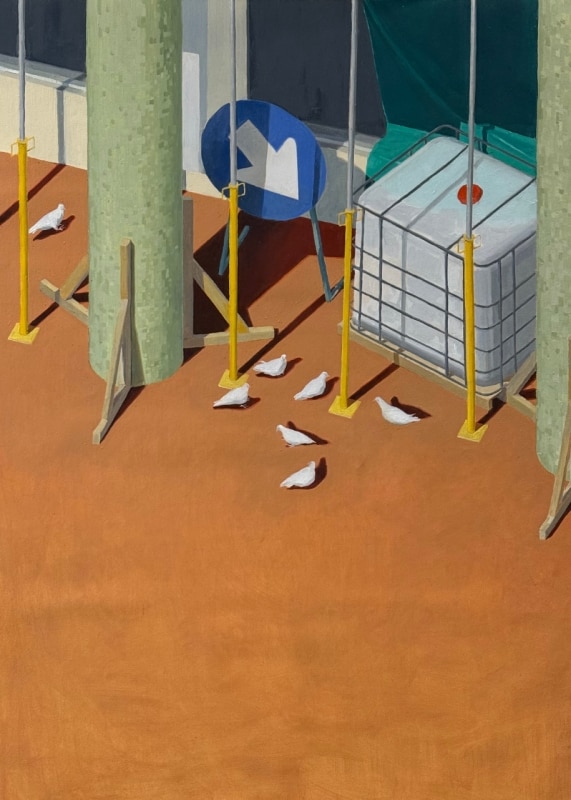
“Lagos, Salvador, Luanda, Dakar, and São Paulo are undergoing postcolonial reorganization processes. Their architectures distill traces of intertwined histories across continents. I think of Lagos Island (the oldest part of Lagos), where freed slaves returning from Brazil imported Portuguese architectural influences, redefining the city. I am interested in reflecting on these exchanges and colonial legacies, and on what they signify in a contemporary sense.”
The key term is reading the present, as the title itself suggests. “The present also concerns diasporic uprooting and memory, and the fluidity of the Atlantic world and its constantly evolving cultural exchanges. It is, in a sense, about proposing a theoretical ‘Third Space’. Homi Bhabha (one of the main postcolonial theorists, Harvard professor) talks about the ‘Third Space’ in relation to diaspora and postcolonial contexts. I am interested not only in shared history, but also in how acts of imagination in the present can create possibilities for future exchanges between these regions across the Ocean.”
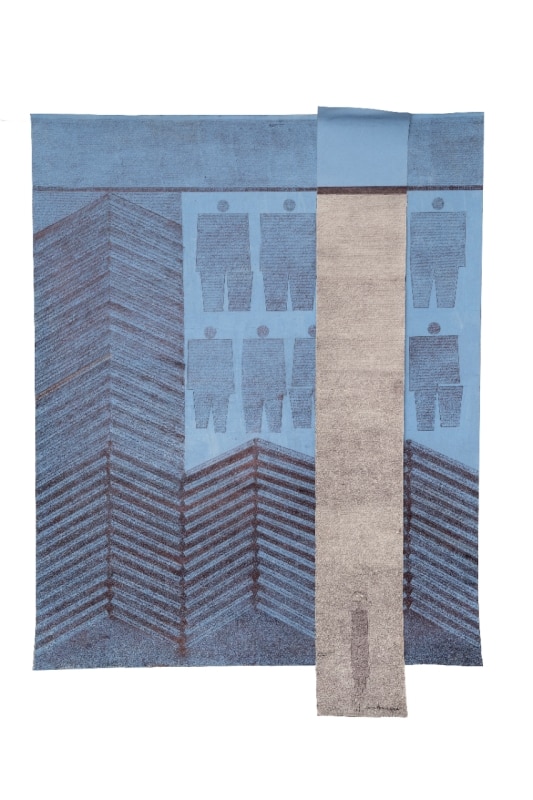
The exhibition examines how artists are trying to make sense of all this with a special sensitivity to urban transformations. Following much conceptual art, they observe, research, and catalogue with an approach that is never purely documentary, but poetic and, in any case, political. “Serigne Mbaye Camara, in Dakar, for example, collects discarded materials and transforms them into assemblages that reflect urban memory,” says Jareh Das. “His figures, inspired by the ‘blue sky of Dakar,’ are constructions that narrate the stratification of the city. Bunmi Agusto documents and draws Portuguese buildings on Lagos Island, now threatened by gentrification. This is a process affecting all African cities, particularly Luanda.
The painter Lilianne Kiame, for instance, focuses on this city, where buildings are demolished and replaced with structures difficult to classify: architectures that appear vaguely Western or perhaps inspired by some Middle Eastern model, but often built with cheap materials unsuitable for the local climate, using lots of concrete, MDF, and plastic facades. The artist documents this process to reflect on capitalist corruption and the role of foreign developers, particularly Chinese, in the transformation of African cities, especially in Luanda and Lagos. Her work raises questions about environmental sustainability and the relationship between architecture, power, and place.”
It speaks of gentrification, uncontrolled urbanization, and the erasure of entire neighborhoods, cultures, and traditions. This curator, one of the most interesting voices in postcolonial studies and contemporary perspectives on diaspora, talks about amnesia. She also highlights artists like Aline Motta, who, through reconstructing her family history, recovers origins, roots, and a possible story.
“Aline Motta’s practice addresses the silences and fractures left by historical erasures. The artist works with archival research and oral histories, but also with fictional narratives, reconstructing fragments of her family genealogy that had been obscured by slavery. In the video installation presented in London, Filha Natural / Natural Daughter, she investigates the possible origins of her great-grandmother, born on a coffee plantation in Vassouras (Rio de Janeiro) in 1855. The installation, combining textiles, video, and photography, is a way to resist the amnesia imposed by colonial structures that erased African histories.”
It is a matter of listening: cities speak, materials tell stories. The Atlantic slave trade left deep marks, but also forms of resilience. Artists tune into these frequencies to imagine shared futures.
Jareh Das
For Frieze London, Das personally selected the galleries to invite, from West Africa, Brazil, and a UK gallery that works mainly with diaspora artists. The idea responds to Frieze’s longstanding interest in developing curated exhibitions and projects, and this year especially emphasizes curatorial innovation and global artistic exchange. “I worked directly with the artists to create an exhibition path where thought develops in a circular and relational trajectory, with works in dialogue with each other,” she explains, reflecting on the significance of bringing the exhibition to London, a symbolic site of a significant colonial history.
“Bringing the exhibition to London means directly confronting one of the contexts most historically implicated in colonial processes. The presence of Nigerian and Afro-Brazilian artists makes visible colonial histories and entanglements often overlooked, such as those between Nigeria, Portugal, Brazil, and England. London thus becomes a space to question the dominant narrative and reveal the complexity of these shared histories.” These are stories that traverse eras and cultures and reach us as echoes in the present.
“Echoes are what continues to resonate from the past in the present, even if transformed. It is a matter of listening: cities speak, materials tell stories. The Atlantic slave trade left deep marks, but also forms of resilience. Artists tune into these frequencies to imagine shared futures.” Concludes the curator as a ray of sunlight illuminates her face.
Opening image: Aline Motta, Natural Daughter #1, 2018 – 2019. Courtesy the artist e Mitre Galeria
- Show:
- Echoes in the Present
- Edited by:
- Jareh Das
- Where:
- Frieze London and Frieze Masters, The Regent's Park
- Dates:
- October 15 - 19, 2025